


In today's interconnected world, our everyday lives depend on stable connectivity, so the need to close the digital divide between rural and urban areas has never been more important. The digital divide discussion often focuses on access and speed. While these measures indicate broadband availability, they do not fully capture the benefits high-speed internet brings, such as doing schoolwork, playing games, or earning a living remotely. Opensignal recently released its first measure of fixed broadband reliability to understand the gaps in access when people are in front of their devices and trying to execute daily tasks. This report uses Opensignal’s new Broadband Reliability Experience metric to assess users' real-world fixed broadband experience across 18 countries. By examining countries with varying income levels and characteristics, we explore the differences in broadband reliability between urban and rural areas.
Key Findings:
- Urban reliability is consistently higher. Urban households have access to better infrastructure, higher-speed broadband tiers, and newer equipment, positively impacting the reliability experience.
- Income levels are less predictive of reliability than density. Fixed broadband reliability in urban areas of middle-income countries like Chile and Poland surpasses rural reliability in many high-income countries.
- Network infrastructure sharing is not associated with high reliability or a narrow digital divide. Countries with limited infrastructure sharing but targeted subsidies for private rural investment mostly perform better than those relying on widespread infrastructure sharing.
- Topography and density are key factors in the size of the divide. Markets with highly concentrated populations in urban areas show small gaps between urban and rural reliability, and spread-out middle-income countries with difficult terrain show big gaps. But a few countries with lots of medium-density areas, like the U.S., and Spain, have relatively small digital divides.
Table of Contents:
Reliability is top of mind for consumers
Consumers consider more than just download speed or price when choosing a broadband package. According to a Deloitte survey, European consumers in Germany, the U.K., and Italy rated high reliability/stability as more important than an attractive price when thinking about a future internet connection for their households. Opensignal’s new Broadband Reliability Experience metric, which uses a 100-1000 point scale, measures broadband experience in a typical household where multiple devices are used simultaneously.

Figure 1: Broadband Reliability Experience
Looking through the lens of Opensignal’s definition of Reliability, e.g. the ability to perform typical household tasks, we can segment countries in our analysis into three broad buckets.
- Higher Reliability (overall score above 650): Sweden, Norway, United Kingdom, Canada, Japan and the United States
- Moderate Reliability (500-650): Australia, New Zealand, Chile, Spain, Italy, Poland and Brazil
- Lower Reliability (under 500): India, Colombia, Mexico, Philippines, and Indonesia
Unsurprisingly, wealthier countries tend to have better reliability. However, the correlation is not strong, indicating that other factors are also influential, such as regulatory frameworks and competition.
Urban broadband is far more reliable than rural
Broadband Reliability Experience is, on average, 23% higher in urban areas than in rural areas across all markets we analyzed. There are a few reasons for this.
- Urban areas have a higher concentration of people and households, making it economically viable for service providers to invest in and maintain high-quality broadband infrastructure.
- The cost per user for installing and maintaining broadband networks is also lower due to the higher number of potential subscribers in a given area.
- Urban subscribers benefit from superior underlying infrastructure, such as roads, power supply, and utility services, which can be leveraged to deploy broadband networks more efficiently.
For example, as of May 2023, on average, 98% of U.K. premises in urban areas had access to superfast broadband (defined as download speeds over 30Mbps), but this drops to 91% for rural premises. This disparity further widens for access to gigabit-capable connections (speeds over 1Gbps): 82% urban compared to 46% rural. These figures will only increase in cities, as new housing and commercial developments often include fiber-optic connections as part of the construction standards. In 2022, the UK government introduced amendments to building regulations to ensure all new buildings are gigabit-ready.

Figure 2: Broadband Reliability Experience — urban versus rural
The access technologies being used can influence our users’ Reliability Experience. Factors such as the underlying infrastructure and the location of the nearest street cabinet—i.e. last-mile connectivity— also matter. The end-user broadband experience is typically very different on an FTTH (Fiber to the Home) vs. FTTC/N (Fiber to the Curb/cabinet/node), with the final connection made via copper or coaxial cable. The experience will also be influenced by Wi-Fi router configuration and the package the customer subscribes to. Several countries face challenges in ensuring access to quality broadband. For example, Indonesia’s and the Philippines’ archipelagic nature makes infrastructure deployment expensive and complex. There are efforts to increase digital inclusion, such as the Indonesian Palapa Ring Project, which saw Indonesia laying more than 35,000km of land and sea cables and has improved mobile connectivity. In addition, the government deployed a high throughput satellite (SATRIA-1) for middle-mile connectivity and last-mile connectivity provided through 4G base stations and Wi-Fi internet access in rural areas.
Infrastructure sharing doesn’t (always) solve the digital divide
It would be pertinent to imagine countries that have government-led initiatives centered around network sharing. We found that the countries with the highest Broadband Reliability Experience scores (see Figure 1) are those with limited infrastructure sharing but targeted subsidies for private rural investment. These countries mostly performed better than those relying on widespread infrastructure sharing. The predominant model of broadband provision is for internet service providers (ISPs) to build, own, and operate their own networks. We have also observed that central government and regional government subsidies play a role in narrowing the urban-rural reliability gap. For example, in countries like the United States, federal programs such as the Rural Digital Opportunity Fund (RDOF) and Connect America Fund (CAF) provide significant funding to support the expansion of high-speed broadband in rural areas. The Canadian government is targeting high-speed internet access for 98% of Canadians by 2026, and a national target of 100% by 2030, focusing on rural and remote communities — through its Universal Broadband Fund (UBF), which has a budget of CAD 3.2 billion.
Challenges to parity across rural and urban zones are only partially solvable
Countries face several issues when extending fixed broadband to rural areas, including higher cost per home due to lower population density, fewer ISPs providing services, and unclear Return on Investment (ROI) once the network is rolled out. A few countries with many medium-density areas, like the U.S., and Spain, have relatively small digital divides. On the other hand, spread-out middle-income countries with difficult terrain show big gaps.

Figure 3: Urban versus rural Broadband Reliability Experience gap
Colombia has the largest disparity with regard to the reliability gap between urban and rural areas, with a difference of 176 points in absolute terms and about 38% lower rural Broadband Reliability Experience than urban. Despite government efforts and programs like "Vive Digital" rural connectivity remains inadequate. This is partially due to geographical barriers — diverse and rugged terrain, including mountains and jungles — making it difficult and expensive to lay broadband infrastructure, as well as the underlying infrastructure such as road, power supply and backhaul connectivity being underdeveloped. According to ENTIC, in 2021, while the majority of Colombians had fixed internet (78.8%), adoption in towns and rural areas was only 46.3%. Recently, Colombia’s Ministry of Information Technology and Communications (MinTIC) announced the launch of a new state-funded project to bring fiber and satellite-based broadband to the country’s most remote areas dubbed ‘ConectiVIDAd para Cambiar Vidas’ (Connectivity to Change Lives), worth COP 2.2 billion (USD 572,000). The digital divide due to challenging geography can be seen in spread out archipelagos like Indonesia and the Philippines.
India presents an example where the urban-rural gap in internet access is relatively small (90 points). This relatively balanced distribution is partially because fixed internet represents a small portion of overall internet access, accounting for only 4.22% as of the end of 2023, due to a high reliance on mobile internet to participate in the digital society. The deployment of fixed internet infrastructure has occurred more recently than in other countries despite cable TV networks being widespread. According to the Telecom Regulatory Authority of India (TRAI), an impressive 87.4% of these fixed internet connections are fiber-optic. To address the remote areas that don't make economic sense to connect via fiber, Airtel, and Jio launched 5G FWA products last year— initial results show promising FWA performance from Jio.
Rural areas in high-income markets fall behind urban areas in middle or lower-income markets
Across rural areas there is higher reliance on technologies that tend to be less reliable. In developed markets, lower-speed Internet access via xDSL was widely available in rural areas for years before mobile broadband became widely available, and now the challenge is upgrading those users. However in developing countries, the only broadband option in rural areas was typically mobile broadband due to lack of fixed infrastructure. Higher rural adoption of xDSL, fixed wireless (FWA), and satellite broadband translates into lower rural reliability scores.
Our data shows that the urban Broadband Reliability Experience in some middle-income markets is on par or better than rural experience in some rich markets. Urban reliability in Chile is superior to the rural experience in all rich markets other than the Nordics and Canada, while urban households in Poland experience more reliable broadband than rural households in Spain, Italy, New Zealand, Australia, USA and Japan. In Poland, FTTH subscriptions represented 48.1% of the total broadband subscriber base in 2023, up from 38.3% the previous year. This was partially driven by the EU Cohesion Fund, with part of that funding telecommunications infrastructure in Poland. According to the Polish telecom regulator, the most popular services chosen by consumers offered throughput between 300Mbps and 1Gbps, accounting for 51.7% of all fixed-line Internet services selected by consumers. More than two thirds of Polish users opted for speeds over 100Mbps, which should, in turn, result in sufficient reliability. However, important to note is that these are advertised maximum speeds - real world broadband experience tends to be very different.
Even lower-income Brazil’s urban reliability is superior to rural reliability in a handful of higher-income and more mature markets, including Italy and Japan. The likeliest explanations for these countries’ urban performance is the high level of fiber adoption by new urban customers, the absence of legacy xDSL broadband, and the limited embedded base of xDSL customers.
Another explanation is that although rural households are within range of fiber coverage, they choose not to upgrade. According to a survey carried out by Orange Concessions, 57% of households in rural areas across three French departments live within fiber coverage yet don't subscribe to it. Asked for the reason why, 42% indicated that their current connection method was sufficient for their needs, representing the main barrier to fiber uptake. 37% stated they would be inclined to upgrade if offered an incentive. Therefore, efforts to connect rural and white-spot areas have to educate people on the benefits of accessing new technologies to stimulate demand and increase access to reliable connections.
Broadband tiers skew higher in urban areas
End-user demand is a significant factor influenced by affordability, digital literacy, and perceived need for services. Additionally, household equipment can impact reliability; for instance, using an older router could significantly affect the experience. Most users buy packages that throttle or cap their speeds to a greater or lesser extent. Higher-speed packages typically cost more than lower ones, and users’ choice of package significantly impacts their experience. This is significant as our Broadband Reliability Experience metric assesses household experience across three components:
- Connectivity - assessing whether a household can connect to the Internet
- Completion - measuring whether tasks can be completed
- Sufficiency - whether tasks are performed sufficiently well
To understand why rural areas have less reliable networks, we segmented our users by maximum download speeds into the following speed brackets: less than 25Mbps, 25 - 50Mbps, 50 - 100Mbps, 100 Mbps—500Mbps, 500 Mbps—1Gbps, and above 1Gbps across urban and rural. Our analysis found that households in urban areas have greater uptake of higher speed brackets, revealing significant differences in the quality of internet service available to residents in rural areas.
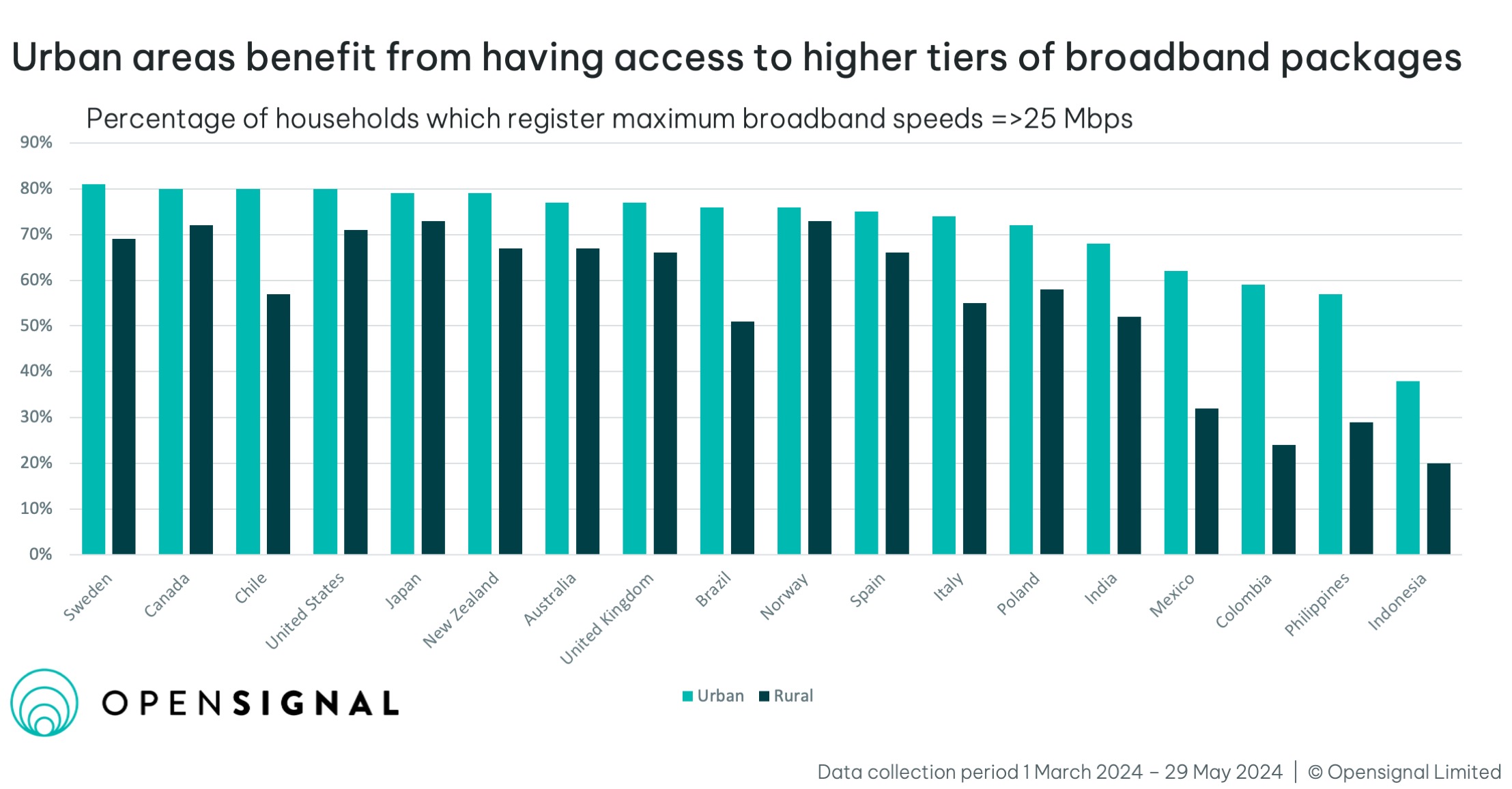
Figure 4: Percentage of households which register maximum speeds >25 Mbps urban versus rural
One reason for the disparity is the technology mix available to rural customers, such as satellite and FWA, and lower spending power per capita. Another could be outdated equipment, such as past-generation routers or poorly optimized Wi-Fi networks.
To explore this issue further, we closely examined Wi-Fi equipment in Spain. Despite having the highest fiber household penetration rate among the countries in our analysis, Spain is in the moderate reliability category. We analyzed how households access Wi-Fi in Spain to understand the gap between fiber adoption and reliability.

Figure 5: Percentage of households with 5GHz urban versus rural
On the surface, reliability in Spanish rural areas should be closely aligned with urban areas, given that at 79%, Spain has some of the highest rural FTTH/B coverage among European countries (EU27+UK). However, fewer rural households in Spain access the Internet using 5GHz connections. This means they more often rely on 2.4GHz, partially due to the following factors:
- Property Size: Rural properties tend to be larger, making the extended range of 2.4 GHz connections more appealing despite their lower speeds.
- Older Equipment: Rural households are likelier to have older routers that only support the 2.4 GHz band. Newer routers support 2.4 and 5GHz frequencies, but the transition to these newer models has been slower in rural areas.
Overall broadband reliability is influenced by several factors beyond fiber penetration, including the age and capabilities of Wi-Fi routers and the frequency bands they support. Addressing these gaps is essential to improving broadband reliability and fully leveraging high-speed fiber networks.
Conclusion
Urban centers enjoy superior Broadband Reliability Experience due to higher population density and better infrastructure, leaving rural areas lagging behind. Yet, some middle-income countries, like Chile and Poland, defy expectations with urban reliability that outshines even rural areas in wealthier nations. Notably, countries that limit infrastructure sharing and focus on targeted rural investments see remarkable improvements. To close this gap and ensure that everyone, regardless of location, enjoys reliable, high-quality internet, we need bold policies, widespread fiber adoption, and innovative solutions to geographical challenges.
Explore our range of insights on the topic of fixed broadband on our Market Insights page. For more information on how Opensignal can aid both your network and marketing operations, please contact us. You can also listen to our webinar, in which we explore the role FWA plays in expanding rural broadband.
Methodology note
Opensignal’s Broadband Reliability Experience metric measures the entire user experience, from establishing a connection to successfully completing tasks like streaming video, browsing the web, and scrolling through social media. It captures the true end-to-end reliability experience by analyzing the two most popular internet protocols - TCP (transmission control protocol) and UDP (user datagram protocol) - for a comprehensive measure of every aspect of households' experience with their ISP’s network. We can assess when things are working flawlessly, when something is erratic, and when there is no connection at all. Calculated on a scale of 100-1000, with higher scores indicating better Reliability Experience, the metric consists of three main components:
- Connectivity: Measuring the household's ability to connect to the internet. While ISPs strive to provide ubiquitous connectivity there are often events that lead to outages, and the connectivity component of the score captures the proportion of times when households don’t have internet access.
- Completion: Completion measures the ability to complete typical tasks. It ensures that the established connection is maintained and there is a consistent flow of information as consumers would expect.
- Sufficiency: Ensures that the task is performed sufficiently well. This component includes speed thresholds, latency thresholds, jitter, and other technical components that are prerequisites for good service and application experiences.
In this analysis, we have used the DEGURBA methodology (Degree of Urbanization), developed by the European Commission and OECD, to classify countries’ territories into urban and rural areas, depending on the population density. For the sake of simplicity, we merged two categories, cities and towns & semi-dense areas, to form the urban category.
Opensignal Limited retains ownership of this insight including all intellectual property rights, data, content, graphs & analysis. Reports and insights produced by Opensignal Limited may not be quoted, reproduced, distributed, published for any commercial purpose (including use in advertisements or other promotional content) without prior written consent. Journalists are encouraged to quote information included in Opensignal reports and insights provided they include clear source attribution. For more information, contact [email protected].
