


Introduction: realising Indonesia’s digital opportunity
Indonesia, the world’s fourth most populous country, is on an ambitious digital transformation journey. With a mobile-first, youthful population and national strategies focused on economic modernization and infrastructure development, mobile networks are central to achieving these goals.
But a key question remains: is the quality and consistency of Indonesia’s mobile networks advancing at the pace required to meet Indonesia’s aspirations?
This article explores Indonesia’s position in Opensignal’s Global Network Excellence Index, revealing the country’s strengths, persistent challenges, and policy levers that can accelerate progress toward digital excellence.
Indonesia’s position in the Global Network Excellence Index
The Opensignal Global Network Excellence Index leverages our proprietary data to provide a market-level ranking of mobile network excellence. It offers a real-world assessment based on direct measurements of user experience, evaluating markets across three core pillars:
- Excellent Consistent Quality (ECQ) – Evaluates how consistently networks support demanding applications such as video streaming, video calls, and gaming, ensuring a seamless user experience.
- 4G/5G Availability – The proportion of time users are connected to modern mobile networks, reflecting the accessibility of mobile infrastructure.
- 4G and 5G Download Speed – Indicates a network’s capacity to handle future digital demands, assessing both current speeds and the potential for future scalability.
Indonesia ranked 58th globally in Q1 2025, maintaining its previous position in Opensignal’s Global Network Excellence Index. A closer look reveals mixed progress compared to global peers:
- 21st in 4G/5G Availability: Indonesia dropped four places despite a modest 0.2 percentage point increase in the share of time users spend on 4G and 5G. This suggests the country is improving, but at a slower pace than others.
- 54th for Excellent Consistent Quality: Indonesia slipped two places, even though its score was statistically flat (- 0.1 p.p.), pointing to a relative decline in consistency compared to faster-improving nations.
- 86th for 4G Download Speed: Improved by 1.0 Mbps to 25.6 Mbps during the first three months of 2025, raising its speed ranking by two positions.
Indonesia’s 5G Download Speed component was excluded from this assessment, given the country’s lack of nationwide commercial rollout.
Among large land area markets (200,000+km²), Indonesia ranks 22nd, trailing countries such as Australia, New Zealand, and Vietnam. Regionally, it placed 13th across South Asia, East Asia, and the Pacific, behind peers like Malaysia and Thailand, all of which are pushing ahead with 5G rollouts and network upgrades.
Connectivity realities: A nation of islands
Indonesia’s vast geography — an archipelago of more than 17,000 islands — poses a unique and persistent challenge to national infrastructure development. Building fixed-line networks across remote, mountainous, and dispersed regions is capital-intensive and logistically complex. As a result, Indonesia's digital growth story is overwhelmingly mobile-led.
According to GSMA Intelligence, fixed broadband penetration reached just 21% of households as of the end of 2024, underscoring the limited reach of traditional broadband solutions and Indonesia’s path to mobile “leapfrogging”.
By contrast, mobile broadband penetration stands at 121 subscriptions per 100 inhabitants, reflecting its role as the default — and often only — gateway to the internet. GSMA data reveals that:
- 70% of urban residents use mobile internet.
- 66% access it daily, cementing mobile as a utility, not a luxury.
Opensignal’s data paints an even clearer picture of mobile reliance:
- One in five mobile users typically never connect to Wi-Fi.
- An additional 22.5% connect to Wi-Fi less than 10% of the time.
This substantial base of mobile-first users highlights the strategic importance of investing in reliable, high-quality mobile infrastructure, especially in areas where fixed access is sparse, unreliable, or unaffordable.
To address these gaps, national initiatives such as the Digital Indonesia Roadmap (2021–2024), the National AI Strategy (2020–2045), and Making Indonesia 4.0 aim to accelerate digital transformation. Infrastructure investments through submarine cables, satellite internet, and public-private partnerships like the Palapa Ring project are helping expand access to remote and underserved areas.
Unlocking Indonesia’s 5G potential
Indonesia has taken important steps toward realizing its digital ambitions, with early 5G launches and efforts to modernize its mobile networks. However, several structural and policy-related challenges are shaping the current pace of progress. Addressing these head-on could unlock significant improvements in mobile experience for millions across the archipelago.
- Spectrum constraints. Indonesia’s mobile ecosystem is constrained by insufficient and fragmented mid-band spectrum*, which is essential for 5G’s optimal performance:
- Only 360MHz of mid-band spectrum is currently assigned for mobile use—less than half of the APAC average of 850MHz.
- The 3.5GHz band, globally considered the “sweet spot” for 5G, remains in use by existing satellite services. Four satellites currently operate in the C-band, with leases extending into the 2030s.
The GSMA projects that each operator needs at least 100 MHz of contiguous mid-band spectrum to deliver reliable 5G performance and meet Indonesia’s speed targets. Yet, Indonesia’s current roadmap delays full allocation of the 3.5GHz band until 2027, placing it behind regional peers like Thailand and Vietnam, which have already auctioned and deployed this spectrum.
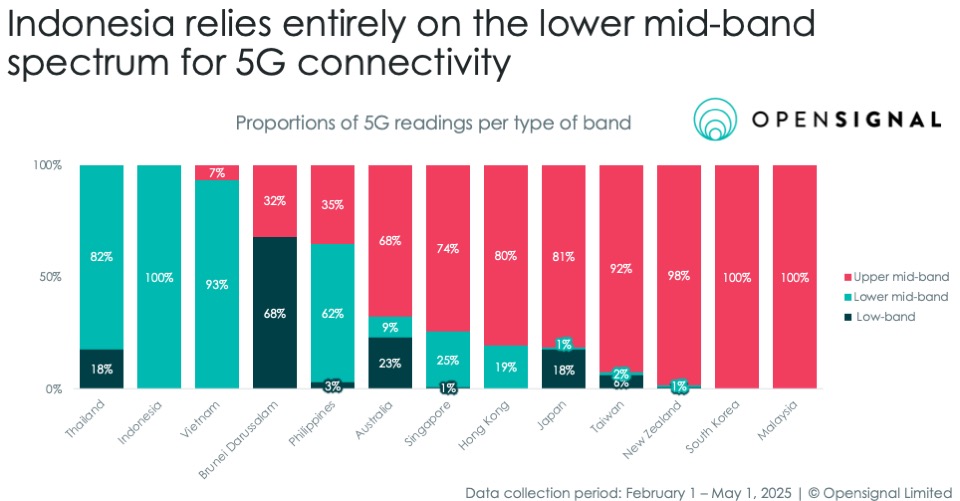
- Limited 5G deployment: While commercial 5G services were launched by Telkomsel, Indosat Ooredoo Hutchison, and XL Axiata starting in 2021 using spectrum in the 1800MHz, 2100MHz, and 2300MHz bands, progress has been slow and fragmented. Most 5G deployments are still confined to urban centers, leaving large parts of Indonesia’s vast geography underserved. For example, Telkomsel has launched only 2,200 5G base stations in 56 cities, out of a total footprint of more than 240,000 base stations. Despite the focus on 5G, Indonesia remains a 4G-first market. As of 2024, 4G accounts for 92% of all mobile connections, according to GSMA Intelligence, and is expected to remain the dominant mobile technology until at least 2027. The country has made commendable progress in retiring legacy networks to improve spectral efficiency:
- XL Axiata shut down 3G services in March 2022, followed by Indosat Ooredoo Hutchison at the end of 2022, and Telkomsel in May 2023.
- This refarming of spectrum from 2G/3G to 4G and 5G has freed up valuable capacity but has yet to translate into a meaningful uplift in network consistency or experience across all regions.

Regulatory modernization in motion: Policymakers recognize the need to modernize the regulatory environment to enable more efficient network investment. Historically, operators have navigated a complex permitting landscape and borne high spectrum-related costs, with annual spectrum fees representing more than 12% of recurring revenues, above the APAC median of 8.7%. Past auctions also resulted in fragmented spectrum holdings, impacting spectral efficiency and increasing costs. Encouragingly, the government’s 2025–2029 digital roadmap addresses many of these issues:
- Proposing reduced fees for 5G spectrum (no more than 50% of 4G rates),
- Offering incentives for rural deployments tied to more affordable spectrum access.
These reforms can support more predictable investment planning and catalyze wider 5G rollout, aligning policy tools with Indonesia’s strategic goal of becoming a regional digital leader.
Looking ahead: policy actions for progress
With the new administration placing a strong emphasis on infrastructure development, particularly in and around Nusantara, Indonesia’s future capital, the country has a timely opportunity to strengthen its digital foundations and unlock nationwide connectivity gains.
In our companion report launching the Global Network Excellence Index, we highlighted key policy and regulatory levers — spectrum, licensing, infrastructure, and access — that can directly enhance the quality of experience (QoE) for users.

Building on that, here are five strategic priorities to accelerate Indonesia’s mobile network evolution:
- Advance spectrum reform. By clearing the 3.5GHz band — globally recognized as optimal for 5G — and allocating additional mid-band spectrum to support capacity expansion and next-generation services the path to 5G deployment would be significantly smoothed.
- Expand shared infrastructure. Promote neutral host models and greater infrastructure sharing between operators. This approach can lower deployment costs, improve rural coverage, and encourage private sector investment.
- Accelerate tower fiberization. Enhance backhaul capacity by connecting towers to high-speed fiber. Towerco Centratama has already deployed over 2,500km of fiber-optic infrastructure, linking more than 1,000 sites, including In-Building Coverage (IBC) areas. Scaling similar efforts is critical for network reliability and performance.
- Enable satellite connectivity for remote islands. With over 17,000 islands, satellite internet will be an important tool for reaching underserved regions. Indonesia launched SATRIA-1 (Satelit Republik Indonesia) in mid-2023 to deliver high-speed broadband to over 150,000 public service points, including schools, health centers, and government offices across rural and remote regions. Furthermore, the Ministry of Communication and Digital (Kemkominfo) is advancing partnerships with LEO satellite providers such as Amazon’s Project Kuiper to connect 3T regions (Frontier, Outermost, and Disadvantaged areas).
- Simplify regulatory processes: Streamlining infrastructure permitting and spectrum allocation procedures can remove critical bottlenecks, enabling faster rollouts and attracting both domestic and international investment.
Conclusion
Indonesia has the scale, ambition, and policy momentum to lead in digital connectivity — but only if the focus shifts from raw speed to reliable, inclusive, and resilient infrastructure.
By addressing spectrum bottlenecks, expanding infrastructure-sharing, and improving mobile network consistency, Indonesia can not only close the performance gap with regional peers, but also set a global example of how to digitize an archipelagic nation.
Please subscribe to our newsletter to receive more insights like this in your inbox. For media or commercial inquiries, do reach out to us.
*Methodology note — band names:
- Low-band spectrum — sub-1GHz frequencies
- Mid-band spectrum — 1-6GHz frequencies
- lower mid-band — spectrum bands between 1.5GHz and 2.6GHz
- upper mid-band — 3.3GHz to 3.8GHz (otherwise known as C-band)
- mmWave — spectrum in the milimetre wave range — 24-100GHz
Opensignal Limited retains ownership of this insight including all intellectual property rights, data, content, graphs & analysis. Reports and insights produced by Opensignal Limited may not be quoted, reproduced, distributed, published for any commercial purpose (including use in advertisements or other promotional content) without prior written consent. Journalists are encouraged to quote information included in Opensignal reports and insights provided they include clear source attribution. For more information, contact [email protected].
