


Authored by Robert Wyrzykowski, Data support by Chris Mills
Starlink entered Indonesia in May 2024, with Elon Musk pledging to “bring connectivity to places that have low connectivity.” Yet, more than a year later, the picture is far more complex.
Indonesia’s connectivity challenges go well beyond a single solution. While the Indonesian government is pushing ahead with its broader digitalization agenda, low broadband penetration and the difficulties of connecting a vast archipelago remain significant obstacles. To bridge the gap between urban and rural areas, policymakers are also turning to alternative technologies such as Fixed Wireless Access (FWA).
In markets like Canada, Starlink has delivered strong performance — outperforming FWA on most metrics, with only a slight disadvantage on Consistent Quality. But the key question for Indonesia is: how does Starlink compare to the country’s available FWA offerings, and can it truly deliver on its promise to improve digital inclusion?
Key findings
- Starlink speeds nosedive: Congestion has cut Starlink’s download speeds by nearly two-thirds and uploads by almost half within 12 months of launch.
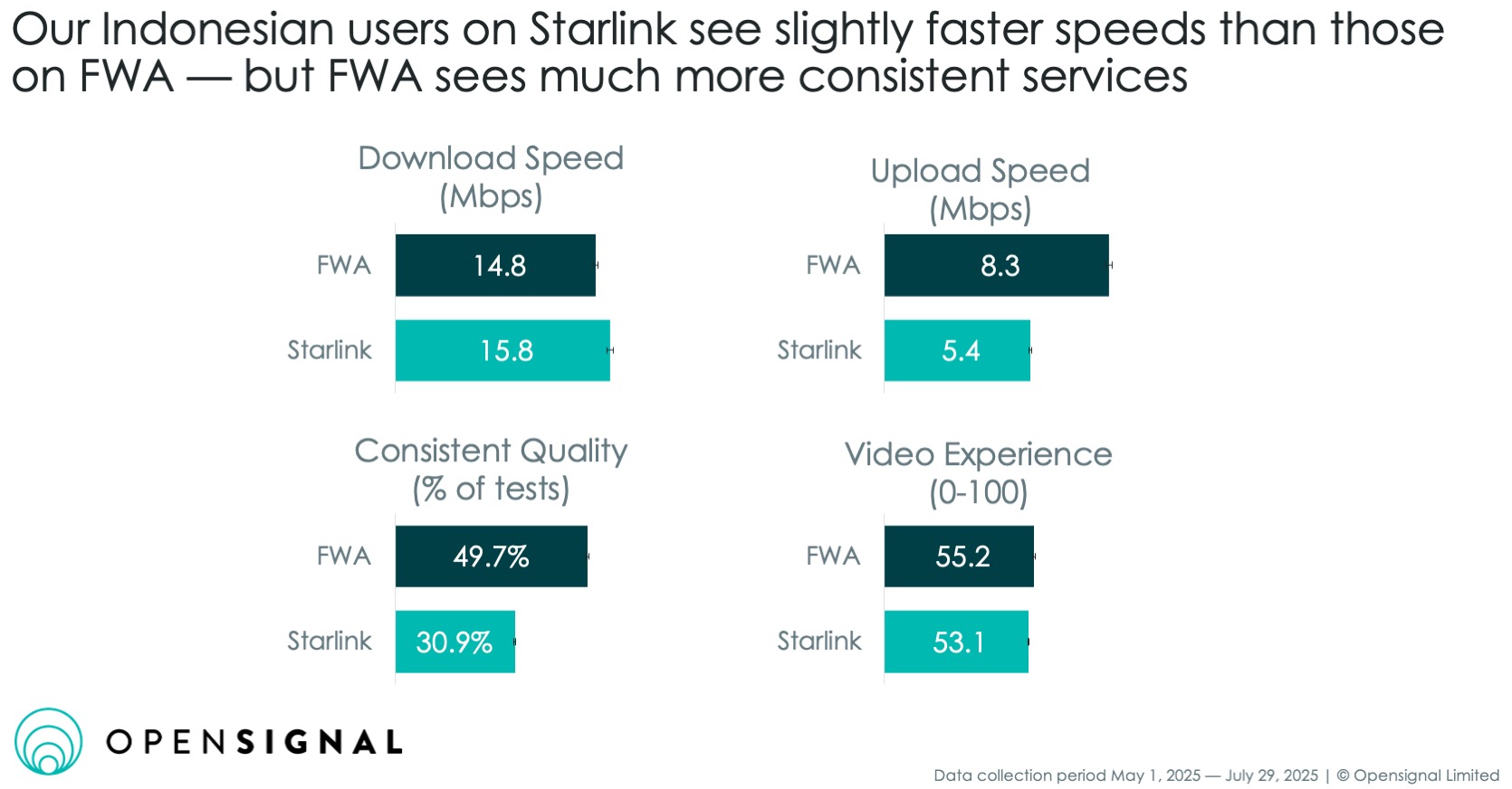
FWA outperforms Starlink on most metrics: Starlink leads in Download Speed, but FWA wins on Upload Speed, Consistent Quality, and Video Experience.
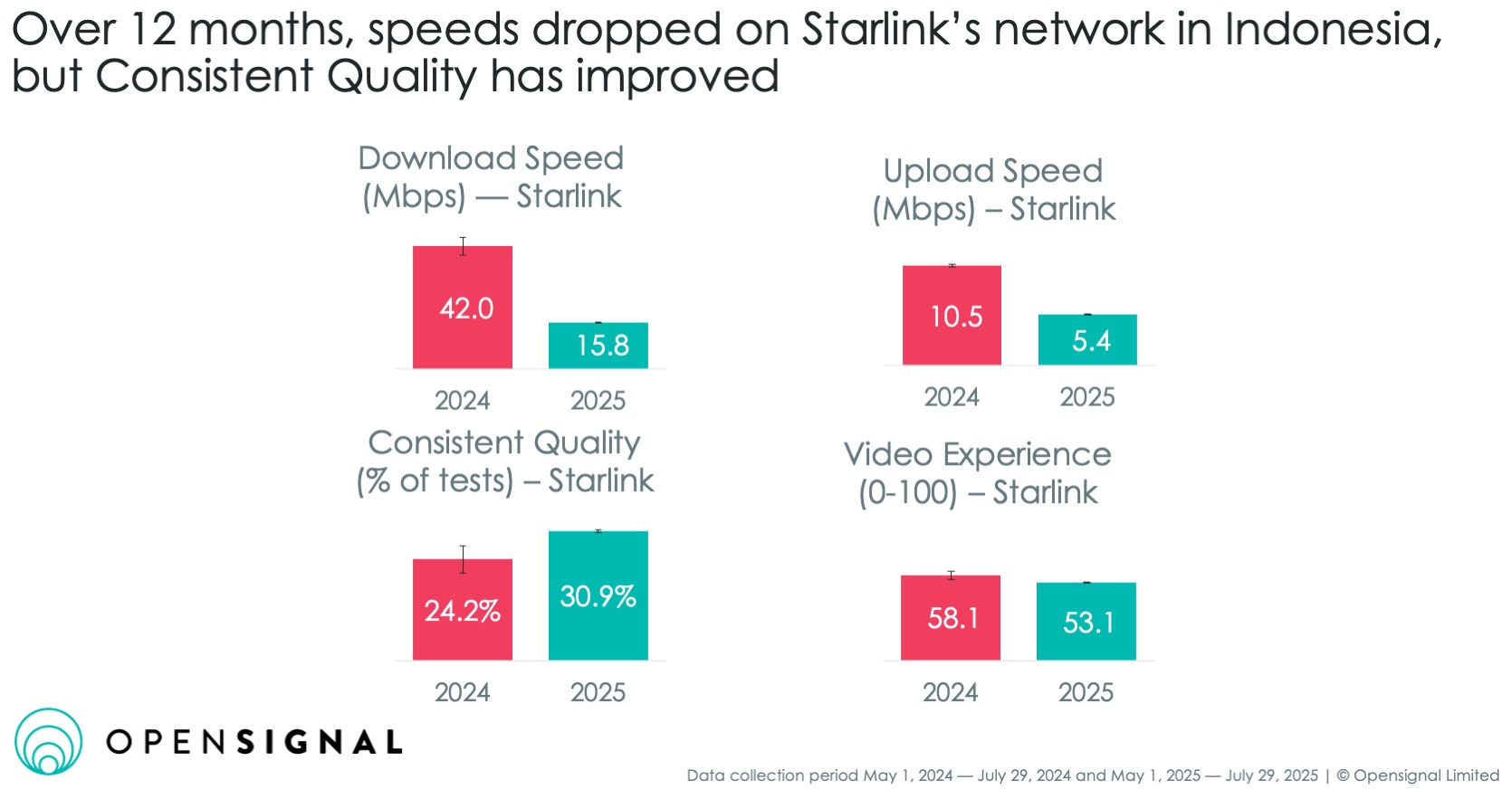
When Starlink launched in Indonesia in May 2024, it brought hope to communities beyond the reach of fiber or mobile networks. With initial speeds of 42.0 Mbps download and 10.5 Mbps upload, it offered a strong alternative to existing wireless connections. But within a year, rapid uptake strained capacity: downloads fell by nearly two-thirds, uploads by almost half, and Video Experience scores dropped by five points.
The culprit was congestion. Demand surged so quickly that Starlink was forced to temporarily freeze new sign-ups. When service resumed in July 2025, new customers faced steep “demand surge fees” ranging from IDR 8 million to IDR 9.4 million (US$490–US$574), depending on the gateway. That’s roughly three times Indonesia’s average monthly wages of IDR 3.09 million (US$190). In practice, this means interested consumers must either pay these high upfront charges or wait until demand eases.
However, not all trends are negative. Consistent Quality improved from 24.2% to 30.9% over the same period. Despite slower speeds, Starlink’s year-on-year improvement in this metric reflects lower latency and infrastructure upgrades.
Comparing Starlink with FWA
But while Starlink shows signs of progress in absolute terms for Consistent Quality, the real test lies in how it compares with local alternatives, such as FWA, which has become an important part of Indonesia’s digital strategy. However, unlike satellite, FWA deployment in rural areas is constrained by coverage, as sparse populations and difficult terrain make tower and backhaul expansion costly.
Starlink delivers marginally faster download speeds than FWA. However, FWA leads on the other three metrics — particularly Consistent Quality, where it scores nearly 50%, significantly higher than Starlink’s result.
Most Indonesian FWA services still run on 4G, with 5G deployments expanding only gradually due to limited 5G spectrum availability. Faced with these constraints, operators are turning to 4G FWA as a pragmatic and commercially viable way to meet market demand.
Telkomsel dominates the segment with its Orbit service, which grew 31% to 1.1 million subscribers in 2023. XL also offers FWA, while IOH entered the market in 2024 with HiFi Air, launched alongside a national 4G/5G expansion deal with Nokia that includes FWA.
Regional value of satellite
Indonesia’s geography — an archipelago of 1,000+ islands — makes satellite connectivity especially valuable.
- Starlink offers more uniform performance nationwide, extending access to remote eastern provinces such as Maluku and Western New Guinea.
- FWA focuses on Java, Sumatra, and other densely populated western regions.
- Stability gap: FWA consistently provides better reliability, while Starlink’s weaker Consistent Quality is most evident in rural zones.
This highlights Starlink’s complementary role: not replacing FWA or fiber, but filling critical gaps in hard-to-reach areas.
Our users’ experiences on Starlink and FWA diverge sharply by urbanicity. In cities, Starlink users enjoy download speeds nearly 25 Mbps faster than FWA. They also see faster speeds in rural areas, while towns and suburbs show similar results between FWA and Starlink.
FWA consistently scores higher on Consistent Quality across all area types, with Starlink’s weaker stability most evident in rural zones.
Regionally, Starlink delivers more uniform performance nationwide, while FWA shows wider disparities, reflecting uneven terrestrial coverage.
Navigating regulatory hurdles and complexity
Starlink entered Indonesia with government backing to expand rural connectivity, particularly for health and education, while also providing links for Indonesian surveillance ships. However, its rollout has faced several regulatory challenges:
- Licensing conditions: Ahead of its May 2024 launch, Starlink secured VSAT and ISP permits, but Komdigi required it to establish a local Network Operations Center (NOC) to monitor its services, concerned that its satellite network could bypass domestic gateways.
- Roaming restrictions: A major point of contention is the Jelajah roaming plan, which emphasizes mobility as a core feature, marketed as “connect at home or on the go.” Indonesian rules prohibit roaming on land for fixed broadband operators, permitting it only on ships and for up to seven days. Komdigi has warned that offering roaming satellite devices in cars or other land-based uses could cost Starlink its license.
- Competition concerns: Indonesia’s competition authority (KPPU) has recommended restricting Starlink to 3T regions (underdeveloped, frontier, outermost), leaving urban areas to local providers. Operators argue this would safeguard infrastructure investment and preserve industry balance. Still, Starlink remains active in cities, with 17.3% of Opensignal readings coming from urban areas — showing that demand extends well beyond its rural mandate.
Conclusions: progress and growing pains
After one year in Indonesia, Starlink has proven its value in extending connectivity to remote and underserved areas where terrestrial solutions struggle to reach.
However, its expansion has also exposed significant challenges — from network congestion eroding performance, to steep fees limiting accessibility and adoption, and ongoing regulatory pressures as policymakers seek to balance innovation with market fairness.
Looking ahead, Starlink’s success will hinge on three key factors:
- Expanding capacity to keep pace with rising demand.
- Stabilizing performance to ensure a consistent user experience.
- Positioning itself as a complementary technology alongside FWA and fiber, rather than a direct competitor.
If these growing pains can be addressed, Starlink has the potential to play a lasting role in Indonesia’s digital ecosystem and support the government’s broader connectivity and digital inclusion goals.
Opensignal classified Indonesia into urban, towns/suburbs, and rural areas, using the DEGURBA methodology
If you’re interested in more on Indonesia’s telecom market, explore our recent reports on mobile and fixed services. For more on alternative connectivity solutions, see our study of Starlink vs. FWA performance in Canada. For tailored analysis, please contact us. And don’t forget to subscribe to Opensignal’s newsletter for deeper insights on Indonesia and global markets.
Opensignal Limited retains ownership of this insight including all intellectual property rights, data, content, graphs & analysis. Reports and insights produced by Opensignal Limited may not be quoted, reproduced, distributed, published for any commercial purpose (including use in advertisements or other promotional content) without prior written consent. Journalists are encouraged to quote information included in Opensignal reports and insights provided they include clear source attribution. For more information, contact [email protected].
