


At GITEX Global 2025 (October 13-17, Dubai World Trade Centre), 5G-Advanced (5G-A) was one of the key themes. Across e&’s exhibition – the UAE’s largest mobile operator – 5G-Advanced capabilities were on display: from AI-driven automation and robotics to immersive XR, smart surveillance, and industrial edge applications.
5G-Advanced (often referred to as 5.5G) represents the next evolutionary phase of 5G, bridging today’s 5G Standalone networks and future 6G networks, and has been defined by the 3GPP Releases 18 and Release 19.
In this report, we explore the e& 5G journey – from Non-Standalone (NSA) to Standalone (SA) – and whether 5G SA delivers measurable improvements in user experience as 5G-Advanced era has already begun in the UAE.
Key findings:
- 5G Standalone users enjoy higher speeds: On average, in Q3 2025 e& users connected to 5G Standalone (SA) experienced 62% faster download speeds (403.7Mbps) than those on Non Standalone (NSA) (249.0Mbps). Upload speeds were also 11% faster on SA (29.8Mbps) vs NSA (26.8Mbps).
- Stable performance throughout 2025: 5G SA maintained stable speeds above 400 Mbps throughout 2025, highlighting network maturity and optimization.
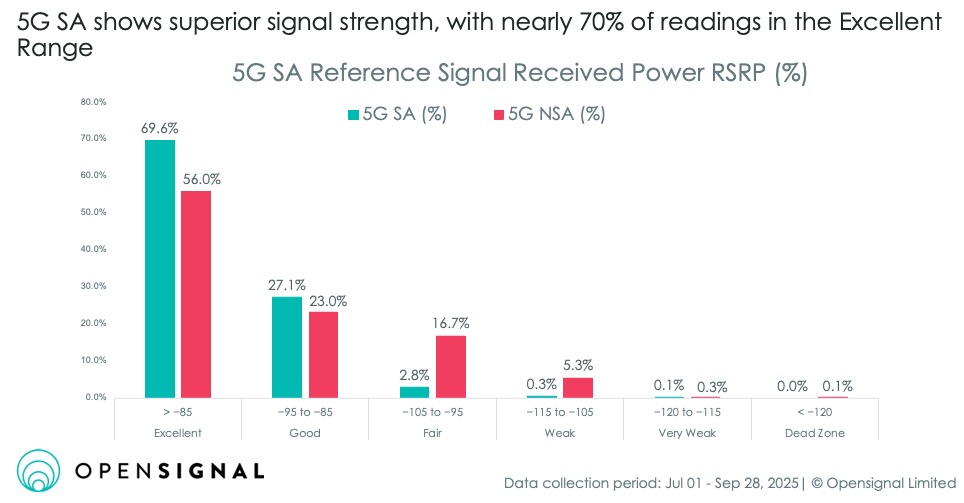
- 5G SA shows stronger and more uniform signal strength: Over 96% of 5G SA connections fall within the Good to Excellent range, confirming stronger, more uniform connectivity across the UAE.
5G SA delivers measurable performance gains
Unlike 5G Non-Standalone (NSA), which depends on the legacy 4G core network for signaling and control, 5G Standalone (SA) operates independently on a dedicated 5G core. This independence unlocks the full potential of 5G, including ultra-reliable low-latency communications (URLLC), network slicing, and enhanced uplink performance.
Building on the foundations of 5G SA, 5G-Advanced represents the next evolutionary phase — transforming 5G into an intelligent, adaptive, and sustainable network platform. It integrates AI and machine learning (AI/ML) across both the radio access network (RAN) and core network, enabling data-driven, self-optimizing network management.
5G-Advanced also enhances adaptability through intelligent radio resource management and multi-band aggregation, while improving sustainability with new energy-efficiency mechanisms that reduce power consumption without compromising performance.
Our analysis examined a range of e&’s network experience metrics — including download and upload speed experience across the first three quarters of 2025 — to assess how the operator’s transition to a pure 5G Standalone (SA) core is transforming user experience and network efficiency.
Opensignal’s latest analysis of e&’s network confirms that 5G Standalone (SA) delivers a clear performance uplift over 5G Non-Standalone (NSA) in downlink speed consistency.
During Q3 2025, our users on e&’s 5G SA network experienced an average 5G Download Speed of 403.7 Mbps, representing a 62% improvement over the 249.0 Mbps on NSA. In the uplink, SA users achieved 29.8 Mbps 5G Upload Speed, 11% faster than the 26.8 Mbps our users saw on NSA.

To capture the scale of this progress, Opensignal analyzed performance data from the beginning of 2025 through Q3, tracking how 5G SA experience evolved over time.
Throughout Q2 and Q3 periods, 5G SA users consistently experienced mean download speeds exceeding 400 Mbps, while 5G NSA users averaged below 270 Mbps. That means that 5G SA performance remained stable across the observed quarters, with minimal variation between measurements.
Uplink evolution: 5G SA overtakes NSA
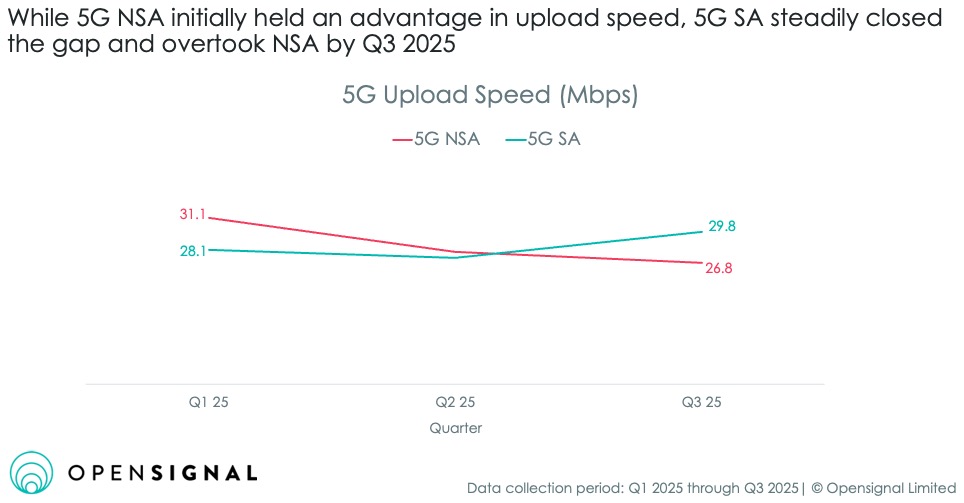
Initially, 5G NSA held an advantage in upload speed due to its hybrid architecture. However, by Q3 2025, the balance shifted — 5G SA overtook NSA as network refinements took hold.
- In Q1 2025, 5G NSA users averaged 31.1 Mbps compared with 28.1 Mbps on SA, reflecting early-stage optimization of the new standalone uplink paths.
- In Q3 2025, 5G SA users achieved 29.8 Mbps download speed, exceeding NSA’s 26.8 Mbps, as uplink scheduling, carrier aggregation, and radio resource management on the 5G core became more refined.
This crossover marks a turning point in SA maturity, reflecting improvements in uplink capacity — a critical factor for modern data-heavy use cases such as video sharing and cloud gaming.
5G SA outperforms 5G NSA in coverage strength
While 5G Reference Signal Received Power (RSRP) reflects signal strength rather than user-perceived quality, it remains a key indicator of radio signal consistency and cell-site reach – representing the strength of the signal a user’s device receives from the network.
Our Q3 2025 data shows 5G SA networks provide excellent coverage, with around 70% of e&’s measurements in excellent range (above -85 dBm), indicating strong radio signal performance on the network. In contrast, 5G NSA networks show a wider range of signal strengths, with nearly 22% of samples below –100 dBm. Measurements below –100 dBm generally indicate weaker signal reach, potentially leading to lower speeds and reduced reliability.
The tighter clustering of 5G SA signals in the mid-to-strong ranges confirms its good coverage, which is essential for achieving low latency and high throughput.
Building on strong foundation: e&’s 5G journey
e&’s performance achievements build on years of progressive network innovation and investment.
The operator launched 5G NSA in 2019, introducing 5G to consumers while leveraging its existing 4G infrastructure. By 2023, e& had commercially rolled out 5G SA for both Fixed Wireless Access (FWA) and smartphones, enabling the provision of high-speed connections for both residential and mobile e& users nationwide.
This evolution reflects the e& 2030 vision, demonstrating the company’s ambition to deliver unmatched network excellence, maintaining global leadership in FTTH penetration and delivering outstanding mobile 5G speeds, ensuring best-in-class connectivity and enhanced customer experiences by investment in telecommunication technologies.
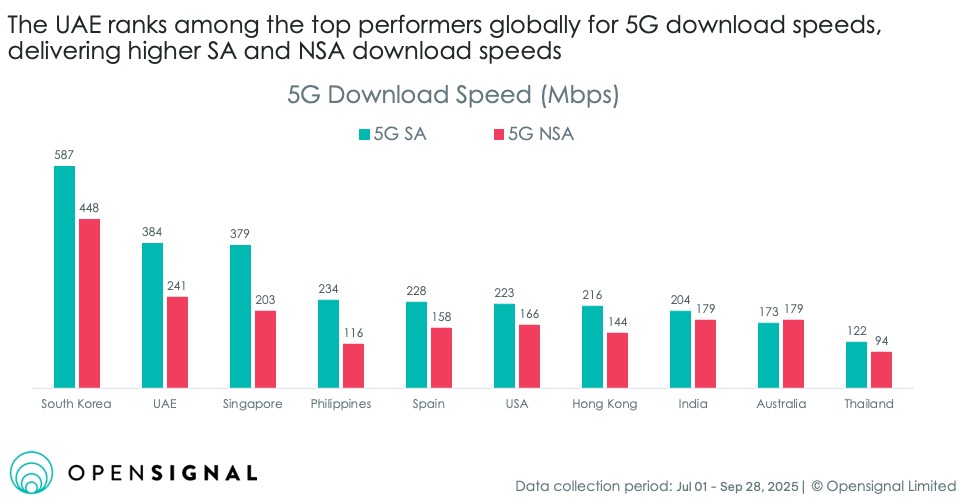
e& powers UAE’s Global Lead in 5G Standalone download speed
The UAE ranks among the top performers globally for 5G SA download speed, recording 384Mbps in our benchmark. This places the country well ahead of its 5G NSA performance, underscoring e&’s pivotal role in driving the UAE’s leadership in 5G Standalone during Q3 2025.
e&`s 5G SA adoption continues to grow, increasing from 20% in Q2 2025 to 24% in Q3 2025, demonstrating consistent progress toward broader SA rollout across the network. The pace of adoption depends not only on network expansion, but also factors such as device and SIM compatibility with 5G SA services, which remain key enablers of broader rollout.
The other Emirati operator – du – has also launched 5G SA network in 2023, but with a slower adoption rate in comparison to e&.
We continue to monitor the progress of 5G SA adoption and its impact on users' experience in the UAE.
For a broader regional perspective, explore Opensignal’s recent 5G SA vs. 5G NSA analysis in Japan and Singapore. If you would like to stay up to date on our recent analysis make sure you subscribe to our newsletter.
Opensignal Limited retains ownership of this insight including all intellectual property rights, data, content, graphs & analysis. Reports and insights produced by Opensignal Limited may not be quoted, reproduced, distributed, published for any commercial purpose (including use in advertisements or other promotional content) without prior written consent. Journalists are encouraged to quote information included in Opensignal reports and insights provided they include clear source attribution. For more information, contact [email protected].
