


Introduction: Saudi Arabia’s Digital Transformation
Saudi Arabia has embarked on an ambitious journey to position itself as a global leader in connectivity, aligning with its Vision 2030 objectives. In the past six years period, the nation has invested $25 billion to enhance its digital infrastructure, ensuring readiness for automation and digital transformation.
As part of Vision 2030—a strategic framework aimed at diversifying the economy and reducing reliance on oil—network infrastructure investments have become a high priority. This includes advancements in 5G core technology, cloud solutions, satellite, and digital connectivity, supporting transformation across key sectors such as manufacturing, healthcare, transportation, and logistics.
However, the key question remains: have these investments translated into a better consumer experience?
In this article, we will analyze Saudi Arabia’s performance in Opensignal’s newly launched Global Network Excellence Index, exploring where the country ranks and identifying areas for improvement.
Saudi Arabia’s position in the Global Network Excellence Index
The Opensignal Global Network Excellence Index leverages our proprietary data to provide a market-level ranking of mobile network excellence. It offers a real-world assessment based on direct measurements of user experience, evaluating markets across three core pillars:
- Excellent Consistent Quality (ECQ) – Evaluates how consistently networks support demanding applications such as video streaming, video calls, and gaming, ensuring a seamless user experience
- 4G/5G Availability – The proportion of time users are connected to modern mobile networks, reflecting the accessibility of mobile infrastructure.
- 4G and 5G Download Speed – Indicates a network’s capacity to handle future digital demands, assessing both current speeds and the potential for future scalability.
Saudi Arabia has made significant strides in mobile network infrastructure, particularly in 5G deployment and spectrum allocation. The Communications, Space & Technology Commission (CST) has proactively reallocated spectrum from incumbent users, making 1,400MHz of licensed low- and mid-band spectrum available to national mobile operators.
The 2024 spectrum award in the 600MHz, 700MHz, and 3.8-4GHz bands introduced strict coverage and Quality of Service (QoS) obligations aimed at achieving nationwide average download speeds of 300Mbps. As a result, all Saudi mobile operators now have access to large amounts of sub-6GHz spectrum. The latest auction further strengthened mid-band availability, enabling operators to use multiple 100MHz carriers, enhancing both capacity and performance.
In the Gulf region, countries like Qatar, Bahrain, Kuwait, and the United Arab Emirates have been pioneers in 5G deployment, with commercial launches as early as 2019. Saudi Arabia's recent spectrum allocations aim to further enhance its 5G capabilities, potentially surpassing its Gulf Cooperation Council (GCC) counterparts.
While Saudi Arabia has made commendable progress in 5G deployment and spectrum allocation, our Index highlights a gap in the availability of modern infrastructure (4G/5G) and consistent quality across its vast territory.
Saudi Arabia compared to its peers
To ensure meaningful benchmarking, our Index segments markets based on geography and economic classification using World Bank data. Saudi Arabia falls within the large land area group, which constitutes markets with land area of >200,000 km². With a 2.15 million km² size, Saudi Arabia is the 12th largest country in the world.
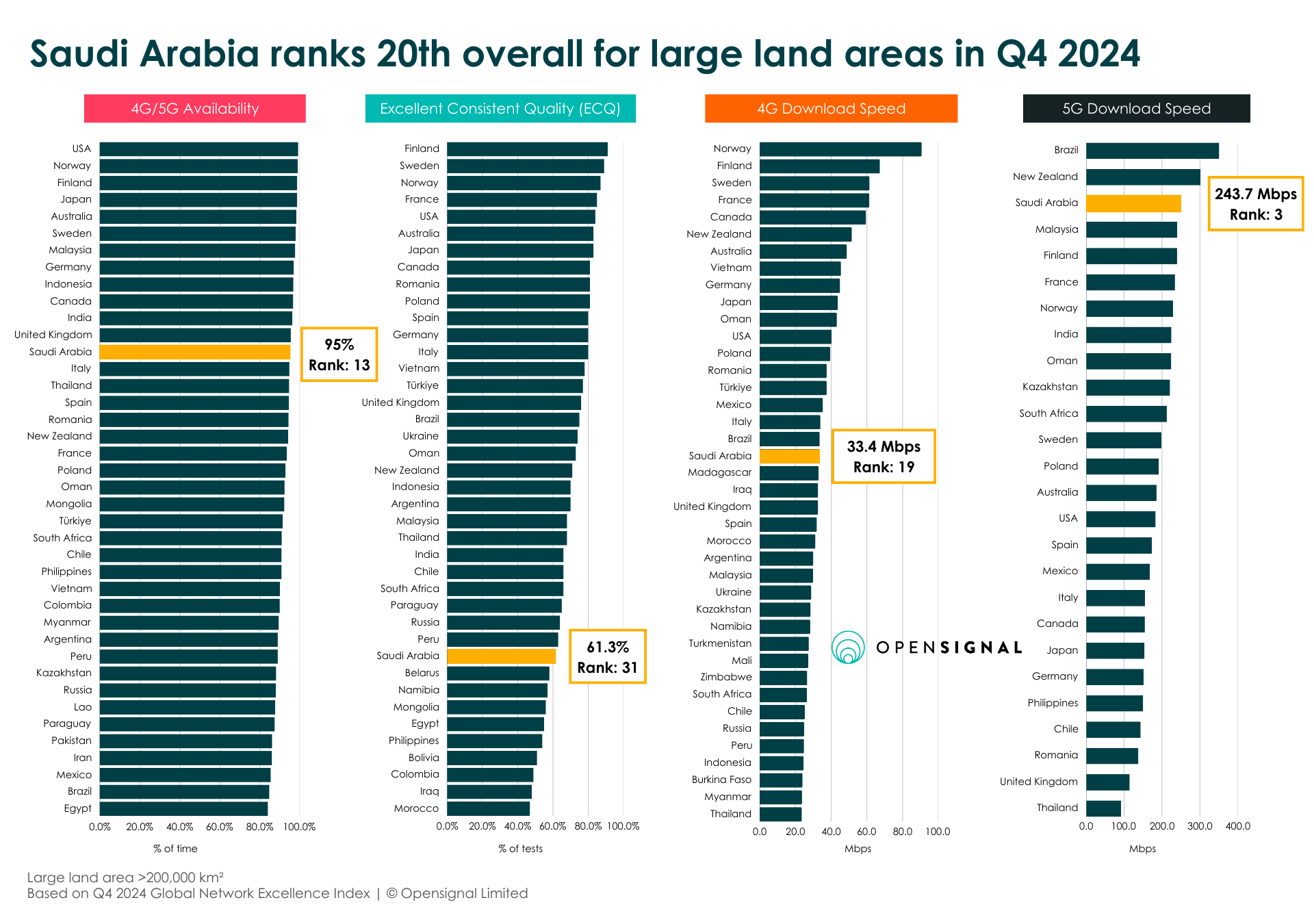
Large nations often face challenges in deploying mobile networks due to geographic and infrastructure constraints; Saudi Arabia ranks 20th among 73 large land area markets in Opensignal’s Index. The country demonstrates high 4G/5G Availability at 95%, placing it 13th amongst its peers. According to CST, the majority of mobile traffic is carried on 4G (66%) and 5G (32%), but our data shows that our users in the Kingdom spend 5% of their time on average without a 4G or 5G signal.
Notably, Saudi Arabia excels in 5G Download Speed, ranking 3rd across 26 large land areas markets with wide commercial 5G rollout, trailing only Brazil and New Zealand. However, its ECQ score lowers its overall rank, with only 61% of tests meeting the required thresholds for Excellent Consistent Quality,
Saudi Arabia in the context of the G20*
Saudi Arabia is a G20 member, a group comprising the world’s largest economies. Within this group, Saudi Arabia ranks 11th overall in mobile network excellence.
Breaking it down into key subcomponents:
- 10th for 4G/5G Availability – indicating strong network availability across the country.
- 12th for 4G Download Speed – showing room for improvement in non-5G performance.
- 3rd for 5G Download Speed – highlighting Saudi Arabia as one of the top performers in next-generation connectivity, behind only South Korea and Brazil.
- 17th for Excellent Consistent Quality (ECQ) – signaling a gap in consistency, which impacts real-world user experience.
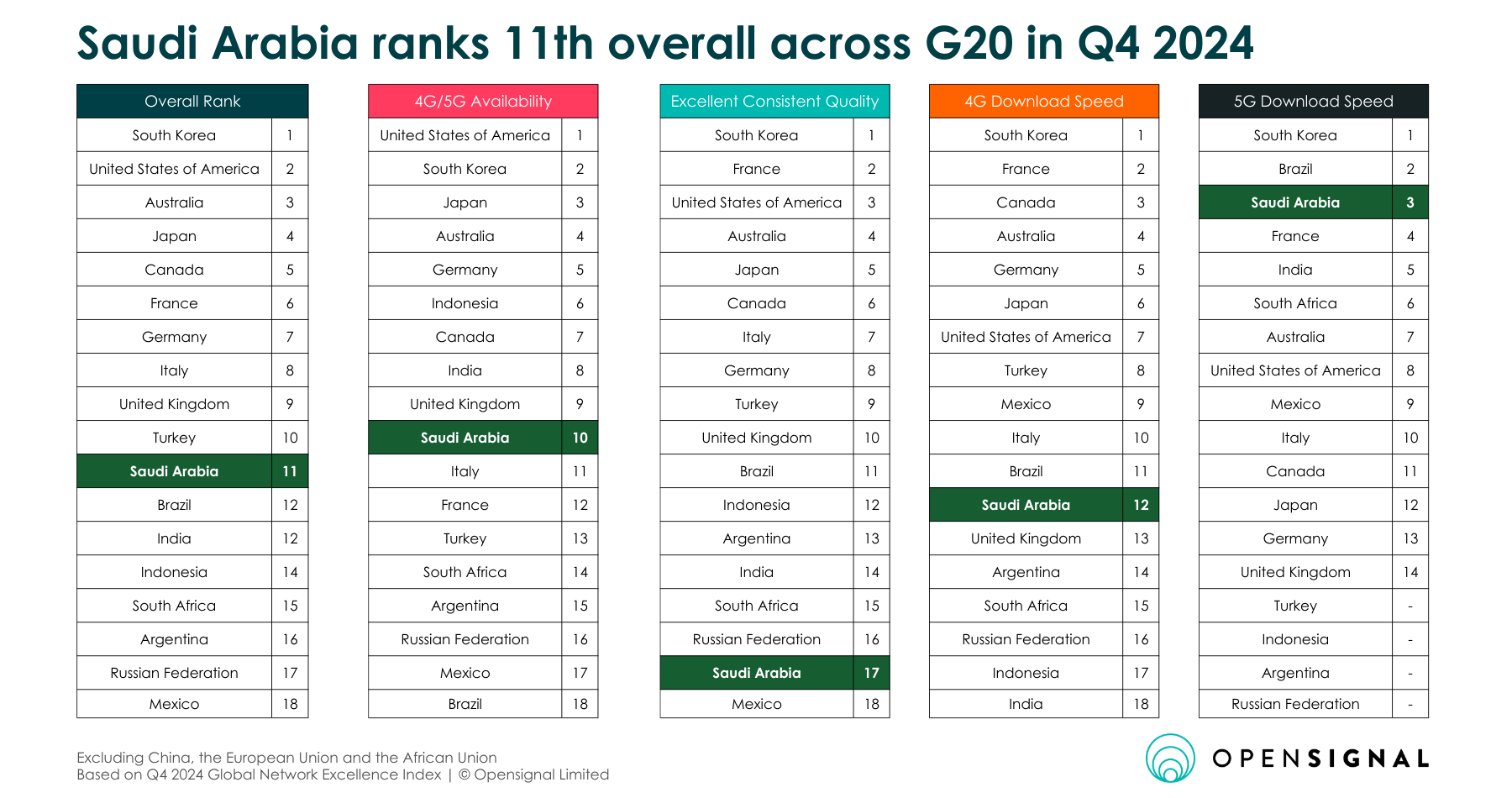
While Saudi Arabia excels in 5G speed, the lower ranking in ECQ suggests that network consistency remains an area for improvement. This raises an important question: How can Saudi Arabia’s investments in digital infrastructure translate into a better everyday experience for consumers?
Speed alone is not enough – customer experience matters
While impressive 5G download speeds are a significant milestone, they do not necessarily translate into a superior user experience. Opensignal’s Excellent Consistent Quality (ECQ) metric provides a more holistic measure of network performance, ensuring mobile users can engage in everyday activities at a “good enough” level, such as HD video streaming, online shopping, and gaming. Furthermore, Opensignal’s internal analysis shows that operators that improve ECQ scores see stronger customer retention and higher Net Promoter Scores (NPS), proving that consistency matters as much as speed. Furthermore, leading operators already use ECQ to assess and enhance network quality. For instance, TIM Brazil emphasized ECQ as a key performance indicator in its 2023 Investor Day presentation.
Key factors beyond speed
1. Consistency over peaks – A network capable of delivering extremely high speeds during ideal conditions does not guarantee a smooth experience at all times. Users require a stable connection, especially during peak hours when network congestion can degrade performance. The Saudi Internet Report 2023 found that peak usage occurs between 9:00 p.m. and 11:00 p.m., with Fridays being the busiest day. This means a network must maintain quality even under heavy load.
2. Low latency and jitter matter - Speed is just one aspect of quality. The Saudi Internet report found that 84.9% of users use voice and video applications, with the most popular being Snapchat (65.1%), imo (24.9%), and FaceTime (15.9%). These video-calling apps and those used for online gaming require low latency, minimal jitter, and consistent packet delivery to avoid disruptions. The ECQ metric captures this by including benchmarks for:
- Latency (<50 ms) – Essential for real-time applications
- Jitter (<12 ms) – Ensures smooth data flow
- Packet Loss (<1%) – Prevents voice and video call interruptions
3. Upload speeds are just as critical - While download speeds are often emphasized, a good user experience also requires reliable upload speeds. The ECQ threshold checks to see if users have at least 1.5Mbps upload throughput, which is vital for:
- Video conferencing (e.g., Microsoft Teams, Zoom)
- Cloud backups and file sharing
- Social media uploads
4. First Byte Delay impacts web browsing - Testing internet speeds typically measures raw throughput, but real-world experiences—like web browsing and app loading times—depend significantly on network responsiveness. The ECQ metric includes a 0.8-second first-byte delay limit, this checks to see if websites and apps load responsively in a way that is independent of download speeds.
5. Network congestion can diminish speed gains - The CST report shows that mobile internet usage in Saudi Arabia is dominant, with 98.9% of users browsing on mobile phones. This heavy reliance on mobile networks means that during congestion, speeds can fluctuate dramatically, making network reliability and consistency more important than just peak speed
Within Saudi Arabia, consumers continue to face challenges such as:
- Varying network consistency: Variations in network performance across different regions can disrupt user activities.
- Congestion & peak time struggles: High traffic periods often lead to network congestion, affecting service quality.
- Video streaming quality: With video comprising a substantial portion of internet traffic, ensuring high-quality streaming is essential.
Addressing these issues is crucial for enhancing overall user satisfaction.
Looking Ahead: What’s Next for Saudi Arabia?
Saudi Arabia is already a leader in spectrum allocation, ranking second among G20 countries.
To further enhance its network excellence, the country should:
- Enhance consistent quality: Prioritize consistent network performance over increasing speed.
- Address customer pain points: Focus on resolving issues that directly impact user satisfaction and engagement.
- Innovate monetization strategies: Develop alternative methods to monetize network investments within regulatory frameworks.
By focusing on ECQ and user experience, Saudi Arabia can continue improving its Opensignal Global Network Excellence Index ranking and solidify its position as a global digital leader.
Make sure to sign up for our newsletter to stay up to date with insights on this and related topics. Feel free to contact us if you’d like to learn more!
Methodology Note
For the full methodology, follow this link.
*Note: China is excluded from our Index due to limitations in accurately measuring end user experience caused by the Great Firewall.
Opensignal’s methodology focuses on measuring real-world user experience rather than theoretical network capacity. By collecting data from both user-initiated and automated periodic tests, Opensignal ensures an accurate representation of typical network conditions. The majority of measurements are conducted at random intervals, independent of user action, to capture true mobile experience as it happens. This approach is widely recognized as a best practice by regulatory bodies such as the FCC in the U.S., reinforcing its reliability in assessing network performance.
Opensignal Limited retains ownership of this insight including all intellectual property rights, data, content, graphs & analysis. Reports and insights produced by Opensignal Limited may not be quoted, reproduced, distributed, published for any commercial purpose (including use in advertisements or other promotional content) without prior written consent. Journalists are encouraged to quote information included in Opensignal reports and insights provided they include clear source attribution. For more information, contact [email protected].
