


Over the past years, Saudi Arabia has been leading the charge in digital infrastructure investment as part of its broader strategy to reduce economic dependence on hydrocarbons. One of the notable outcomes of this transformation is the Kingdom’s emergence as one of the most dynamic and rapidly growing markets for fixed wireless access (FWA). Driven by extensive 5G network deployments, unprecedented spectrum availability and strong government support, FWA has gained traction as a compelling alternative to fiber broadband. In this report, Opensignal analyzes the current state of FWA in Saudi Arabia — exploring the market forces behind this shift toward next-generation fixed wireless connectivity and examining how it is reshaping the competitive landscape in the broadband market.
All three major providers — stc, Mobily (Etihad Etisalat), and Zain KSA — today offer high-speed, unlimited-data 5G home broadband services. While the majority of FWA connections are delivered over 5G, some 4G LTE subscriptions remain in use. Reflecting the wireless broadband landscape in Saudi Arabia, this report includes both 4G and 5G technologies in our analysis of the FWA market.
Key Findings:
- While FWA doesn’t match wireline in raw performance, its widespread availability and simple installation are driving strong adoption. Today, an estimated one in five broadband connections in Saudi Arabia are on fixed wireless — it shows that the accessibility and convenience of wireless broadband outweigh the modest performance gap. On average, our users see FWA download speeds just 21% below wireline, and FWA Consistent Quality — our proprietary measure of everyday user experience — trails wireline by only 25%.
- All three mobile operators continue to invest heavily in 5G infrastructure. At present, Saudi operators still deliver most wireless traffic over 5G non-standalone access (5G NSA) cores, but their 2024 road-maps show a clear pivot toward standalone (5G SA). Stc boasts the widest national footprint and is aggressively extending its fiber-backed 5G sites. Mobily is enhancing its capacity with additional spectrum investment focused on top cities, while Zain still has room for further urban-centric deployments across the Kingdom.
- Zain’s FWA service is unbeaten on speed. Our FWA users with Zain experience the fastest average download speeds among the competing services in Saudi Arabia, and also see the fastest upload speeds alongside those on Mobily. Mobily FWA leads on Consistent Quality, which means our users’ connection quality was good enough for everyday use-cases, like gaming or watching HD videos, more often that on other providers — edging out Zain by just a few percentage points.
- FWA experience differs significantly across the Kingdom’s largest cities. In the capital, Riyadh, users enjoy the most consistent experience in the country. Jeddah and Dammam also perform well, while Al Madinah trails behind — highlighting regional disparities in FWA experience.
- Congestion impacts experience on fixed wireless. All three FWA providers show a dip in consistent quality during evening hours (18:00–23:59), reflecting increased network load during peak usage times.
FWA adoption & technology drivers
Saudi Arabia was one of the first countries in the MENA region to launch 5G, beginning its rollout in mid-2019 and sustaining an aggressive deployment pace ever since. By Q1 2025, 5G networks covered approximately 78% of the population, according to GSMA Intelligence. Reflecting this momentum, Opensignal’s Global Network Excellence Index recently ranked the Kingdom among the world’s top performers for 5G, placing fourth for 5G Download Speed among large land area markets — a strong indicator of exceptional network capacity.
This strong 5G foundation has enabled Saudi Arabia to establish a robust platform for delivering mass-market next-generation fixed wireless access. Opensignal data shows that FWA users today experience average download speeds of 43Mbps, compared to 54.3Mbps on wireline (which primarily refers to fiber in the Kingdom, but includes a small share of legacy DSL connections). This reflects a modest 21% performance gap. Meanwhile, our Consistent Quality metric — which measures the share of user tests meeting everyday performance thresholds — stands at 46.9% for FWA versus 62.3% on wireline — a 25% difference.
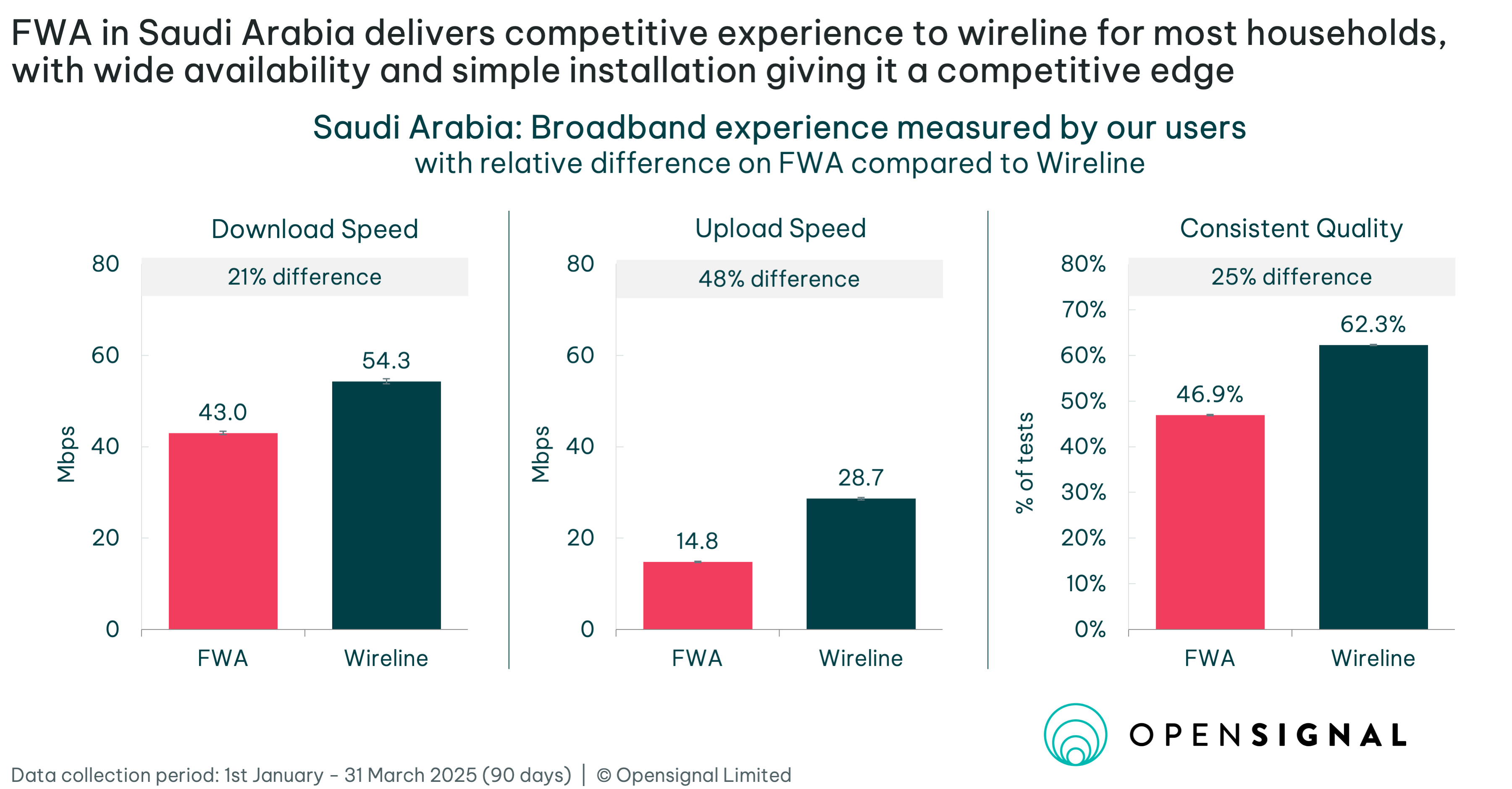
This translates into a competitive level of fixed-wireless performance for most households, which paired together with extensive footprint and ease of installation has resulted in strong adoption – as of Q4 2024 Telegeography estimated some 600,000 FWA connections in Saudi Arabia. This accounts for around 20% of the total broadband market — one of the highest proportions globally, taking into account the vast majority of these today are 5G-based. Furthermore, according to Ericsson’s 2024 ConsumerLab report, four out of five households in Saudi using 5G FWA relied on it as their primary internet connection — a similar level of adoption to countries like the US, Norway, and Australia.
A key enabler of this rapid FWA growth has been Saudi Arabia’s generous spectrum policy. Following the 2024 spectrum auction, the Communications, Space and Technology Commission (CST) released a total of 1400MHz spectrum – spanning the sub-6GHz range – the highest allocation among the G20 countries. To drive meaningful deployment, the CST imposed strict coverage and Quality of Service (QoS) obligations. This will act as an additional lever on participating networks to fully utilize their available spectrum bands.
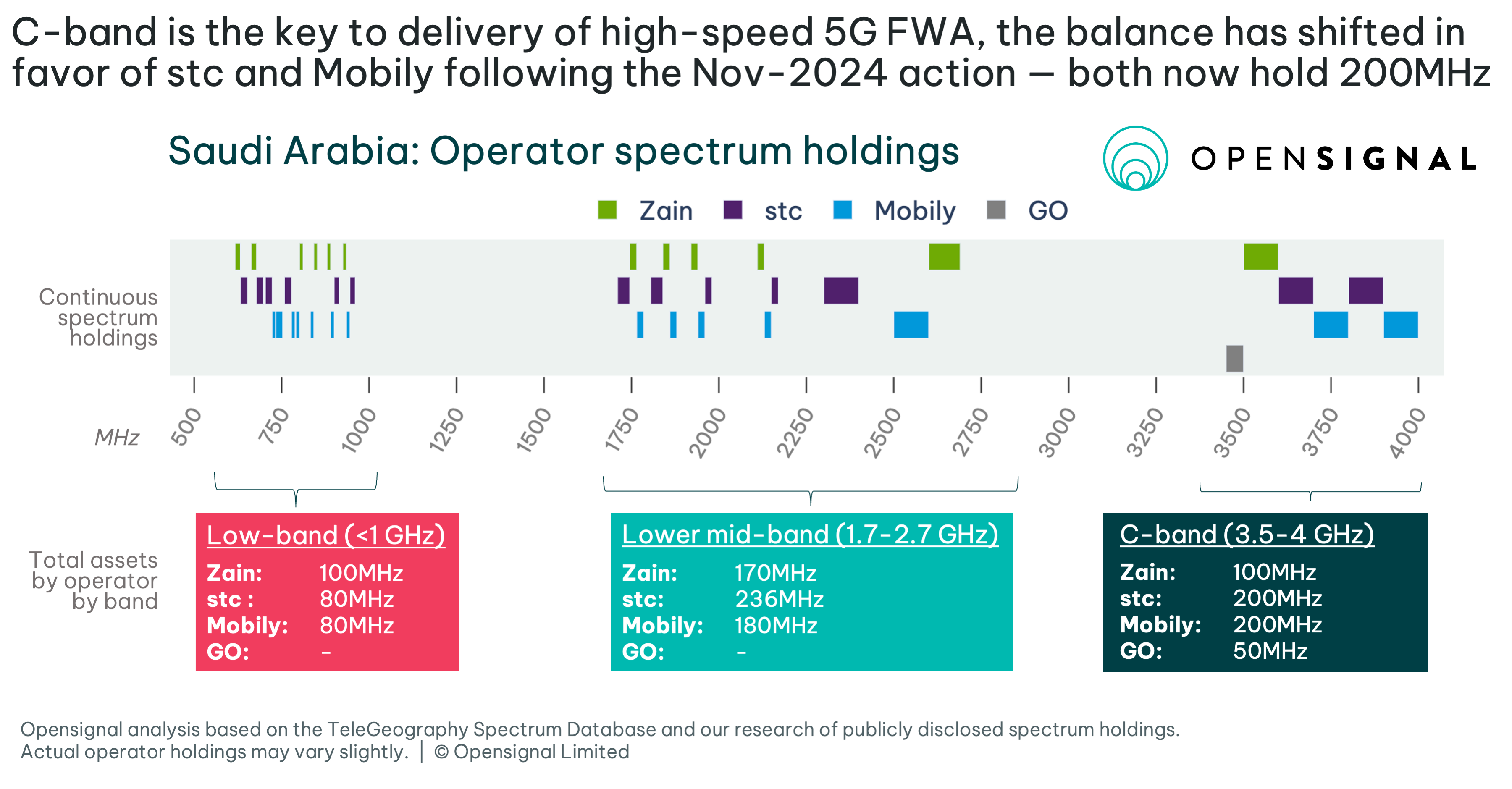
All three major FWA providers in Saudi Arabia offer closely competing 5G home broadband services, but their spectrum holdings and network investments vary significantly. Stc leads with a total of 516MHz, giving it around 12% more spectrum than Mobily’s 460MHz and around 40% more than Zain’s 370MHz. The additional lower mid-band capacity gives stc an edge in indoor penetration and wider signal coverage. That said, C-band remains the most critical for delivering high-speed 5G FWA in densely populated urban areas. Until the November 2024 auction, all three operators held equal 100MHz C-band allocations from the CST’s 2019 auction. Following the latest awards, however, the balance has shifted in favor of stc and Mobily, both of which doubled their C-band holdings to 200MHz. It remains unclear whether these newly acquired assets had been fully deployed on networks by the end of Q1 2025, which marks the cut-off point for the data collection period used to assess operator results in this report.
Operator market shares and strategic positioning
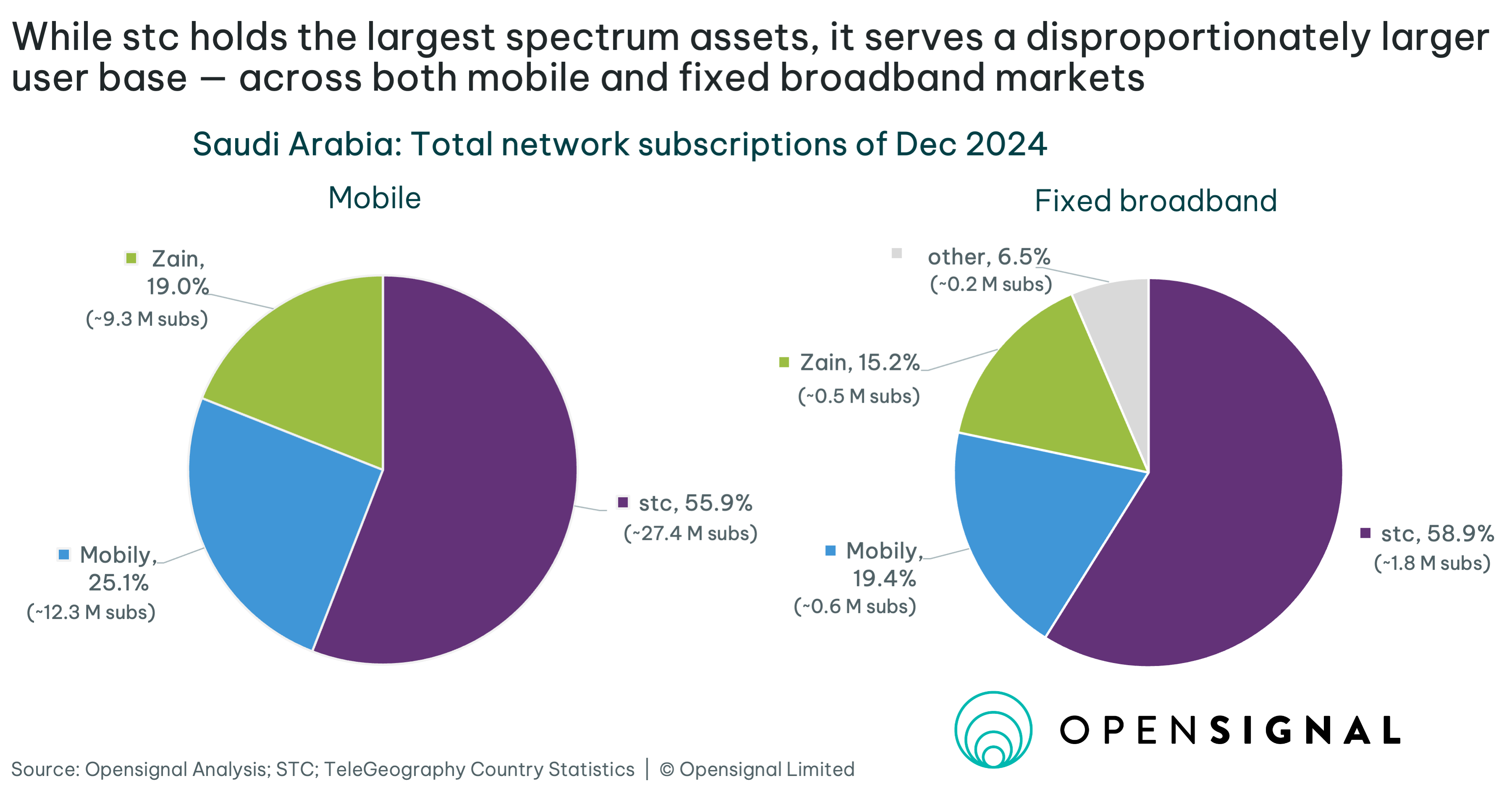
Saudi Arabia’s broadband market is highly concentrated, with the three main providers examined in this report — stc, Mobily, and Zain — accounting for 93.5% of all fixed broadband subscriptions. While all three offer FWA plans at broadly similar price points, ranging from 239 SAR (USD 61) to 403 SAR (USD 107) per month, stc positions its offering at the higher end of the spectrum, indicating its market leadership position.
Stc is the largest telecom operator in Saudi Arabia and the country’s historical incumbent. While it holds the most extensive spectrum assets, stc also serves a disproportionately larger share of the mobile and broadband markets. In fixed broadband, stc accounts for nearly 59% of total subscriptions, representing around 1.8 million users. Although it does not disclose specific figures for FWA, its broad network reach and strong brand suggest it commands a significant share of the fixed wireless segment as well. This scale puts added pressure on network capacity and performance — particularly in densely populated areas. Opensignal data shows that FWA users on stc’s network experience lower network consistency and slower download and upload speeds compared to users on other providers. Stc only markets 5G FWA plans today, differentiating offerings based on maximum speed tiers, with options capped at 200Mbps or uncapped for premium users.
Mobily is the second-largest broadband provider in Saudi Arabia, though it trails significantly behind stc, with around 600,000 subscribers — representing 19.4% of the market as of December 2024. Mobily has a well-established infrastructure in the Kingdom’s largest cities, where customers typically benefit from the highest quality FWA service. This focus on populated centers is likely behind what is reflected in Opensignal’s data, which shows that Mobily’s FWA users enjoy the most consistent user experience among the three major providers across our readings in Saudi Arabia. Mobily’s consumer FWA offering entirely steers consumers towards 5G FWA, but does have a 4G option as well. Its 5G FWA is differentiated through three speed-based tiers of 100Mbps, 200Mbps, and unrestricted.
Zain is the smallest of the three major consumer telecom providers in the market, with 470,000 broadband subscribers and a market share of 15.2% in December 2024. Zain has reported success with uptake of its FWA offering, stating in late 2024 that its user base has been doubling annually since 2020. FWA has enabled Zain to compete directly with its wireline-heavy rivals, with the provider leveraging a wireless-first approach as a strategic advantage. Today, Zain is offering 5G FWA packages with download speed ceilings of 100Mbps / 200Mbps / 300Mbps / unrestricted. This higher speed tier differentiation suggests Zain’s capacity to serve faster speeds than its competitors, which is supported by our data that shows users on Zain FWA have the fastest download speeds in the market on average.
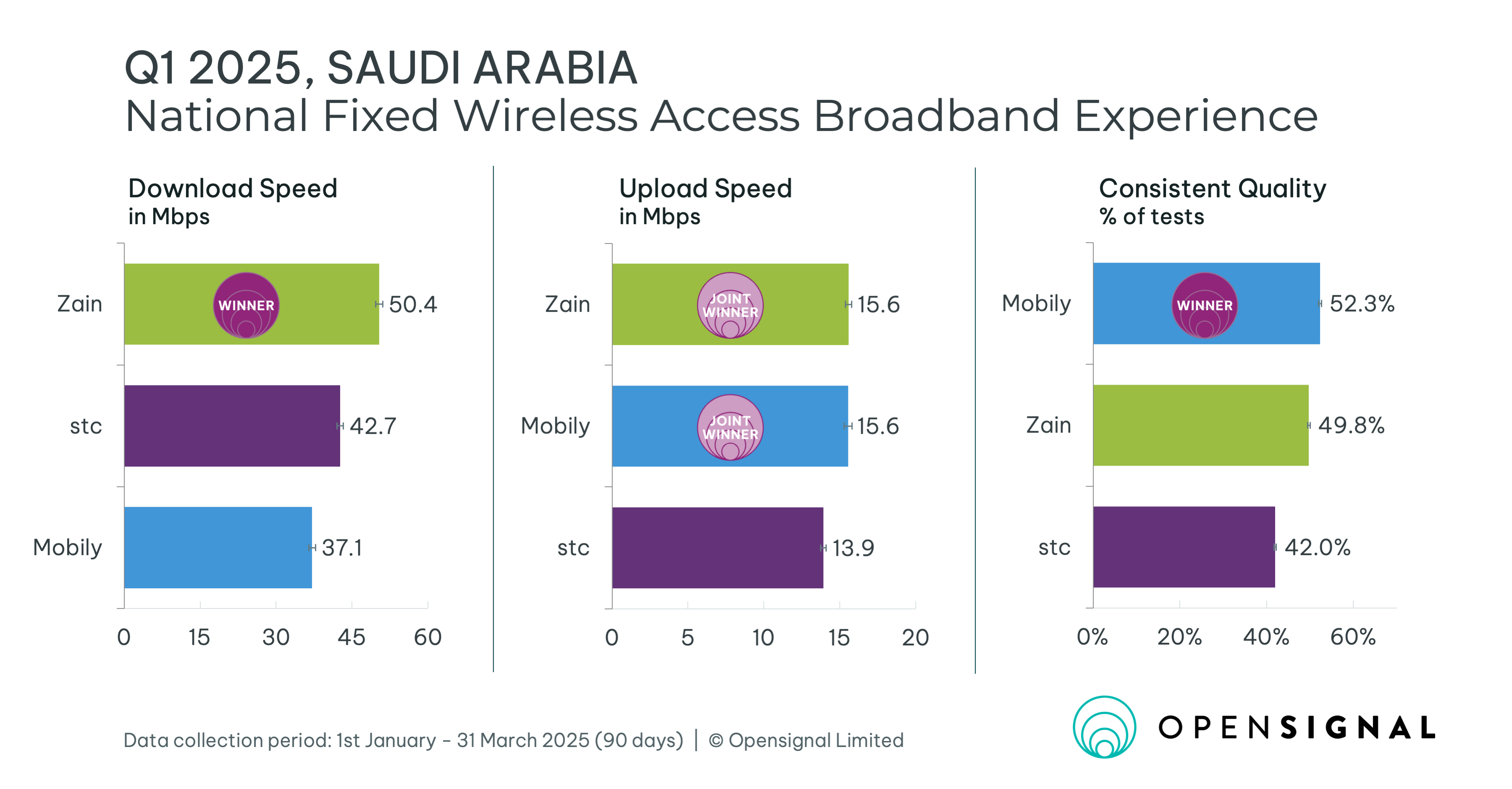
Zain wins on Download Speed across Saudi Arabia – as our users on the provider observe the fastest average download speeds among the competing FWA services. Zain’s subscribers can, therefore, on average, expect to finish large downloads, OS updates or UHD video buffering noticeably quicker than customers on the other two FWA networks (Zain’s speed is 18% faster than stc and 36% faster than Mobily).
Zain and Mobily share the lead for Upload Speed, offering the best average upstream experience on FWA across Saudi Arabia. Users on Mobily or Zain can send large files, back up photos or share their stream of live video with a bit more headroom than stc users (having speeds around 12% above those on stc).
Across Saudi Arabia, Mobily’s service does best on Consistent Quality – which assesses if the connection is good enough to perform most common everyday use cases for an individual user. With a score of 52.3%, Mobily’s FWA service meets the minimum thresholds in over half of user tests, just a few percentage points ahead of experience our users see on Zain’s service with its 49.8%. Both Mobily and Zain, in turn, are substantially ahead of stc's 42%.
Infrastructure rollout and future investment
stc boasts the widest fixed and mobile geographic reach among Saudi Arabia’s telecom operators and has steadily expanded its 5G network since its commercial launch in 2019. According to stc's 2024 annual report, the provider had achieved 54.7% population coverage with 5G, and commissioned 661 new 5G sites, bringing the total number to 8,993. Most impressively, over 8,035 of these sites are connected via fiber. Stc continues to build on this momentum: in March 2025, it announced a new phase of expansion, aiming to expand its 5G services in over 75 cities across the Kingdom. This, together with the 100MHz of additional C-band band spectrum it recently acquired, puts stc in a strong position to build on its dominant 5G FWA market offering. Stc has reported numerous 5G standalone access (5G SA) network demonstrations, but is still on the path of enabling 5G SA network wide – citing it as part of its vision for 5G expansion.
Mobily entered the FWA market with an already extensive fixed-line presence. FWA today plays a central role in Mobily’s fixed broadband strategy — expansion of which the company labelled as its key achievement in its 2024 annual report, with the intention of seeking differentiation of its service through “competitive pricing, attractive promotions and superior customer service”. Mobily’s 5G network is urban focused – Mobily boasts that its network reaches 87% of the population in the Kingdom’s seven largest cities. Mobily recently acquired 120MHz of additional spectrum in the 700MHz and 3800MHz bands for SAR 9.4 billion (approximately USD 2.5 billion) – which can be used to strengthen its FWA product in the cities where Mobily already has built out infrastructure. Mobily says 5G SA is on its network-modernisation roadmap, but has yet to announce a firm launch date.
Zain, unlike stc and Mobily, has historically lacked a substantial fixed-line footprint, with no large-scale fiber or DSL infrastructure. As a result, the operator used the arrival of 5G as a strategic entry point into the home broadband market via wireless. Zain’s initial 5G rollout was concentrated in major urban centers, giving it more limited reach than its rivals, but the company has since stepped up its investment to close the gap. In 2023, Zain announced a capital investment of SAR 1.6 billion (approximately USD 427 million) to expand its 5G network to 122 cities and 7,000+ sites, with a strong focus on scaling capacity to support the rising demand for FWA. In Zain’s 2024 annual report, the operator stated it has since made a significant CAPEX investment of USD 396 million, aimed at expanding 5G network coverage and enhancing 4G LTE capacity. By the end of 2024 Zain’s coverage extended to 66 cities across the Kingdom – a smaller reach than its competitors. Zain’s decision not to acquire additional C-band spectrum in the November 2024 auction suggests the operator still has room to expand its 5G footprint in urban areas, without an immediate need to address congestion within its existing coverage. Zain has already activated 5G standalone access as part of its 2024 BSS overhaul, marking a live SA launch on its network
How user experience on FWA varies across Saudi Arabia
In this analysis, we use Opensignal’s Consistent Quality metric to delve into the FWA experience across our users in Saudi Arabia. The metric assesses if the connection is good enough to perform most common everyday use cases for an individual user. This metric looks at whether a single device, once connected, gets good enough performance for activities like watching HD videos, video calls, or online gaming — at any time of day. It's measured as a percentage of tests that exceed quality thresholds for download and upload throughput speeds, latency, jitter, packet loss, and time to first byte.
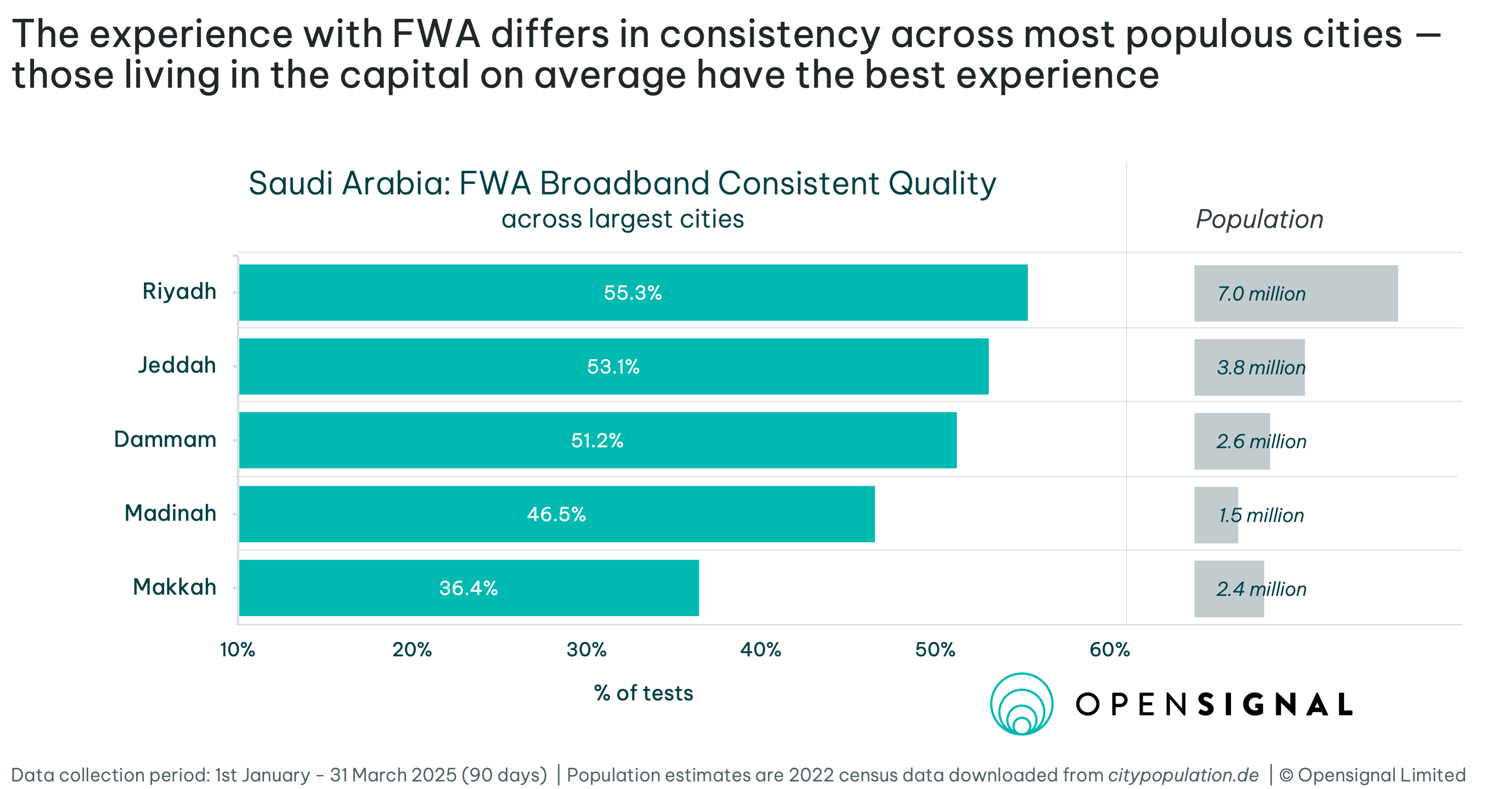
FWA performance across Saudi Arabia’s five most populous cities shows significant variation, with residents of the capital enjoying the most consistent experience. In Riyadh, 55.3% of user tests met the consistent quality threshold, the highest among the listed cities. Jeddah follows with 53.1%, while Dammam ranks third at 51.2%. Al Madinah, with 46.5%, shows slightly lower consistency levels. Mecca records the lowest performance, with just 36.4% of tests meeting the quality criteria — highlighting a significant gap in user experience compared to the capital.
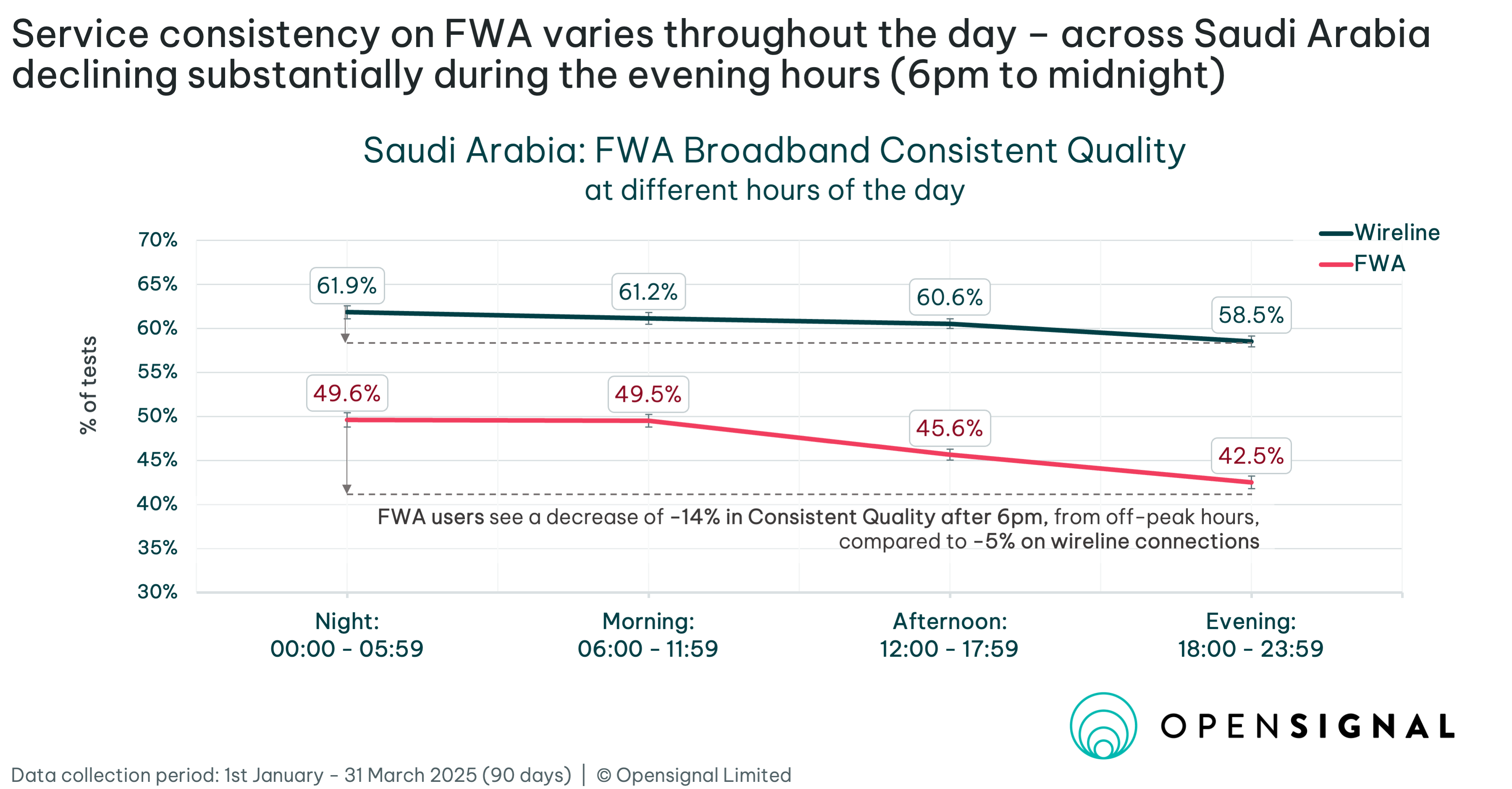
FWA service consistency in Saudi Arabia varies significantly throughout the day, with noticeable evening slowdowns. During off-peak hours — night (49.6%) and morning (49.5%) — Consistent Quality remains steady. However, performance dips in the afternoon (45.6%) and drops further in the evening (42.5%), when the demand is at its peak in the Kingdom. This represents a 14% decrease in Consistent Quality during the evening hours (6pm to midnight) compared to off-peak periods, highlighting the impact of network congestion on user experience. The fluctuations on wireline service are far less significant — declining at most by 5% in the equivalent comparison of night to evening periods. Our data suggests that evening congestion on FWA impacts all providers — but a user’s geographic location typically plays a significant role in how much service quality varies.
Broadband Consistent Quality across urban areas
Below, we provide a geographic breakdown of results collected across several of Saudi Arabia’s largest cities, underpinning some of the earlier findings presented in our analysis. This level of detail reveals variations in user experience — not only between operators, but also across different districts within individual cities.
More from Opensignal
Opensignal is committed to advancing mobile connectivity through our reporting. Please read our other publications on Saudi Arabia, including the recently published Mobile Network Experience Report (February 2025), or reach out to us to learn more about what we can offer. Subscribe to our newsletter at the bottom of the page to stay up to date.
Definitions
Consistent Quality
Broadband Consistent Quality measures how often a network, from the perspective of a single device once connectivity is established, meets the requirements for common applications. Broadband Consistent Quality uses six key performance indicators: download and upload throughput, latency, jitter, packet loss, and time to first byte, setting thresholds appropriate for individual rather than multiple device usage. Metrics represent the percentage of users’ tests meeting these performance thresholds to support activities like watching HD video, completing group video calls, and gaming across all hours of the day.
Download Speed
Measured in Mbps, Broadband Download Speed represents the typical everyday speeds a user experiences across a provider’s network.
Upload Speed
Measured in Mbps, Broadband Upload Speed measures the average upload speeds for each internet service provider observed by our users across their fixed networks. Typically, upload speeds are slower than download speeds, but this often depends on the technology used for broadband connections.
Opensignal Limited retains ownership of this insight including all intellectual property rights, data, content, graphs & analysis. Reports and insights produced by Opensignal Limited may not be quoted, reproduced, distributed, published for any commercial purpose (including use in advertisements or other promotional content) without prior written consent. Journalists are encouraged to quote information included in Opensignal reports and insights provided they include clear source attribution. For more information, contact [email protected].
