


In December 2025, Sweden will wave goodbye to 3G. All four of the country’s operators are phasing out the once work-horse mobile technology. Shutting down 3G will allow them to free up capacity and spectrum to improve users’ 4G and 5G experience, while also improving energy efficiency.
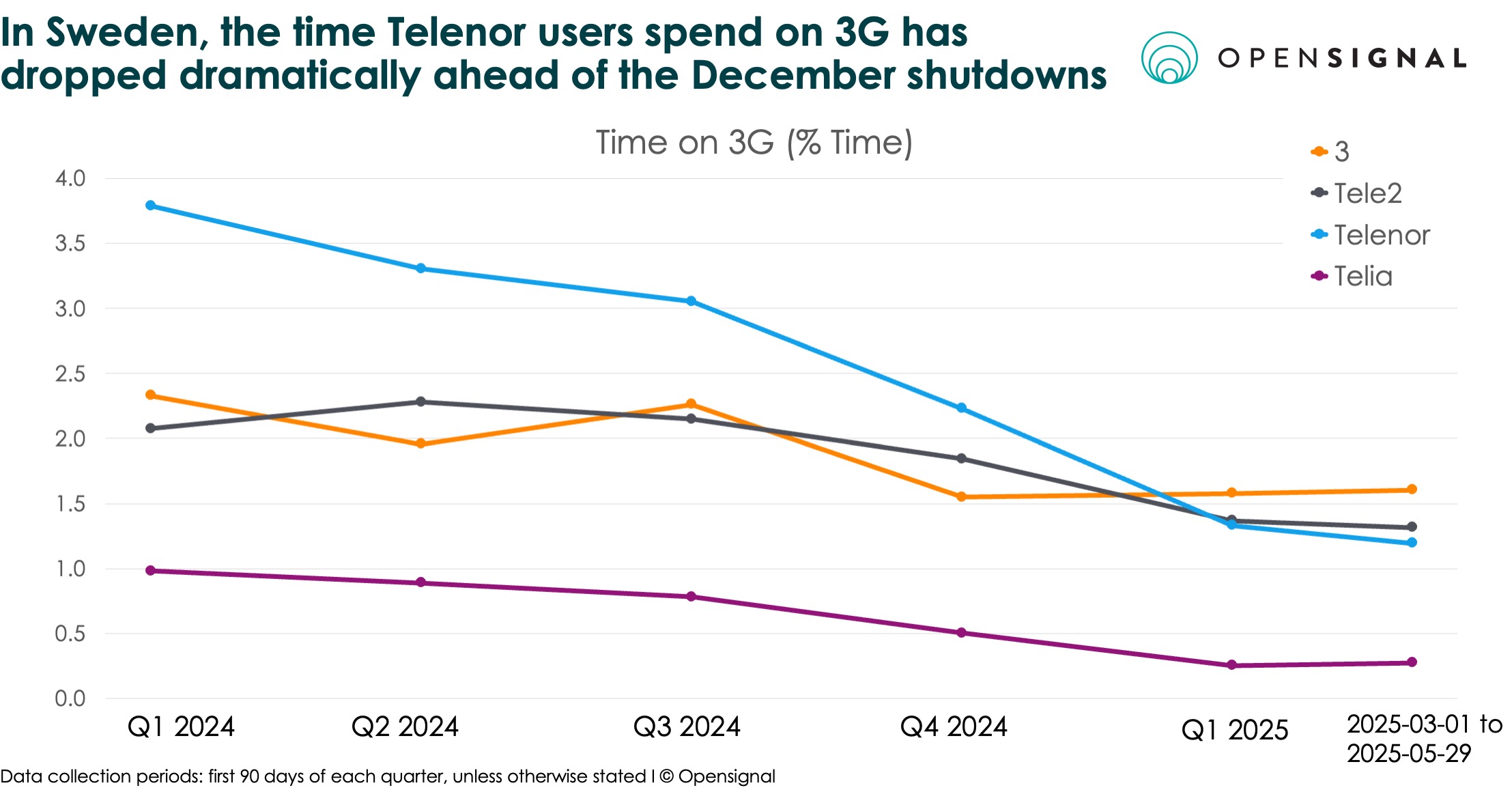
With less than half a year to complete this difficult task, the question is who's winning the 3G sunset race? In this piece, Opensignal takes a look at Swedish operators’ recent progress in the form of Time on 3G — the proportion of time our users spend with a 3G connection. This matters as the less 3G is being used prior to switch-off, the easier the transition will be for customers. In addition, all else being equal, the less time users spend on 3G the better, given the superior mobile experience they see on 4G and 5G.
Key findings:
- Telenor’s Time on 3G score has dropped to less than a third of that seen in Q1 2024. As a result, Telenor is now roughly level with Tele2 for this measure of the mobile experience.
- However, Telia appears furthest ahead in terms of 3G switch-off. Telia users now spend less than 0.3% of their time on 3G, compared to the 1% seen back in Q1 2024.
- Users on 3 are also spending less time on 3G than in the first three quarters of 2024. However, Time on 3G for 3 appears to be on a slight upward trend.
- Time on 3G varies significantly across Sweden, with our regional analysis showing hotspots for users on 3 in the middle of the country and for Tele2 users in the south.

The degree to which our users rely on 3G changes greatly depending on their location and their choice of operator — hinting at operators’ different 3G shutdown strategies.
For example, our users on 3 in Gävleborg spend 5.6% of their time connected to 3G, compared to 1.8% and 1.1% for those on Telenor and Telia, while users on 3 in the same region spend less than 0.1% of their time on 3G. Similarly, Time on 3G in Blekinge, our Tele2 users spend 5% of their time on 3G, compared to virtually zero for their counterparts on Telia and 1.3-1.8% for those on other operators’ networks.
Other läns (counties), where there is a three percentage point or more difference between the highest and the lowest Time on 3G scores for operators are: Uppsala, Västmanland, Dalarna, Jönköping and Västerbotten.
Time on 3G is relatively high across three out of four operators in Norrbotten, the most northern of Sweden’s läns, with scores in the range of 2.4-2.7%, with the notable exception of Telia.
While Telia’s nationally low Time on 3G is reflected regionally, it is relatively high in Södermanland, Kronoberg and Jönköping, with scores of 0.9-1.1%.
Ahead of the curve
Sweden is part of a general rush to retire 3G and 2G networks — the Global Mobile Suppliers Association (GSA) predicted in December 2024 that the number of 3G switch-offs globally will hit a peak this year (27, up from 23 in 2024). 3G has been fully retired in quite a few European countries already, including Germany, Finland and Greece.
Despite both 2G and 3G still being in use in Sweden, our Swedish users spent the fifth smallest amount of time on these older technologies in Europe — only behind other Nordic countries and the Netherlands — according to this piece we published back in December 2024. This implies that compared to many other European countries, Sweden is in a great position to shut down its legacy networks.
How the industry is lending a helping hand: the Byt Nät Nu campaign
Another factor that is making Sweden’s shutdowns easier is the Byt Nät Nu (Change Network Now) information campaign. This is being run by the Swedish tech industry and employers' organization TechSverige, together with mobile operators Tele2, Telenor, Telia and 3. Such a coordinated network shutdown campaign is rare and other markets/operators may benefit from adopting a similar approach. Campaigns like Byt Nät Nu are vital, given the need to encourage as many consumers and businesses to upgrade to 4G and 5G devices, sims and mobile plans prior to the switchoffs.
 The Byt Nät Nu campaign is providing Swedish stakeholders with the information they need to avoid being affected by the country’s upcoming 2G and 3G shutdowns, in the form of FAQs, articles and even podcasts.
Engagement with consumers and businesses is especially important if operators are shutting down both 2G and 3G. This is because when these legacy networks are gone, the only way to make non-over-the-top voice calls — including calls to the emergency services — will be via Voice over LTE (VoLTE), which is not supported by some older 4G devices.
According to the Byt Nät Nu campaign, 2G coverage will be maintained nationwide until 2G networks are switched off — which will occur in 2025 for most operators. Telia plans to shut down its 2G network at the end of 2027, to help make the transition for customers as smooth as possible — taking into account the fact that many devices that aren’t phones, such as alarm and heating systems, and even farming equipment — rely on 2G for connectivity.
What’s next for Sweden’s mobile future?
Looking ahead, Sweden is increasingly embracing 5G. According to the PTS, over four in 10 mobile subscriptions were 5G in 2024 and in the same year, 5G networks accounted for just under a fifth of all mobile data traffic in the country, up 150% from 2023.
Look out for more analysis from us on the Swedish mobile experience. And why not stay up-to-date with all the Opensignal insights and articles by signing up to our newsletter?
Opensignal Limited retains ownership of this insight including all intellectual property rights, data, content, graphs & analysis. Reports and insights produced by Opensignal Limited may not be quoted, reproduced, distributed, published for any commercial purpose (including use in advertisements or other promotional content) without prior written consent. Journalists are encouraged to quote information included in Opensignal reports and insights provided they include clear source attribution. For more information, contact [email protected].
