


The merger between Vodafone and Three-UK is a seismic shift in the U.K.’s mobile landscape. It’s a welcome move — the U.K. currently lags behind many other countries when it comes to network experience.
Since the merger's completion in late May 2025, the newly formed VodafoneThree has recently outlined a rough timetable for network integration aimed at improving users’ experience and has provided details on how it will enable roaming between the two networks. The first step? A 20% average boost in 4G speeds for some Three-UK and SMARTY users, made possible through spectrum sharing.
However, speed isn’t everything when it comes to mobile experience. In this piece, we compare Vodafone’s and Three-UK’s performance in terms of 4G Download Speed and Excellent Consistent Quality — a far more holistic measure of the user experience — looking both nationally and regionally.
But will the merger deliver what users actually need?
Key findings:
- A 4G speed boost is already redundant: VodafoneThree has promised a 20% 4G speed boost for Three-UK users, but nationally Opensignal’s Three-UK users already see faster 4G download speeds than those on Vodafone – scoring 30.1Mbps vs Vodafone’s 28.6Mbps.
- Consistency is what matters. Three-UK users lag Vodafone and the national average on the consistency of their experience. Three-UK scores just 68.6% for Excellent Consistent Quality, compared to 75.4% for Vodafone and 72.5% for the national average.
- Londoners stand to gain the most. In London, Vodafone outperforms Three-UK by nearly 20% on 4G speed and 15% on Excellent Consistent Quality, making the capital the region with the biggest potential benefit from integration.
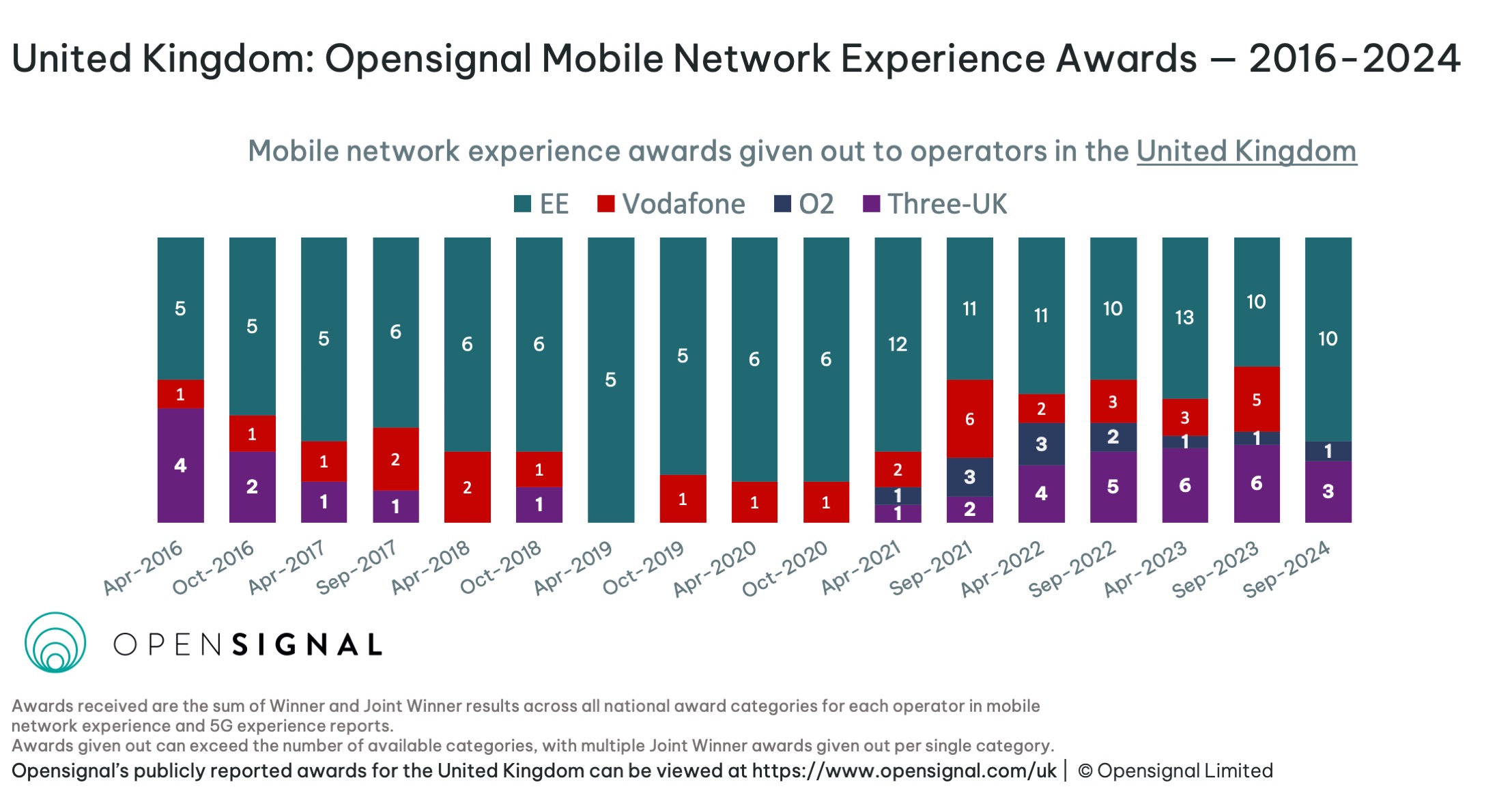
- More profound changes are still to come. The introduction of roaming between the two networks, deployment of their combined spectrum holdings (pending divestments to VMO2) and VodafoneThree’s promised rapid roll-out of 5G standalone access coverage could cause a massive shift in which operators claim Opensignal’s mobile experience awards in future U.K. mobile network experience reports.
Three-UK users would benefit more from consistency improvements than faster 4G speeds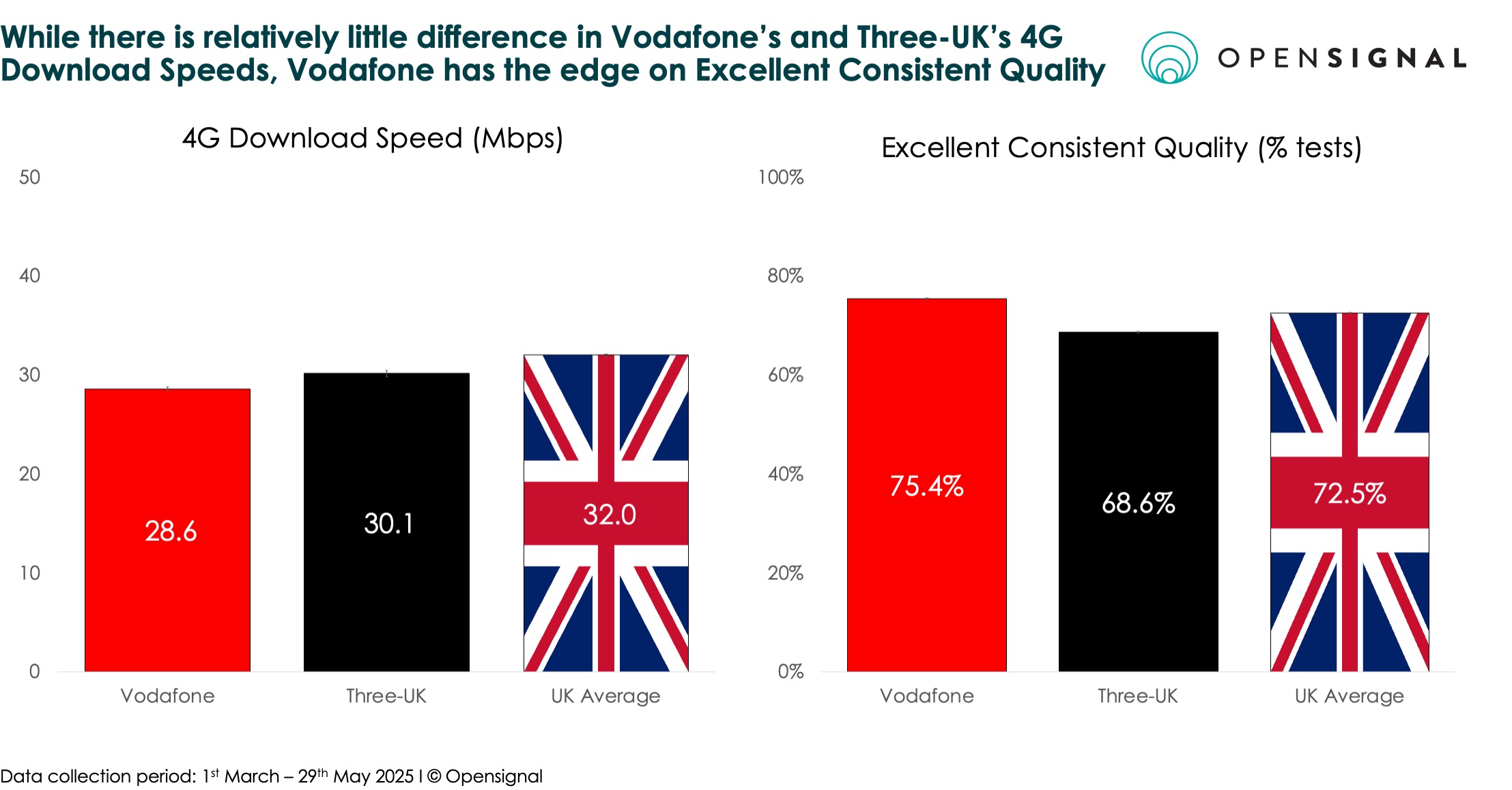
On June 12, VodafoneThree announced that “Within just two weeks, through sharing of combined spectrum, 7 million Three and SMARTY customers will receive a 20% average speed boost on 4G.” However, nationally our users on Three-UK already see faster average 4G download speeds than those on Vodafone.
Where Three-UK users need more of a boost is in terms of the consistency of their experience when carrying out more demanding tasks, like video calling or uploading an image to social media. This is measured by Opensignal’s Excellent Consistent Quality metric — which, like 4G Download Speed, is a key part of the Global Network Excellence Index. Only 68.6% of Three-UK users’ tests meet the required thresholds for Excellent Consistent Quality, compared to 75.4% for those on Vodafone and the 72.5% seen nationally.
The fact that Three-UK users’ Excellent Consistent Quality is below the national average implies that bringing it into line with Vodafone’s would help boost the national figure and the U.K.’s standing internationally. Improvements are sorely needed, as according to Opensignal’s Global Network Excellence Index in Q1 2025 the U.K. placed 48th globally, behind Vietnam and Uruguay. In addition, the U.K. has historically performed poorly compared to its G7 peers in terms of reliability and average 5G download speeds.
Londoners see faster 4G download speeds and have a more consistent experience with Vodafone than on Three-UK

While nationally Three-UK users typically see faster average 4G download speeds than their Vodafone counterparts, this isn’t the case everywhere in the U.K. In London, Vodafone’s 4G Download Speed score is nearly 20% faster than Three-UK’s, while in the North West, it’s about 13% faster. These are areas where Three-UK users could especially benefit from spectrum sharing.
When comparing the two operators, London is also a Vodafone stronghold for Excellent Consistent Quality, with Vodafone users seeing 15.1% higher scores than their Three-UK counterparts. There are a further four regions where our Vodafone users’ Excellent Consistent Quality scores are 10-15% better than those on Three-UK — Wales, Northern Ireland, the North East and the South West. In addition, the gap for Eastern England is just under the 10% threshold in favour of Vodafone, while our users in Scotland see the smallest difference — of 3.7%.
The Vodafone/Three-UK merger could reshape the U.K.’s mobile experience landscape
More changes are in store for Vodafone and Three-UK customers. VodafoneThree initially said that it plans to enable automatic roaming across both networks “within a few months”, allowing users to always connect to the best available signal.
This will be achieved through Multi-Operator Core Network (MOCN) technology. VodafoneThree later stated that as of June 2025 it has enabled MOCN at 24 masts and that this will rise by a further 10,000 by March 2026. It also says that 95% of the MOCN rollout will be complete in six years — with a focus on the areas that will most benefit from it — and it will be completed in eight years’ time (2033). It attributes the length of the roll-out to the fact that some masts will need new hardware. This means that the introduction of roaming between the two networks will be a much longer process than VodafoneThree first implied. In addition, whether or not users quickly see improvements will depend heavily on whether their area has been prioritised for MOCN roll-out.
Previous Opensignal analysis showed that fully combining Vodafone’s and Three-UK’s networks would boost their users’ Coverage Experience to the point where it would tie with O2, the winner of the Coverage Experience award in our latest U.K. Mobile Network Experience report. However, this does not factor in any future rationalisation of the two networks by VodafoneThree.
Other key upcoming developments include:
- VodafoneThree intends to rapidly roll-out 5G standalone (SA) access coverage.
- Vodafone and Three combining their spectrum assets (subject to Ofcom approval) and Vodafone selling some spectrum to Virgin Media O2 — 78.8 MHz (also subject to Ofcom approval).
Together, these changes could reshape the U.K.’s mobile market, shifting the balance of Opensignal’s experience awards. For example, EE has long dominated our national award tables due to its broad spectrum holdings. Similarly, Three-UK’s strong 5G speed performance stems from its large 3.4–3.8GHz holdings acquired in the UK Broadband deal.
Globally, we’ve seen that greater spectrum bandwidth translates into better real-world performance, particularly for video streaming and multiplayer gaming. In Singapore, our recent findings show that users on 5G standalone networks consistently enjoy a better experience than those on non-standalone setups.
Closing the gap could lift the whole market
We’ve shown that Three-UK often has the edge over Vodafone on 4G Download Speed, but is lagging behind on Excellent Consistent Quality. Addressing this gap, for example through further integration between Vodafone’s and Three-UK’s networks — would help boost the UK’s overall mobile experience, which currently is behind that seen in many other countries. Londoners, in particular, stand to gain the most if Three-UK’s service quality is brought up to Vodafone’s standards through network integration. However, given the length of the MOCN roll-out and the fact that it will be many years before both the Vodafone and Three networks are running on the same core network, it will be a long time before our Vodafone and Three users’ mobile experience is fully aligned.
Interested in European mobile M&A?
If you’re interested in European mobile M&A, do check out my two recent blogs on this topic. The first focuses on the drivers behind the current push for more consolidation, while my second blog looks at how well the lessons learned from the Vodafone/Three-UK merger could be applied to five other European markets. Look for more on the Vodafone/Three-UK merger and European M&A from us in the coming months and please sign up to our newsletter so you don’t miss out on the latest analysis from Opensignal.
This article was updated on 30th June 2025 to correct the amount of spectrum that VMO2 will purchase from Vodafone (subject to Ofcom approval) from 83.8MHz to 78.8MHz, in light of this announcement from Virgin Media O2.
Opensignal Limited retains ownership of this insight including all intellectual property rights, data, content, graphs & analysis. Reports and insights produced by Opensignal Limited may not be quoted, reproduced, distributed, published for any commercial purpose (including use in advertisements or other promotional content) without prior written consent. Journalists are encouraged to quote information included in Opensignal reports and insights provided they include clear source attribution. For more information, contact [email protected].
