


Berlin hosted the first-ever GITEX Europe this May, and I had the privilege of moderating a panel and leading fireside chats throughout the event. The halls were buzzing with AI startups, national pavilions, and investors all focused on the technologies reshaping Europe’s digital future.
AI was the headline theme, but the conversations stretched far beyond that, touching on green tech, smart cities, sovereign cloud, and global investment. From what I saw on stage and in the corridors, it’s clear that Europe is serious about charting its own path in digital infrastructure and innovation.
In this post, I reflect on three key sessions that I have moderated.
Beyond spectrum: Europe’s competitive frontier
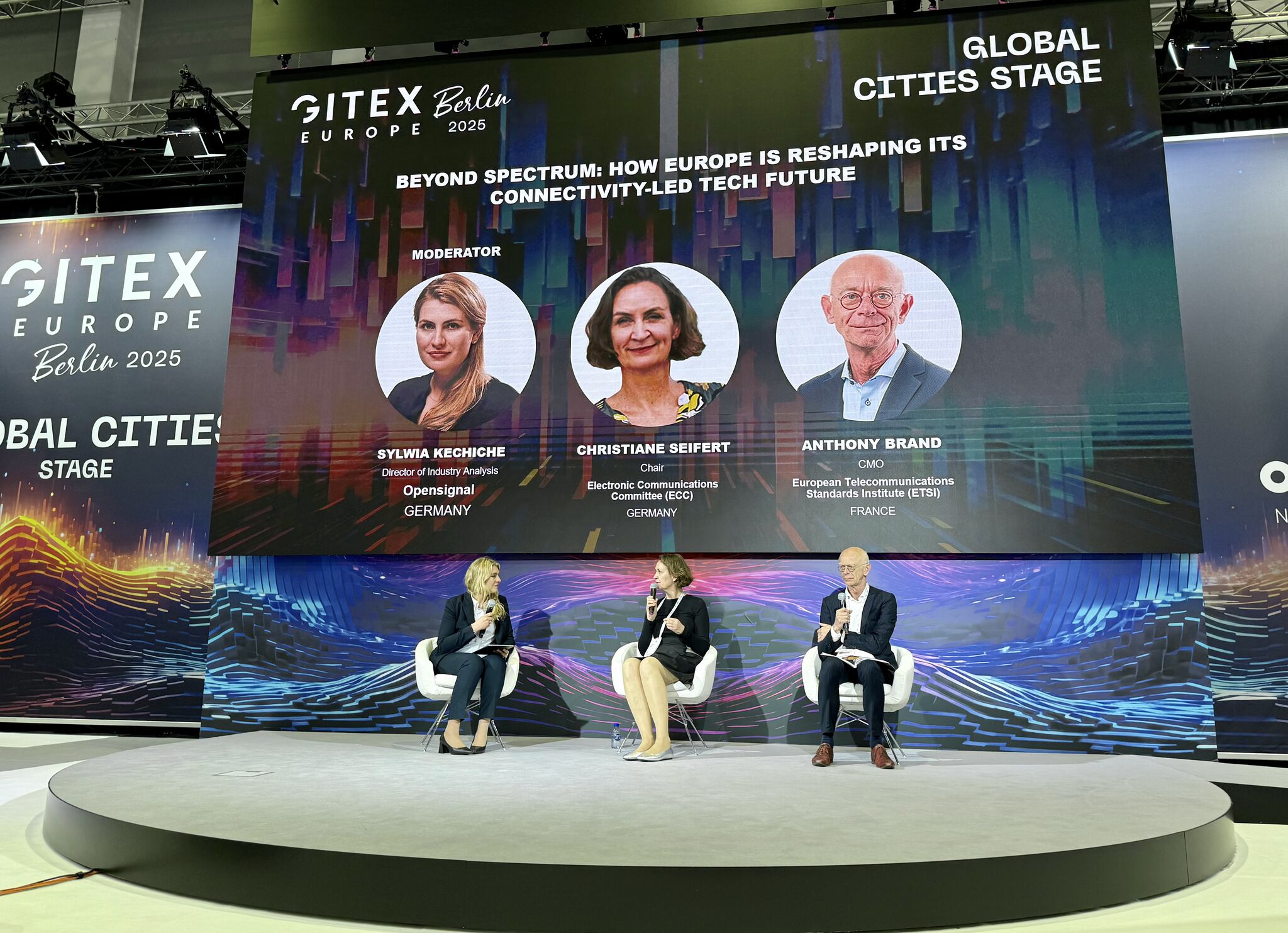
I recently had the pleasure of joining Ton Brand (ETSI) and Chris Seifert (ECC) for a panel discussion on the evolution of spectrum strategy in Europe. The focus is shifting—from spectrum availability to spectrum optimization—as we prepare for 6G.
Most European countries have now assigned the two key 5G pioneer bands—the 3.5 GHz band and the 700 MHz band—but spectrum strategy is evolving. The focus is shifting from availability to optimization as we look ahead to 6G and beyond.
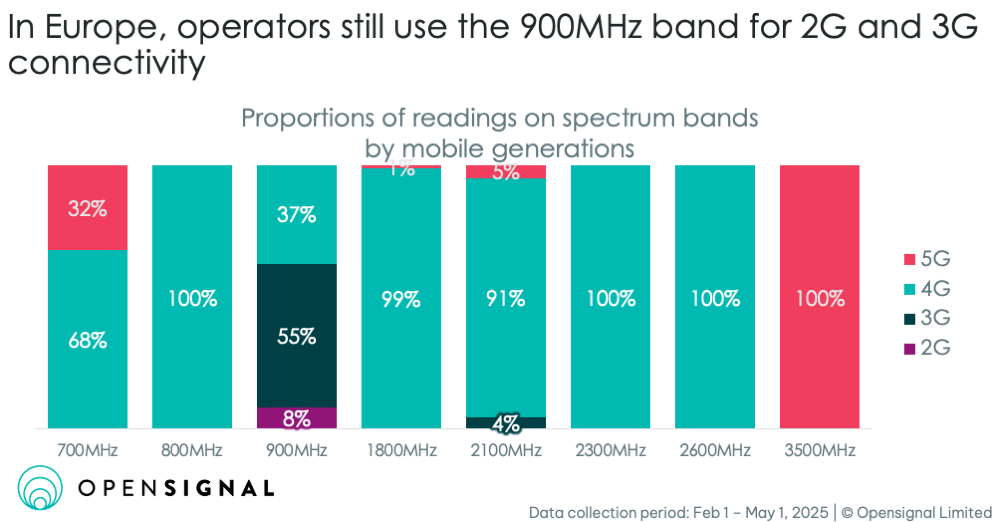
One key insight: legacy networks are still deeply embedded, particularly in the 900MHz band.
According to Opensignal data (see chart below), European operators continue to use:
- 900 MHz for all four mobile generations: 37% for 4G, 55% for 3G, and 8% for 2G
- 2100 MHz, a legacy 3G band, is still heavily used for 4G (91%) with residual 3G traffic (4%)
Bands like 800 MHz, 1800 MHz, 2300 MHz, 2600 MHz, and 3500 MHz are now dedicated to 4G and 5G
Both ECC and ETSI are central to Europe’s connectivity journey, but first, let’s unpack the acronyms:
- ECC (Electronic Communications Committee), part of CEPT (European Conference of Postal and Telecommunications Administrations), develops policies for electronic communications in Europe, aligning with broader European and international regulations.
- ETSI (European Telecommunications Standards Institute) is a key standardization body that develops and tests global ICT standards, supporting innovation across systems, applications, and services.
Together, we discussed how these organizations shape the region’s digital future beyond spectrum allocation through technical standards, regulatory frameworks, and cross-border collaboration.
My key takeaways from the discussion:
- Close the 5G coverage gap, especially in underserved areas and transport corridors. Harmonized spectrum exists—it’s time to use it.
- Coordinate legacy network sunsets, ensuring continuity for essential M2M/IoT services like eCall.
- Balance competing demands in the upper 6 GHz band, where mobile, Wi-Fi, and satellite players all stake a claim.
- Guide investment towards 6G. CEPT has published its 6G roadmap (link here), with an EU roadmap also on the way.
- Contribute to harmonization and standards development—ensuring Europe stays at the table as next-gen technologies take shape.
Bottom line: Spectrum may not make headlines, but it underpins everything—from real-world network quality to Europe’s ambition to lead in AI, cloud, and next-gen connectivity.
Sovereign Cloud: A blueprint for resilience
The fireside chat with Ana-Maria Stefan (Delos Cloud) underscored how geopolitical risks are reshaping Europe’s approach to cloud infrastructure. Germany’s Sovereign Cloud model—a partnership between SAP, Microsoft, and Arvato Systems —is building a highly secure, regulator-approved platform with German data residency, cleared staff, and audit trails.
A few points stood out:
- Sovereignty isn't just about control—it's also about flexibility. Delos Cloud supports both proprietary and open-source solutions.
- Sovereign cloud is a prerequisite for public sector AI adoption, ensuring compliance, transparency, and trust.
- Europe still lacks a cohesive industrial strategy for digital sovereignty. Targeted investment and faster public-private collaboration are needed.
To scale AI responsibly, Europe must build trust-first infrastructure. This isn’t about shutting out global tech giants—it’s about rewriting the terms of engagement to protect European values and regulatory autonomy.
EuroHPC: supercomputing with purpose
In conversation with René Chatwel (EuroHPC) and Dr. Bastian Koller (HLRS), we explored how Europe is building a sovereign high-performance computing (HPC) backbone, with a €7B budget to fuel AI-native supercomputing.
What’s exciting?
- Cloud-native HPC: On-demand, containerized models lower entry barriers for startups and SMEs.
- Beyond research: National centers are now solving real-world challenges in climate, manufacturing, and health.
- Hybrid AI-HPC workflows are paving the way for quantum-augmented systems by 2030.
But accessibility remains a challenge. Training, guidance, and cloud-native tooling will be essential to unlock the full value of these investments.
Final take: beyond demos
One thing stood out: telecom operators were notably absent. But they shouldn’t miss the signal. Europe’s connectivity story is changing. It’s no longer just about speed and coverage but also enabling digital sovereignty, cloud transformation, and AI readiness. Some telecom operators are already trying to get on board, eyeing a share of the €20 billion in EC funding earmarked for building a network of AI factories. Whether these efforts will pay off remains to be seen.
If you want to keep up-to-date with all the Opensignal insights and articles, sign up for our newsletter
Opensignal Limited retains ownership of this insight including all intellectual property rights, data, content, graphs & analysis. Reports and insights produced by Opensignal Limited may not be quoted, reproduced, distributed, published for any commercial purpose (including use in advertisements or other promotional content) without prior written consent. Journalists are encouraged to quote information included in Opensignal reports and insights provided they include clear source attribution. For more information, contact [email protected].
