


Europe’s 5G landscape is on a rollercoaster. New Opensignal data reveals that Poland's average 5G Download Speed surged by over 57%, while Sweden experienced a decline of 23%. What’s behind these opposing trends? The answer lies deep in the airwaves: spectrum availability and use. Opensignal has investigated this topic through the lens of how certain European operators are evolving their 5G deployments across different spectrum bands — and what it means for mobile users.
Key findings:
- A mixed picture of 5G Download Speed in Europe: Some European markets have seen substantial year-on-year increases in 5G Download Speed in 2025, while others have experienced declines.
- 3.5GHz band drives 5G speed: Increases in the use of the 3.5GHz spectrum strongly correlate with higher 5G Download Speed.
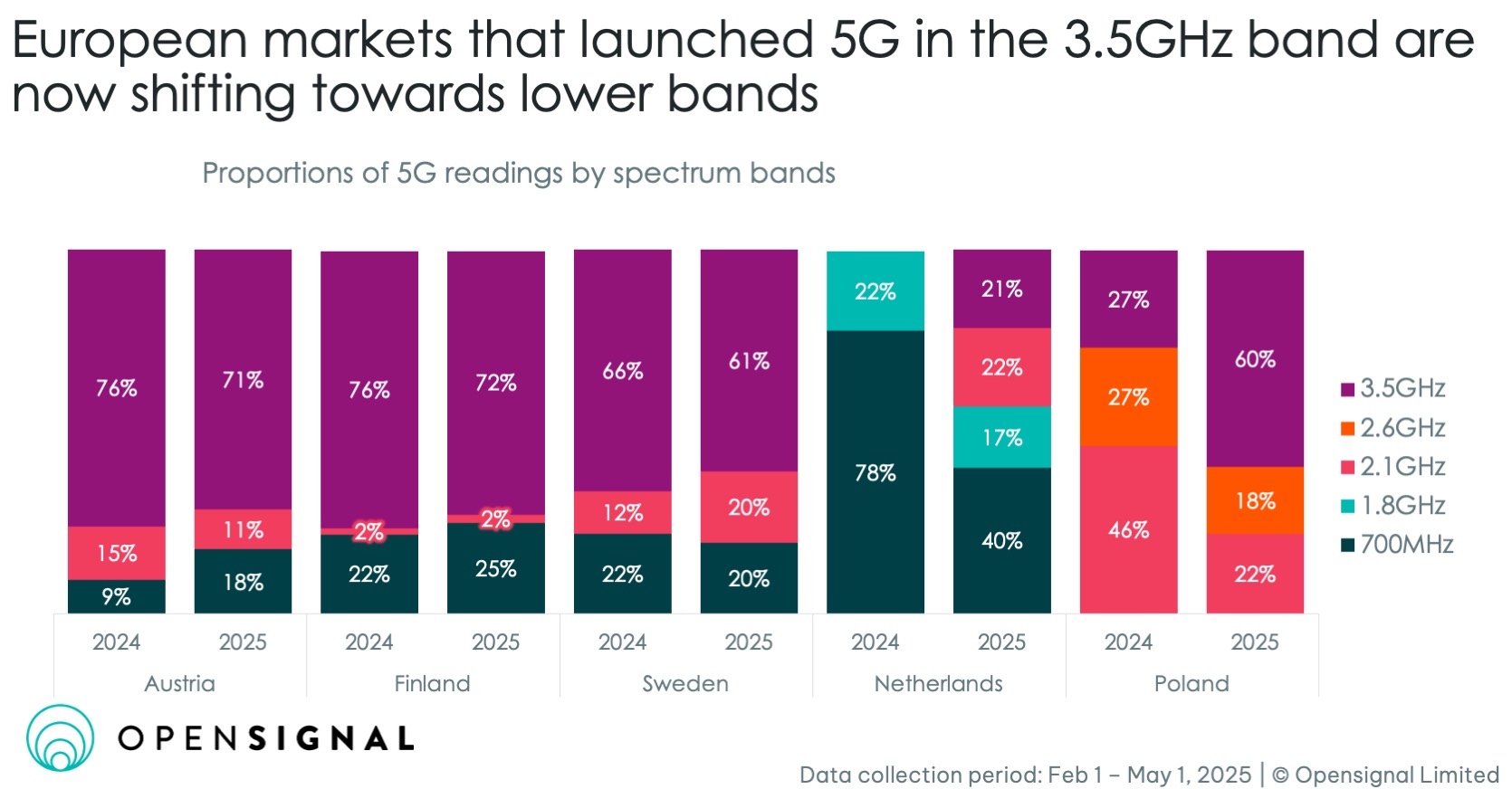
- Addition of lower bands: We observe growing use of lower bands such as 700MHz and 2.1GHz in 5G deployments in mature markets like Sweden and Austria. Operators are likely using these bands as 5G usage grows and more capacity is needed, as well as to meet coverage commitments.
Europe’s 5G ups and downs: disparities in 5G Download Speed trends across markets
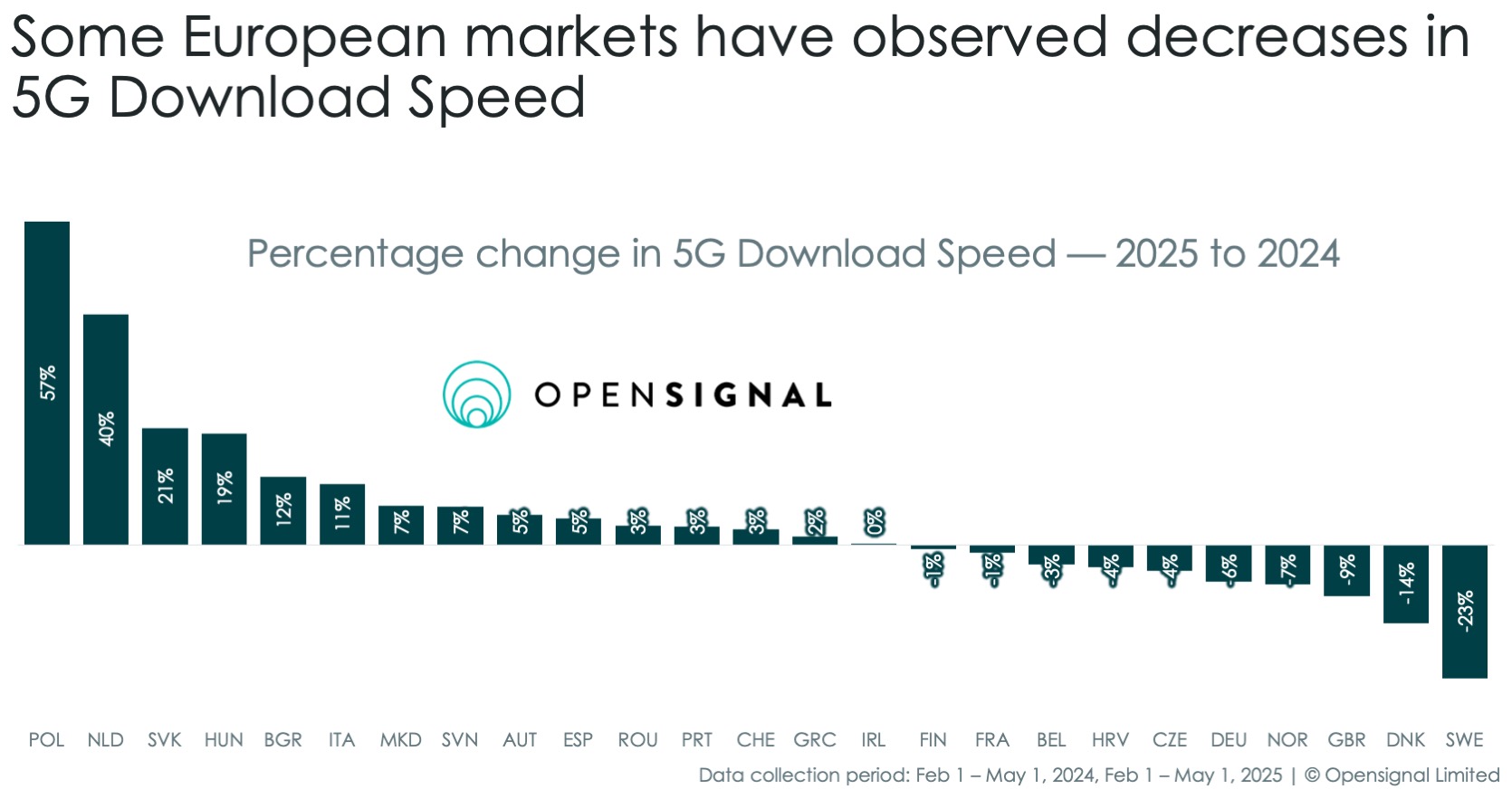
Opensignal data highlights significant differences in 5G performance across Europe. Users in Poland and the Netherlands are enjoying year-on-year improvements in average 5G Download Speed. In contrast, markets like Sweden and Denmark have seen declines over the same period.
One possible reason for declining speeds is increased network congestion. As more users adopt 5G and more devices connect, networks experience performance degradation. Scaling physical infrastructure — such as small cells, fiber backhaul, or network densification — is capital-intensive and slow-moving, requiring long-term investment. It may not be possible in many cases due to local planning and other infrastructure regulations. However, shifts in spectrum usage are also key drivers of the evolving mobile experience across Europe.
Evolving at different speeds
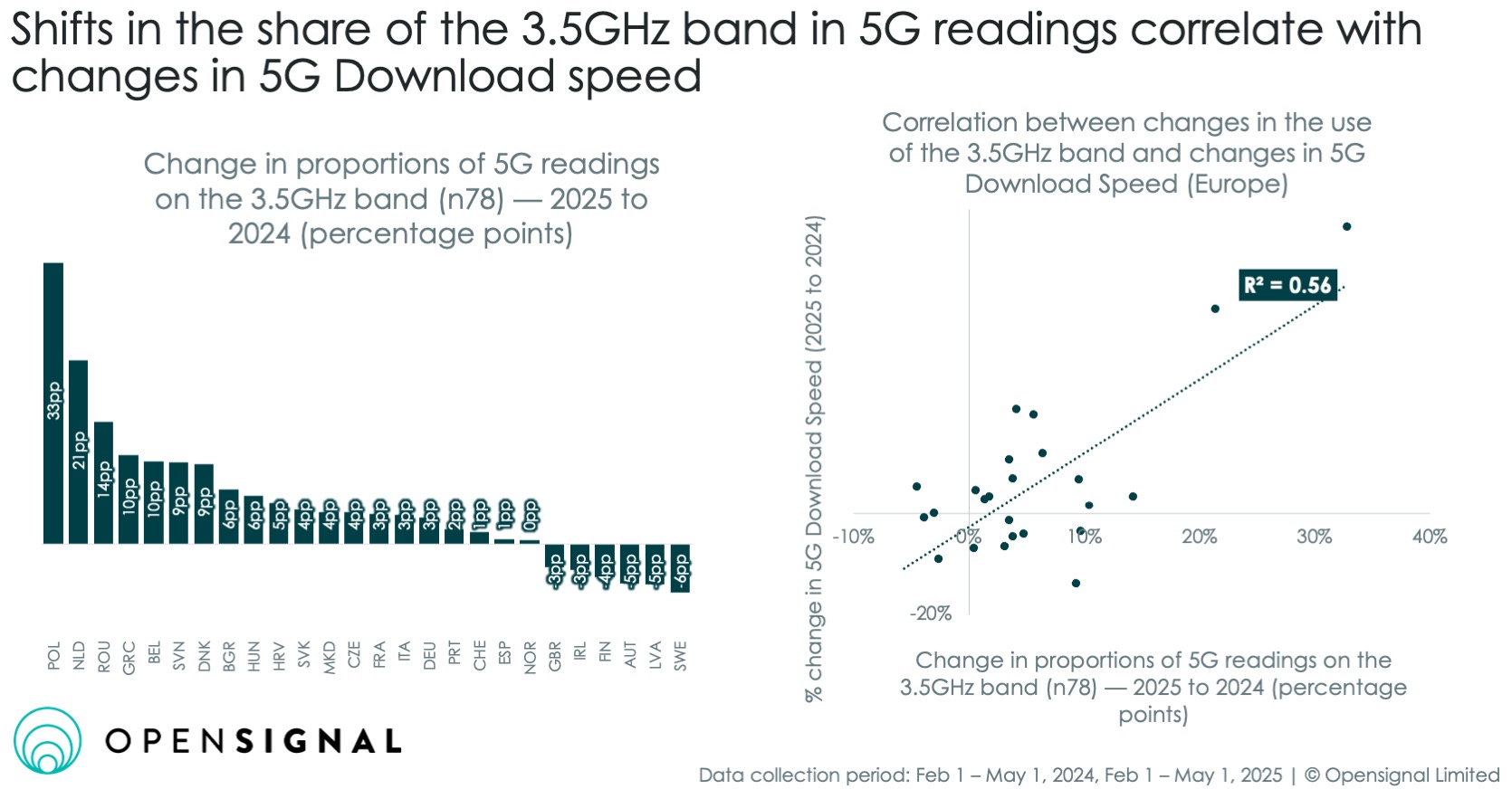
The 3.5GHz band is widely seen as ideal for 5G because it balances capacity and coverage — making it well-suited for enhanced mobile broadband services. Our analysis shows a strong correlation (r² = 0.56) between increased 3.5GHz usage and improvements in average 5G download speed.
Commercial 5G deployments began in Europe in 2019, with Switzerland leading the way. However, the assignment of 5G spectrum licenses and subsequent roll-outs have varied widely across markets. Some regulators delayed 3.5GHz assignments — partly due to the COVID-19 pandemic — and these delays impacted performance outcomes.
In Poland and the Netherlands, recent 3.5GHz spectrum auctions (held in 2023 and 2024, respectively) have enabled operators to fully utilize this key band, replacing their earlier reliance on lower-frequency bands — such as 700MHz and 1.8GHz (Netherlands), or 2.1GHz and 2.6GHz (Poland). This shift has driven significant performance improvements.
Poland's earlier reliance on lower bands had constrained 5G performance. Since gaining access to the 3.5GHz band, Polish operators have quickly ramped up its usage — unlocking much faster speeds. Both Poland and the Netherlands, which saw large increases in 5G Download Speed, have recently made a notable transition to 3.5GHz in their deployments.
A different focus: enhanced coverage and lower bands
So why is 5G Download Speed decreasing in some of Europe’s most advanced markets?
Mature 5G markets like Austria, Finland, and Sweden were early adopters of the 3.5GHz band. But these countries are now increasingly using additional bands, to fulfil 5G growth capacity needs and for rural coverage due to investment commitments derived from assignments. The 700MHz band is especially well-suited for this, and European regulators often attach rural coverage obligations to licenses in this band. However, 700 MHz provides indoors and continued 5G use in urban areas as well.
- In Sweden, the regulator (Swedish Post and Telecom Authority) has linked Telia’s 700MHz licence with a requirement to provide at least 10Mbps in designated areas. Additionally, we’ve observed growing use of the 2.1GHz band for 5G. This band offers wider coverage than higher frequencies, while still providing reasonable capacity.
- In Austria, the Regulatory Authority for Broadcasting and Telecommunications (RTR) required operators to meet rural coverage obligations as part of the 2020 multi-band auction. By 2027, Austrian operators must cover 80% of 2,100 underserved communities with minimum download speeds of 30Mbps, and ensure at least 10Mbps along 90% of federal and state roads.
- Similarly, Finland’s Traficom agency tied 700MHz spectrum licenses to strict coverage mandates. Operators must provide service to at least 99% of the Finnish population — including key roads and railways in the country.
A glance into the future: what is needed for 6G in Europe?

Currently, European operators rely heavily on the 3.5GHz band for 5G — which also delivers the fastest average speeds. Around one third of readings on the 700MHz band come from 5G services. Other bands see less frequent 5G use — however, this will change.
Our data has demonstrated that wider bandwidths available to 5G mobile users boost 5G Download Speed. And this is a trend we’ve seen for years now, as each new mobile network generation of mobile technology has introduced significantly wider channel bandwidths. These expansions have enabled mobile networks to increase their overall capacity and transmit more data simultaneously.
As 5G evolves, operators will increasingly refarm lower frequencies to boost capacity using multi-band carrier aggregation. Sweden is one of the examples where the 2.1GHz band seems to be gaining prominence in 5G roll-outs. This evolving spectrum landscape underscores a strategic balance between speed and coverage, as operators adapt their deployments to meet growing demands.
Ongoing discussions around spectrum for 6G are already underway in Europe, with major implications for how the next generation of connectivity will be deployed and integrated across industries, devices, and public infrastructure. 6G is expected to push channel bandwidths even further, starting with 200MHz per operator. The upper portion of the 6GHz band (6.425–7.125 GHz) has been identified for IMT in some regions during WRC-23, including Europe. While national regulators have discretion over this band, the EU’s Radio Spectrum Policy Group has recently proposed from 380 to 700MHz of 6GHz to be used for mobile services.
As 6G research transitions into real-world trials and eventual rollout, Opensignal will closely track the evolution of network readiness, user experience, and spectrum efficiency across European markets.
For deeper insights on spectrum and connectivity trends, subscribe to Opensignal’s newsletter. To read more about spectrum, visit GSMA Spectrum.
Opensignal Limited retains ownership of this insight including all intellectual property rights, data, content, graphs & analysis. Reports and insights produced by Opensignal Limited may not be quoted, reproduced, distributed, published for any commercial purpose (including use in advertisements or other promotional content) without prior written consent. Journalists are encouraged to quote information included in Opensignal reports and insights provided they include clear source attribution. For more information, contact [email protected].
