


In less than three years time, the South African regulator ICASA plans to initiate the switch off of the nations’ 2G and 3G networks to free up spectrum for 4G and 5G. However, our smartphone users still spend up to 10% of their time on these legacy networks, and millions of older devices remain in active use. Operators face significant challenges in migrating users — from affordability constraints to security concerns driving the use of basic phones. While Cell C and MTN have improved their Consistent Quality (CQ) scores substantially, indicating a better user experience, the path to a smooth shutdown will likely require coordinated regulatory and commercial actions.
In this report, we examine South Africa’s mobile networks over a two-year period, from early 2023 to the start of 2025, focusing on our users’ CQ and Availability scores to capture the real-life user experience and highlight improvements in mobile network performance.
Key Findings
- Legacy network usage remains high. Our South African smartphone users still spend up to 10% of their time connected to 2G and 3G underscoring the challenge ahead for nationwide 4G/5G adoption.
- Cell C and MTN’s CQ scores show the most improvement. Cell C has seen a 15 percentage point improvement in CQ over 18 months, while MTN’s score grew 11 points. Cell C has used its virtualized RAN model to focus on core network investment and user experience — allowing it to keep up with its larger rivals in terms of CQ.
- 4G handset discounts may fall short. While operators have introduced more affordable 4G devices, millions of 3G users remain, prompting concerns that regulatory support may be needed to accelerate the migration.
Legacy shutdown countdown: are South Africa’s operators ready?
South Africa’s plan to sunset its 2G and 3G networks by 2027 promises to unlock valuable spectrum for expanding 4G and 5G services. However, the path to shutdown is far from straightforward — and the readiness of both operators and users remains in question.
The deadline for sunsetting 2G & 3G has already been pushed back at operators’ request. Further delays may be unavoidable, particularly for Cell C, which no longer operates its own radio network and instead relies on roaming agreements with MTN and Vodacom. MTN aims to close down its 3G network in 2026. In contrast, Vodacom is likely to switch-off 2G first, as it transitions its 3G voice users over to VoLTE.
One of the biggest challenges to 2G network sunsetting is the large number of cheap 2G-only handsets being used by consumers in an effort to avoid crime. Theft of mobile phones — frequently involving the threat of violence — are all-too common in some areas, meaning people will not carry smartphones on the street for fear of becoming a target. Some of these users will have more than one phone, with mobile device penetration topping 300% in South Africa according to GSMA Intelligence, equating to over three devices per mobile user. So users may have a smartphone for use at home or the office – but many remain reliant on the cheaper 2G devices while out and about.
To accelerate migration, ICASA introduced a ban in 2024 prohibiting the approval and activation of new 2G and 3G only devices in 2024. This mirrors similar policy interventions seen in parts of the Middle East, where regulators have successfully reduced the numbers of 2G and 3G devices by banning imports.
Operators have begun launching commercial initiatives to bridge the gap:
- Vodacom now offers 4G cloud-based feature phones – which allows for some smartphone functionality – for less than US$14.
- MTN plans to sell subsidized 4G smartphones – but only to selected prepaid customers.
These measures will have some effect, but whether they will be in time for South Africa’s imminent 2G and 3G network sunsetting remains a major concern.
3G dependence persists
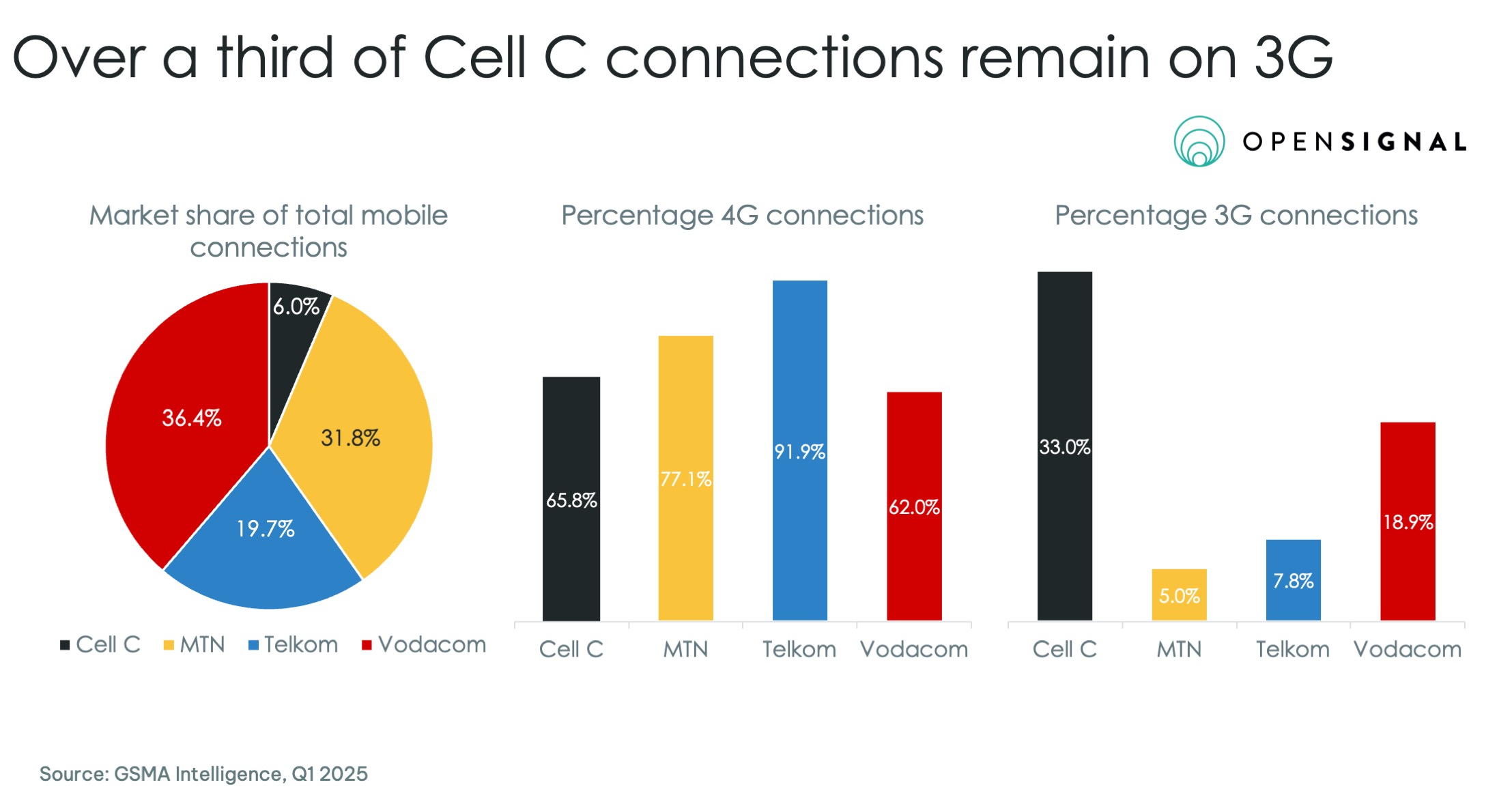
Vodacom and MTN lead the South African market, each commanding over 30% connections market share in Q1 2025. According to GSMA Intelligence, MTN had 77% of its total connections on 4G networks — with the majority of the remainder on 5G. In contrast, less than two-thirds of Vodacom’s total connections are on 4G, with rest split between 5G and 3G.
Cell C, which has not yet launched 5G commercially, has a similar proportion of total connections on 4G but close to a third of its connections remain on 3G. It will be a challenge for the operator to migrate its 3G customers to 4G before the end of 2027.
But connection data only tells part of the story.
Legacy networks are still in use
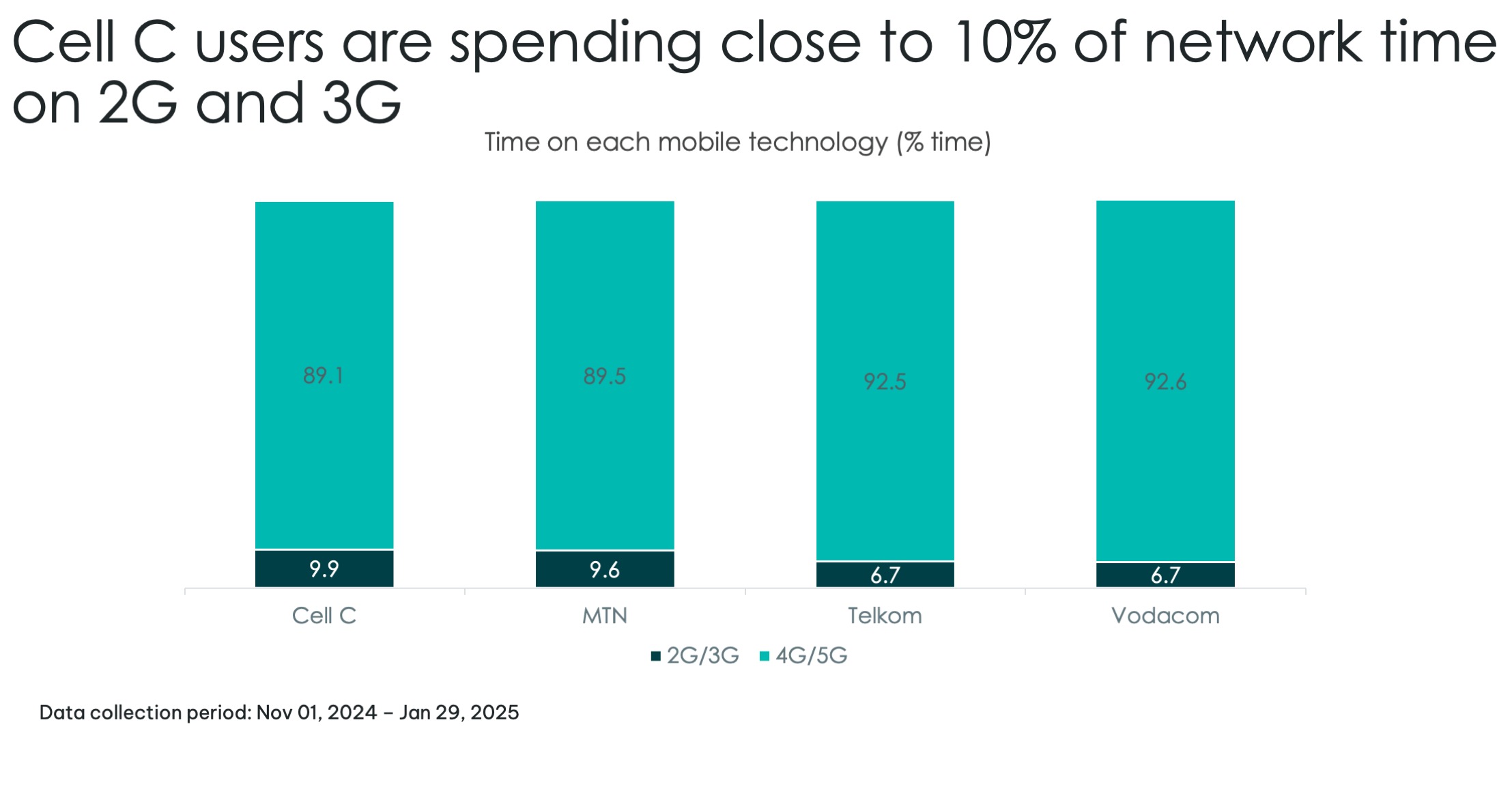
In South Africa, our smartphone users on Cell C and MTN still spend up to 10% of their time on legacy 2G and 3G networks. By comparison, usage of legacy networks drops to just under 7% for Telkom and Vodacom users. While over a third of Cell C’s connections are on 2G and 3G, our smartphone users are spending less time on these networks – meaning that the key challenge for South Africa’s operators is to reduce the use of 2G and 3G devices.
This time-based metric paints a clearer picture of the user experience than connection counts alone. While over a third of Cell C’s total connections remain on 2G or 3G, the actual user experience is shifting — with time spent on legacy networks slowly declining across all operators. Still, this lingering reliance raises important questions about South Africa’s readiness for a full legacy shutdown, especially among vulnerable or price-sensitive segments.
Cell C roaming strategy supports user experience
Since decommissioning its own radio network in 2023, Cell C has relied on national roaming agreements with both MTN and Vodacom. This virtualized RAN approach hasn’t negatively affected its performance – and may in fact help it improve its coverage and performance, since the operator is able to use parts of two different networks.
In our last South Africa Mobile Network Experience Report, published in August 2024, Cell C wins the Video Experience award outright, whilst claiming Joint Winner for Games Experience and Upload Speed Experience. The operator is also lauded as a Global Rising Star for Upload Speed and Video Experience in Opensignal’s Network Experience Awards 2025 and 2024.
Most notably, Cell C has shown the greatest improvement in Consistent Quality (CQ) — our metric that captures whether users can reliably complete common demanding tasks such as video calling or high-definition streaming. Cell C has not only kept up with its rivals in terms of CQ, but has seen the greatest growth (of over 15 percentage points) in this metric over our past four mobile network experience reports on the South African market. Cell C's CQ score improved the most – by 15 percentage points – while MTN's improved by 11 points over the 18 months since our August 2023 report. Vodacom's score improved by just under 8 percentage points, while Telkom's score improved by just under 7 points.
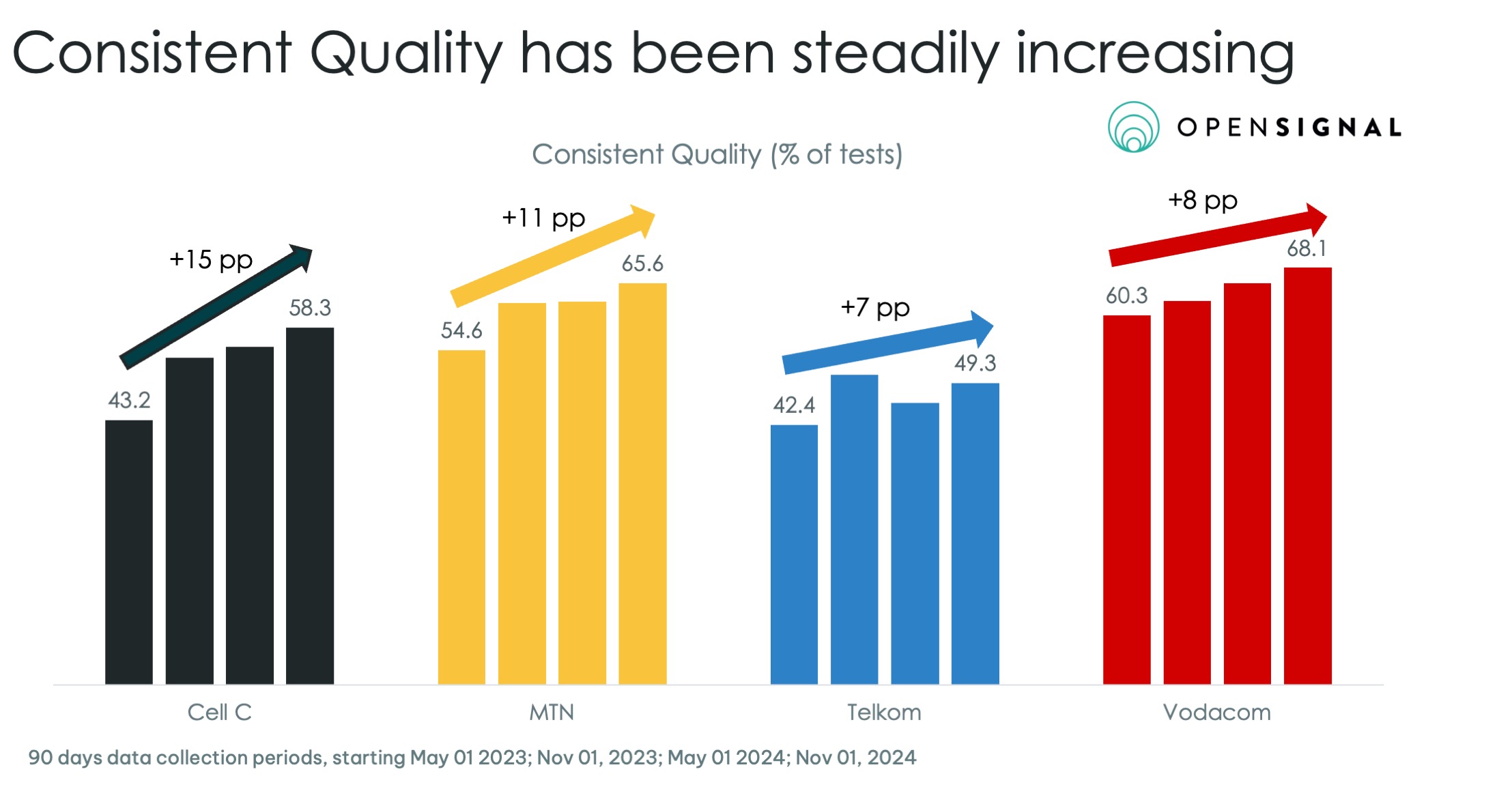
When trying to understand users' mobile experience, speed measurements are becoming less relevant. Operators that prioritize consistency and reliability in everyday usage will have a competitive edge — and Cell C’s gains demonstrate what’s possible, even without its own RAN.
Diverging network investment strategies
Operators are taking different approaches as they prepare for South Africa’s mobile future:
- Cell C's virtualized RAN model has allowed the operator the freedom to focus on upgrading its network core – with the company saying its shift to a virtualised network has enabled it to progress faster, innovate smarter, and focus on giving customers a reliable, quality connection. But the operator remains somewhat reliant on its larger rivals MTN and Vodacom in its efforts to migrate to 4G Multi-Operator Core Network (MOCN), and move its voice users over to VoLTE.
- MTN is currently prioritising its 4G network over 5G rollout, as it seeks to build network resilience, manage spectrum demands, and improve customer experience.
- Vodacom is more focused on 5G rollout – but this investment has yet to translate to any major improvement in our experience metrics, allowing its rivals to catch up.
South African mobile network experience continues to improve
In Opensignal’s Global Network Excellence Index, South Africa ranks 23rd among 73 large land area markets in Q1 2025– up two places since the previous report as its 4G/5G Availability, Consistent Quality, and 4G Download Speed scores improved.
The country now demonstrates overall Availability scores of over 98% on 3G, 4G or 5G networks — an encouraging sign that infrastructure upgrades are having real-world impact.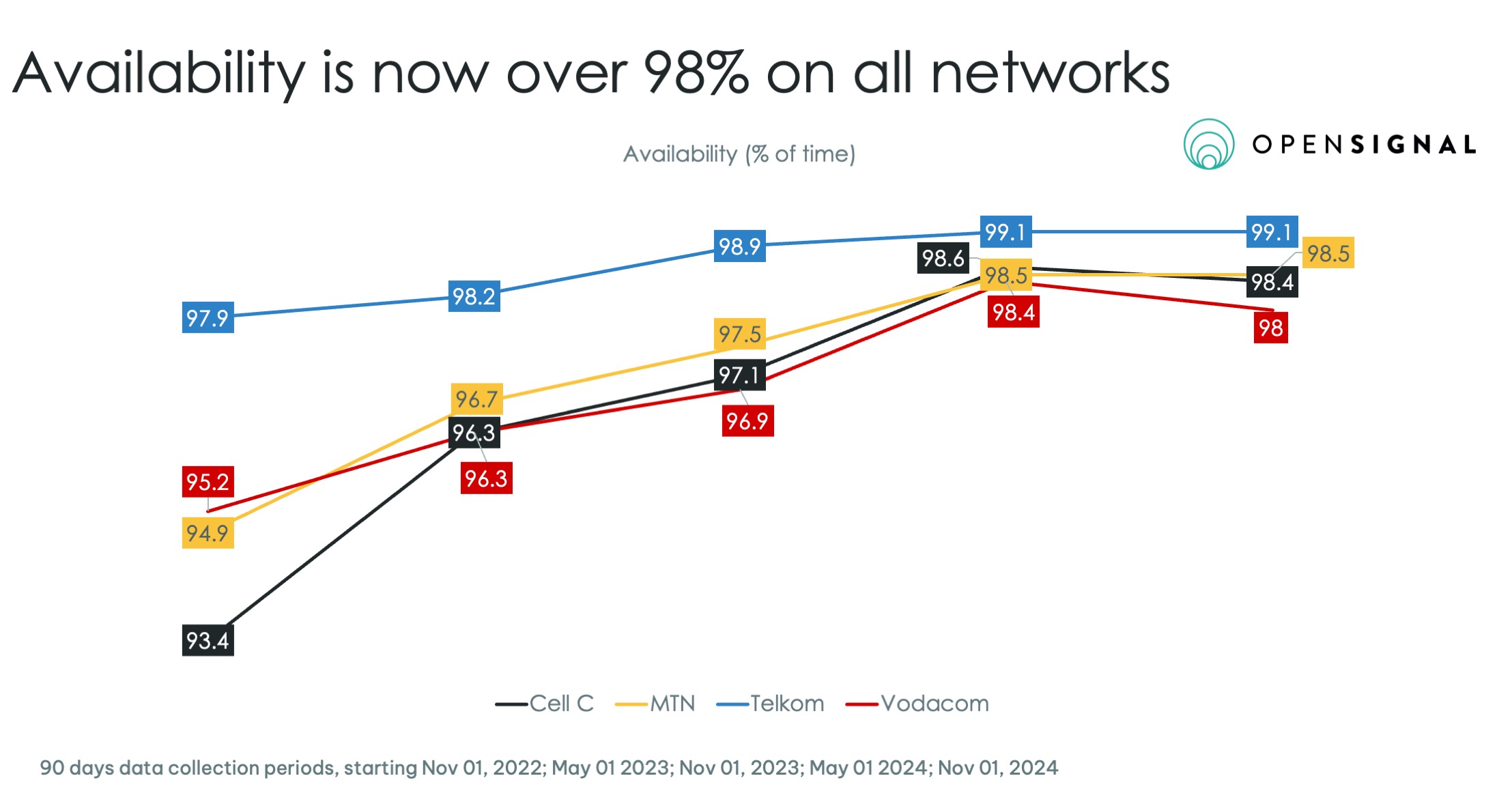
Looking ahead
Operators have made measurable progress, particularly in CQ and network availability — but uneven user migration and strategic differences across providers could delay full legacy network retirement. Opensignal will continue tracking network performance and user experience trends as the market evolves.
To learn about how the experience of our users varies between mobile operators, please read our most recent South African report.
For telecom operators and regulators looking to optimize mobile experiences under extreme demand, Opensignal’s ONX platform offers actionable insights.
Opensignal Limited retains ownership of this insight including all intellectual property rights, data, content, graphs & analysis. Reports and insights produced by Opensignal Limited may not be quoted, reproduced, distributed, published for any commercial purpose (including use in advertisements or other promotional content) without prior written consent. Journalists are encouraged to quote information included in Opensignal reports and insights provided they include clear source attribution. For more information, contact [email protected].
