


5G Standalone (SA) has been a major buzzword in the telecom industry for some time. Given the substantial investments required from Mobile Network Operators (MNOs), one must ask: is it truly worth it? Following our recent analysis of the 5G SA market in Singapore, we now turn our attention to Japan — one of the global frontrunners in 5G SA commercial rollouts.
In this insight, we examine the experience of our users on 5G SA networks in Japan, compared to 5G Non-Standalone (NSA). For operator-level comparisons, our analysis focuses on 5G SA performance on the au and SoftBank networks. While NTT Docomo has also launched 5G SA, it has deployed a small number of SA cells compared to au and SoftBank — which primarily use higher-frequency bands (sub-6 GHz and mmWave) — and so its 5G SA coverage is smaller. For this reason, NTT Docomo’s results are excluded from our operator-level comparisons. However, aggregated results comparing 5G SA and 5G NSA do include NTT Docomo’s data.
Key Findings:
- 5G SA outperforms 5G NSA across the board
Across all analyzed metrics, our users in Japan enjoy a superior mobile experience on 5G SA networks compared to Non-Standalone (NSA). - Faster speeds with 5G SA
In both download and upload metrics, Japanese users experience faster average speeds on 5G SA than on 5G NSA. - Lower latency improves user experience
5G SA networks exhibit a 25% reduction in 5G UDP latency compared to NSA, enhancing applications that require rapid responsiveness — such as gaming and video calls. - au leads over SoftBank in most 5G SA categories
Users on au’s network benefit from the fastest 5G SA speeds, lowest latency, and better quality in gaming and video streaming services compared to those on SoftBank’s network.
Quantifying the Impact of 5G SA Deployment in Japan

To quantify the uplift from the deployment of 5G SA infrastructure, we compared the aggregated scores for all three Japanese operators that have commercially launched 5G SA services to date — au, NTT Docomo, and SoftBank — with their respective aggregated 5G NSA scores. As of July 2025, Rakuten Mobile has not yet deployed 5G SA services, although it has conducted 5G SA tests in a virtualized environment.
Our data demonstrates that 5G SA represents a significant upgrade from 5G NSA, particularly in terms of speed and latency. Download speeds on 5G SA are approximately 1.7 times higher than on 5G NSA, while upload speeds are 1.5 times higher.
One of the key promises of 5G SA is lower latency — which translates to faster response times, enabling smoother and better performance for applications like video calls and mobile gaming. Our data confirms this advantage: 5G UDP Latency sees a notable improvement on SA networks, with average latency reduced by 25%. By eliminating the 4G backbone from the infrastructure, 5G SA enables faster latency and reduced lag for users. This results in a better overall user experience, especially for streaming and gaming. In our measurements, users experienced shorter initial delays when starting video streams on 5G SA compared to 5G NSA — meaning videos load more quickly on their phones.
Reliability Experience, which measures the ability of Opensignal users to connect to and successfully complete basic tasks on mobile networks, also shows clear improvements on 5G SA compared to 5G NSA.
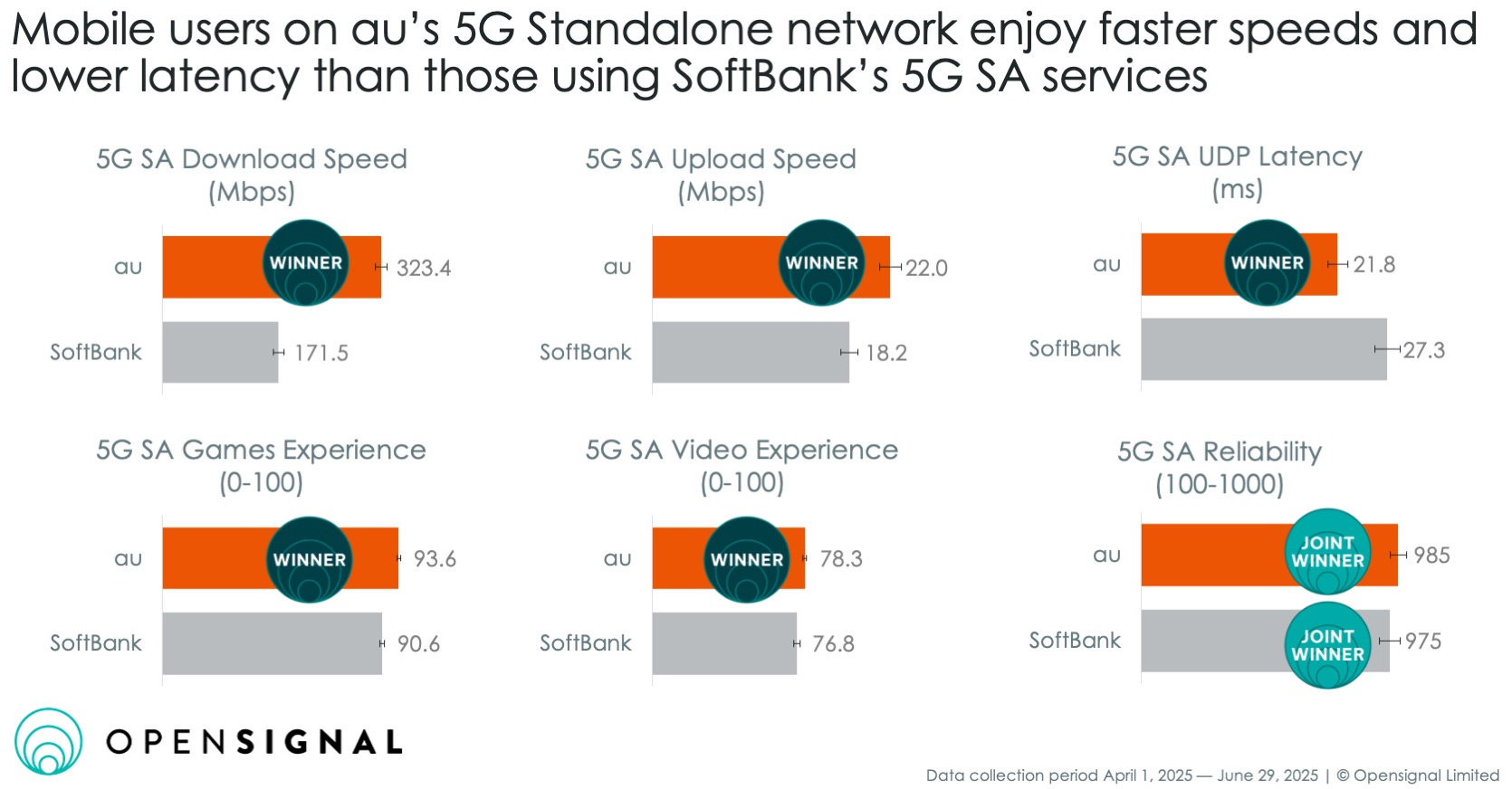
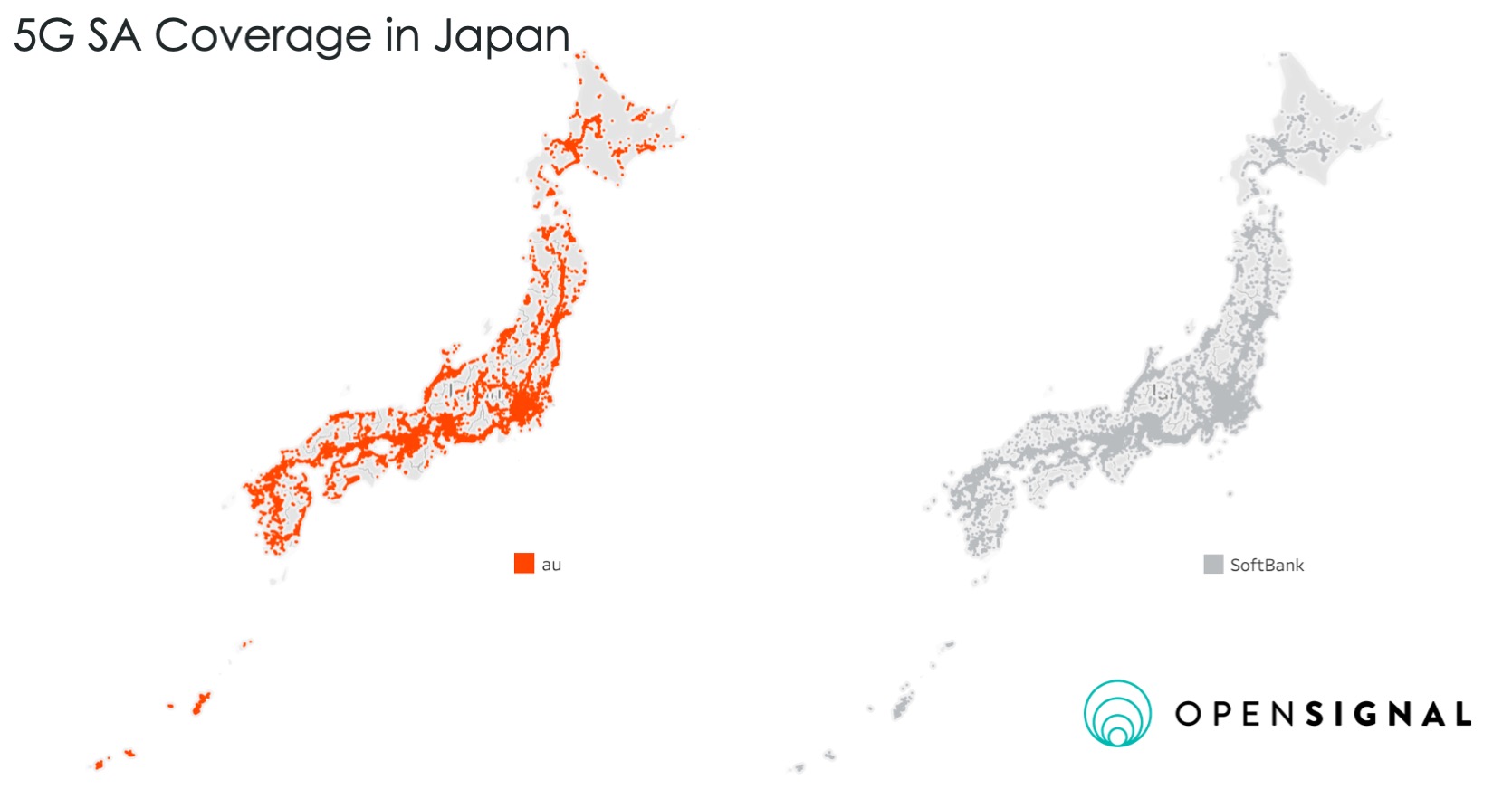
Across all metrics, au demonstrates superior performance on its 5G SA network — including faster speeds, lower latency, and higher scores for video and gaming experiences. The key to au’s advantage lies in its strategic deployment of Sub‑6 SA base stations.
In contrast, SoftBank has not yet reached the same level of performance across these key metrics, although it remains competitive in the market. When it comes to 5G SA Reliability Experience, both operators are in a statistical tie, indicating no significant difference in the reliability of their 5G SA services.
Beyond consumer experience: impact on enterprises
However, the benefits of 5G SA extend beyond enhancing consumer experiences. Japanese enterprises and the public sector have shown a great appetite for high-performing, resilient, programmable, and energy-efficient networks, with advanced capabilities such as network slicing. The rollout of private 5G SA networks is expected to boost the efficiency and performance of key vertical industries — such as automotive or manufacturing — supported by the use of mmWave alongside Sub-6 GHz bands.
Japan also holds a unique position on the global stage, as the country is pioneering a broader shift toward Open RAN. Several of its MNOs have already deployed open-technology solutions, a move that is expected to generate cost savings while fostering a more diverse supplier ecosystem. This, in turn, will accelerate the deployment of 5G SA infrastructure across Japan. Opensignal will continue to closely monitor the evolution of 5G SA in Japan and share further insights in our upcoming reports.
If you are interested in our recent analysis of Japan’s telecommunications market — check out our previous reports on mobile and fixed services. Please contact us if you are looking for a more custom approach to our 5G SA analysis. Subscribe to our newsletter to stay up to date!
Opensignal Limited retains ownership of this insight including all intellectual property rights, data, content, graphs & analysis. Reports and insights produced by Opensignal Limited may not be quoted, reproduced, distributed, published for any commercial purpose (including use in advertisements or other promotional content) without prior written consent. Journalists are encouraged to quote information included in Opensignal reports and insights provided they include clear source attribution. For more information, contact [email protected].
