


BAIT, Walmart’s MVNO, has captured millions of Mexican users with a value-first mobile experience. However, with rising wholesale costs, a changing regulatory backdrop, and no access to 5G, can its low-cost model continue to thrive?
In this report we:
- Examine BAIT’s mobile experience compared to its cost
- Explore regional trends and subscriber momentum
- Analyze the strategic implications of a potential Movistar acquisition
- Assess the risks posed by its dependence on Altán Redes and regulatory change
Key findings:
- BAIT offers "good enough" performance
While average download speeds lag behind the main mobile network operators (Telcel and AT&T), several core Opensignal metrics are within 10% of the main mobile network operators. - Lower pricing drives subscriber wins
BAIT delivers mobile data at less than half the cost per GB compared to Telcel and AT&T. This is a key factor in its high WPL (Wins per Loss) ratio and expanding user base. - Regional strength in southern Mexico
BAIT sees its strongest subscriber win rates in more price-sensitive areas like Chiapas. - Acquisition ambitions raise strategic risks
A merger with Movistar would increase BAIT’s scale, but would create challenges in aligning pricing models and customer expectations across two fundamentally different mobile experiences. - Dependency on Altán Redes is a double-edged sword
While Altán benefits from BAIT’s growth, retail ambitions or regulatory shifts could turn the partnership into competition — especially in the absence of 5G capability.
BAIT’s Market Entry: A Disruptor Emerges
When Walmart launched BAIT in 2020, it had a clear value proposition: low prices, “maximum speed coverage”, and integration with Walmart’s rewards ecosystem. Now in 2025, BAIT has delivered on its ambitions. BAIT now accounts for a large part of Mexico’s mobile subscribers, whether you measure with the official figures (8.4 million active lines as of March 2025), or the brand’s own claims (21.5 million consumers).
However, rising wholesale prices and a changing regulatory backdrop might spell trouble. Altán Redes — BAIT’s host network — recently released new wholesale pricing. This has forced BAIT to charge more for its services, eroding its value proposition. As costs rise, we assess whether its mobile offering remains “good enough” to keep and grow its user base.
Competitive where it counts
For a low-cost provider like BAIT, we are defining “good enough” as a strong mobile experience relative to its price. It does not mean offering a service on par with the main mobile network operators. The goal is to meet the needs of cost-conscious users while staying reasonably close to the experience offered by major mobile network operators.
On two metrics, BAIT users in Opensignal data see an experience better or equal to the average experience of subscribers on the main retail mobile network operators. BAIT subscribers see a better Upload Speed Experience than those on the main mobile network operators. They also experience a nearly identical Availability — the proportion of time users spend with a 3G or better connection.
BAIT achieves a Reliability score that is only 6% worse than that seen on the main mobile network operators. Reliability assesses whether users can connect to and complete basic tasks on their mobile connection. It factors in the percentage of time a user is successfully connected, as well as task completion and sufficiency. While this 6% difference in score is likely noticeable to consumers, it indicates that mobile experience is not far behind that of the main mobile network operators for most day-to-day usage.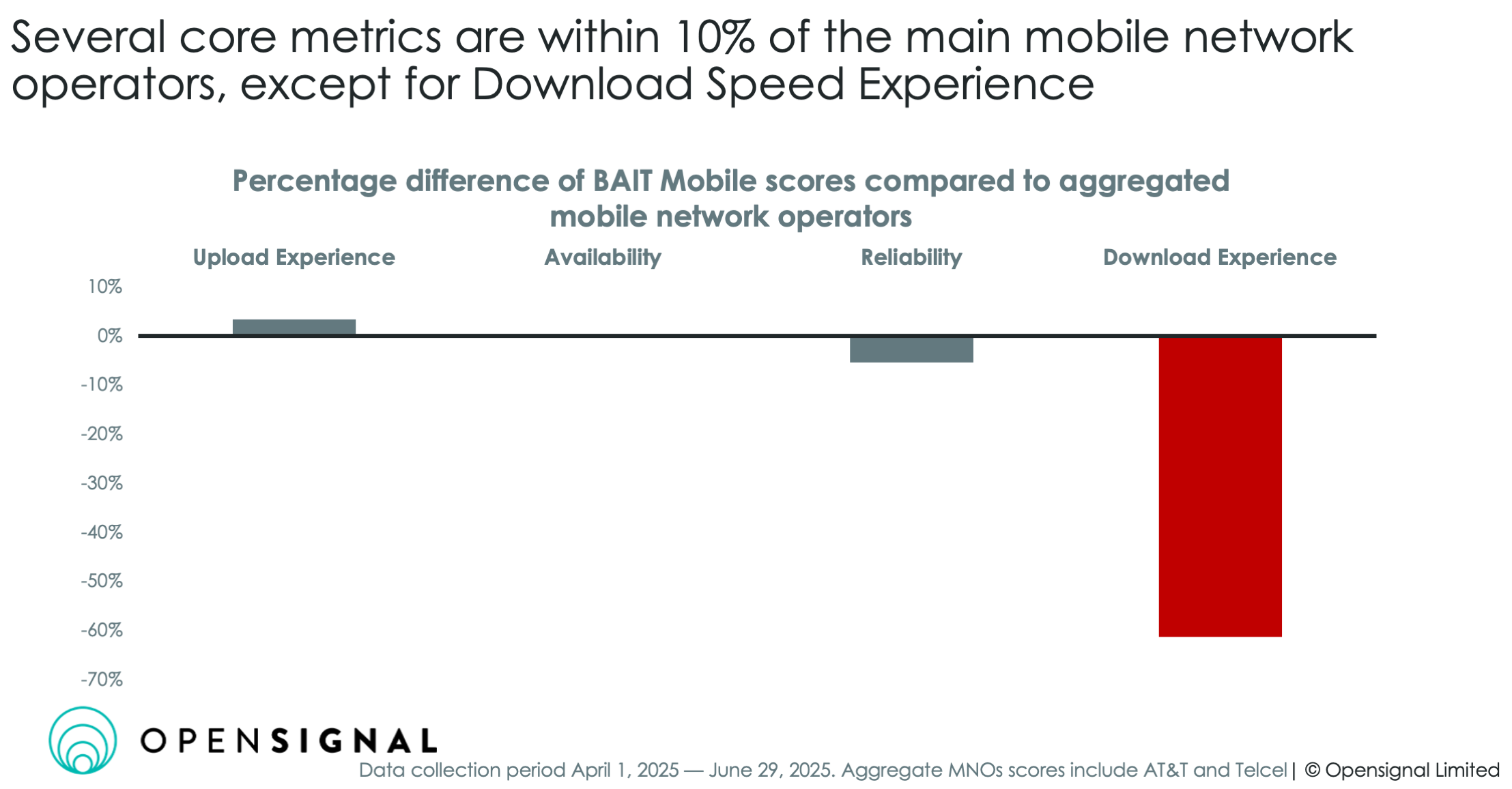
But Download Speed Experience shows a notable gap. BAIT users in Opensignal data see an average Download Speed of 14.6 Mbps, while users on the main mobile network operators see an average that is more than double this at 38.0 Mbps. Speed isn’t everything when it comes to mobile experience, but users who want to download apps or large files may notice the difference.
Value leadership: price Per GB
BAIT’s edge lies in its pricing. A $100 MXN prepaid recharge on BAIT offers more data for the same price. Importantly this offers a generous data return for a smaller cost outlay, reinforcing BAIT’s appeal to cost-conscious consumers. It offers a price per GB that is less than half the average of the main mobile network operators. While promotions on these mobile network operators lower the cost per GB that they offer, these only match BAIT’s standard current pricing. At half the price, but only a 10% difference in mobile experience on many metrics, it’s clear why BAIT has been an attractive prospect for many consumers.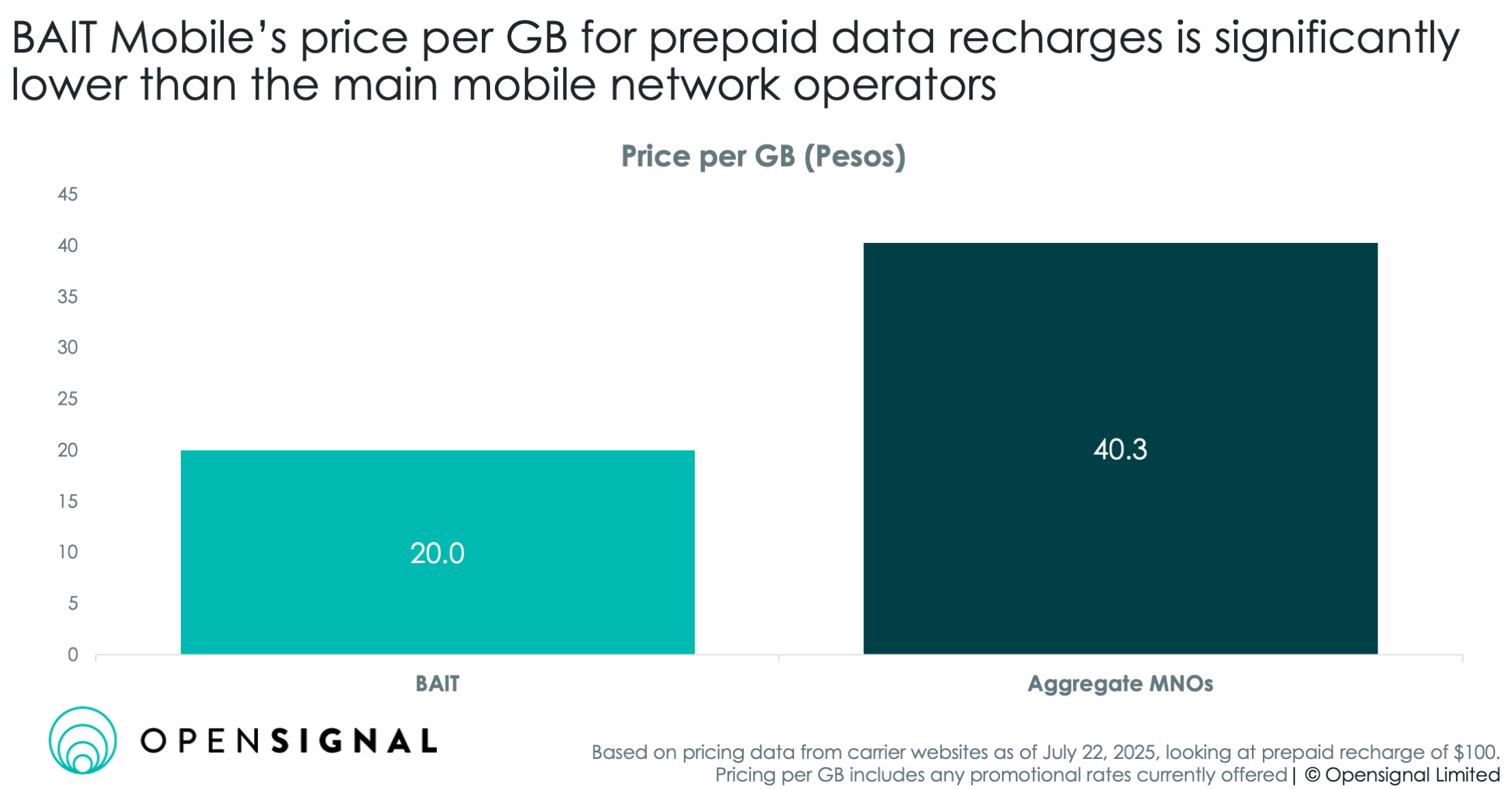
BAIT’s integration with Walmart is the lynchpin of this lower pricing. This integration streamlines the cost of acquisition that traditional mobile network operators and MVNOs face. Walmart offers in-store and online retail outlets, as well as advertising. It also enables SIM purchases and recharges to be completed during regular shopping trips. Meanwhile, Walmex’s (Walmart’s parent company in Mexico) status as Mexico’s largest retailer gives BAIT a cushion to focus on aggressive subscriber growth rather than short-term revenue. Against a backdrop of slow growth in the Mexican economy, this is an advantage not available to the main network operators.
Southern strength in subscriber growth
Beyond assessing that the network is “good enough” from a price to performance ratio, this is also evident in subscriber behaviour. According to Opensignal’s Global Subscriber Analytics data, BAIT shows a positive wins per loss (WPL) ratio against Mexico’s mobile network operators. This is a significant contributing factor to the success of MVNOs in Mexico in our previous content on the growth of brand MVNOs — where Opensignal reported a WPL of 1.3 for standalone MVNOs in Mexico, compared to 0.8 for mobile network operators (Telcel and AT&T combined). A WPL of 1.3 means that for every 1 subscriber that leaves the service, the operator gains 1.3 subscribers. This success appears to be growing. BAIT saw a 8-12% improvement in WPL from major retail mobile network operators when comparing figures from May 2025 vs May 2024 – meaning BAIT’s market share growth is coming at the expense of the large mobile network operators.
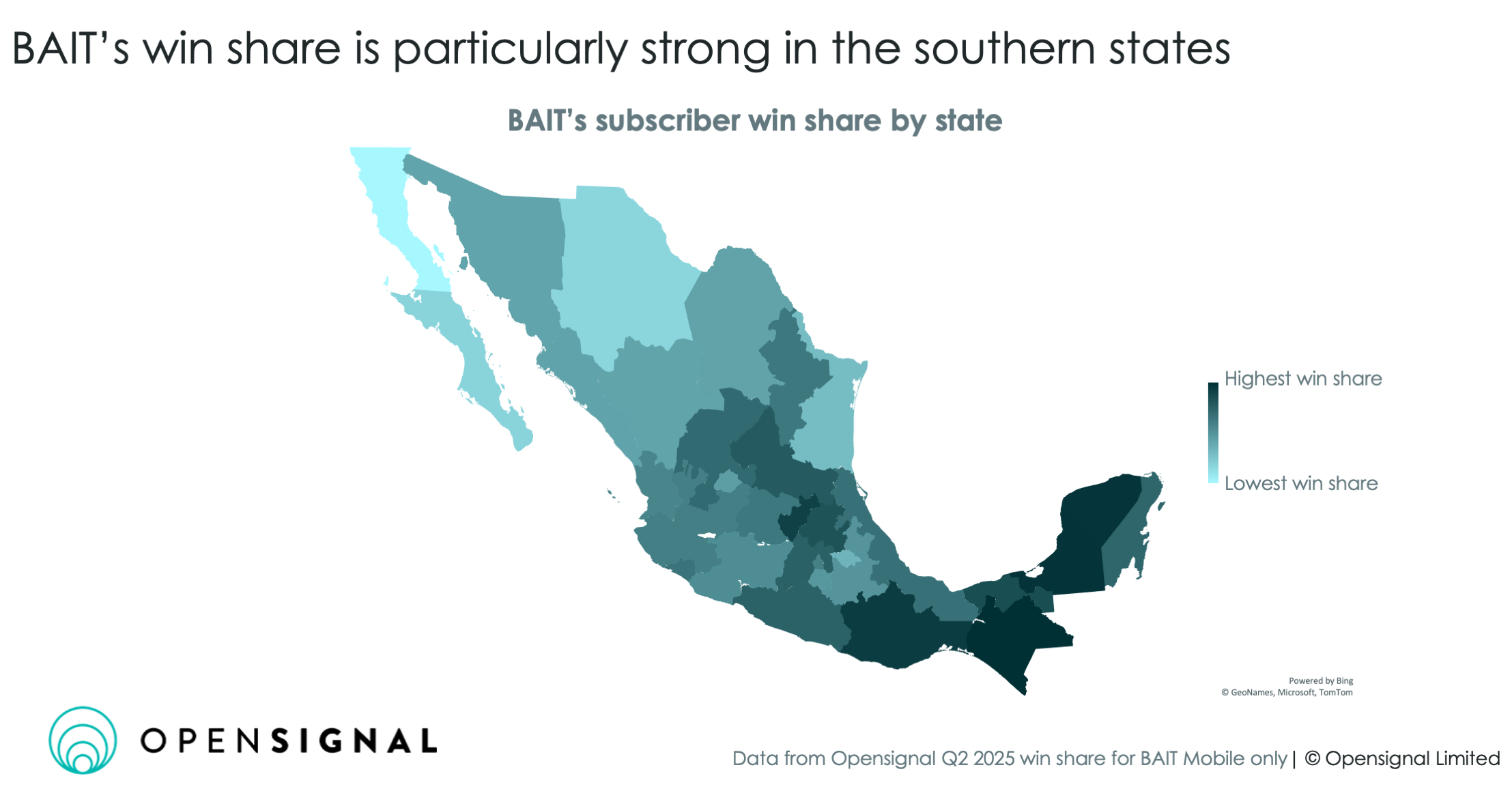
In line with its status as a price-conscious provider, BAIT performs especially well in regions with more price-sensitive users. Its win share — the percentage of new or switching customers who choose BAIT — is highest in southern states like Chiapas.
Buying scale: could BAIT acquire Movistar?
As BAIT attempts to sustain its rapid subscriber growth, acquisition seems like a sensible next step. In April 2025, the CEO of BAIT made a bold statement — that 2025 was the year that would see BAIT become Mexico’s second-largest mobile operator. This, along with comments about consolidation among Mexican MVNOs, suggested that BAIT may consider purchasing Movistar, the mobile network operators-turned-MVNO owned by Telefonica. However, recent reporting suggests that Movistar is in exclusive talks with Beyond ONE.
Should these rumours be true, this might not be such a bad thing for BAIT. While an acquisition of this scale speaks to BAIT’s bold ambitions, such a merger would be challenging. Long considered a legacy brand in retreat, Movistar’s latest porting numbers showed 32,667 net adds — which led El Economista to declare it the winner of the first half of 2025. For BAIT, this is both an opportunity and a risk — more subscribers presents a bigger opportunity, but likely at a higher cost.
However the main potential hurdle comes from the network backbones of the two MVNOs. Movistar operates on AT&T’s network, an agreement that is set to continue through 2030. As such, its users are accustomed to an experience that mirrors that of AT&T users, including the higher Reliability and Download Speed Experience discussed above. With this in mind, they may be less receptive to the slower speeds offered on BAIT. Movistar and AT&T’s parity also extends to pricing — with base pricing for prepaid recharges often identical between the two.
Were BAIT to re-enter the conversation as an acquirer for Movistar, the resulting merged company would likely be the second-largest mobile provider — but perhaps not for long. The costs of integrating the two services would likely be significant. It’s also unclear whether Movistar’s customers would stay with BAIT, given their current service and pricing don’t match BAIT’s lower-cost, “good enough” model.
Altán Redes: partner or competitor?
BAIT’s relationship with Altán Redes is largely cooperative, but may prove both a blessing and a curse. BAIT recently had to weather a price increase from Altán Redes, while Altán Redes needs BAIT to thrive for its continued success. After all, BAIT is the source of 80% of Altán Redes’s revenue. This is a significant part of why Altán Redes achieved an operating profit for the first time in January 2025.
The main complication is how Altán Redes proceeds under a new regulatory landscape and with a new leader. Most notably, it has long floated the idea that it would like to launch a direct retail business. While this may be an unlikely scenario, the government has suggested it could weigh up the benefits of such an arrangement. If it were to go ahead, this would undermine BAIT’s value proposition by providing identical, if not better, pricing and speeds. This would leave Walmart’s distribution channels as BAIT’s primary differentiator, and it’s not clear if this would be enough to maintain its growth.
Lack of 5G threatens postpaid success
Meanwhile, Altán Redes lacks the 5G network of the main retail mobile network operators in Mexico — a feature that limits BAIT’s expected success in the postpaid market. Up until now, that has been inconsequential for BAIT; Altán Redes’ 4.5G service is enough to attract cost-conscious users and those previously limited to 3G on major networks.
However, as this low-cost market opportunity becomes saturated, BAIT will need to be able to diversify. The best avenue would be to offer the same cost-effective approach but for customers with higher expectations. Most likely, this means having a 5G offering to support its postpaid ambition.
But 5G is not a service Altán Redes can currently provide. To date, the wholesale network has only run limited trials using 2.5GHz spectrum and expressed interest in acquiring 40MHz to support future 5G rollout. This may have influenced the government’s decision to cancel Mexico’s 5G spectrum auction earlier this year. However, Altán still lacks the spectrum and infrastructure. In the event spectrum is acquired, it will take time to deploy the network before BAIT can offer 5G to its users.
Future outlook
BAIT has reshaped Mexico’s mobile landscape. Its success in attracting subscribers, delivering decent performance, and leveraging Walmart’s retail network has proven potent.
However, BAIT may soon face diminishing returns on its early momentum. The most price-sensitive consumers are likely already on board. To keep growing, BAIT will need to offer more than just low prices — it must also keep up with rising user expectations. As costs rise and competition shifts, understanding how its mobile experience compares to others will be essential.
Subscribe to our newsletter to follow the latest LATAM mobile trends, or reach out to our sales team for more detailed insight on win composition and Global Subscriber Analytics.
Opensignal Limited retains ownership of this insight including all intellectual property rights, data, content, graphs & analysis. Reports and insights produced by Opensignal Limited may not be quoted, reproduced, distributed, published for any commercial purpose (including use in advertisements or other promotional content) without prior written consent. Journalists are encouraged to quote information included in Opensignal reports and insights provided they include clear source attribution. For more information, contact [email protected].
