


As 5G matures and network virtualization becomes the new standard, our understanding of network performance must evolve. On July 23rd, I had the pleasure of hosting a fireside chat with Mahmoud Elsakhawy, General Manager of End-to-End Performance & Capacity at Rakuten Mobile, one of the world’s most ambitious and disruptive operators.
Over 30 minutes, we discussed how to measure user experience in a meaningful way, reflecting on how to stay relevant in a world shaped by real user behavior.
It’s not just about speed - and it never was
I opened the session with a simple but important question: Is speed still the most important KPI?
The answer, as Mahmoud eloquently put it, is no. While speed remains a critical element of performance, it's far from the whole story. Today's users expect more than fast downloads. They want reliability, responsiveness, and a seamless experience no matter where they are or what they’re doing. Whether streaming video, playing online games, or attending a virtual meeting, packet loss, jitter, and latency matter far more than headline speeds to ensure a good user experience.
As Mahmoud pointed out, “3Mbps is enough for 720p video, which is sufficient for smartphones but if the network isn’t stable, the experience still suffers.” This emphasis on stability over headline speeds aligns with how today's users interact with their networks: constantly connected, application-driven, and highly sensitive to quality fluctuations.
From KPIs to KQIs to service quality index: measuring what matters
Rakuten Mobile’s approach is deeply application-aware and rooted in the end-to-end customer journey:
- Horizontally: From the device to the application
- Vertically: From the core to the edge, all the way to the cloud
This holistic view is operationalized through Key Quality Indicators (KQIs) that reflect what users actually experience.
Metrics like Opensignal’s Consistent Quality (CQ) and Excellent Consistent Quality (ECQ) play a key role. They prioritize stability and responsiveness over headline performance, a meaningful shift for operators seeking to align engineering with user satisfaction.
So why does this matter? Because networks are now judged by experience, not engineering specs. Operators that embed application-aware analytics into their strategy can bridge the gap between technical delivery and customer expectations – a crucial differentiator in a saturated, hyper competitive market.
Rakuten Mobile’s growth: experience at the core
Rakuten Mobile’s results speak for themselves. Since its full scale 2020 launch, Rakuten Mobile has reached several milestones. As of July 2025, the operator surpassed 9 million subscribers, signaling growing credibility and appeal in one of the world’s most mature mobile markets.
This growth has been enabled by visible improvements in network quality, which Mahmoud credits to relentless focus on performance innovation.
In previous analyses of Rakuten Mobile’s journey using Opensignal subscriber analytics data, we explored the sources of its customer base, examining where consumers are switching from. An equally compelling aspect of the operator’s growth story is its inclusive retail strategy. The operator has invested in a multilingual retail staff presence, enabling meaningful engagement with Japan’s growing international population. These residents now account for 25% of all new subscriptions at Rakuten Mobile stores.
At the same time, Rakuten Mobile is gaining traction among younger generations, especially digital natives in their 20s and 30s as per the latest annual report. This is driven by several key factors:
- Its app-based onboarding and account management, which appeals to users comfortable with digital self-service.
- Affordable unlimited data plans, which offer a compelling alternative to more expensive tiered plans from legacy operators.
- A strong brand presence within the Rakuten ecosystem, including integration with Rakuten Points and Rakuten Ichiba, incentivizing subscriptions through ecosystem loyalty rewards.

Rakuten Mobile continues to expand its 5G footprint. It has seen continuous gains in 5G Availability, particularly in the Kanto, Nagoya, and Osaka regions, and now covers all 47 Japanese prefectures with Massive MIMO deployed in over 80% of its 5G sites. Improvements in metrics like packet loss, latency, jitter, and especially reduction in “No Signal” areas underscore the progress it has made. Additionally, Rakuten Mobile's use of cloud-native architecture enables it to scale efficiently and offer competitive pricing, which resonates with price-sensitive consumers, including students and young professionals. This strategic positioning supports Rakuten Mobiles’s broader goal of democratizing mobile connectivity in Japan.
Benchmarking Rakuten Mobile in the global context
To understand how Rakuten Mobile’s user experience stacks up globally, we benchmarked its performance using Opensignal’s 2025 Global Awards, comparing it to the average scores of 142 operators across 41 large-area markets.
Rakuten Mobile exceeds the global average in all six experience metrics:
- Download Speed Experience
- Upload Speed Experience
- Voice App Experience
- Video Experience
- Games Experience
- Reliability Experience
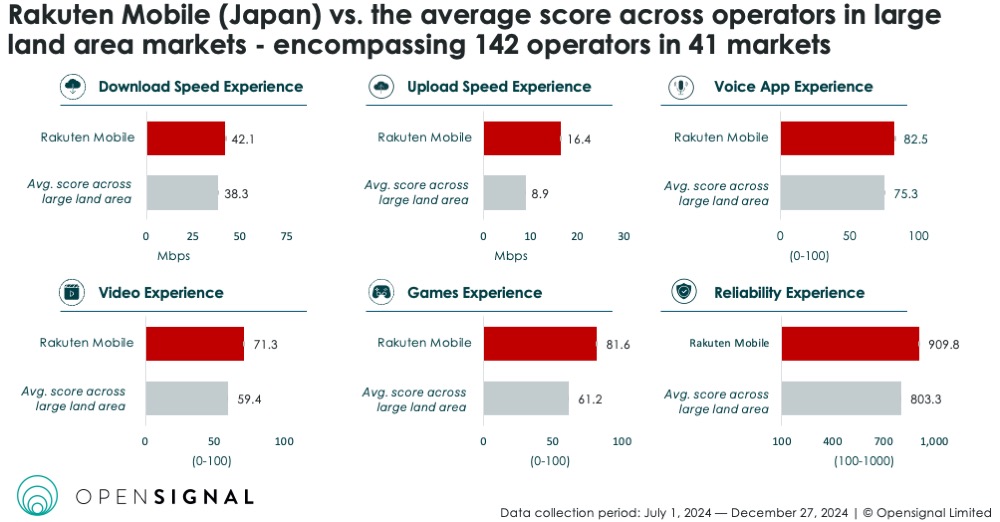
This across-the-board outperformance underscores the strength and effectiveness of Rakuten Mobiles’s unique network model. It remains globally distinctive for its use of a fully virtualized, cloud-native network, leveraging automation, software-defined networking (SDN), and disaggregated infrastructure.
These achievements also reflect the operator’s growing maturity and innovation capacity. Rakuten Mobile recently took a major step forward by announcing the deployment of 5G Standalone (SA) network cloud functions in collaboration with Rakuten Symphony Cloud Solutions, Cisco, Nokia, and F5. This move reinforces the operator’s long-term commitment to technological leadership and network differentiation.
Crowdsourced data as a strategic tool
What sets Rakuten Mobile apart is the diversity of data sources it draws upon: internal node statistics, field tests, active/passive probes, social media, and notably, crowdsourced data. As Mahmoud emphasized, this helps the team monitor performance at a granular, real-world level—urban and rural, peak and off-peak, indoor and outdoor.
This data empowers Rakuten Mobile to identify cell-edge degradation, fine-tune site planning, and benchmark against competitors with a level of confidence that lab-based testing alone cannot offer.
Looking forward: predictive, real-time and experience centric
Toward the end of our chat, I asked Mahmoud what he thinks is still under-measured in the industry. His response really resonated with me: the need to bridge the gap between technical KPIs and marketing metrics. Connecting latency to churn, or jitter to satisfaction scores, remains a challenge but also an opportunity. It’s an area Rakuten Mobile is keen to advance, particularly as they prepare for nationwide satellite-to-mobile coverage by 2026 in partnership with AST SpaceMobile.
Looking ahead, Mahmoud sees the need for more application-aware, real-time, and predictive analytics, especially in the context of Open RAN, private 5G, and network slicing. His ideal global benchmark? Gaming experience and consistency because they capture latency, reliability, and responsiveness in a single measure that users really feel.
Key Takeaways
Here’s what I walked away with from our conversation:
- Speed is no longer the headline story. Reliability and consistency define modern performance.
- CQ and ECQ provide essential insight into experience across complex, cloud-native networks.
- Crowdsourced data has become essential for operators who want to understand — and improve — real-world performance.
- The future is experience-centric. Success lies in connecting network KPIs with business impact, enabled by predictive, real-time analytics.
Follow this link to explore Opensignal’s latest reports and if you have missed the webinar you can rewatch it here to learn about Rakuten Mobile’s innovative approach to network measurement. As networks become more cloud-native and AI-driven, the conversation about performance needs to catch up too.
Opensignal Limited retains ownership of this insight including all intellectual property rights, data, content, graphs & analysis. Reports and insights produced by Opensignal Limited may not be quoted, reproduced, distributed, published for any commercial purpose (including use in advertisements or other promotional content) without prior written consent. Journalists are encouraged to quote information included in Opensignal reports and insights provided they include clear source attribution. For more information, contact [email protected].
