


by Chris Mills, Robert Wyrzykowski
In a shared infrastructure model, what differentiates one broadband provider from another?
This question is particularly relevant in Australia, where all Retail Service Providers (RSPs) deliver services over the same wholesale platform — the government-owned National Broadband Network (NBN). Despite identical underlying infrastructure, end-user broadband experiences are far from uniform. One overlooked factor is the in-home gateway device through which users connect to their Wi-Fi networks.
Following our earlier similar analysis on the U.S. market, Opensignal looked at broadband consistency across Australian households to understand how experience varies depending on whether users rely on provider-supplied gateways or Bring-Your-Own (BYO) equipment. This analysis covers only wireline broadband connections and excludes fixed wireless access (FWA).
Key findings
- RSP-issued gateways outperform BYO alternatives: Our Australian users subscribed to major RSPs like Optus or Telstra enjoy more consistent broadband experiences when using RSP-issued gateways.
- Diverse in-home equipment strategies among Australian RSPs: Some providers offer higher-end routers subsidized over the course of a contract, while others may not offer them for free but provide options for new subscribers to purchase a compatible gateway.
- FTTP drives demand for higher speed tiers: Australian NBN users are increasingly opting for higher speed tiers — particularly 100Mbps and 250Mbps — a trend driven by the growing availability of fiber-to-the-premises (FTTP), which enables faster and more consistent performance.
Why do home gateways matter so much in a shared infrastructure market?

All Australian RSPs share the same NBN infrastructure, but customer experience still varies. What explains this? Beyond traffic management and capacity provisioning, in-home equipment plays the next most important role.
Feature | RSP-provided gateways | BYO gateways |
Cost | Varies, but often included or a single upfront fee | Can be very cheap, often under AU150 or even AU100, and can include used/refurbished devices |
Setup | Preconfigured for the provider's network | Requires proper NBN setup, as configurations vary by provider |
Support | Fully supported by the provider, with remote management and troubleshooting | May not receive full RSP support, complicating troubleshooting |
Performance | Optimized for the network and receives regular firmware updates | May not deliver optimal performance due to differing configurations, even with NBN-ready devices from other providers |
Management | Remotely managed by the provider, who can push firmware updates and optimize Wi-Fi | Management is the user's responsibility; updates and optimization are not guaranteed by the RSP |
And Opensignal data reflects these differences in configurations between RSP-issued and BYO routers. Subscribers of Optus, Telstra, and Superloop experience the greatest improvements in the consistency and reliability of fixed broadband services when using RSP-provided gateways, compared to those using BYO gateways. Other major RSPs also see increases in their Consistent Quality scores.
Different gateway strategies among Australian RSPs
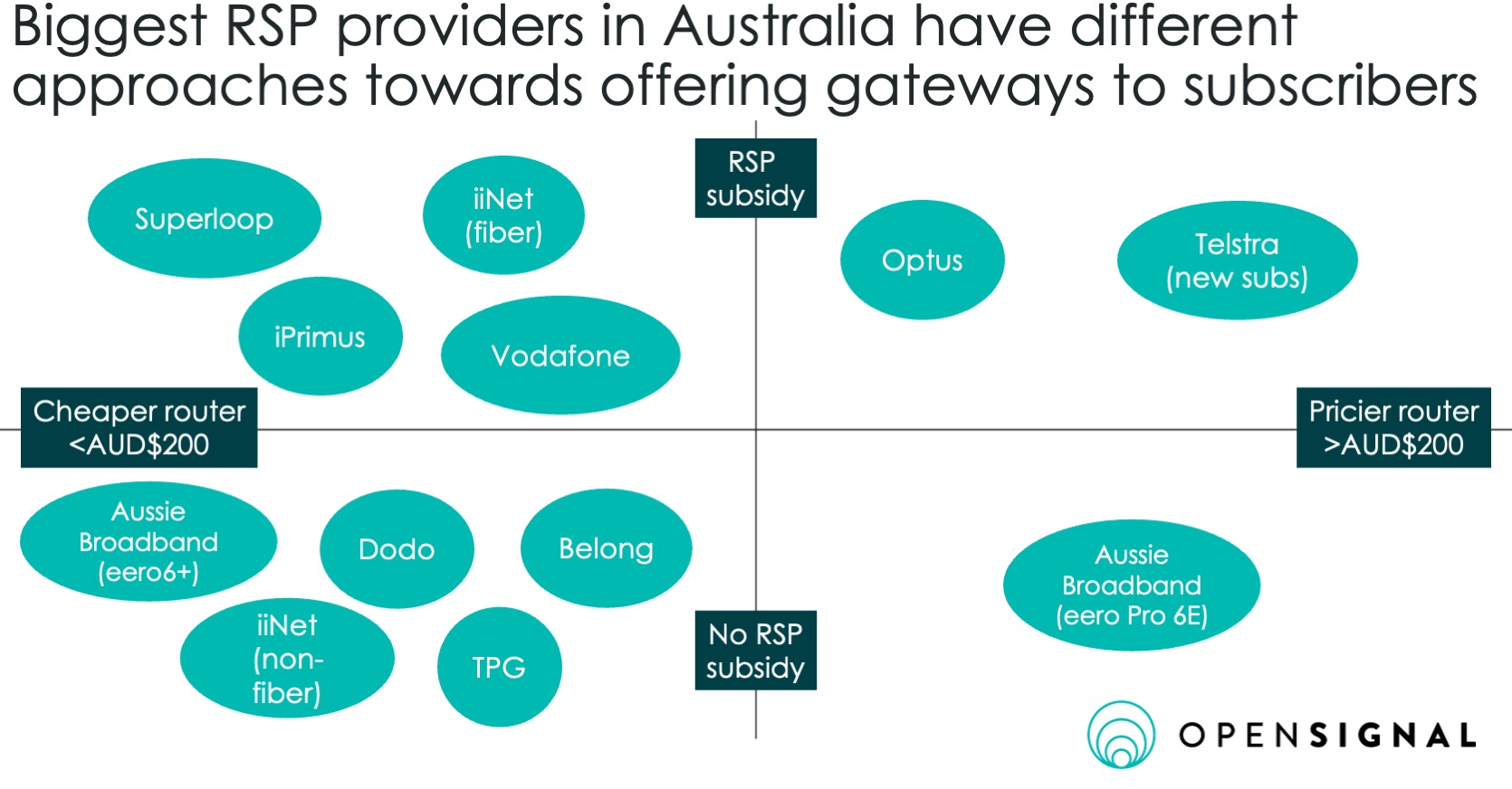
Major Australian RSPs offer a variety of Wi-Fi 6 routers to their subscribers on NBN plans, while also giving new customers the option to bring their own devices to help minimize costs. However, the terms under which this occurs vary significantly across providers — quoted prices reflect the estimated total cost of gateways as per August 2025:
- Premium, branded gateways as acquisition tools — Optus (AU$306) and Telstra (AU$288) use high-end, own-branded routers with 4G backup to attract new customers and boost perceived service quality — and strong gains in Consistent Quality reflect this. Both RSPs use router branding to reinforce loyalty and in-home brand visibility.
- Cost accessible strategy — Superloop (AU$168), iPrimus (AU$180), iiNet (AU$192), and Vodafone (AU$180) offer cheaper and usually unbranded routers at no cost, tied to contract terms.
- BYO friendly with no lock-in plans — these RSPs offer generally cheaper routers without major subsidies, as customers pay either upfront or in monthly installments. TPG and iiNet offer TP-Link for (AU$114.95) — iiNet for its non-fiber plans — although TPG subsidizes gateways for its non-NBN TPG Fibre plans. Aussie Broadband (AU$240 or AU$180), Belong ($132), and Dodo (AU$169.99) are other examples of Australian RSPs who don’t offer router subsidies. Belong, as Telstra's brand, aligns with the parent company’s strategy by offering its own branded router.
Disclaimer: Prices quoted are the estimated total cost of offered gateways, as per August 2025.
Market Trends: FTTP & FWA shape the router landscape
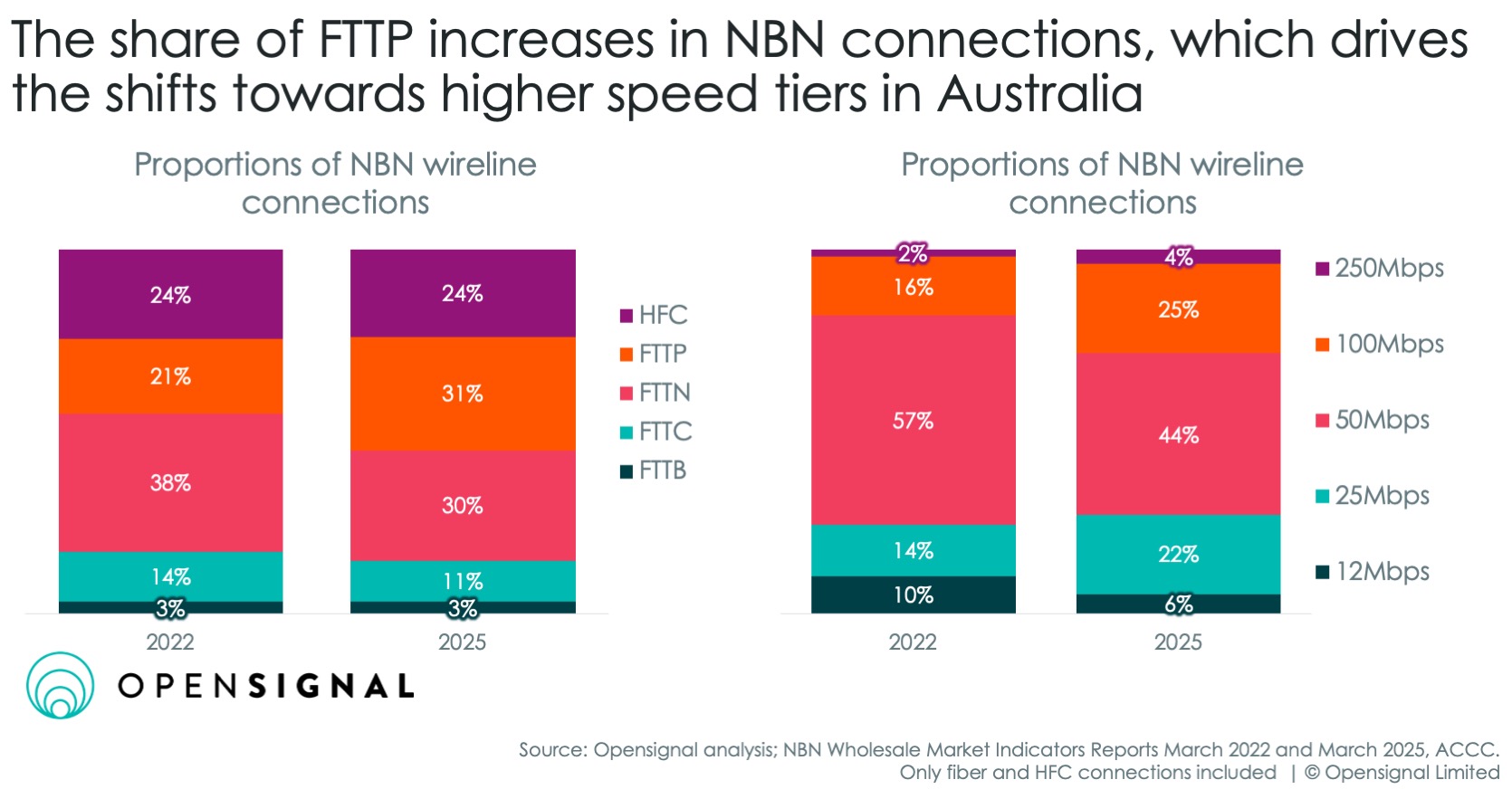
According to ACCC reports, the share of fibre-to-the-premises (FTTP) in total wireline connections is growing across the board, as a result of ongoing infrastructural upgrades. Technologies which rely on older copper wiring for the final leg, like Fibre to the Node (FTTN) or fibre-to-the-curb (FTTC), have been steadily losing their share within the overall NBN wireline footprint.
The FTTP rollout is driving more users to higher-speed fiber plans, spurred by growing demand and promotional offers. The 100Mbps and 250Mbps tiers are rising in popularity, while 50Mbps and 12Mbps plans are declining in use. This trend may accelerate with NBN’s planned September 2025 upgrades: NBN 100 will jump to 500Mbps and NBN 250 to 750Mbps — however, available only to FTTP and Hybrid Fibre Coaxial (HFC) connections.
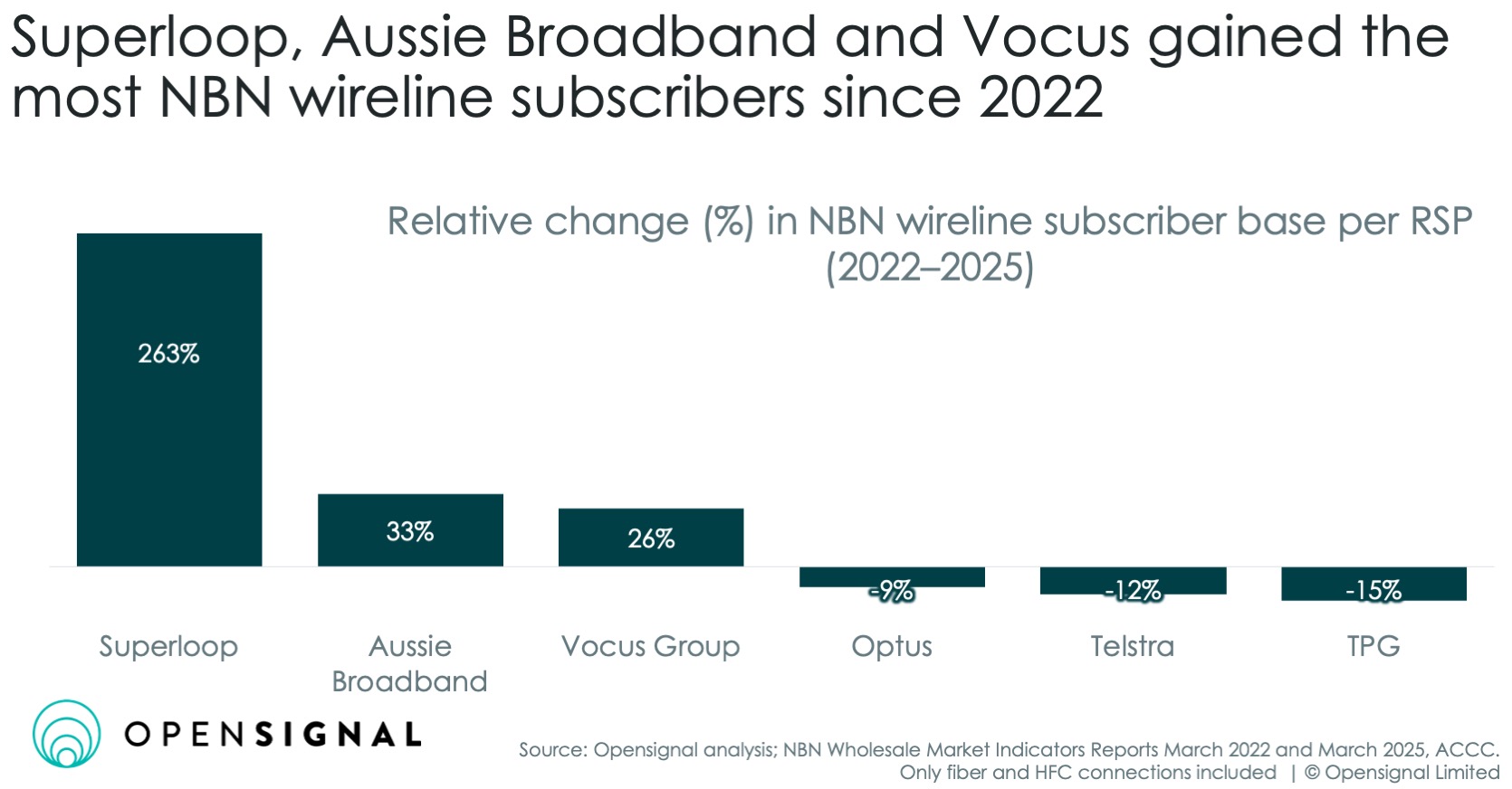
Australian operators have criticized NBN’s high wholesale fees, which drive some RSPs to increase their retail prices. ACCC data shows major providers such as Telstra, TPG, and Optus losing NBN wireline subscribers, while smaller RSPs — including Superloop, Aussie Broadband, and Vocus — have gained ground, driven by new FTTP connections. Superloop, in particular, has increased its subscriber base more than 3.5 times since 2022.
To counter losses, Optus, Telstra and TPG are expanding Fixed Wireless Access (FWA) services using their own networks, bypassing NBN fees that cost around AU$50 million per 100,000 NBN connections, according to TPG. The FWA segment is another clear example of ISPs supplying their own routers to customers. In fact, all Australian FWA subscribers use RSP-provided gateways, as operators do not sell FWA SIMs directly.
Are Australian gateways ready for the upcoming supercharge?
Accessing faster speeds announced by NBN doesn’t depend only on access to FTTP and HFC, but also on router quality. Many customers keep old routers for years, often limiting their access to higher speeds. Promoting ISP-owned gateways that support upcoming NBN speed upgrades can reduce churn, as they offer better reliability, support, and customer dependence on provider-managed hardware.
If you are interested in more analysis of Australia’s fixed broadband market — check out our previous reports on this market. Please contact us if you are looking for a more custom approach to fixed broadband analysis. Subscribe to our newsletter to stay up to date!
Opensignal Limited retains ownership of this insight including all intellectual property rights, data, content, graphs & analysis. Reports and insights produced by Opensignal Limited may not be quoted, reproduced, distributed, published for any commercial purpose (including use in advertisements or other promotional content) without prior written consent. Journalists are encouraged to quote information included in Opensignal reports and insights provided they include clear source attribution. For more information, contact [email protected].
