


Across the African continent, mobile networks are the backbone of digital progress, as many countries have “leapfrogged” over fixed broadband deployment.
Opensignal’s latest Global Network Excellence Index shows a mixed picture of the state of mobile connectivity in the region. The key factor setting the leaders apart, such as Mauritius, Morocco, Tunisia, and Egypt, from laggards is a proactive and timely approach to spectrum management. Many countries trail behind, held back not only by slow spectrum reform, but also by patchy telecommunication and supply infrastructure, and barriers to adoption like affordability
The quality of these mobile networks is crucial for driving economic growth, digital inclusion, and access to vital services like healthcare and banking, making it essential for policymakers and investors to address these disparities.
Why does mobile experience matter?
In Africa, mobile networks are the primary way most people access digital services, with only 1.6% of households connected via fixed broadband as of 2022. Despite this reliance, substantial gaps in access persist, especially in Sub-Saharan Africa. According to GSMA Intelligence, as of 2022, around 15% of the population lacked any mobile broadband coverage, and another 59% had coverage but didn’t access mobile internet, creating a significant “usage gap”.
Closing these gaps has enormous economic and social potential. The World Bank and ITU have shown that a 10 percentage-point increase in mobile broadband penetration can result in a 2.5% increase in per-capita GDP. Furthermore, mobile technologies already play an important role, contributing 8.1% of GDP in Sub-Saharan Africa in 2022.
The three pillars of Network Excellence
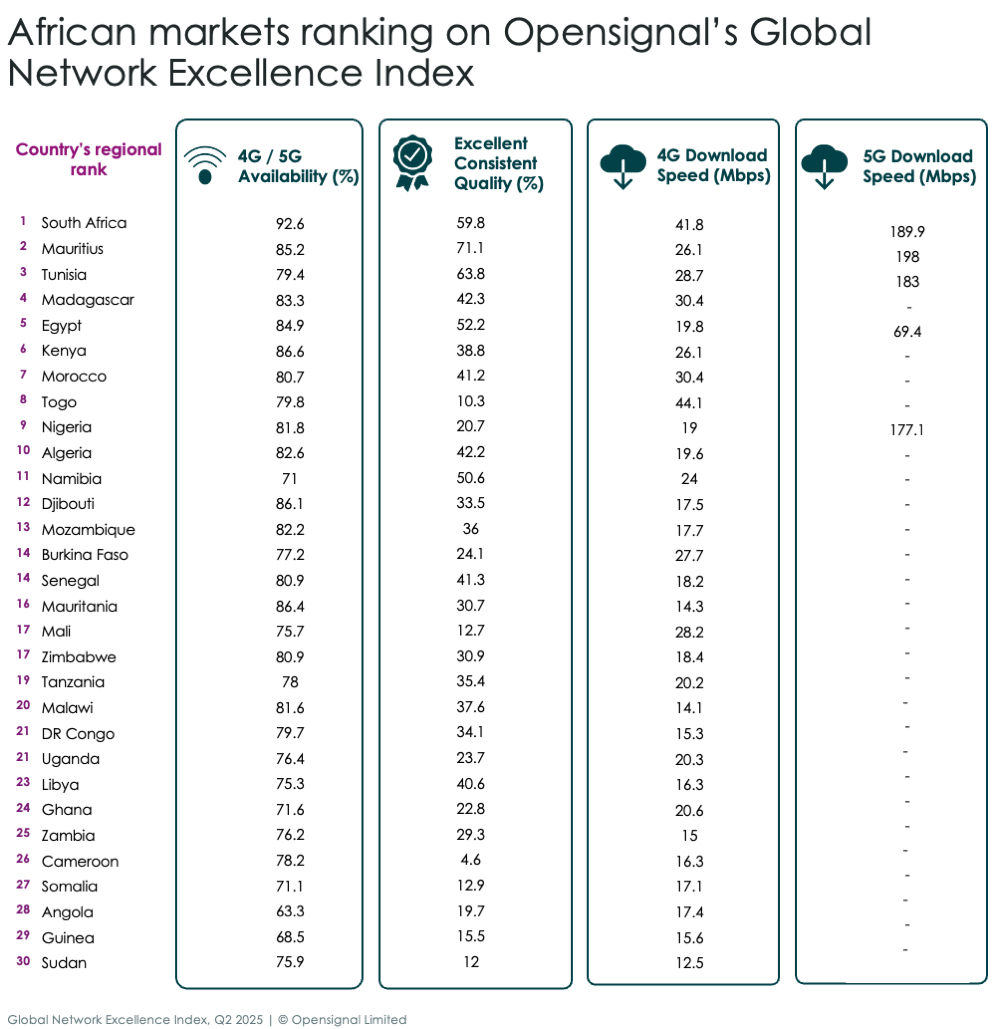
Opensignal’s Global Network Excellence Index provides a comprehensive framework for assessing the state of mobile networks, evaluating countries based on three core pillars of mobile experience: 4G/5G Availability, Excellent Consistent Quality (ECQ), and 4G and 5G Download Speeds. These metrics move beyond theoretical network capabilities to measure the real-world experience of users.
Pillar 1: 4G/5G Availability
Measures the proportion of time users connect to modern networks (4G and 5G).
While availability is closely linked to coverage, the two are not identical: coverage defines where 4G/5G is deployed, but availability reflects whether users are actually connecting to those networks in practice. A significant gap between coverage and availability exists across Africa, particularly in rural and underserved areas, where a set of factors come into play:
1. The rural urban divide
The availability of modern networks varies starkly between urban and rural areas:
- Coverage gap: According to the ITU, by 2024, 14% of Africa’s population lacked mobile broadband coverage. This proportion worsened to 25% in rural areas.
- Usage gap: Connectivity isn’t only about coverage but also adoption – the percentage of individuals using the internet. While 57.1% of city dwellers were online, only 22.7% of rural residents used the internet, whether via mobile or other means.
This divide underscores that even when infrastructure exists, socioeconomic and affordability factors can hinder usage in rural regions.
2. Reliance on legacy networks
Even when 4G/5G networks are rolled out, many users remain on older generations:
3. Time on 2G/3G: In many African countries, our users still spend 7–37% of their time connected to older 2G/3G networks, limiting both speed and service quality. For example, our data shows that in South Africa, rural users spend far less time on 4G/5G than urban users, despite relatively better coverage in the country compared to others on the continent.
4. Spectrum inertia and policy constraints
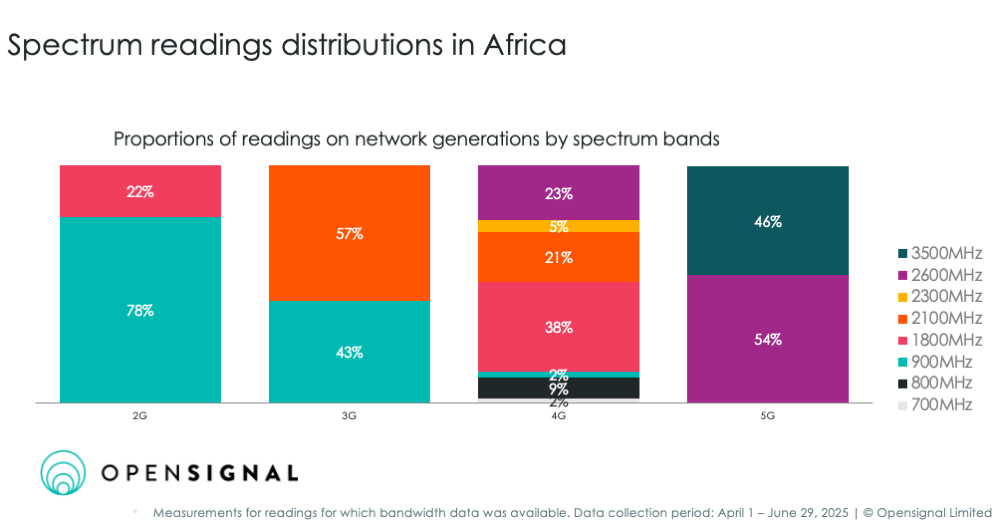
Spectrum management plays a critical role in modernizing networks. Lack of technology-neutral licensing: In many African countries, spectrum remains locked to legacy use cases. For example, our data shows that a good portion of the 900 MHz band remains tied to 3G, unlike in North Africa and the Middle East where it has been refarmed to higher generations.
Pillar 2: Excellent Consistent Quality (ECQ)
Assesses a network’s ability to consistently support high-performance applications like video calls, mobile banking, and HD streaming.
Across Africa, ECQ scores show significant variation, reflecting disparities in mobile network quality and the reality that many users run out of data due to insufficient credit, a common issue in a region where 93% of mobile connections are prepaid, according to GSMA Intelligence.
- Leaders (≥60%): Mauritius leads the continent with an ECQ score of 71%, closely followed by Tunisia (64%) and South Africa (60%), demonstrating their capability to consistently support applications at a “good enough” level
- Mid-tier (40–59%): including Egypt (52%), Namibia (51%), and countries such as Madagascar, Algeria, Senegal, Morocco, Libya, Kenya, and Malawi, indicate moderate levels of reliable connectivity, with opportunities to strengthen infrastructure and network management further.
- Lower-mid (20–39%): Mozambique, Tanzania, DR Congo, Djibouti, Zimbabwe, Mauritania, Zambia, Burkina Faso, Uganda, Ghana, Nigeria, Angola.
- Lowest (<20%): Guinea, Somalia, Mali, Sudan, Togo, Cameroon, Ethiopia, signaling substantial gaps in network reliability and performance, requiring targeted investments and strategic policy interventions.
The high cost of mobile data, which is detailed below, undermines the ability of users to have a consistent and high-quality experience, regardless of the underlying network capabilities.
Pillar 3: 4G and 5G Download Speeds
Measures current speed and capacity, as well as readiness for future demand.
While most African markets are still in the early stages of 5G deployment, five countries have launched commercial 5G services at scale and are therefore included in the Opensignal Index: South Africa, Nigeria, Egypt, Tunisia, and Mauritius. South Africa was the first in the region to roll out 5G, setting a benchmark for speed and capacity gains across the continent.
Opensignal data shows a strong link between average spectrum bandwidth and better mobile performance, measured as 4G download speed.
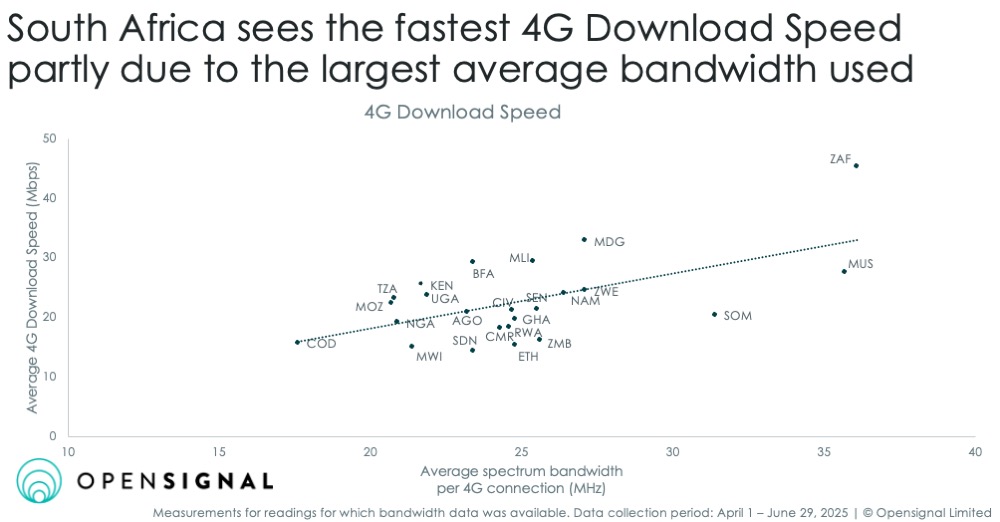
South Africa, with over 35 MHz of average spectrum, achieves speeds exceeding 45 Mbps, positioning it ahead of others in 4G download speed. In contrast, countries like Congo DRC and Mozambique, with less spectrum, are at the lower end of download speeds. A major structural issue driving this disparity is “spectrum inertia,” where a lack of technology-neutral licensing prevents mobile operators from repurposing spectrum previously allocated to legacy networks. For instance, much of the 900 MHz spectrum remains allocated to 3G services, unlike in Northern African and Middle Eastern markets, where it has already been refarmed for 3G/4G. Meanwhile, 2100 MHz spectrum is mostly used by GCC countries to support 4G services while in Africa it is still predominantly supporting 3G services.
Strategic enablers of network excellence
Network quality is influenced by a multitude of factors beyond spectrum:
Supporting infrastructure and backhaul
A mobile network's quality is only as good as its backhaul infrastructure. Despite significant investments in international submarine cable systems, such as the Eastern Africa Submarine System (EASSy) and the Africa Coast to Europe (ACE) cable network, which connect multiple countries and provide crucial international bandwidth, the "last mile" remains a bottleneck. For example, Nigeria has access to various submarine cable systems with approximately 10 Terabytes of bandwidth at landing points, but much of this capacity lies fallow due to a lack of last-mile infrastructure to move it from the shores inland. Proximity to an optical fiber node reduces latency, improves connection stability, and lowers deployment costs, which makes broadband access more affordable and efficient.
Furthermore, physical infrastructure sabotage presents a critical threat to service quality and network expansion. In South Africa, the theft of copper cables, driven by sophisticated transnational organized crime syndicates, costs the economy an estimated R187 billion($10.6bn) annually in knock-on effects, a figure far exceeding the direct losses for major entities. This is not the work of petty thieves either; it is driven by sophisticated transnational organized crime syndicates.
In Nigeria, the situation is a declared “national emergency,” with an alarming average of 1,744 attacks on telecom infrastructure recorded weekly, including 1,100 fibre cuts and 99 cases of equipment theft. The persistent attacks are undermining the country’s broadband expansion targets and digital inclusion goals. The Nigerian Communications Commission (NCC) has responded by designating telecom infrastructure as “Critical National Information Infrastructure” (CNII) under the Cybersecurity Act, a move that aligns physical security with the broader national security framework.
For example, countries like Somalia and Guinea, despite having reasonable spectrum allocations, underperform due to factors such as poor backhaul.
Energy supply
An unreliable power grids forces telecom providers to rely heavily on diesel generators, inflating operational costs and creating service bottlenecks. In Nigeria, operators use over 40 million liters of diesel per month, spending more than USD 350 million annually to keep base stations operational. The Africa Finance Corporation reports that powering rural base stations can cost up to 37% more than their urban counterparts, partially due to diesel dependency.
To combat this, operators are increasingly investing in renewable solutions like solar and battery-backup systems, shared procurement of power, and energy policy incentives, particularly in countries like South Africa, Kenya, and Namibia. The adoption of specialized infrastructure providers known as TowerCo Energy Services Companies (ESCOs) is also gaining traction, enabling network operators to outsource power management and transition to more efficient hybrid energy systems.
- Device and data affordability
Even with robust networks and a reliable power supply, the affordability of modern devices and data access remains a major barrier to adoption. An entry-level internet-capable phone can cost up to 95% of the poorest 20% 's monthly income. Furthermore, the cost of data is also prohibitive 1 GB of data costs an average of 2.4% of monthly income, which is well above the UN’s 2% affordability benchmark.
In response, innovative business models and initiatives are emerging to make digital access more affordable:
- In Kenya, Safaricom has addressed this with its "Maisha Poa Ni Digital" campaign, which offers affordable 4G smartphones with payment plans to encourage users to upgrade from 2G phones.
In South Africa, operators offer innovative financing models, such as: lay-by, rent-to-own, and financing schemes, offering consumers flexible payment solutions. For example, in July 2025, MTN’s mobile money business - MoMo - made 4G and 5G smartphones available on credit for prepaid customers, without the need for background credit check under the “Handset Rent-to-Own” initiative. This is hot on the heels of the announcement that MTN will sell subsidised 4G smartphones for as little as R99 ($5.6), with the end goal of migrating customers away from legacy networks.
Beyond Spectrum: A broader policy blueprint
In our companion report launching the Global Network Excellence Index, we highlighted key policy and regulatory levers — spectrum, licensing, infrastructure, and access — that can directly enhance the quality of experience (QoE) for users. While a one-size-fits-all approach won't work, Opensignal's findings provide a clear roadmap for African nations to improve their mobile experience:
Modernizing spectrum management
Strategic and timely spectrum management is an important enabler of network excellence. A fundamental tool in this area is technology-neutral licensing, which allows mobile operators to repurpose spectrum previously used for legacy networks (2G and 3G) for newer, more efficient services (4G and 5G) at a pace dictated by market demand, thereby optimizing overall spectrum utilization (see chart below). The case of Mauritius and its commitment to technology-neutral licensing is a testament to this approach.
According to GSMA as of July 2025, there were 278 completed, planned or in progress 2G and 3G switch-offs in 83 countries and territories. For Africa, the switch-off process is currently in very early stages: only South Africa has set a path to migrating away from legacy networks.
Embracing infrastructure sharing
Policies that encourage passive (towers, sites, power systems, ducts, and dark fiber optic cable) and active (RAN, spectrum, antennas, base stations, switches) infrastructure sharing can significantly reduce deployment costs, enabling operators to expand coverage more quickly, particularly in rural and underserved areas. Research on other low-income countries shows that tower-sharing deals can lead to lower prices and increased mobile and internet access. Although, 38 African countries have integrated infrastructure sharing into their regulatory frameworks, several operators are also driving this forward through signing collaboration agreements, recent examples include:
- Airtel Africa and MTN Group, for instance, announced a collaboration to share fiber and wireless infrastructure in Nigeria and Uganda to improve network efficiency and drive digital inclusion.
- Airtel Africa and Vodacom have entered into a strategic infrastructure-sharing agreement across Mozambique, Tanzania, and the Democratic Republic of Congo, helping to expand coverage and enhance service quality in underserved markets.
Exploring innovative funding model
Traditional funding from operators and governments is often insufficient to meet the investment required to close the digital divide. To address this, policymakers are exploring alternative funding sources and innovative models, such as public-private partnerships (PPPs). One example is India, which has focused on backhaul infrastructure through the BharatNet project, a massive government-led initiative to connect all of India's village councils with high-speed optical fiber using a public-private partnership model, providing a compelling example for extending services into rural areas at an affordable cost. Furthermore, universal service funds and incentives for non-traditional players, such as community network operators, are gaining traction.
Conclusion
While Opensignal’s Global Network Excellence Index highlights the uneven state of Africa’s mobile networks, it also provides a clear blueprint for progress. The leading nations such as South Africa and Mauritius have demonstrated that proactive, strategic regulatory policy, especially concerning spectrum, is the primary driver of superior user experience. However, the cautionary tale of Nigeria shows that spectrum alone is not a panacea. A truly excellent and consistently high-quality mobile experience depends on a robust backhaul infrastructure, a stable and independent regulatory environment, and a policy toolkit that looks beyond a single technology to foster a comprehensive ecosystem of innovation and investment. By focusing on these strategic enablers, African nations can not only improve their ranking in the Global Network Excellence Index but also accelerate their journey toward genuine digital inclusion.
Download the full Opensignal Global Network Excellence Index by following this link. To stay updated on our latest insights, sign up for our newsletter. Contact Opensignal to learn how our data can support your network optimization strategies.
Opensignal Limited retains ownership of this insight including all intellectual property rights, data, content, graphs & analysis. Reports and insights produced by Opensignal Limited may not be quoted, reproduced, distributed, published for any commercial purpose (including use in advertisements or other promotional content) without prior written consent. Journalists are encouraged to quote information included in Opensignal reports and insights provided they include clear source attribution. For more information, contact [email protected].
