


Authored by Sylwia Kechiche, Data support by Adam Winstanley
In South Africa, mobile operators are fighting not just for subscribers but for their most valuable customers: premium and high-end device users. These users, often tied to postpaid contracts and higher ARPU, expect flawless connectivity, whether web browsing, streaming, or relying on their device for work.
To understand their experience, we compared our users' mobile performance across three key metrics: Excellent Consistent Quality (ECQ), download, and upload speed across different device tiers. The results show not only how networks perform, but how well operators’ device strategies support their ambitions.
Key Takeaways:
- Vodacom leads on premium devices and 5G speed experience: its users see the largest gains when upgrading to premium devices and 5G.
- MTN delivers consistent speed and quality: both download and upload speed on premium and high-tier devices perform similarly, and ECQ remains strong across both, aligning with its “Smartphone for All” and prepaid migration initiatives.
- Rain lags in mobile performance: this reflects its strategy to differentiate itself as a fixed–mobile convergence player.

For download speeds, Vodacom leads, especially on premium devices (157.3 Mbps). Even its high-tier users enjoy speeds above MTN’s premium segment. This reinforces the operator’s strategy of tying postpaid growth to flagship devices such as the iPhone 16 and Galaxy S25, often with trade-in options to reduce monthly cost.
MTN, on the other hand, shows up strongly across all tiers, with premium and high-tier close to parity, reflecting the operator's focus on migrating prepaid customers onto affordable 4G/5G devices. In July 2025, MTN’s mobile money business - MoMo - made 4G and 5G smartphones available on credit for prepaid customers, without the need for background credit check under the “Handset Rent-to-Own” initiative. This is hot on the heels of the announcement that MTN will sell subsidised 4G smartphones for as little as R99 ($5.6), with the end goal of migrating customers away from legacy networks.
Telkom and Cell C both show large gaps between premium/high-tier users (61–73 Mbps) and mid-tier (around 29 Mbps).
Rain trails all operators, with lower speeds across all device tiers. However, its strategy is different to the competitors. Under the RainOne brand, launched in May 2023, the operator positioned itself as a bundled FWA & mobile provider, focusing on delivering a seamless "home and phone" experience. The RainOne package includes a free-to-use 5G router (the101 and the101 pro), which provides unlimited 5G home WiFi. Mobile's part of the package is as “an add-on” rather than a core service, consisting of two free 4G mobile SIMs with a small monthly data, voice, and SMS allowance. Recently, the operator expanded its device portfolio, launching a new device called Loop, which combines a portable speaker, 5G router and camera.
Upload speeds are less tier-sensitive than download speeds, but premium devices still pull ahead. In this category, the gap between MTN and Vodacom narrows noticeably.
Beyond speed: focus on ECQ
But speeds alone don’t tell the full story. To capture the real-world experience, we looked at the Excellent Consistent Quality (ECQ), a metric that evaluates network performance across six KPIs, ensuring that tests that meet ECQ’s thresholds align with users having a seamless experience for applications like video calls, e-commerce, and mobile banking without disruptions. In other words, ECQ tells us whether users can count on their connection to work consistently, not just when network conditions are ideal.
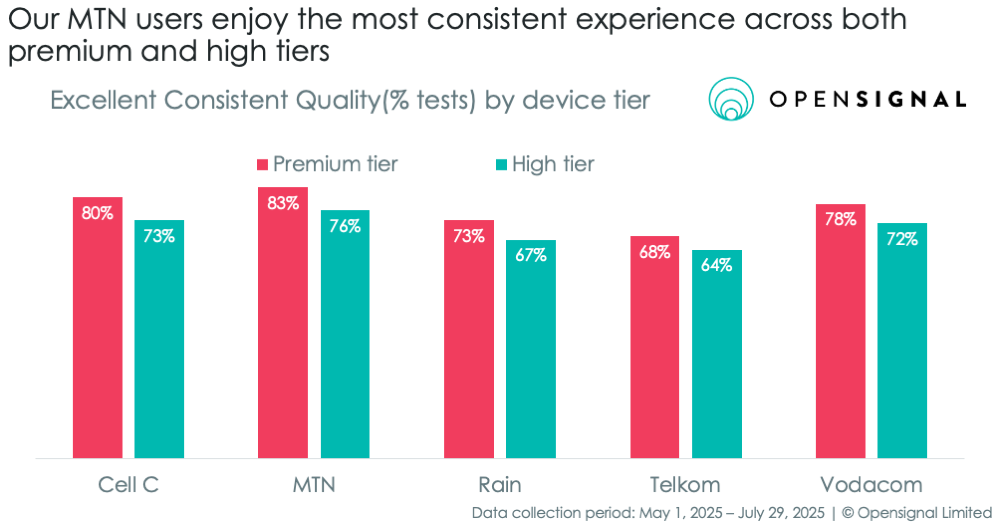
Here, MTN stands out as its users on premium tier devices achieve 83% ECQ, meaning 8 out of 10 tests meet the thresholds of a “good enough” experience. Cell C users also reach 80% ECQ on premium devices, but for high-tier the score falls to 73%.
5G brings gains but the impact differs.
The rollout of 5G in South Africa is uneven, with coverage concentrated in major cities and economic hubs where demand is highest. Vodacom, which launched 5G in May 2020, had deployed 3,063 sites by mid-2025, reaching 51.7% of the population. MTN, which went live a month later, now operates over 3,422 sites, covering 57% of population as per its latest report. By contrast, Telkom and Cell C remain well behind in 5G coverage and adoption, while Rain has focused primarily on fixed wireless access, which is why they are excluded from the 5G part of this analysis.
Yet despite this aggressive infrastructure build-out, adoption remains low. For many South Africans, 4G is still “good enough” with affordability barriers slowing the transition to 5G networks. Unsurprisingly, there is a big gap between what consumers “aspire to own” and what they can afford. A 2020 survey found that the "dream phone" for nearly half of South African consumers (46%) is an iPhone, followed by Samsung at 27%. This aspirational desire is reflected in the high-value contract offerings from major operators, which feature the latest premium devices such as the Apple iPhone 16 series and Samsung Galaxy S25 series.
However, the reality for the majority of the market is constrained by affordability. While a Samsung Galaxy S25 Ultra might be available on contract for R999 ($57) per month, or a Galaxy Z Fold7 for R1,749 ($98) per month on 36 months contract, these price points are beyond the reach of the average prepaid customer who spends between R100 and R500 on phone services per month. Operators are trying to bridge this gap by offering innovative financing models, such as: lay-by, rent-to-own, and financing schemes, offering consumers flexible payment solutions. These initiatives are some of the reasons behind the 63% increase in 5G smartphone shipments, despite the overall market's focus on budget devices.
So does having a 5G connection make a difference?
To answer this, we compared download performance across mid, high and premium tier devices on 4G and 5G for both MTN and Vodacom.
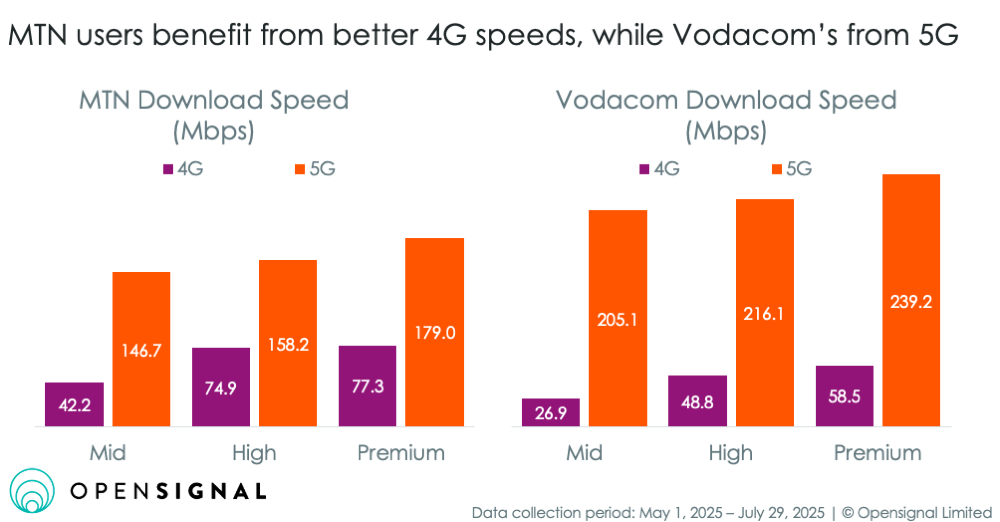
Vodacom delivers the best premium and 5G experience, with premium 5G speeds soaring past 239 Mbps. Its users see the largest gains when upgrading to premium devices and 5G. Vodacom is committed to 5G expansion, and it announced infra investment with R20bn ($1.1bn) commitment for 2025-26 financial year, targeting 5G services and deeper network coverage across South African underserved areas.
MTN offers a consistent experience, with premium and high-tier devices performing similarly and ECQ remaining strong across both. Its 5G uplift is solid but smaller than Vodacom’s. This partially stems from the fact that due to the pervasive issue of load shedding has disrupted MTN’s 5G rollout plans, forcing the operator to reallocate resources toward strengthening overall network resiliency.
Looking ahead
South Africa’s premium users experience better mobile performance, which in a mobile-first market matters a lot. For operators, these high-value customers drive revenue, and bundling strategies amplify the perceived value of their deals, justifying higher monthly spend and reinforcing brand loyalty. The primary competition for both operators lies in attracting and retaining these lucrative postpaid subscribers.
Yet, unless operators and policymakers succeed in scaling device accessibility, the risk is a two-speed mobile market: one group of premium users benefitting from faster speeds and more consistent networks, while the mass market remains stuck on legacy 2G/3G technologies. While South Africa communicated plans to sunset its 2G and 3G networks by 2027, in order to unlock valuable spectrum for expanding 4G and 5G services, this has been postponed quite a few times already. Even though ICASA introduced a ban prohibiting the approval and activation of new 2G and 3G only devices in 2024, this necessitates a proactive policy to migrate users away from legacy tech.
Subscribe to our newsletter & reach out to us for more insights, and why not check our latest insights and Mobile Network Experience report.
Device segmentation methodology
We use DeviceAtlas hardware classification to segment devices into five categories: entry level, low tier, mid tier, high tier, and premium. These categories align with common classifications in the cellular industry but also have broader applicability.
The classification is based on a wide range of hardware characteristics, including: screen capabilities, connectivity supported, device RAM, number of CPU cores, ect. This approach allows us to consistently analyze performance across device types and user segments.
Opensignal Limited retains ownership of this insight including all intellectual property rights, data, content, graphs & analysis. Reports and insights produced by Opensignal Limited may not be quoted, reproduced, distributed, published for any commercial purpose (including use in advertisements or other promotional content) without prior written consent. Journalists are encouraged to quote information included in Opensignal reports and insights provided they include clear source attribution. For more information, contact [email protected].
