


Authored by Sylwia Kechiche, Data support by Robert Wyrzykowski
Spectrum is the invisible foundation of wireless infrastructure, and decisions taken today will define how inclusive, competitive, and resilient connectivity becomes in the next decade.
At the Digital National Summit (ASEAN edition) in Kuala Lumpur, Opensignal joined the GSMA Spectrum team to engage policymakers and regulators on “Building ASEAN digital infrastructure through spectrum harmonisation and spectrum planning for IMT towards 2030.”
While the Association of Southeast Asian Nations (ASEAN*) is a diverse range of countries with different economies, cultures and incomes, this summit made it clear that as a region, ASEAN nations are aligned on their common ambitions when it comes to extending connectivity to all. In spectrum strategy terms, the direction of travel to embracing 5G and technological innovation is clear: legacy is fading, but the future remains different throughout the region, as country-level dynamics shape the realities of spectrum availability, regulatory certainty and ultimately, network deployment.
Key takeaways:
- Legacy sunsetting of 2G and 3G networks: Shutting down legacy 2G/3G networks will free up valuable spectrum, directly improving user experience.
- Spectrum policy defines 5G impact: Assigning mid-band early translates into significant speed uplifts; without it, 5G deployment risks raising consumer expectations that are not met - notably the lack of significant improvements to speed.
- Next frontier: the future of AI, cloud, and the region’s digital economies will all depend on a robust connectivity foundation, which in turn is influenced by spectrum decisions taken today.
Network evolution and spectrum refarming
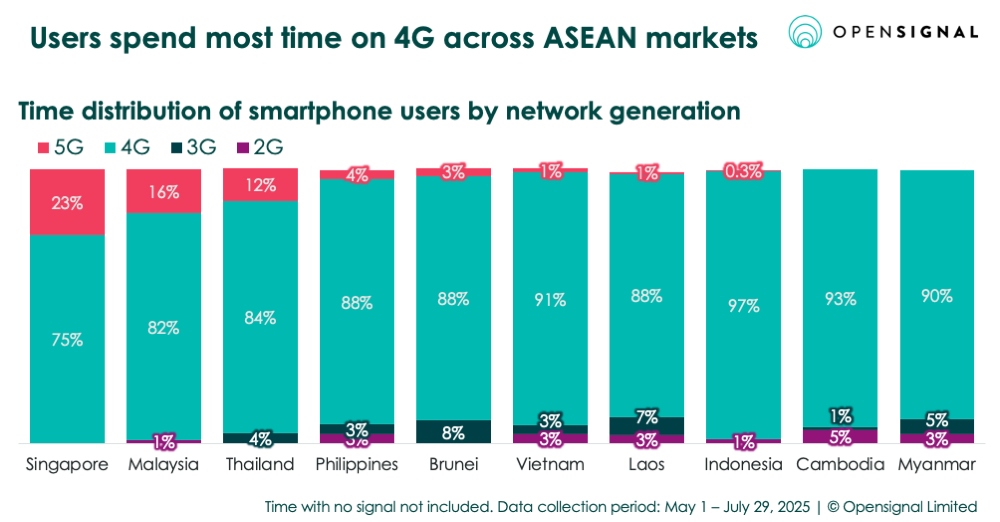
Opensignal data shows that reliance on 2G and 3G networks is rapidly diminishing across ASEAN:
- Singapore sunsetted its 2G networks more than eight years ago in April 2017. The original target for 3G shutdown of July 31, 2024 was adjusted to give a small number of remaining customers more time to switch, however, all operators switched off 3G services by November 2024.
- Malaysia switched off its 3G network in March 2022, as part of the Jalinan Digital Negara (JENDELA) plan, a national initiative to improve digital infrastructure and migrate existing spectrum from 3G to 4G.
- Indonesia’s 3G network shutdown was a phased process led by individual operators: XL Axiata shut down 3G services in March 2022, followed by Indosat Ooredoo Hutchison at the end of 2022, and Telkomsel in May 2023.
- Thailand has already decommissioned 2G services and is pushing ahead with 4G and 5G upgrades.
- Brunei Darussalam’s 2G networks have been already shut down, Unified National Networks (UNN) announced that network sunset took place in June 2021.
- In the Philippines, the National Telecommunications Commission (NTC) issued Memorandum Circular 003-09-2025 for the Decommissioning of the 3G and 2G Network Services on 28 August 2025. 3G networks are to be switched by 31 December 2025.
The 2G and 3G switch off process is a critical component of the region’s pathway to improved mobile services, as the availability of refarmed 2G and 3G spectrum will directly impact the end-user experience. By reallocating low- and mid-band spectrum, operators can expand coverage and increase capacity, making 4G networks more resilient and ensuring 5G services aren’t only an urban luxury. Opensignal highlighted this in our Global Network Excellence Index: countries that accelerate legacy shutdowns and reallocate spectrum see faster, more equitable improvements in user experience.
5G rollouts: a mixed picture
According to Digital Nations 2025: Achieving the ASEAN Connectivity Strategic Plan, 5G technology plays a crucial role in driving digitalisation initiatives across the ASEAN region. Today, commercial 5G services are live in eight member states - Brunei Darussalam, Indonesia, Laos, Malaysia, Philippines, Singapore, Thailand and Vietnam.
But the real question is: how much better is 5G compared to 4G for end users?
Opensignal’s analysis shows that the answer varies widely across the ASEAN region, and it depends on two critical factors:
- The spectrum bands assigned for 5G, particularly the availability of harmonised mid-band spectrum, such as 3.5 GHz.
- The strength of underlying 4G networks, which remain the dominant technology in most markets and set the baseline against which 5G uplift is measured.
While upper mid-band (3.5 GHz) spectrum accounts for about 66% of Opensignal readings, adoption across ASEAN remains uneven. Spectrum assignment and refarming timelines vary widely between markets.

3.5 GHz is widely used in Malaysia, as 200 MHz of the 3.5 GHz band (and 2 x 40 MHz of 700 MHz band) was first assigned to the government's single wholesale network, Digital Nasional Berhad (DNB), in early 2021.
In Singapore, the Infocomm Media Development Authority (IMDA) awarded licenses for the 3.5 GHz band in June 2020. These licenses were granted to Singtel and a consortium of StarHub and M1. Now Singapore moves to 5G SA.
Brunei has allocated the 3.5 GHz band for 5G, but its use is still expanding with only 32 sites.
Vietnam's Authority of Radio Frequency Management (ARFM) in the Ministry of Information and Communications (MIC) – recently merged and renamed as the Ministry of Science and Technology – held its first successful 5G spectrum auctions in early 2024. It has now released spectrum in the 700 MHz band in 2025, with the commercial network rollout ongoing encouraged by the 15% capital expenditure subsidy to operators deploying at least 20,000 BTS in 2025.

Where mid-band spectrum has been allocated early and deployed at scale, such as in Malaysia, Singapore, Vietnam, and the Philippines, our users experience a significant uplift, with speeds improving around sixfold. In contrast, markets where spectrum is constrained or rollouts remain fragmented, such as Indonesia, Brunei, and Laos deliver only marginal gains, showing that 5G is only as strong as the policy and spectrum frameworks that underpin it. In particular:
- Malaysia leads with the strongest uplift. At 6.3x, Malaysia demonstrates how spectrum refarming and coordinated policy can deliver a step-change in user experience at least in the early days of 5G. While this would seem to validate the government’s early 5G focus through Digital Nasional Berhad (DNB), it is likely that Malaysian mobile consumers will see the benefit of 5G competition from a dual-network model following the licensing of U Mobile as the second 5G provider in March 2025 and its launch of a 5G wholesale network in August 2025. The Malaysian Communications and Multimedia Commission (MCMC), is also commencing a major spectrum review on allowing IMT bands other than 700 MHz and 3.5 GHz to be used for 5G services.
- Singapore, Vietnam, Philippines report uplifts of 5.7–5.8x, underscoring that where mid-band spectrum is widely available, users feel the benefits immediately
- Thailand moderate uplift despite early launches. Thailand was one of the first ASEAN countries to auction 5G spectrum (2020), however, our data shows only a 3.9x uplift in speed. The delayed timeline for 3.5 GHz spectrum (anticipated to be made available between 2027 and 2029) and uncertainty regarding market structure and competition in a duopoly risks slowing progress.
- Brunei's uplift hides another story. The 5G over 4G uplift of 3.2 hides an important fact: Brunei’s 4G speeds are the highest among the countries analyzed, at 56.5 Mbps, while its average 5G speed reaches 181.4 Mbps. This is particularly notable given that much of the country’s 5G service is delivered over the 700 MHz band.
- In Indonesia challenges persist. Operators have made commendable progress in retiring legacy networks. However, the Indonesian regulator, Komdigi, has not yet auctioned the 700 MHz and 2.6 GHz bands, which are vacant and would provide both coverage and capacity spectrum sought by industry. Even more challenging is the 3.5 GHz band, globally recognised as the “sweet spot” for 5G, remains tied up with satellite services.
- In Cambodia, even though a comprehensive 5G study was undertaken by the ministry and regulator, the release of the 3.5 GHz band has not occurred, nor have operators operating licenses be amended to allow them to provide 5G services. This is likely to occur in late 2025 or early 2026.
The Next Frontier: Beyond Connectivity
As the ASEAN region looks towards 2030, spectrum availability is not only about faster speeds, it is central to enabling the next wave of digital transformation. Emerging technologies like AI, cloud computing, and data-driven economies will place further demands on connectivity. Without sufficient spectrum, these opportunities risk being unevenly realised.
At the ASEAN Digital Nation event, this direction of travel for regional connectivity requirements was clear:
- Microsoft announced a $4bn investment in data centres in the region.
- Ericsson stressed that AI’s societal impact hinges on cloud and mobile infrastructure.
- With ASEAN’s youthful population, there is a demographic dividend waiting to be unlocked — provided investments in skills, digital talent, and inclusive infrastructure are prioritised
Policymakers and regulators across ASEAN face the dual challenge of ensuring efficient spectrum use while preparing for the next wave of IMT technologies. By facilitating the retirement of legacy networks, harmonising spectrum assignments, and clearing mid-band spectrum, the region can build the resilient digital infrastructure needed to power inclusive growth through 2030 and beyond.
For further insights and a deeper analysis of the impact of spectrum on mobile network experience, subscribe to Opensignal’s newsletter. To read more about spectrum, visit GSMA Spectrum, and for more APAC content, visit GSMA Asia Pacific.
* The Association of Southeast Asian Nations (ASEAN) has 10 current member states: Brunei, Cambodia, Indonesia, Laos, Malaysia, Myanmar, the Philippines, Singapore, Thailand, and Vietnam.
Opensignal Limited retains ownership of this insight including all intellectual property rights, data, content, graphs & analysis. Reports and insights produced by Opensignal Limited may not be quoted, reproduced, distributed, published for any commercial purpose (including use in advertisements or other promotional content) without prior written consent. Journalists are encouraged to quote information included in Opensignal reports and insights provided they include clear source attribution. For more information, contact [email protected].
