


At this year’s FTTH Congress CEE 2025, operators, vendors, policymakers, and investors gathered to discuss one of the region’s biggest success stories: the rapid expansion of fiber networks across Central and Eastern Europe (CEE).
With impressive rollout progress and growing competition, CEE has become one of Europe’s most dynamic fiber markets. But as the discussions revealed, coverage is just a first step, adoption, resilience, and user experience matter too.
Key takeaways:
- Fiber rollout on track, adoption still catching up. While FTTH coverage in CEE has reached 74.1%, adoption lags at 43%, highlighting that availability alone doesn’t guarantee take-up.
- Looking to open-access models as a driver of sustainable growth. Panelists agreed that collaboration and infrastructure sharing are already shaping the next phase of fiber development. In order to create a competitive yet sustainable market, avoiding overbuild, aligning on standards, and ensuring fair pricing are key.
- Resilience is becoming a competitive differentiator. From Ukraine’s “Power Independent Internet” to localized energy reserves and network segmentation, resilience is emerging as a defining capability – ensuring service continuity during crises and building long-term trust.
Policy and user experience will define the next decade. Harmonized EU policies and predictable regulation facilitates network deployment, but the real measure of success is user adoption and real life experience – turning high-speed access into meaningful, everyday connectivity.
CEE’s FTTH growth story: rollout on track, take-up lags
According to the latest data from the FTTH Council Europe, the CEE region has achieved an average FTTH penetration rate of 43%, while coverage now stands at 74.1%, almost matching the EU39 average (74.6%).
Yet the gap between coverage and adoption remains wide.
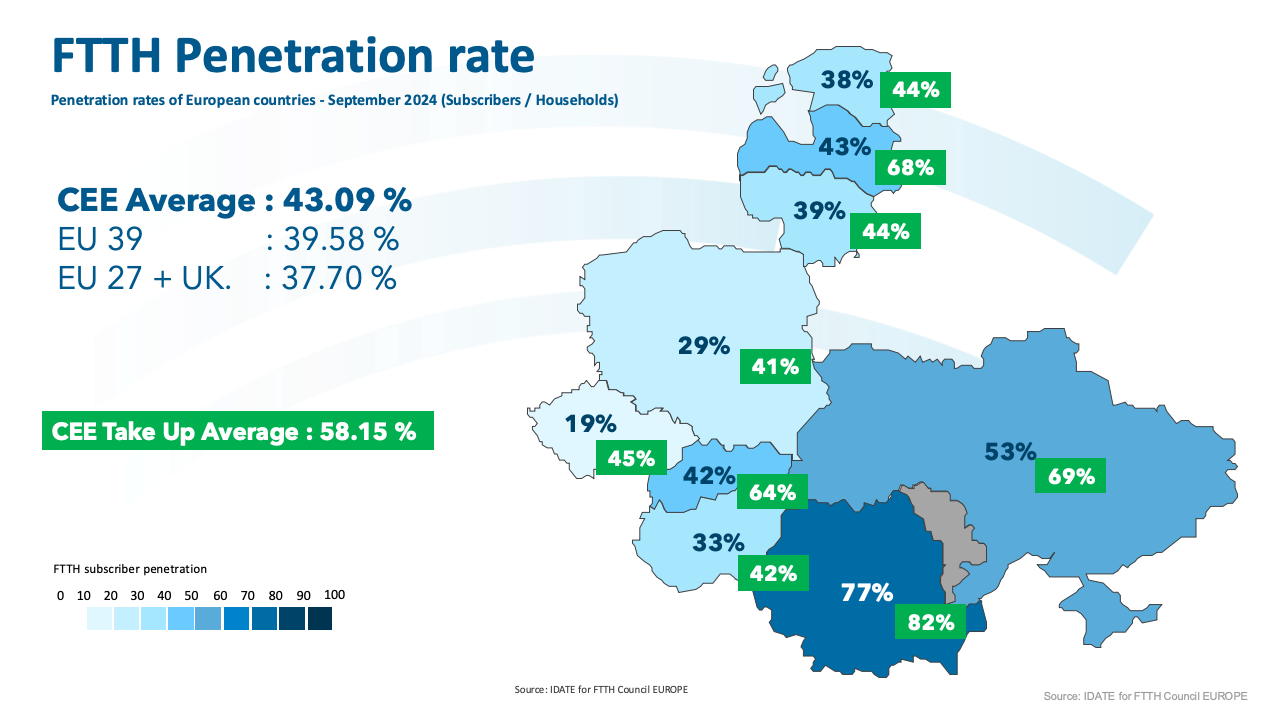
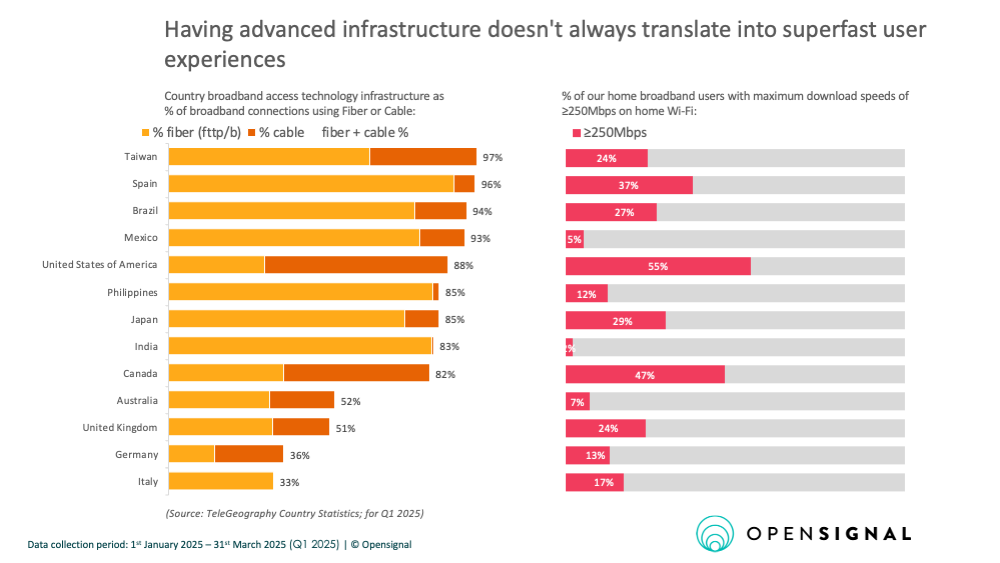
This disparity highlights that fiber availability alone does not guarantee adoption. Awareness, affordability, and in-home connectivity are critical to unlocking the full potential of fiber. As we often see in our own data, the in-home Wi-Fi experience can make or break overall satisfaction, regardless of how fast or reliable the access network is.
Poland’s journey: from deployment to adoption
Poland’s progress took centre stage at the congress, with local operators showcasing how open-access networks and public-private partnerships are transforming the market. Speakers agreed that infrastructure investment must go hand in hand with education and government support.
fiberhost’s Marta Wojciechowska stressed that while infrastructure is built to commercialize and generate returns, its broader societal benefit lies in lifting communities to a higher level of digital inclusion.
For NEXERA, raising awareness remains a key challenge. Many households in rural areas remain unaware that fiber is already available in their villages. Similarly, Polski Światłowód Otwarty’s Ignacio Irurita emphasized that regulatory predictability and clear rights-of-way (RoW) frameworks are essential to sustaining investor confidence and ensuring long-term rollout momentum.
Meanwhile, Światłowód Inwestycje’s Magdalena Russyan pointed out that avoiding overbuild and fostering local collaboration are key to achieving sustainable expansion.
Panelists agreed that the country’s fiber journey mirrors its historical electrification drive of the 1950s – a long-term process requiring both infrastructure and education. They have also noted that digital inclusion demands the same sustained commitment to ensure everyone benefits from the connectivity revolution.
Open Access: financial sustainability in the spotlight
With higher debt costs and increasing investor scrutiny, the financing landscape for fiber is evolving. Projects ought to demonstrate clear business models and regulatory stability to attract long-term investment.
During the open access session, experts including Herbert Flatscher (FiberEins TK GmbH), Wojciech Dziomdziora (NEXERA), Hervé Dubreil (Orange), and William Kennish (ING) explored how wholesale and open-access models are reshaping competition and efficiency across Europe.
France emerged as a leading example, where over 50% of Orange’s FTTH customers are wholesale-based, showing that mature open-access models can be both profitable and scalable. Meanwhile, Slovakia and Poland are still developing their frameworks but are showing promising signs of progress thanks to collaboration and limited overbuild.
However, the panel cautioned that price erosion remains a real risk. Open access encourages competition, but long-term sustainability requires maintaining fair pricing for both operators and consumers to preserve investment incentives.
Policy Direction: The EU’s Digital Decade Vision
In her keynote, Kamila Kloc, Director for the Digital Decade & Connectivity at the European Commission, outlined the EU’s roadmap for a more integrated and investment-friendly digital market. She highlighted ongoing initiatives such as the Digital Networks Act and Gigabit Infrastructure Act, designed to harmonize authorization regimes, simplify permitting, and strengthen network resilience across Member States. The remaining challenges include bridging the rural-urban divide, boosting take-up, and addressing regulatory fragmentation across Europe.
She emphasized that reliable power underpins reliable connectivity, noting that resilience monitoring must extend beyond national borders to ensure a robust pan-European digital ecosystem.
Resilience under pressure: Ukraine’s Example
The war in Ukraine underscored the critical importance of resilience – not just for business continuity, but for national security. Ukrtelecom presented how it has restructured its network architecture to withstand cyber and physical threats through segmentation and isolation between IT and telecom cores, effectively reducing vulnerability and enhancing operational stability.
The company’s “Power Independent Internet” concept has become a market differentiator, inspired by the urgent need to keep communities connected even under severe power disruptions. By redesigning its FTTH network architecture to rely on less active equipment and minimal power backup, Ukrtelecom ensures that customers can stay online using a small power bank for home routers, making connectivity both resilient and energy-efficient.
From a technical standpoint, this model demonstrates how FTTH can operate independently of central power supply – a key advantage during outages or attacks. Ukrtelecom has also redesigned its fuel supply chain, moving away from reliance on oil refineries and railway delivery, instead securing local fuel reserves to power generators in emergencies.
To strengthen resilience further, the operator has deployed bulletproof infrastructure, drone and anti-drone detection systems, and rapid-response field teams equipped to restore connectivity in crisis zones. These measures have allowed Ukrtelecom not only to maintain service continuity but also to position resilience as a core business value.
I had the privilege of moderating the session that featured this powerful example of innovation under pressure. In times of crisis — whether caused by natural disasters, geopolitical shocks, or large-scale cyberattacks — connectivity becomes more than just a service; it becomes a lifeline. As Alexey Khakhlyuk from Ukrtelecom highlighted, connectivity can literally save lives. The ability to communicate, coordinate emergency response, and keep people informed and connected all depend on the strength and adaptability of our networks.
The crisis has also united competitors, with national roaming agreements and mutual support among operators becoming lifelines for maintaining connectivity, a powerful example of industry solidarity in the face of adversity.
The road ahead - collaboration, education, and experience
The fiber revolution in CEE is accelerating, from single-digit coverage a decade ago to near parity with Western Europe today. Yet the next stage of transformation will depend less on new cables and more on collaboration, education, and user experience.
As Opensignal data continues to show, connectivity quality doesn’t end at the doorstep. To truly bridge the digital divide, policymakers, operators, and communities must work together to ensure that high-speed access translates into meaningful, everyday experiences for users.
Because fiber is more than infrastructure; it is the foundation of a resilient and inclusive digital future.
Read our latest regional and global reports to explore how network quality impacts real-world user experiences. Get in touch to discuss how Opensignal’s insights can help you benchmark performance, identify opportunities, and plan smarter network investments.
Opensignal Limited retains ownership of this insight including all intellectual property rights, data, content, graphs & analysis. Reports and insights produced by Opensignal Limited may not be quoted, reproduced, distributed, published for any commercial purpose (including use in advertisements or other promotional content) without prior written consent. Journalists are encouraged to quote information included in Opensignal reports and insights provided they include clear source attribution. For more information, contact [email protected].
