


In the latest spectrum auction, the U.K.’s three mobile operators — EE, O2, and Vodafone/Three — each spent £13 million in the Principal Stage, securing 800 MHz in the 26 GHz band and 1 GHz in the 40 GHz band. In total, 5.4 GHz of mmWave spectrum was awarded for £39 million — but final costs will be confirmed after the Assignment Stage, when operators bid for specific frequency positions.
These licenses cover designated “High Density Areas,” such as cities, stadiums, and train stations. Outside these zones, the same bands are available on a first-come, first-served basis through Shared Access licenses.
The U.K. now joins the growing list of markets that have already auctioned mmWave spectrum for mobile use. Many European countries — including Italy, Finland, Austria, Greece, Croatia, and Spain — as well as several in Asia-Pacific, such as Australia, Singapore, South Korea, Taiwan, and Thailand, have done the same. The U.S. leads the pack, having completed multiple auctions across several mmWave bands. But, what is the actual impact of mmWave on the mobile network connectivity? After observing the spectrum landscape for many years, I decided to examine how widely mmWave is used on mobile users’ devices.
The promise and the reality
The excitement around mmWave is easy to understand. Thanks to its high frequencies and wide bandwidth, mmWave has the potential to supercharge 5G with massive capacity and ultra-low latency — theoretically making it the “holy grail” of mobile connectivity.
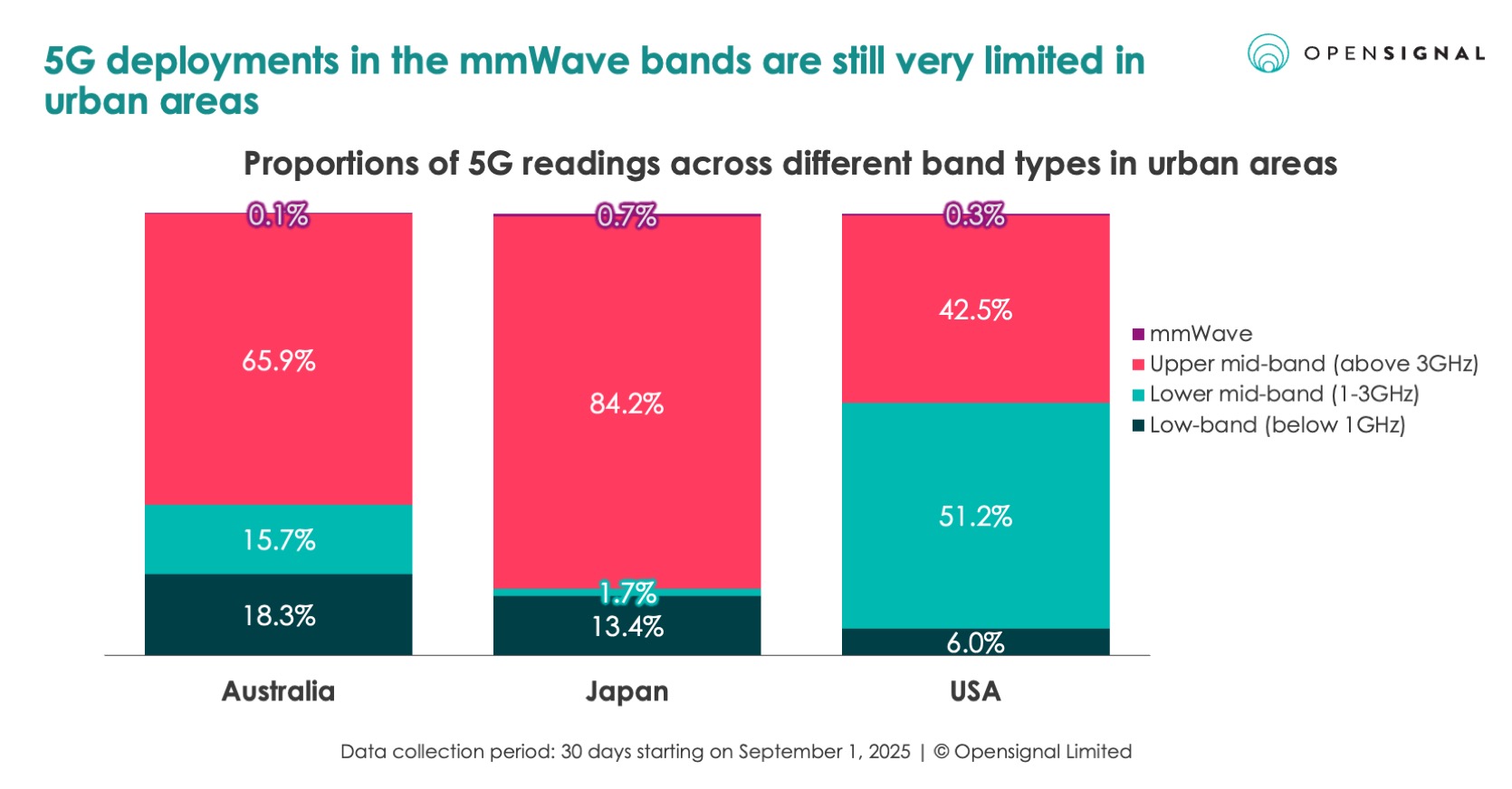
Yet, several years into the global 5G rollout and after many mmWave auctions completed, mmWave use remains extremely limited. According to Opensignal data, mmWave readings in urban areas in Australia, Japan, and the U.S. range between just 0.1% and 0.7% — a tiny fraction in overall, but still substantially higher than in many other countries where mmWave use is practically non-existent. Despite owning licenses for years, most markets have yet to begin significant deployments.
So what’s holding it back?
mmWave’s biggest strength — its short wavelengths that enable huge data throughput — is also its major weakness for widespread deployments. These signals travel only short distances and struggle to penetrate buildings. That means smaller coverage areas and the need for separate indoor infrastructure. A single mmWave cell typically covers only a few hundred meters, so providing citywide coverage would require a dense network of small cells. Building such a network comes with substantial logistical and financial challenges, especially around power supply and fiber backhaul.
However, an even larger limitation for a wider 5G mmWave adoption are the mobile devices. Most smartphones today don’t support mmWave frequencies. Adding this capability requires advanced chipsets and precise calibration, which increase manufacturing costs. As a result, only premium devices tend to support mmWave, while mid-range and budget models omit it to remain affordable. And even regional models of premium devices, such as the iPhone, don’t support mmWave outside the U.S. and Puerto Rico.
A niche, for now
For the time being, 5G mmWave will remain best suited for high-traffic zones and specialized applications. For everyday users, the benefits are still limited. Until mmWave becomes standard in most devices, and operators have a stronger business case to justify dense deployments, its rollout will likely remain slow and selective.
But that doesn’t mean the story ends here. As devices develop and urban networks mature, mmWave could yet fulfill its promise — transforming how we experience connectivity in the cities and high-traffic areas. The question isn’t if it happens, but when and to what extent.
Opensignal Limited retains ownership of this insight including all intellectual property rights, data, content, graphs & analysis. Reports and insights produced by Opensignal Limited may not be quoted, reproduced, distributed, published for any commercial purpose (including use in advertisements or other promotional content) without prior written consent. Journalists are encouraged to quote information included in Opensignal reports and insights provided they include clear source attribution. For more information, contact [email protected].
