


Authored by Robert Wyrzykowski, Data support by Chris Mills
When Starlink launched in Indonesia in May 2024, it arrived with bold promises to bring fast internet and bridge the digital gap in underserved regions. Indeed, it is filling gaps where fiber and 5G still don’t reach. Yet a closer look at its pricing model reveals a paradox: while Starlink connects remote areas physically, its sky-high costs mean the service remains financially out of reach for many households it aims to serve.
Key findings:
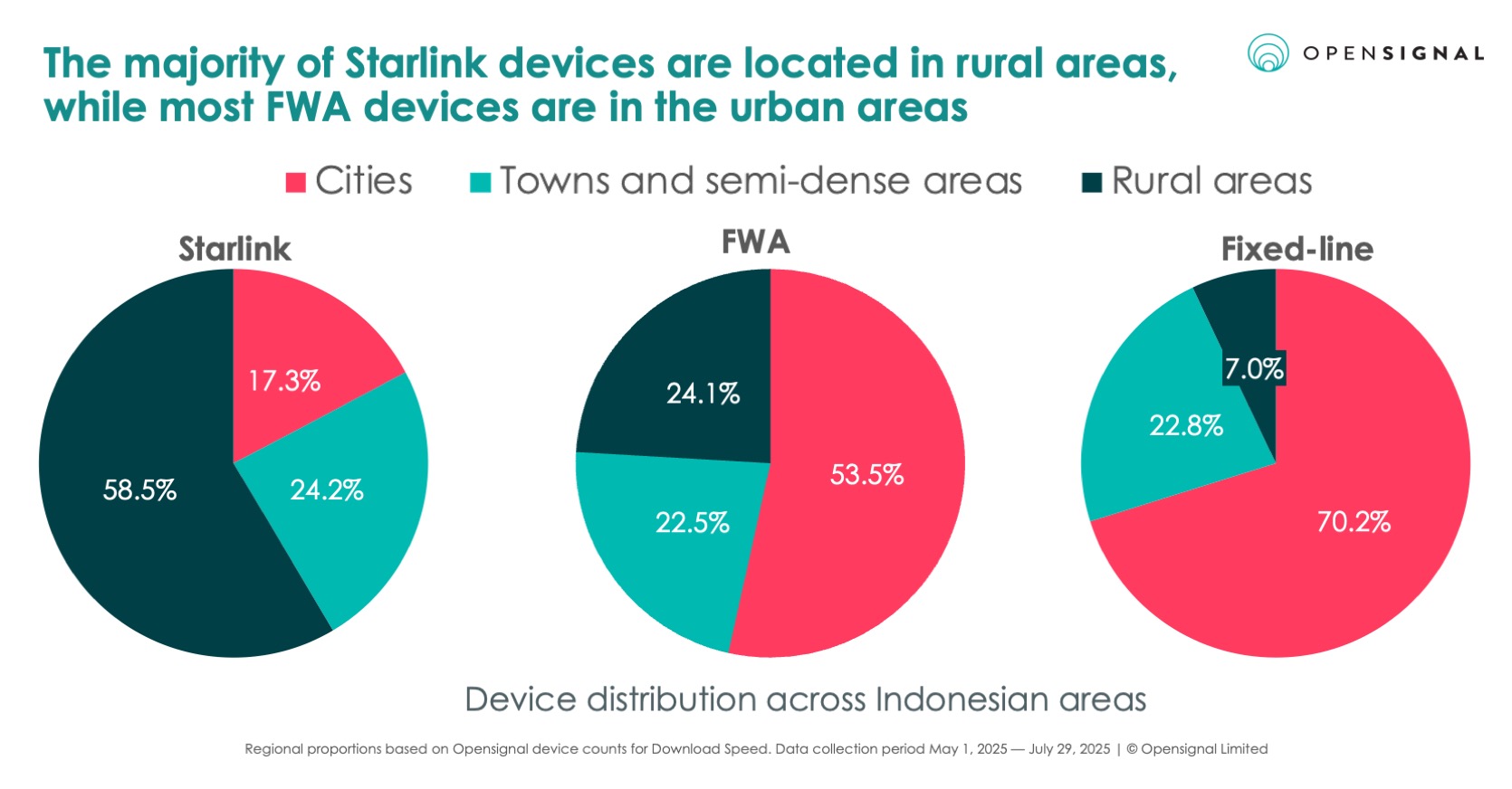
- Starlink is predominantly used in rural areas: Our data shows that nearly 60% of Starlink users are in rural Indonesia, versus just 24% for FWA and 7% for fixed-line services, which are far more concentrated in cities.
- Some rural areas in Indonesia still struggle for connectivity: many kabupatens in regions like Kalimantan, Maluku, and Papua see over 5% of time without mobile signal. This opens opportunities for both Starlink and FWA deployments to narrow the urban-rural connectivity gap.
- High prices hinder wide adoption: Starlink’s steep hardware and data costs remain a major barrier for mass adoption, especially in rural households. Meanwhile, FWA remains a more affordable alternative to typical households.
Rural Indonesia becomes Starlink’s stronghold, but for whom?
Starlink’s mission is clear: to bridge coverage gaps in remote areas, including for health and education. In rural Indonesia, where fiber rollout is slow and costly, both satellite and Fixed Wireless Access (FWA) play key roles.Satellite deployment is often easier, bypassing the need for ground infrastructure.
Using the DEGURBA methodology, Opensignal classified Indonesia into urban, towns/suburbs, and rural areas. The differences are stark: nearly 60% of Starlink users are in rural areas, but only 17% in cities. FWA shows the opposite trend,concentrated in cities, with just a quarter of devices in rural areas. Fixed-line ISPs are even more focused on rollouts in urban areas — more than 70% of Opensignal’s fixed-line users in Indonesia are located in cities, compared with only 7% in rural areas.
While Starlink temporarily paused new sign-ups due to high demand, fixed-line broadband still dominates rural markets with over 70% share among Opensignal users. In contrast, 23% of Opensignal users in rural areas connect via Starlink — nearly four times more than those using FWA.
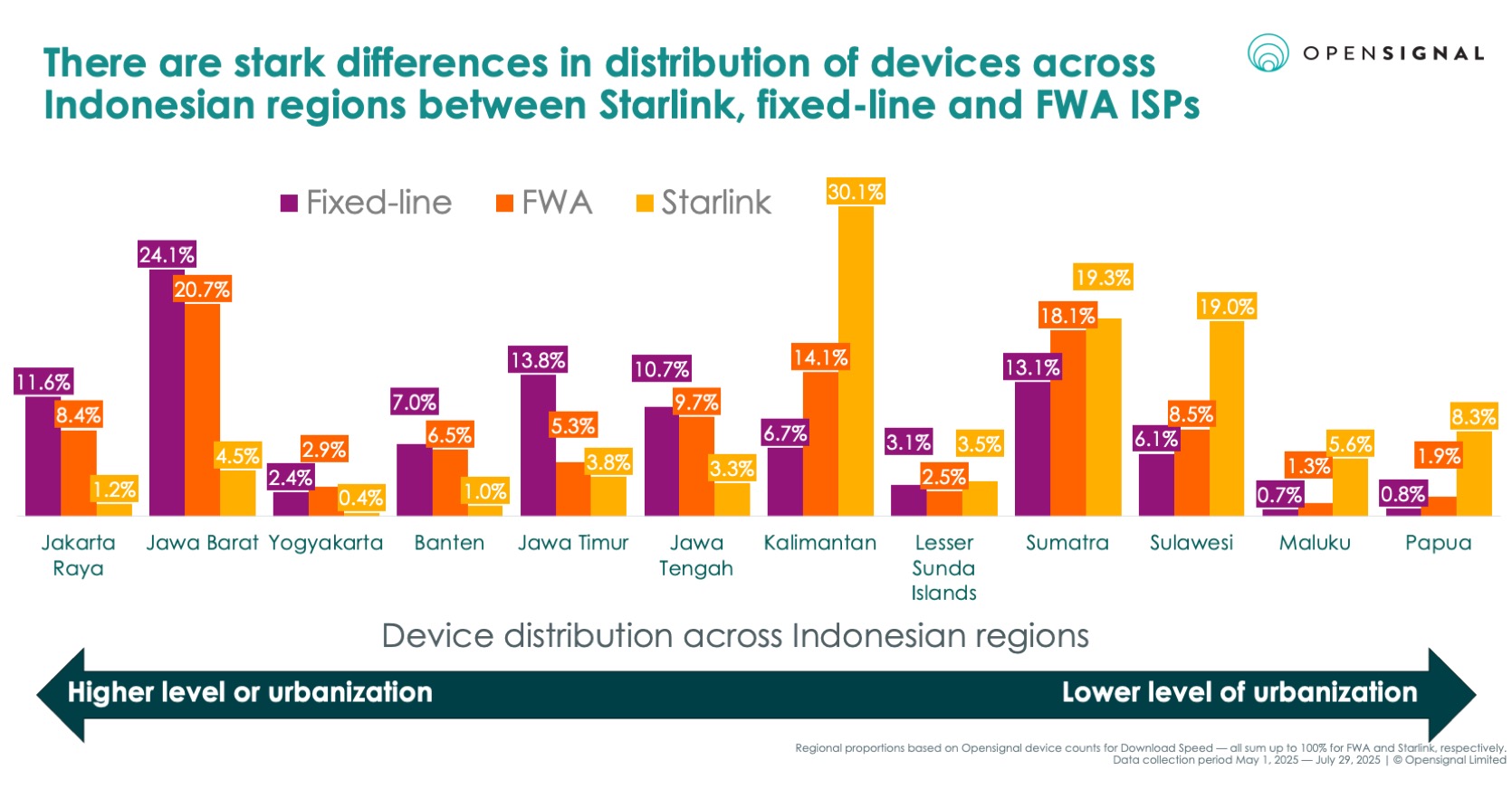
Across regions, Starlink’s presence is strongest in less urbanized areas like Kalimantan, Sulawesi, Maluku, and Papua, while FWA dominates in Jawa. The pattern underscores Starlink’s role as a rural connectivity gap-filler, targeting areas where fiber and mobile FWA coverage is limited. Meanwhile, domestic FWA and fixed-line players focus mainly on competitive urban markets, where their propositions can compete with fixed-line providers on price while offering good enough quality of services.

The lower presence of FWA in rural areas of Indonesia may be linked to the high cost of backhaul and the lower return on investment anticipated by operators. As a result, kabupatens in Kalimantan, Maluku, and Papua record higher proportions of time with no mobile signal, with several areas exceeding 5% of time without connectivity. In contrast, most kabupatens in western Indonesia experience relatively low levels of signal unavailability.
The deployment of Starlink’s satellite broadband services in less urbanized regions could significantly enhance network reach and reliability, helping to reduce connectivity disparities between urban centers and rural or remote parts of Indonesia. Although this still opens opportunities for mobile operators to deploy infrastructure in these areas and provide both mobile and FWA services.
Starlink pricing: why Starlink remains a premium solution for the few
Starlink’s initial focus is on connecting 2,700 health clinics and community health centers across Indonesia. Its business and community plans may appear cost-effective on a per-user basis, but this approach effectively limits internet access to shared community sites. However, for individual residential users who want to install the internet access at home, Starlink’s high pricing remains the main barrier for adoption, despite its strong rural presence, especially in areas where the FWA struggles with coverage.
Hardware costs in Indonesia are steep for individual users: the Starlink Mini kit (IDR 4.75 million / US$291) is far above 4G FWA routers from IOH, Telkomsel, or XL, which start from around IDR 400,000 (US$24). On top of that — even though the price of the regular Starlink kit has dropped from its launch price of IDR 7.8 million (US$478) to IDR 5.9 million (US$362) — Starlink currently adds a demand surge fee of IDR 8-9.4 million (US$490-574), pushing entry costs even further out of reach.
Monthly fees for Starlink also remain far costlier than FWA options. The most affordable Starlink plan, Residensial Lite at IDR 479,000 (US$29.51), exceeds most FWA packages — even though it already is priced much lower for the Indonesian market than the cheapest Starlink plan in the U.S., starting from US$80.
This price gap is striking when compared against Indonesia’s average monthly wages of IDR 3.09 million (US$190). The Residensial Lite plan costs nearly one-sixth of that income, while the regular plan approaches a quarter. Hardware adds an even bigger burden — Starlink’s kit exceeds the average monthly wage, with temporary high-demand fees pushing it further out of reach. For most households, especially in rural areas where earnings are lower, Starlink remains simply unaffordable.
Provider | Plan | Monthly price in IDR (US$) | Hardware price in IDR (US$) | Comments |
Unlimited plans — Residensial, Residensial Lite, Jelajah | Residential: 750,000 ($46) Lite: 479,000 ($30) Jelajah: 1,639,000 ($101) | Mini Kit: 4,750,000 ($291) + high demand fee 9,375,000 ($574) Standard Kit: 5,900,000 ($362) + high demand fee 8,000,000 ($490) | Jelajah — roaming (RVs, caravans). Lite is deprioritized vs. Residential during peak times which may result in slower speeds | |
Speed tiers 50-200Mbps | 230,000-490,000 ($14-29) | a monthly rental of 80,000 ($5) |
| |
45GB – 300GB | 82,000-410,000 ($5-25) | 445,000–2,879,000 ($27–177)* source |
| |
Value (48GB) – Ultimate (198GB) | 105,000-285,000 ($6-$18) | 394,000–524,000 ($24–32)** | Requires monthly top-ups after starter quota. | |
75GB – 500GB | 75,000–250,000 ($5–15) | 399,000–629,000 ($24–39) |
|
* Higher prices include 5G gateways,
** Router prices for XL Satu Lite are estimated by deducting the recurring package costs of the Value, Smart, and Family deals.
By contrast, most FWA plans in Indonesia rarely exceed IDR 300,000 (US$18), even for large data allowances, and gateways are significantly cheaper. Our latest analysis of speed tiers shows that gateways using newer Wi-Fi generations deliver far better performance. Many users — particularly in emerging markets — still rely on outdated equipment, making in-home Wi-Fi a key bottleneck to achieving higher speeds.
Unlicensed ISP resellers are also widespread across Indonesia, further driving down entry costs. Looking ahead, Komdigi has allocated an 80 MHz block in the 1.4 GHz band to enable even more affordable FWA services, priced between IDR 100,000 and 150,000 (US$6–9) per month, with Surge and MyRepublic winning regional licences in the auction. Taken together, these factors make Starlink’s pricing a far less attractive and convenient option for typical consumers.
Complementary, not disruptive
In Indonesia, Starlink’s role so far is more complementary than disruptive. It extends connectivity where terrestrial networks fall short – but affordability limits its impact. While rural demand is strong, Starlink’s high costs and production expenses keep it out of reach for many – and affordability is a critical component of addressing digital inclusion.
While potential customers in Indonesia currently face a substantial premium due to high demand, there is hope ahead. The company has been reducing prices for its Starlink Mini kits in selected markets — including the U.S and Canada, the UK, Australia, and Zimbabwe — and has also lowered monthly service costs across several European countries. Looking ahead, Starlink’s success in Indonesia will depend on its ability to make services more affordable, as the company still holds significant potential to reshape rural connectivity across the nation.
If you’re interested in more on Indonesia’s telecom market, explore our recent reports on mobile and fixed services, as well as our study of Starlink vs. FWA performance in Canada. For tailored analysis, please contact us. And don’t forget to subscribe to Opensignal’s newsletter for deeper insights on Indonesia and global markets.
Opensignal Limited retains ownership of this insight including all intellectual property rights, data, content, graphs & analysis. Reports and insights produced by Opensignal Limited may not be quoted, reproduced, distributed, published for any commercial purpose (including use in advertisements or other promotional content) without prior written consent. Journalists are encouraged to quote information included in Opensignal reports and insights provided they include clear source attribution. For more information, contact [email protected].
