


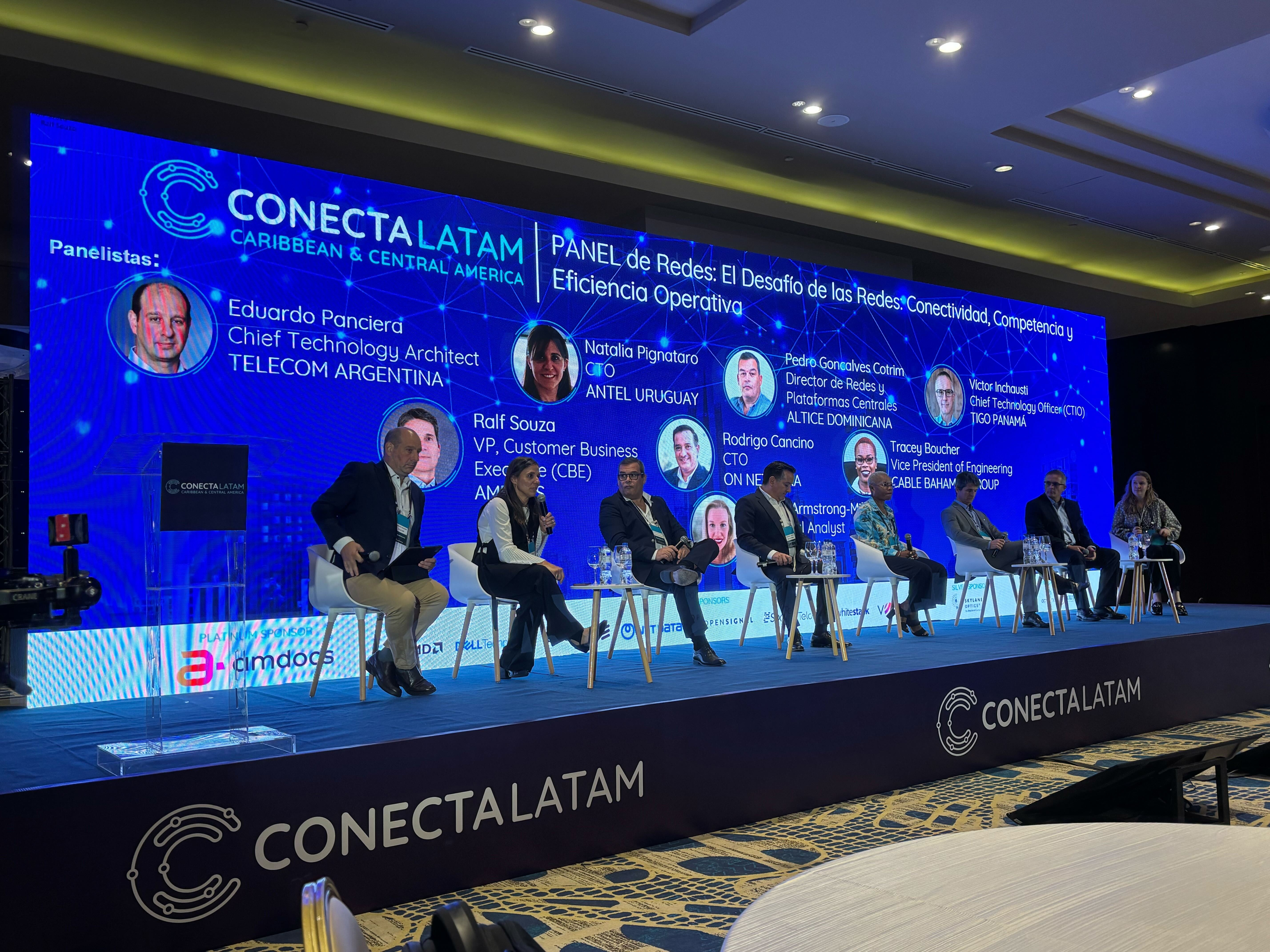
While conferences are often a sea of spokespeople sharing the latest and greatest in telecoms, Conecta LATAM stood out for the quality of the conversation. Across panels — and particularly in the discussion I moderated on connectivity, competition and operational efficiency with senior technology leaders from across the region — there was an unusually frank focus on what it actually takes to deliver resilient, sustainable connectivity in LATAM and the Caribbean. In this blog, I’ll unpick some of the key topics from the event, both from my panel and more broadly – covering the region’s progress towards 5G, the need for partnerships, and a measured approach to innovation.
1. Laying the Foundations: Pragmatic 5G and Network Investment
It’s an unavoidable truth that LATAM’s adoption of 5G has lagged behind other parts of the world — with GSMA Intelligence data placing 5G adoption at between 9% of connections in the Caribbean to 14% in Southern America as of Q3 2025. However, while other regions may have been faster to market, many have run into roadblocks translating technology to revenue and customer perception gains. Instead, LATAM has an opportunity to roll out 5G in a more conscientious manner — in line with the reality of high energy costs, lower ARPUs, and a need for greater consistency and network reach rather than flashy top speeds. This was emphasised on the panel I moderated by Tracey Boucher, Vice President of Engineering at Cable Bahamas Group — that the real change in customer expectation is for a network that just works reliably.
The implication is that LATAM has a chance to avoid some of the missteps seen in other regions — prioritising consistency, coverage and sustainability over headline-grabbing speeds, and aligning network investment more closely with what actually improves day-to-day user experience.
2. Why Partnerships Are Now Essential, Not Optional
Given the high costs of rollouts like those mentioned with 5G, a key theme across several panels was on the need for partnerships. For fiber rollouts, neutral-host fiber models have been an important part of Brazil’s broadband story, and are also being used to improve fiber penetration in Chile and Colombia. This was something Rodrigo Cancino, CTO at ON*NETFIBRA stressed during the discussion. Its neutral host fiber service has had positive results in the market at reducing the digital gap, allowing for investment in areas where individual operators would not otherwise be able to offer service due to financial constraints.
However, fiber is only part of the story. In a panel looking at digital transformation in the region, Enrique Coulembier, CEO of Chile’s Mundo Telecomunicaciones reiterated the need for public private partnerships to expand connectivity into underserved areas — and using the right mix of technologies between fixed wireless access (FWA), satellite or wired connectivity to cost-effectively provide services.
Taken together, these discussions highlighted that no single operator or technology can solve the region’s coverage challenges alone. Scalable connectivity in LATAM increasingly depends on collaboration — between operators, infrastructure providers and the public sector — to make investment viable beyond dense urban cores. This is essential to manage the vast differences in urban and rural experience we’ve seen in the region, such as in Brazil.
3. Innovation Where It Counts: Revenue, Efficiency and Reality
While consumer 5G may be lacking the so-called “killer application” that drives demand and revenue, there was continued optimism around specialized B2B 5G deployments. Top of the list was the use of 5G for media. One real-life example was shared by Jonas Ribeiro, Head of Infrastructure and Telecommunication Products, GLOBO around transmitting video footage live from events for content production. Here, the use of private 5G proved significantly faster to set up ahead of the live event compared to previous technologies, and the difference in latency compared to wired cameras was considered “imperceivable”.
However, the real innovation that everyone wanted to talk about was AI. While a lot of the consumer AI trends seemed like more “hype” than substance, operators in the region like Algar Telecom (a Brazilian regional telco) noted that AI was already driving value and improvements on the B2B side and the backend of networks. A critical deterministic factor for AI success was to start with a business outcome in mind — ensuring that the burden of managing AI didn’t outstrip the value it creates. Put differently — operators (and indeed the rest of us!) should not just consider whether AI can solve a problem, but whether it should. As we move past the initial buzz around AI, we’re hearing this more across different regions – such as on the panel my colleague, Sylwia Kechiche, moderated at MWC Doha.
This pragmatic approach to AI reflects a broader maturity in the region — one where technology decisions are increasingly filtered through the lens of operational reality, rather than hype or fear of missing out.
All of these trends underscored for me the real theme of the week — pragmatism. It’s easy to get swept away in extremes of the telecoms industry — whether that’s the potential of 6G or fiber connectivity, or the fear of declining revenues and soaring costs. However, the real progress comes from the decisions that drive sustainable, inclusive, and future-proof connectivity.
To read more of our insights, be sure to visit our insights page. In addition, we will be at MWC 2026, so follow this link if you would like to set up a meeting with us.
Opensignal Limited retains ownership of this insight including all intellectual property rights, data, content, graphs & analysis. Reports and insights produced by Opensignal Limited may not be quoted, reproduced, distributed, published for any commercial purpose (including use in advertisements or other promotional content) without prior written consent. Journalists are encouraged to quote information included in Opensignal reports and insights provided they include clear source attribution. For more information, contact [email protected].
