


Opensignal closed out the year with two global webinars unpacking the biggest developments that shaped mobile and broadband connectivity in 2025. Our analyst team unpacked developments across 5G, FWA, Wi-Fi, satellite, and the industry’s accelerating shift toward AI-driven operating models.
You can register to watch the recordings here:
For those who want to dive deeper, we have also made the presentation deck available, offering all charts and visuals referenced during the webinars:
But if you’re looking for the essential takeaways, read on.
Table of Contents:
5G matures globally but progress is uneven
Using Opensignal’s Global Network Excellence Index Time on 4G/5G metrics, a clear pattern emerges in 2025: operators that keep users on modern infrastructure for more of the time deliver significantly better real-world mobile experiences.
Time on 4G/5G captures the proportion of a user's experience happening on modern networks — one of the clearest indicators of network quality.
This year, network sunsets accelerated worldwide as operators across APAC, the GCC, and Europe switched off 2G and 3G and refarmed valuable spectrum to 4G and 5G — one of the strongest indicators of long-term commitment to next-generation networks.
Zooming into regional trends, we see very different stages of progress across global markets.
Europe: entering the 5G maturation phase
Europe made some of the most visible gains in 2025. With Poland and the Netherlands finally activating C-band, user experience surged, earning several operators “global rising star” recognition. Meanwhile, ongoing 3G shutdowns freed low-band spectrum that boosted indoor and rural performance.
Yet Europe’s progress remains fragmented: Time on 5G ranges from around 30% in Finland to roughly half that in some major markets, reflecting uneven maturity across the region.
APAC: global leader in Standalone 5G
Across APAC, 2025 reinforced the region’s leadership in 5G Standalone (SA), supported by:
- Strong enterprise demand for slicing, RedCap, and private 5G
- Government-backed national 5G roadmaps
- Early spectrum availability
- A robust 5G device ecosystem
Countries such as Malaysia and Indonesia completed their 3G sunsets, accelerating the shift to 4G/5G-only environments and strengthening overall performance.
Middle East & Africa: fast momentum, uneven foundations
In the Middle East, operators continued expanding 5G coverage while pushing FWA-led home broadband at scale. Several GCC markets are already preparing for 5G Advanced as part of their national digital strategies.
Across Africa, momentum is more gradual. While leading markets have begun their 5G rollout journey, only around 30% of African countries have awarded 5G spectrum, slowing continent-wide adoption. Still, early commercial launches and targeted investments in key cities signal an increasing pace ahead.
The Americas: a tale of two regions
From an Americas perspective, the divide is sharp:
- North America is now among the world’s most advanced 5G SA regions, with all three major U.S. operators offering nationwide standalone networks.
- Southern America, however, continues to face rollout delays driven by spectrum constraints, macroeconomic pressures, and more modest consumer demand for 5G.
The remaining challenge: 5G monetization
Despite progress in refarming and SA deployment, a common global theme remains: Operators continue to struggle to monetize 5G at scale. This is a key reason why SA rollout lags behind its technical potential, slowing progress toward 5G Advanced and next-generation capabilities.
FWA takes center stage
If 5G monetization is challenging, Fixed Wireless Access (FWA) is the clear exception – emerging as one of the most successful commercial stories of the 5G era.
In India and Indonesia, FWA is significantly increasing time spent on Wi-Fi, driven by offerings such as Jio AirFiber, which leverages 5G SA capacity and network slicing to maintain performance without congesting mobile networks.
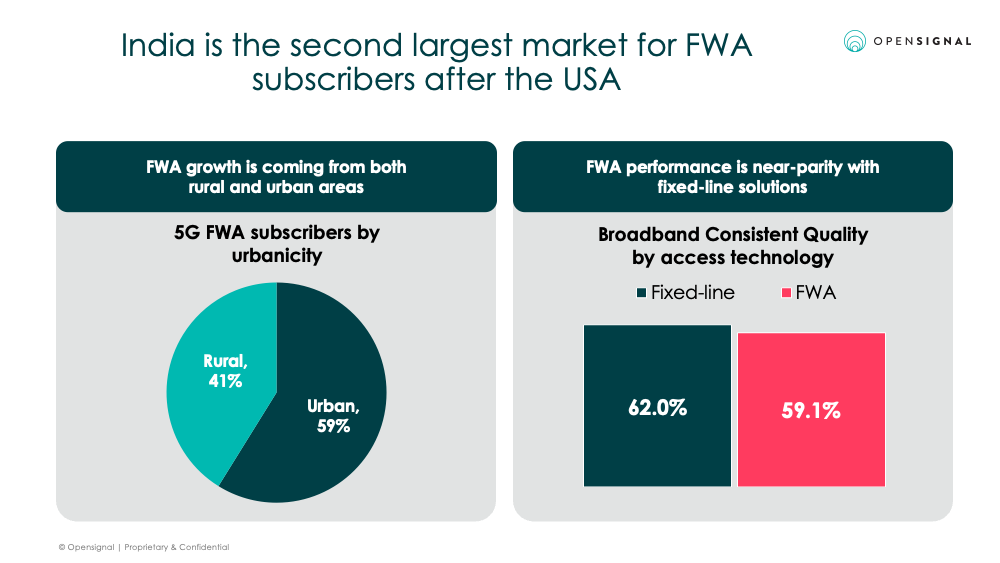
Opensignal data reveals three tiers of FWA performance relative to fixed line (fiber, DSL and cable):
- Near-parity – India, USA
- Good enough – Japan, Italy
- Niche – Canada, Saudi Arabia
In the US, where FWA penetration is highest, providers are primarily attracting unserved or underserved households, expanding the overall broadband market rather than competing directly other FWA providers. In Latin America, FWA is becoming a critical tool in markets where fiber buildouts remain slow or financially challenging.
The bottleneck moves indoors: the importance of CPE
A major finding of 2025 is that broadband bottlenecks are increasingly inside the home, not in the access network.
Opensignal research shows:
- Many users still rely on older Wi-Fi 4 equipment and the 2.4 GHz band
- Countries shifting to Wi-Fi 6 see clear improvements in Consistent Quality and speed tiers
- ISP-provided gateways consistently outperform customer-owned routers, thanks to better installation, troubleshooting, and equipment quality
As fiber, cable, FWA, and even satellite improve, the in-home Wi-Fi environment has become one of the most influential drivers of broadband experience. This also means operators can no longer rely on access technology alone to differentiate — in-home Wi-Fi has become a central part of the broadband value proposition, and those that have included gateways/routers as part of their offer benefit.
Satellite connectivity expands – with distinct use cases
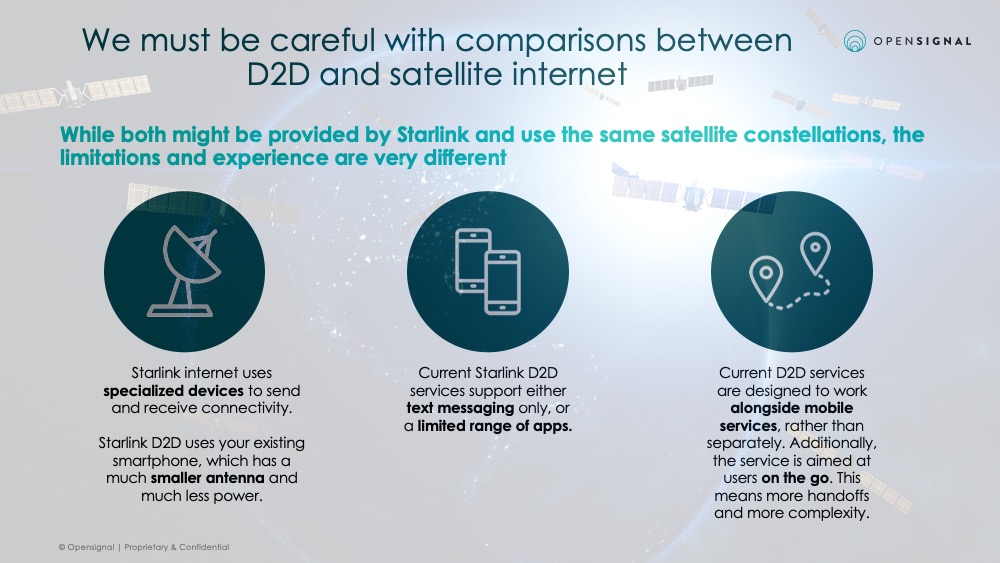
Satellite broadband, led by Starlink, continued to gain momentum in 2025, particularly in remote or underserved areas.
Our findings show:
- In rural Canada and Indonesia, Starlink often outperforms terrestrial FWA
- In urban markets, terrestrial FWA typically delivers better Consistent Quality
- Satellite remains essential for maritime, aviation, remote clinics, and community connectivity
Across the Americas, satellite and FWA now serve largely complementary roles: FWA dominates urban environments, while satellite fills gaps that terrestrial networks cannot economically reach
Direct-to-Device (D2D) moves from concept to reality
Direct-to-Device — satellite connectivity delivered directly to standard smartphones — saw real traction in 2025.
- In the U.S., T-Mobile expanded its satellite-enabled service from text to a small set of apps
- Canada, Chile, and Peru launched early D2D services focused on messaging
- D2D helped maintain resilience during natural disasters by enabling communication in coverage outages
Expectations, however, should remain realistic. For the foreseeable future, D2D connectivity will be best suited for low-bandwidth use cases such as SMS, basic mapping, and weather applications — not full mobile broadband replacement.
AI necessitates telcos' structural pivot
Beyond networks, 2025 was the year operators began reorganizing around AI as a core strategic pillar.
Operators such as SK Telecom, Singtel, and Telus have already restructured to support AI-driven innovation, recognising that AI requires:
- New talent pools
- New governance models
- New business units
- A fundamentally different operating model from legacy connectivity services

AI is now central to both cost efficiency (hyper-automation, predictive maintenance, advanced customer service) and growth (dynamic pricing, personalization, new digital services).
Looking ahead
The 2025 Wrap-Up highlighted one overarching theme: connectivity is entering a period of convergence.
- Across access types: mobile, fixed, and non-terrestrial networks blending into seamless experiences
- Across business models: AI-enabled efficiency and revenue generation
As the industry prepares for 5G Advanced and lays the groundwork for 6G, operators will need to focus not only on spectrum and infrastructure but also on:
- Enhancing in-home experience
- Embracing hybrid connectivity models
- Accelerating AI-driven transformation
At Opensignal, we are dedicated to delivering actionable insights that empower stakeholders to optimize networks and enhance user experiences. If you’re attending MWC, we’d love to meet you. Book a meeting with Opensignal to explore how our mobile and broadband insights can help you drive commercial success.
Opensignal Limited retains ownership of this insight including all intellectual property rights, data, content, graphs & analysis. Reports and insights produced by Opensignal Limited may not be quoted, reproduced, distributed, published for any commercial purpose (including use in advertisements or other promotional content) without prior written consent. Journalists are encouraged to quote information included in Opensignal reports and insights provided they include clear source attribution. For more information, contact [email protected].
