


Broadband connectivity is foundational to modern economies, enabling everything from work and education to entertainment and digital services. As reliance on high-speed internet grows, so does the importance of understanding not just where broadband is available, but how well it performs for users in real-world conditions.
Across Europe, fixed broadband networks have undergone significant upgrades, with high fiber coverage and ultrafast broadband lines now prevalent across most parts of the region. While some countries continue expanding infrastructure to meet national and EU connectivity targets, particularly in rural and sparsely populated areas, attention is increasingly shifting from broadband penetration to quality — from whether a connection exists, to whether it meets capacity thresholds and how consistently and reliably the service works.
This report presents our assessment of fixed broadband experience across major 15 European broadband markets, looking at the largest national internet service providers (ISPs), and basing our analysis on experience measurements taken during the final quarter of 2025.
Criteria in selecting ISPs for European broadband experience comparison
Broadband experience is shaped by multiple factors: the type of access technology used, the subscribed plan, peak-time congestion, in-home Wi-Fi conditions, and household usage patterns. Opensignal’s data is uniquely positioned to capture this complexity by measuring the experience directly at the user’s device. Rather than relying on theoretical capabilities or advertised speeds, our approach reflects how networks perform under everyday conditions — where it matters most.
In this analysis, we report the measured home broadband experience delivered on average from 2 October to 30 December 2025, across the leading residential broadband providers in 15 European markets. Results are presented at the level of consumer-facing brands, since these are the entities households interact with when selecting and evaluating service. Performance differences reflect not only the underlying infrastructure, but also each provider’s distribution of plans, technologies, and in-home equipment.
Our analysis focuses on providers with national-level presence and significant subscriber base — typically those accounting for 5% or more of household broadband connections in their respective countries. Smaller regional or local providers have been excluded to ensure comparability and to reflect the experience of the majority of users.
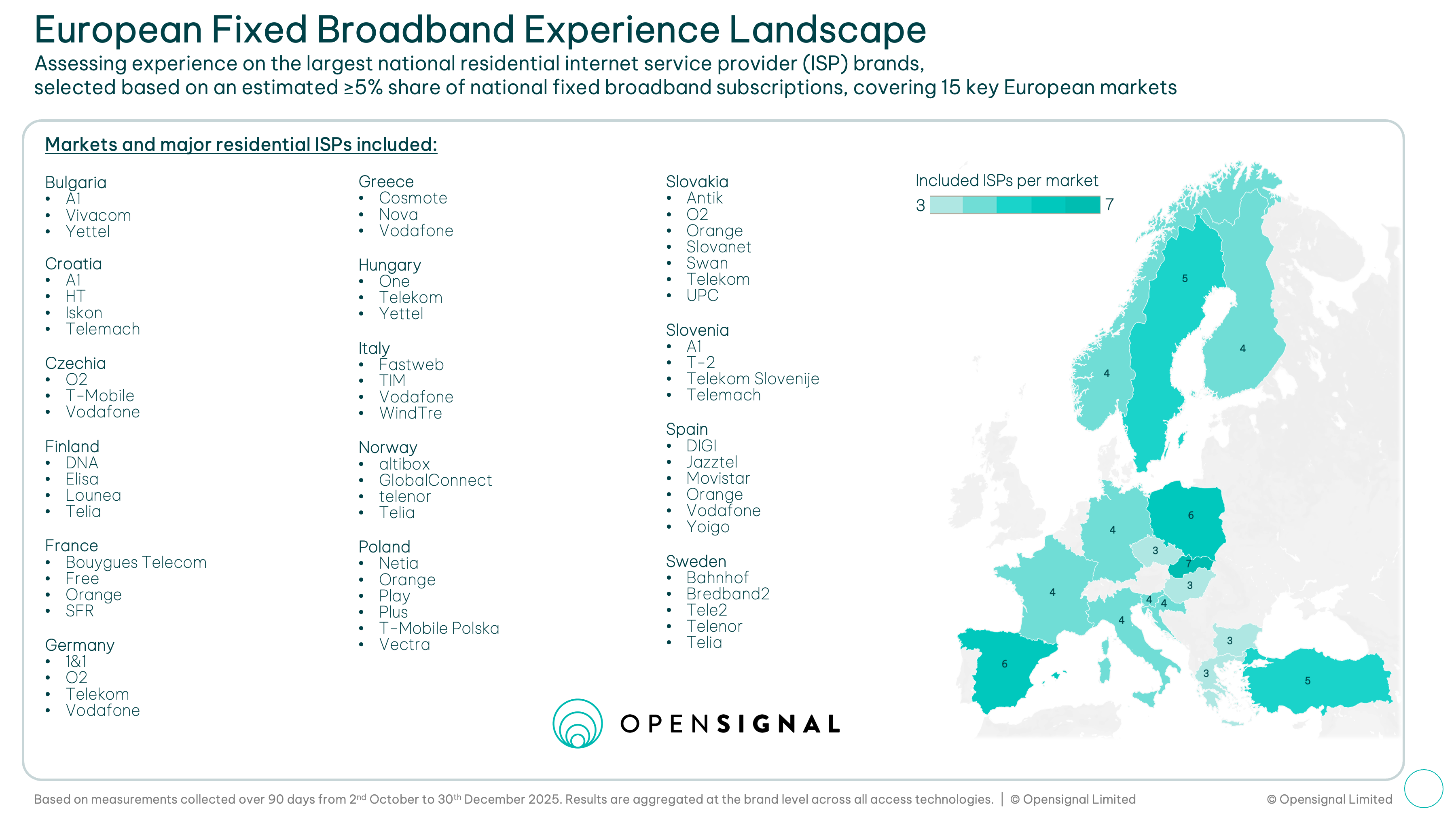
Across most markets, fixed broadband competition is structured around three to four major national providers. While local market conditions vary, this pattern reflects a broader industry evolution in which historical incumbents have been joined by challenger brands delivering broadband at scale.
To reflect the varied ways broadband is used in the home, we assess five key dimensions of broadband user experience: Consistent Quality, Download Speed, Upload Speed, Reliability Experience and Video Experience. Together, these metrics offer a holistic view of the everyday broadband experience, and not just peak speeds that the connection can facilitate.
The experience is evaluated based on measurements collected from our users across all broadband access technologies deployed by the listed providers. These include fiber-based services (FTTx), cable networks (DOCSIS over coaxial-fiber), copper-based technologies (xDSL), and, where applicable, Fixed Wireless Access (FWA) connections.
18 February 2026 (17:00 GMT): Denmark has been removed from this report post-publication after we identified an issue that could affect the accuracy of the published results.
Opensignal Limited retains ownership of this insight including all intellectual property rights, data, content, graphs & analysis. Reports and insights produced by Opensignal Limited may not be quoted, reproduced, distributed, published for any commercial purpose (including use in advertisements or other promotional content) without prior written consent. Journalists are encouraged to quote information included in Opensignal reports and insights provided they include clear source attribution. For more information, contact [email protected].
