


Canada’s broadband market is entering a new phase of direct, head-to-head competition. Fiber and cable deployment is slowly maturing across networks — jointly accounting for 83% of connections according to TeleGeography statistics for Q2 2025 — and in 2025 the CRTC added a new layer of pressure by opening up wholesale access to other operators’ fiber infrastructure outside an Internet Service Provider’s (ISP) core footprint.
This means competitors can now target the same subscribers using the same last-mile technology. Two of the three national ISPs have already begun. Telus began offering service in Ontario and Quebec in early 2025, while Bell announced in October 2025 that it would resell fiber services in Western Canada.
When the last-mile access technology is no longer the primary competitive advantage, the real differentiation happens at the gateway inside the home. Gateway performance — shaped by factors like Wi-Fi generation and frequency management — now plays an outsized role in shaping the user’s day-to-day experience.
In this report, we address two central questions: To what extent ISP-provided in-home Wi-FI equipment is linked with improved users’ actual broadband experience, and why these effects differ across operators.
Key findings
- ISP-provided gateways outperform bring-your-own (BYO).
Our measure of Broadband Consistent Quality is on average higher for users on ISP-provided in-home Wi-Fi gateways compared to those on BYO gateways for all three national ISPs – by at least 12 percentage points. BYO devices are when consumers purchase and install gateways from a third-party provider, and then connect the end-point device to the internet via that gateway — for example, a router connected in bridge mode to an ISP modem, or an access point. - Bell sees the largest uplift.
Bell users on its provided gateways see a 17.5 percentage point improvement over its users on BYO devices. - Later Wi-Fi generations and frequencies matter.
Using later Wi-Fi generations (Wi-Fi 6 or later) and the 5 GHz band improves experience with broadband.
Some ISP-provided customer premises equipment (CPE) is always required for setting up a broadband connection. Over the last few years, it has become common for ISPs to provide the full home broadband set-up, including the Wi-Fi access point. However, historically, CPEs have created friction for consumers. A 2019 study found that swapping equipment (e.g. returning the old ISP-provided equipment and installing a new one) was the main perceived barrier to switching ISPs for those who thought about but then did not switch.
This additional friction may be part of why, when we look at US cablecos, we have seen a correlation between ISP-provided routers and lower churn. For operators, this underscores how gateway control affects both churn dynamics and the economics of customer acquisition. With this lower churn, wider use of ISP-provided gateways can make acquisition harder. However, it also gives ISPs a marketing and upsell opportunity: highlighting the performance advantages of their Wi-Fi solutions over the typical BYO equipment.
All three major operators have been investing in their gateway offering
To this end, all three of the major Canadian operators have pursued new initiatives in their customer premises equipment over the last few years:
- Rogers: In 2024, Rogers announced a partnership with US provider Comcast, including the use of its Xfinity Gateway modems under the Xfinity brand. Rogers then became the first ISP of the three major national providers in Canada to launch its Wi-Fi 7 offering using Xfinity technology in June 2025. Now, the ISP offers an option for consumers to upgrade to “Rogers Xfinity Pro”. This service offers a Wi-Fi 7 compatible router, along with professional Wi-Fi installation and cellular backup called “Storm-Ready WiFi”. However, customers on its standard packages, even its “Premier 2G” offering, receive the Gen 3 modem, which supports Wi-Fi 6E. This positions Rogers well in terms of users accessing later generations of Wi-Fi technology.
- Telus: Telus launched Wi-Fi 7 capabilities in late July 2025, offered to customers on its Gigabit plans and above. It also offers Wi-Fi Plus, where technicians ensure strong 5 GHz coverage throughout the home. Telus’ approach emphasizes whole-home optimization as a key part of its value proposition.
- Bell: Bell was the last of the three to announce its Wi-Fi 7 capabilities, with the launch of Gigahub 2.0 in September 2025. It is offered as standard to new customers — even those on lower speed tariffs — or for an additional fee to current subscribers. This suggests that although Bell adopted Wi-Fi 7 later, it is now a key part of its strategy.
These latest investments into the user side hardware show how all three major operators have been, and continue to, invest in keeping their equipment offerings, as well as their add-on services, close to the forefront of in-home Wi-Fi technologies.
ISP-provided gateways are critical to Canada’s advanced broadband experience
However, how does that investment show up in practice — and does it really play a significant role in shaping the experience of consumers? In our previous research on broadband speed tiers, we saw a close match between advertised and actual user experience, more so than in many of the other markets analyzed. This suggests that Canadians generally benefit from effective in-home equipment and high-quality Wi-Fi. Our data confirms that this is largely due to ISPs’ high-quality equipment.
When looking at Broadband Consistent Quality, subscribers using ISP-provided equipment typically have a better experience. Bell users see a Consistent Quality result that is 17.5 percentage points better when using Bell-provided equipment. Meanwhile, Telus and Rogers see improvements of 13.5 and 12.7 percentage points respectively.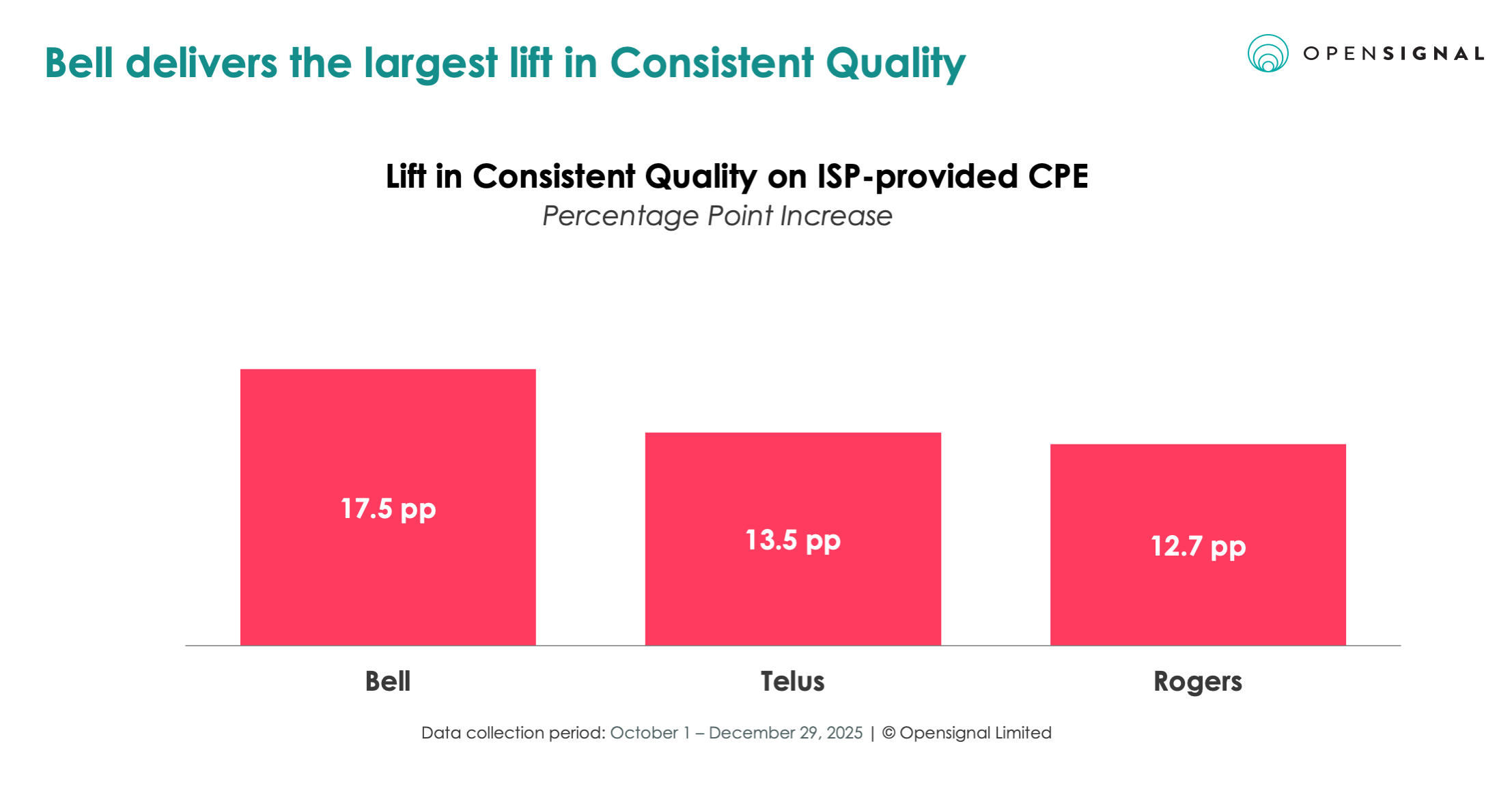
Wi-Fi generation and frequency significantly impact performance
Within Opensignal’s data we can begin to unpack why ISP equipment offers this improvement — as well as why this varies between the three major operators. Firstly, as we’ve discussed previously, Wi-Fi generation matters. Later Wi-Fi generations consistently deliver better Broadband Consistent Quality than earlier ones. Canada is relatively advanced in this regard, with a higher proportion of users on Wi-Fi 6 or later technologies than we see in some other markets like Australia and the United Kingdom.
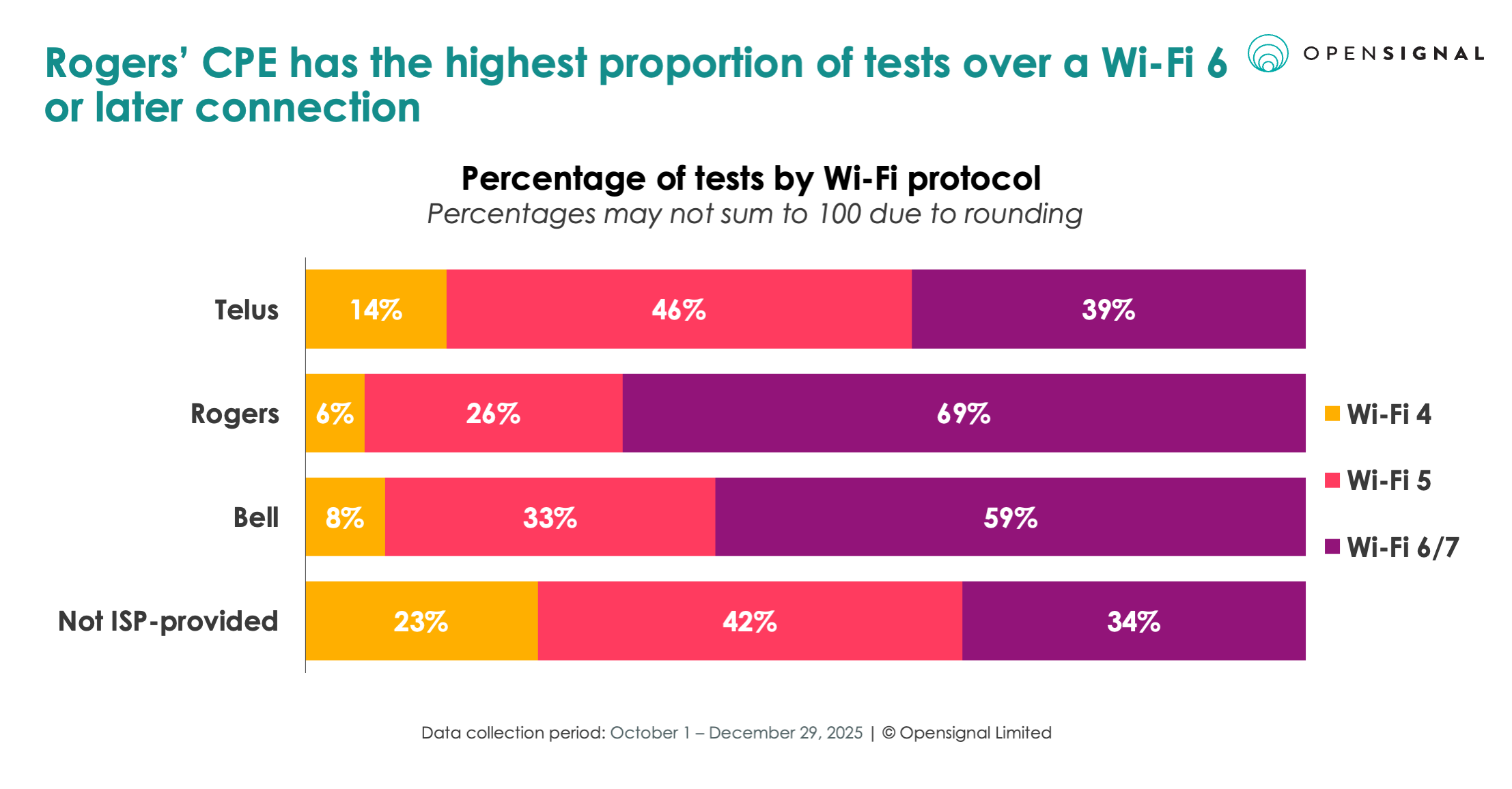
Not all operators have been equally successful at moving customers to newer Wi-Fi generations. Our users on Rogers’ gateways have the highest proportion of tests on Wi-Fi 6 or 7 compared to Bell, Telus or subscribers on non-ISP-provided gateways. Similarly, it has the smallest proportion of users on Wi-Fi 4 ISP-provided routers.
Having a Wi-Fi 6 or 7 gateway is only the first step. While Rogers may have more modern gateways, what drives up Bell’s performance uplift is the increased use of 5 GHz connections. When we look at the percentage of tests by frequency band, looking specifically at those more modern (Wi-Fi 6 or later) gateways, we see Bell users spending more time on 5 GHz.
Why does this matter? Because 5 GHz connections tend to be faster and less congested — with 2.4 GHz having much better propagation characteristics, the band results in a lot of noise where the signal is not needed. The dominance of the higher Wi-Fi frequency band is a significant contributing factor to why Bell’s users on its provided in-home gateways get such a boosted performance when compared to its users connecting to BYO gateways. 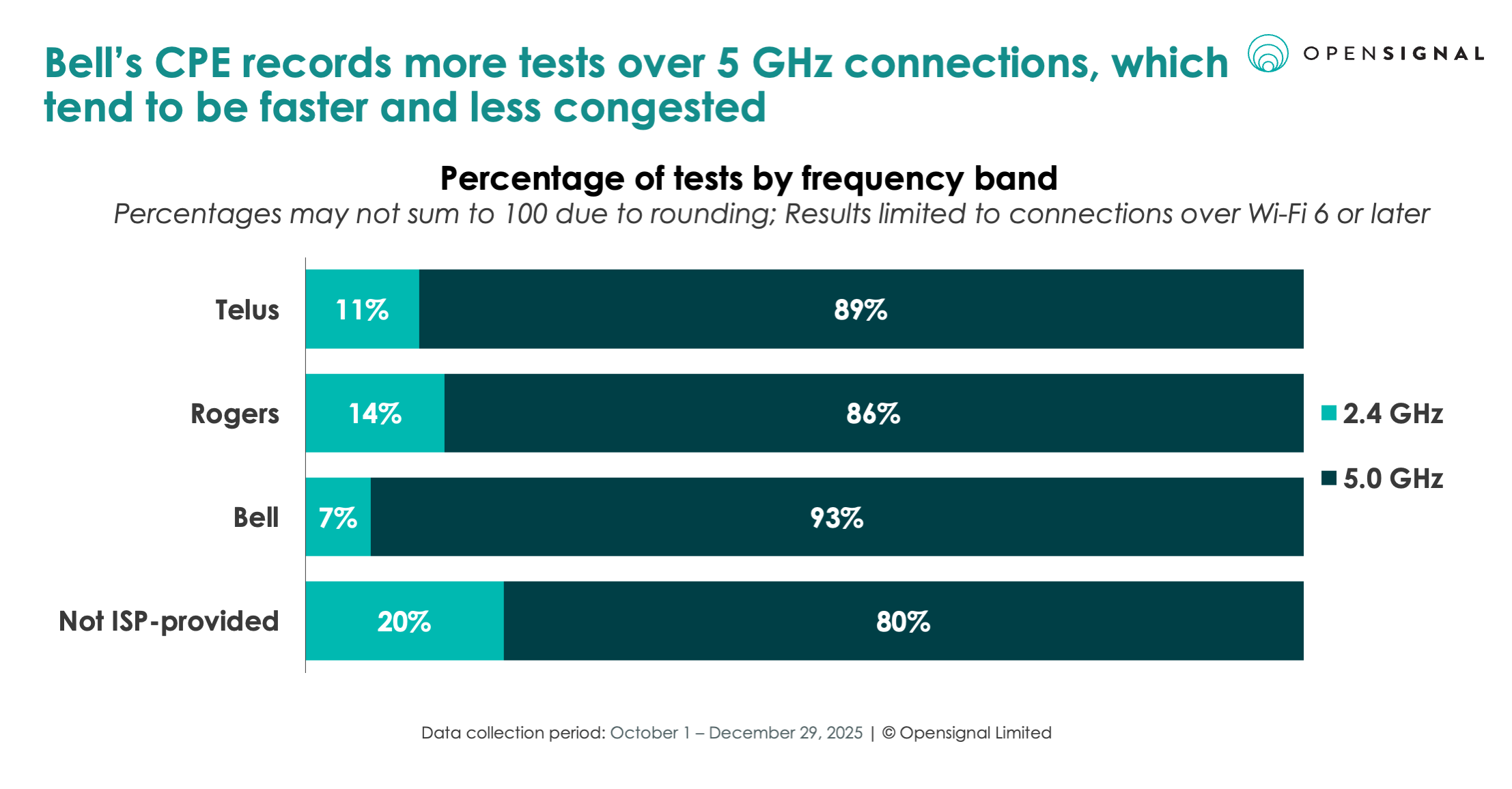
In-home Wi-Fi is a key lever in the relationship between ISPs and consumers
As wholesale access expands and footprint overlap increases, strong in-home Wi-Fi gateway performance will become a key competitive tool. For consumers, the rollout of Wi-Fi 6, 6E, and 7 hardware means better in-home connectivity and more meaningful differences between provider offerings. Our results suggest that consumers are better off opting for the best available gateway from their chosen provider. This will likely offer a materially better experience than trying to improve performance by purchasing third-party BYO gateways.
For operators, next-generation in-home Wi-Fi environment represents a controllable lever for improving perceived network quality, reducing churn, and differentiating in an era of increasing wholesale overlap. Reliable, advanced gateways will be essential to getting the most from Canada’s increasingly advanced broadband networks.
To learn more on the latest on the Canadian telecoms market, read our latest reports here. Or, subscribe to our newsletter to keep up to date with our latest publications.
Opensignal Limited retains ownership of this insight including all intellectual property rights, data, content, graphs & analysis. Reports and insights produced by Opensignal Limited may not be quoted, reproduced, distributed, published for any commercial purpose (including use in advertisements or other promotional content) without prior written consent. Journalists are encouraged to quote information included in Opensignal reports and insights provided they include clear source attribution. For more information, contact [email protected].
