


A “two-speed” market: world-class networks, device-limited experience
Saudi Arabia has spent the past few years accelerating its transition to a 5G-first, spectrum-rich mobile market. From a spectrum perspective, the Kingdom now stands out globally. According to GSMA, Saudi Arabia is among the countries that have assigned the largest amount of mobile spectrum per operator, following a series of coordinated auctions over the recent years.
This investment has translated into exceptional network capability. When assessed using High-end devices filter, Saudi Arabia records the fastest mobile download speeds among large landmass countries in the Q4 2025 Global Network Excellence Index. This reflects billions of dollars of sustained investment in spectrum, radio access networks and backhaul, and confirms that Saudi Arabia has built a network with world-class capacity.
However, as highlighted in our latest global update — mobile network excellence in 2026 is no longer defined by peak speeds alone. The more relevant question is whether networks deliver reliable, everyday performance at scale, and whether the benefits of that investment are widely accessible across the population.
Key Findings:
- World-class network capacity: Saudi Arabia is the fastest large landmass market globally on mobile download speed, reaching 207 Mbps on High-end devices.
- Devices are now the bottleneck: Average speeds fall to 121 Mbps across all devices, showing that handset limitations — not the network — increasingly constrain user experience.
- Consistency is the next frontier: While peak speeds are strong, Excellent Consistent Quality (ECQ) lags behind, pointing to the need to improve reliable, everyday performance at scale.
Saudi Arabia’s position in the Global Network Excellence Index
The Global Network Excellence Index provides a country-level benchmark built on billions of real-world measurements, structured around three pillars:
- Excellent Consistent Quality (ECQ) — how reliably networks support demanding everyday apps
- Time on 4G/5G — how often users are connected to modern mobile networks
- Download Speed — a capacity signal reflecting what users actually experience across technologies
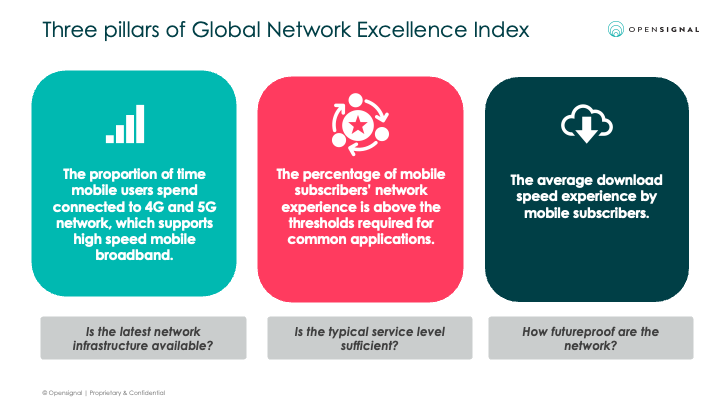
The February 2026 update sharpens the Index’s ability to distinguish network capability from device limitations by introducing device-based views. The High-end devices view is now the default, while the All-devices view remains critical for understanding population-wide experience.
This makes it easier to answer two distinct questions:
- How capable is the network when users aren’t hardware-limited?
- How inclusive is the experience across the whole device population?
Saudi Arabia illustrates why both perspectives matter.
World-class capacity — constrained by device capability
Measured on High-end devices, Saudi Arabia achieves 207 Mbps in the Q4 2025 Index, making it the fastest large landmass market globally. When measured across all devices, average download speeds fall to 121 Mbps, creating a substantial 86 Mbps performance gap.
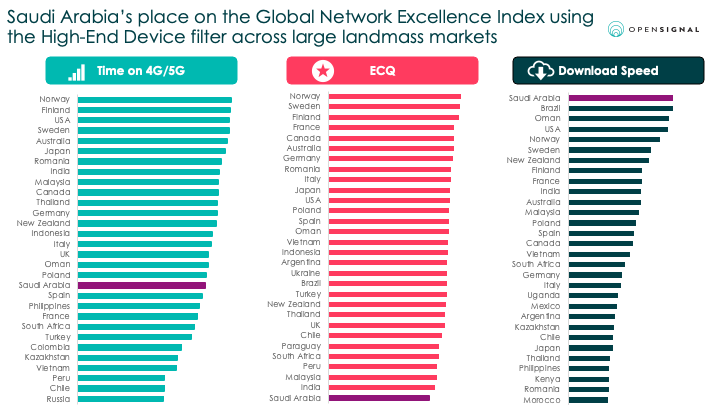
This gap is also visible in the rankings. Saudi Arabia places 18th among large landmass markets overall on the High-end devices view, slipping to 19th on the All-devices view. While the ranking change itself is modest, the underlying performance gap is material — highlighting how strongly device capability now shapes experienced speeds.
Recent device market dynamics help explain this gap. In Q1 2025, Saudi Arabia — which accounts for around 26% of the regional smartphone market — saw overall handset shipments decline by 12% year-over-year as consumers shifted spending during Ramadan toward travel, food and automotive purchases. Slower replacement cycles have extended the lifespan of mid-range and older devices, even as network capability continues to advance.
At the same time, the premium segment is expanding. Shipments of smartphones priced above $600 grew by 17% year-over-year, led by premium Android smartphones. Users with these devices are already able to unlock far more of Saudi Arabia’s network potential — reinforcing a clear two-speed experience between premium users and the broader population.
The primary technical bottleneck lies in how devices exploit the Kingdom’s spectrum resources. Saudi Arabia has assigned a total of 1,400 MHz of licensed sub-6 GHz spectrum nationally, making it a leader among G20 countries in spectrum availability.
- Network side: All national mobile operators — stc, Mobily and Zain — can deploy multiple 100 MHz carriers, enabling theoretical peak throughput in the multi-gigabit range under optimal conditions.
- Device side: Accessing this capacity requires support for multi-carrier aggregation (CA). While ultra-premium devices support 5CC or 6CC aggregation, a large share of the Saudi device base still relies on basic or mid-range chipsets. Many popular mid-tier smartphones support only one or two aggregated carriers, limiting the amount of spectrum they can utilize at any given time.
As a result, Saudi Arabia’s network capability is now ahead of what many devices can practically exploit — a reversal of the situation seen a decade ago, when device capabilities often outpaced network performance.
High modern availability: transitioning away from legacy networks
Opensignal data shows that mobile users now spend around 97% of their time connected to 4G or 5G when on high-end devices, placing Saudi Arabia 19th among large landmass markets for availability across both High-end and All-device views (95.7% of time on 4G/5G). This indicates that reliance on legacy technologies is rapidly diminishing, and that modern coverage maturity is already high.
This progress is supported not only by network investment, but also by clear regulatory direction. Since 2020, Saudi regulators have required all network-based devices — including smartphones, tablets and smart watches — to support 4G as a prerequisite for market approval.
At the same time, legacy shutdowns have begun but remain part so far: stc has shut down 3G in 2023 and reallocated spectrum to 4G and 5G to improve user experience.
As markets approach near-universal 4G/5G usage, the nature of performance constraints shifts. Coverage is no longer the primary bottleneck. Instead, the key determinants of experience increasingly become:
- device capability, and
network consistency under load, indoors and across wide geographies.
Speed versus consistency: the next phase of network excellence
Saudi Arabia’s results reinforce a key message from the Global Network Excellence Index: speed and network excellence are not the same thing.
- Speed: With High-end download speeds of 207 Mbps, Saudi Arabia is the fastest large landmass market globally.
- Consistency (ECQ): ECQ stands at 69.7% on High-end devices (ranking 30th among large landmass markets) and 63.6% across All devices.
In practical terms, this is the difference between downloading large files quickly and reliably supporting real-time services such as video calls, streaming and cloud gaming without jitter or performance drops.
This pattern is not unique to Saudi Arabia. It is characteristic of markets that have successfully solved the capacity challenge and are now entering the optimization phase of network evolution.
Crucially, this does not diminish Saudi Arabia’s achievement. Instead, it clearly defines where the next phase of improvement lies: shifting focus from raw throughput to consistency and everyday reliability.
What to watch next
Saudi Arabia has already built a network with exceptional capacity. The next phase of network excellence will depend on:
- Device catch-up: accelerating migration to hardware capable of fully exploiting modern 5G networks
- Consistency-first optimisation: improving ECQ outcomes across peak hours, indoor environments and wide geographies
- Experience-led KPIs: shifting focus from headline speeds toward everyday reliability
Taken together, these steps would allow the population-wide experience to converge more closely with what Saudi Arabia’s network is already capable of delivering.
Interested in how other countries perform on the Global Network Excellence Index?
Explore the full rankings here
Opensignal Limited retains ownership of this insight including all intellectual property rights, data, content, graphs & analysis. Reports and insights produced by Opensignal Limited may not be quoted, reproduced, distributed, published for any commercial purpose (including use in advertisements or other promotional content) without prior written consent. Journalists are encouraged to quote information included in Opensignal reports and insights provided they include clear source attribution. For more information, contact [email protected].
