


What does mobile network excellence really mean in 2026?
For much of the past decade, the conversation around mobile performance has been shaped by peak speeds and technology launches. As 5G moves from promise to everyday reality, however, those indicators are no longer sufficient on their own. The more relevant question today is not whether a country has launched 5G, but whether its networks reliably support how people actually live, work and connect — consistently and at scale.
This is the motivation behind the Global Network Excellence Index: a country-level benchmark designed to assess how well mobile networks deliver real-world connectivity today, and how ready they are to support future digital demand.
Key Findings:
5G is no longer the story — experience at scale is. Countries that consistently deliver reliable, everyday performance now outperform those focused on launches or peak speed claims.
Networks are often better than users think. In many markets, underlying network capability exceeds what most users experience, with device limitations increasingly masking true performance.
A “two-speed” mobile world is emerging. High-end devices unlock dramatically better performance, while users on mid-tier hardware fall further behind — turning device access into a new digital divide.
Fast doesn’t always mean reliable. Some markets lead globally on download speed yet lag on consistency, showing that capacity and user experience are diverging.
Table of Contents:
Rethinking mobile network excellence in a 5G-first world
At its core, the Index focuses on three dimensions that together define mobile network excellence:
- Time on 4G/5G – the proportion of time users are connected to modern mobile networks, reflecting accessibility and coverage maturity.
- Excellent Consistent Quality (ECQ) – how reliably networks support demanding, everyday applications such as video calls, streaming and digital payments.
- Download Speed – the capacity of networks to support current demand and scale for future growth.
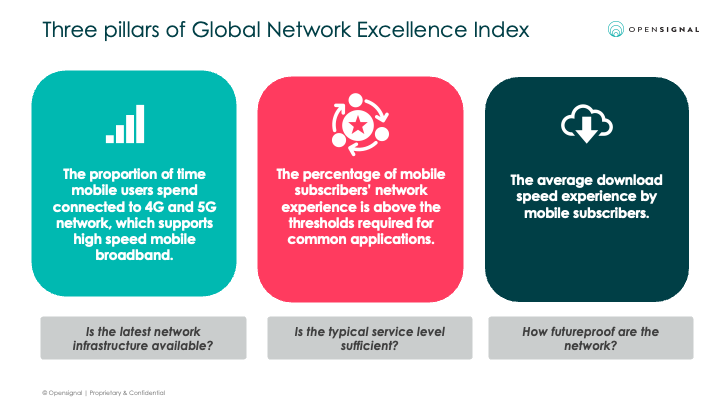
Taken together, these pillars provide a more complete picture of network excellence, balancing access, reliability and capacity. Increasingly, they also offer insight into how spectrum policy, investment choices and market structure translate into real-world outcomes.
As mobile ecosystems evolve, so too must the way these pillars are measured and interpreted.
Why the Index needs to evolve now
The mobile landscape continues to change rapidly. In most markets, users no longer experience 4G and 5G as distinct technologies. Smartphones move seamlessly between generations, delivering what users perceive as a single mobile service. At the same time, the share of time users spend on 5G still varies widely by country, reflecting differences in spectrum availability, network investment and device adoption.
At the network level, this transition is well underway. By late 2025, the GSA identified 647 operators in 191 countries and territories investing in 5G, with 358 offering commercial 5G mobile services (roughly a third of all operators). Standalone 5G is also gaining traction, while early deployments of 5G-Advanced signal the next phase of network evolution.
In parallel, many operators are accelerating the retirement of legacy technologies. Across markets, 2G and 3G sunsetting is progressing as spectrum refarming becomes essential to expanding LTE and 5G capacity, particularly where mid-band spectrum is constrained. As our recent work on spectrum in ASEAN, Europe and MENA has shown, the pace of sunsetting — and the policies that enable it — now has a direct impact on modern network availability.
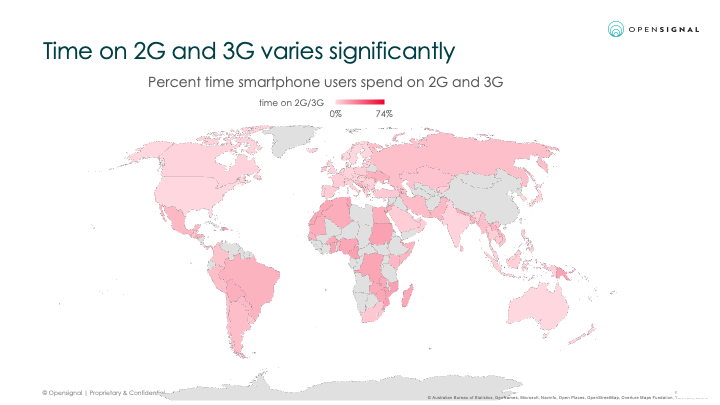
From a benchmarking perspective, this convergence of multi-generation networks, uneven device ecosystems and rising user expectations makes comparison more complex — but also more important. Simple milestones such as “5G launched” are no longer sufficient to explain how well national networks support real-world digital activity.
This shift is also reflected in policy and regulation. Frameworks such as the Digital Networks Act point toward a broader focus on network capability, resilience and long-term investment conditions, rather than generation-specific targets alone.
The February 2026 update to the Global Network Excellence Index responds to these realities. It refines how we assess network performance in a 5G-first, multi-generation world, while preserving the Index’s core purpose: fair, transparent country-level benchmarking based on real-world experience.
A clearer view of network capability: separating networks from devices
One of the most important updates in this release is the introduction of two device-based views, with the High-end devices* view now set as the default.
At country level, network performance is influenced not only by infrastructure investment and spectrum availability, but also by the smartphones people use. In many markets, a high share of lower-tier devices can cap observed speeds and quality, even where the underlying network is capable of delivering more.
This challenge is becoming more pronounced as the device ecosystem itself shifts. According to Counterpoint Research, premium smartphones (with a wholesale average selling price of $600 or more) accounted for around 25% of global smartphone shipments in 2024, up from roughly 15% in 2020. Ultra-premium devices (priced above $1,000) now represent over 40% of that premium segment. Counterpoint projects that global smartphone average selling prices will continue to rise, reaching around $370 in 2025 and exceeding $400 by the end of the decade, driven by 5G and AI-enabled features.
These trends highlight a growing divergence between markets where device adoption keeps pace with network investment, and those where it does not.
As a result, country-level benchmarks can blur two distinct questions:
- How well does the network perform for users whose experience is not constrained by hardware?
- How inclusive is the overall digital experience across the full population?
These are both important questions — but they cannot be answered with a single device population.
What the Index reveals about device effects
Separating device-limited experience from network-limited performance allows the Global Network Excellence Index to highlight where network capability is already ahead of the device ecosystem.
This pattern is visible across several markets. For example:
- In Qatar, download speeds on High-end devices are almost double those observed across all devices.
- Brazil shows a similar gap, with High-end devices experiencing more than twice the speed of the national average. This indicates a highly stratified market where premium hardware is essential to unlock modern network speeds.
- In Saudi Arabia, rankings improve when viewed through the High-end lens, indicating network capability that is partially masked in the broader device mix. When assessed using high-end devices, Saudi Arabia delivers the fastest download speeds among large land countries.
Earlier Opensignal analysis of South Africa illustrates this “two-speed” reality particularly clearly. For example, on Vodacom’s network, premium-device users record average download speeds of 157.3 Mbps — more than double the 73.8 Mbps seen by users with mid-tier devices. The network itself is capable of more than the average user can access — a theme we explored in depth in our work on Africa’s digital divide.
These findings suggest that in many markets, constraints on user experience are increasingly linked to device access rather than network build-out. With device prices trending upward globally, this gap risks widening further unless markets actively address affordability and migration pathways.
For policymakers and regulators, this reframes part of the digital inclusion debate. Improving outcomes may require as much focus on device access and financing mechanisms as on spectrum allocation and infrastructure deployment.
At the same time, the Index retains an All devices view to reflect the lived experience across the full device mix. Taken together, these perspectives help separate network capability from device access, supporting more informed discussions around inclusion and long-term readiness.
Measuring speed in a multi-generation world
The second update reflects how modern mobile networks are built and experienced.
As 5G adoption grows, separating 4G and 5G download speeds becomes less meaningful at the country level. Users do not choose between technologies; their devices do so dynamically based on coverage and network conditions. In practice, mobile connectivity is experienced as a single service delivered across multiple generations.
From February 2026 onward, the Index therefore uses a single Download Speed, calculated as a device-level mean across all access technologies.
This approach provides a clearer view of how network investment translates into usable capacity at scale. It also aligns with broader market trends. Spectrum refarming, site densification, backhaul upgrades and core modernisation typically improve performance across LTE and 5G layers simultaneously — a relationship we have explored previously when benchmarking readiness for advanced 5G services.
Using Download Speed also helps avoid overstating progress from early or uneven 5G deployments. In markets where 5G coverage remains limited, standalone 5G speed metrics can reflect performance experienced by a relatively small subset of users. Download Speed ensures that countries are assessed on the performance most users actually experience, while still recognising markets where sustained investment has lifted performance across generations.
A comparison between Q4 2024 and Q4 2025 illustrates this effect. While some countries shift positions as networks evolve and device mixes change, the top-ranked markets remain consistent across time and device views, reinforcing that the Index is capturing structural network strength rather than short-term effects.

Speed versus consistency: an important distinction
One of the most revealing insights from the Q4 2025 Index is the growing decoupling of speed and consistency.
Saudi Arabia provides a clear illustration of this dynamic. It ranks among the global leaders for Download Speed –– placing first among large land-mass markets when assessed using High-end devices –– yet ranks 30th for Excellent Consistent Quality, with a score of 69.7%.
This contrast suggests that while the network has been built with substantial capacity — supported by significant C-band spectrum allocations — the user experience is shaped by more than raw throughput alone. Factors such as latency, packet loss and network optimisation play an increasingly important role in determining how consistently that capacity translates into a reliable, everyday experience.
By contrast, markets such as Norway, the Netherlands and Sweden consistently rank near the top of the Index despite lower overall speeds. Their strength lies in balanced performance across all three pillars, particularly availability and consistency.
The implication is straightforward: spectrum investment solves the capacity problem, but network optimisation solves the experience problem.
What this changes – and what it doesn’t
This shift does not change the story the data tells. Instead, it sharpens it.
- The default High-end view answers the question: “How well do networks perform for most capable users, at scale?”
- The Premium-only lens (used analytically) reveals the frontier of network readiness, helping distinguish markets where 5G is merely present from those where it is delivering its full potential.
The result is not a different story – but a clearer one: separating device effects from network capability, and providing a more meaningful view of national readiness in a 5G-first world.
What hasn’t changed – and why that matters
While the methodology of the Global Network Excellence Index has evolved, the principles underpinning the Index remain firmly in place.
It continues to be:
- a country-level benchmark, not an individual networks ranking,
- based on billions of real-world measurements, and
- structured around three equally weighted pillars that balance access, reliability and capacity.
This consistency ensures that changes in rankings reflect genuine differences in how networks are experienced, not methodological volatility.
Our Mobile Network Experience reports will continue to provide operator level views within a country using the Download Speed Experience. This metric represents the typical everyday speeds a user experiences across an operator’s mobile data networks, weighted by the time spent on each technology.
Interpreting change responsibly
As with any refinement, some movement in rankings is expected. These shifts should not be read as sudden changes in network investment or performance.
Instead, they typically reflect:
- a clearer separation between network capability and device constraints, and
- a more accurate portrayal of performance in markets where 5G has reached scale.
In that sense, the Index is not changing its message. It is sharpening it.
More than a ranking
The Global Network Excellence Index is increasingly used as a strategic reference point: by regulators shaping spectrum policy, by governments assessing digital readiness, and by industry leaders evaluating investment priorities.
As mobile networks become critical infrastructure for digital economies, excellence can no longer be defined by launch announcements or peak speeds alone. It is defined by how reliably networks perform at scale — and how prepared they are for future demand.
The Index will continue to evolve — guided by customer feedback, empirical evidence and market reality — to ensure it remains a credible, transparent and relevant benchmark in a rapidly changing mobile world.
Explore the February 2026 update
- Explore the latest rankings here
- Read the methodology note
- Read the 2025 full report and case studies on Saudi Arabia, and Indonesia
If you’d like to discuss what these results mean for your market, meet the Opensignal team at MWC 2026.
*These device tiers are grounded in objective hardware capability, not just price bands. DeviceAtlas uses a five-tier model (Entry, Low, Mid, High, Premium) based on hardware performance changes across a broad set of device capabilities. This enables segmentation of real traffic by device capability for analysis and optimization purposes.
Opensignal Limited retains ownership of this insight including all intellectual property rights, data, content, graphs & analysis. Reports and insights produced by Opensignal Limited may not be quoted, reproduced, distributed, published for any commercial purpose (including use in advertisements or other promotional content) without prior written consent. Journalists are encouraged to quote information included in Opensignal reports and insights provided they include clear source attribution. For more information, contact [email protected].
