


Key Findings:
- Our converged users on Xfinity get the best combined Consistent Quality, and combined Download Speed Experience
Xfinity tops the leaderboard for Consistent Quality with a combined fixed-mobile result of 83.9%.This places Xfinity less than a percentage point ahead of second-placed Verizon. Xfinity also wins for combined Download Speed Experience, with a score of 247.1 Mbps.
- AT&T ranks top for combined Upload Speed Experience, with a score over double that of their nearest competitor
AT&T has a clear lead for combined Upload Speed Experience. At 109.0Mbps, compared to second-placed Verizon’s 48.0Mbps, it stands out for its subscribers having a significantly better average experience for this category.
- Consistent Quality results are similar for converged subscribers across all home broadband access technologies
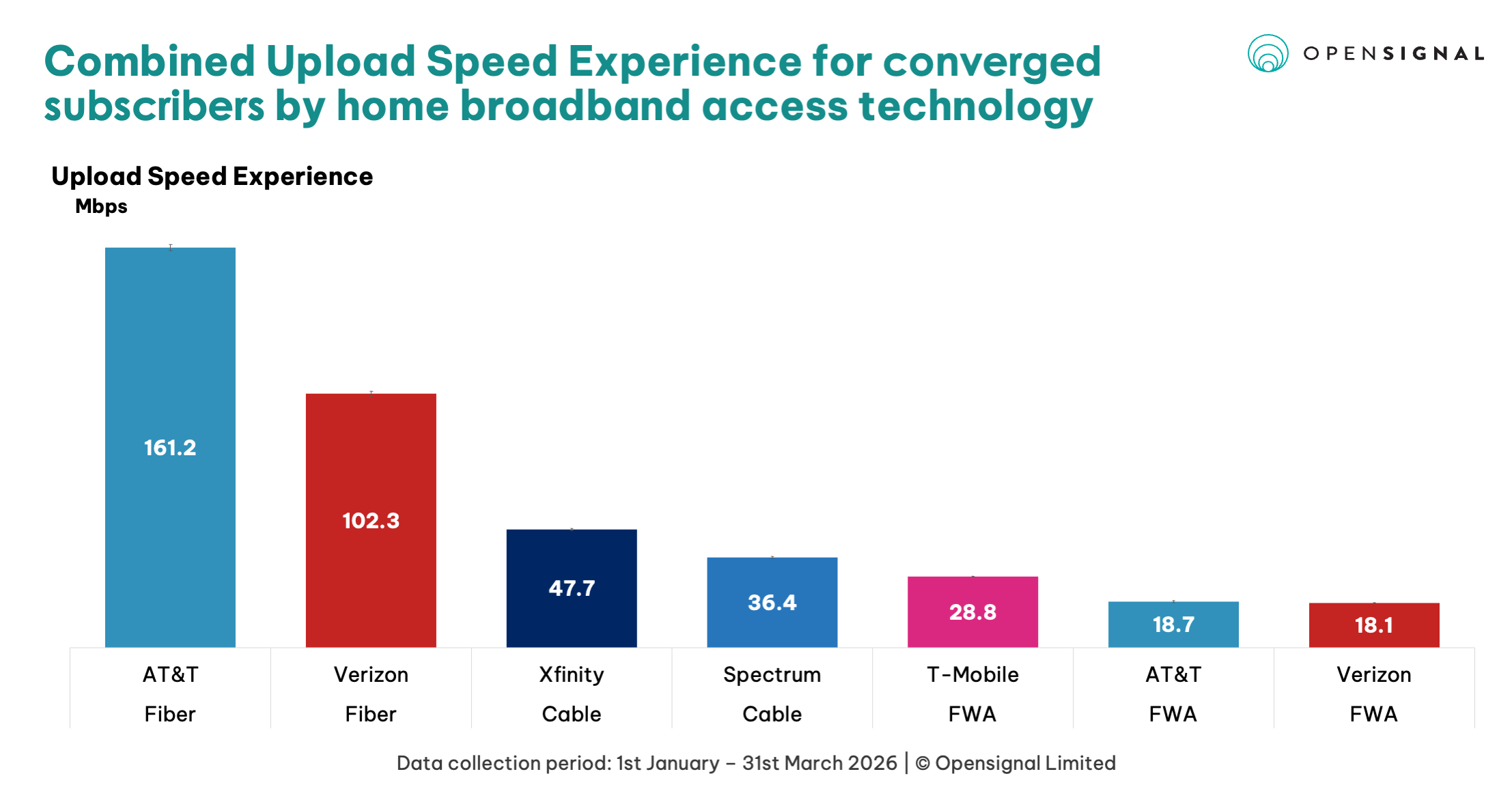
Although fiber delivers the best performance, cable is close behind, and fixed-wireless access (FWA) remains within a narrow gap – especially T-Mobile’s FWA offering, which scores less than half a percentage point behind the converged experience of Spectrum’s cable subscribers.
- Home broadband access technology has a more pronounced impact on converged speed experience
Our subscribers with cable and fiber as their home broadband technology experience higher average download speeds than our subscribers on FWA. Here, cable subscribers have experiences similar to those of fiber subscribers. While AT&T’s fiber home subscribers experience the highest combined download speeds, Xfinity’s cable subscribers show the second highest result, just ahead of our users on Verizon’s fiber offering.
Table of Contents:
Market Overview
Convergence is a key focus in U.S. telecom provider strategies, driven by two trends: subscriber expectations of seamless connection wherever they are; and more limited growth opportunities for providers. In Opensignal’s Subscriber Analytics data, we see US mobile subscriptions growing at just over 2% through 2025, while broadband penetration sits at over 90% of occupied households.
As a result, the focus is on finding strategies to attract and retain subscribers, maximize Customer Lifetime Value and minimize churn. Enter fixed-mobile convergence, which is associated with churn reduction, and increased customer satisfaction.
Cablecos Xfinity and Spectrum have pursued convergence using an MVNO agreement with Verizon for their consumer subscribers, while also working with T-Mobile for its business wireless offerings. Both are also exploring ways to reduce mobile data costs including Wi-Fi offload and the use of CBRS spectrum for small-scale network deployments.
At the same time, all three telcos have been building out their broadband offerings. AT&T emphasised its shift “to focus on converged customers", as well as increased investment in expanding fiber and wireless. Acquisitions have also formed a large part of this race to expand their broadband footprints, including Verizon’s acquisition of Frontier (fiber) and Starry (FWA for multi-dwelling units), AT&T’s acquisition of Lumen (for fiber) and additional spectrum from EchoStar (for FWA), and T-Mobile’s purchase of both Metronet and Lumos to enter into the fiber market. At this time, we have not included any of these company acquisitions in our results -- however, these moves highlight the continued importance operators place on strengthening both fixed and mobile networks.
In this report, we look at the experience of our users who purchase both mobile and broadband services from the same provider (“converged subscribers”), and consider their combined connectivity experience across both cellular and Wi-Fi connections – this is what we refer to as the “combined experience” for each metric. This report focuses on the five largest providers in the U.S. – AT&T, Spectrum (Charter), T-Mobile, Verizon, and Xfinity (Comcast). We have also included these results segmented by the home access technology that a user subscribes to, to show the impact this can have on combined experience. Data for this report was collected between January 1 and March 31, 2026.
Nationwide converged experience
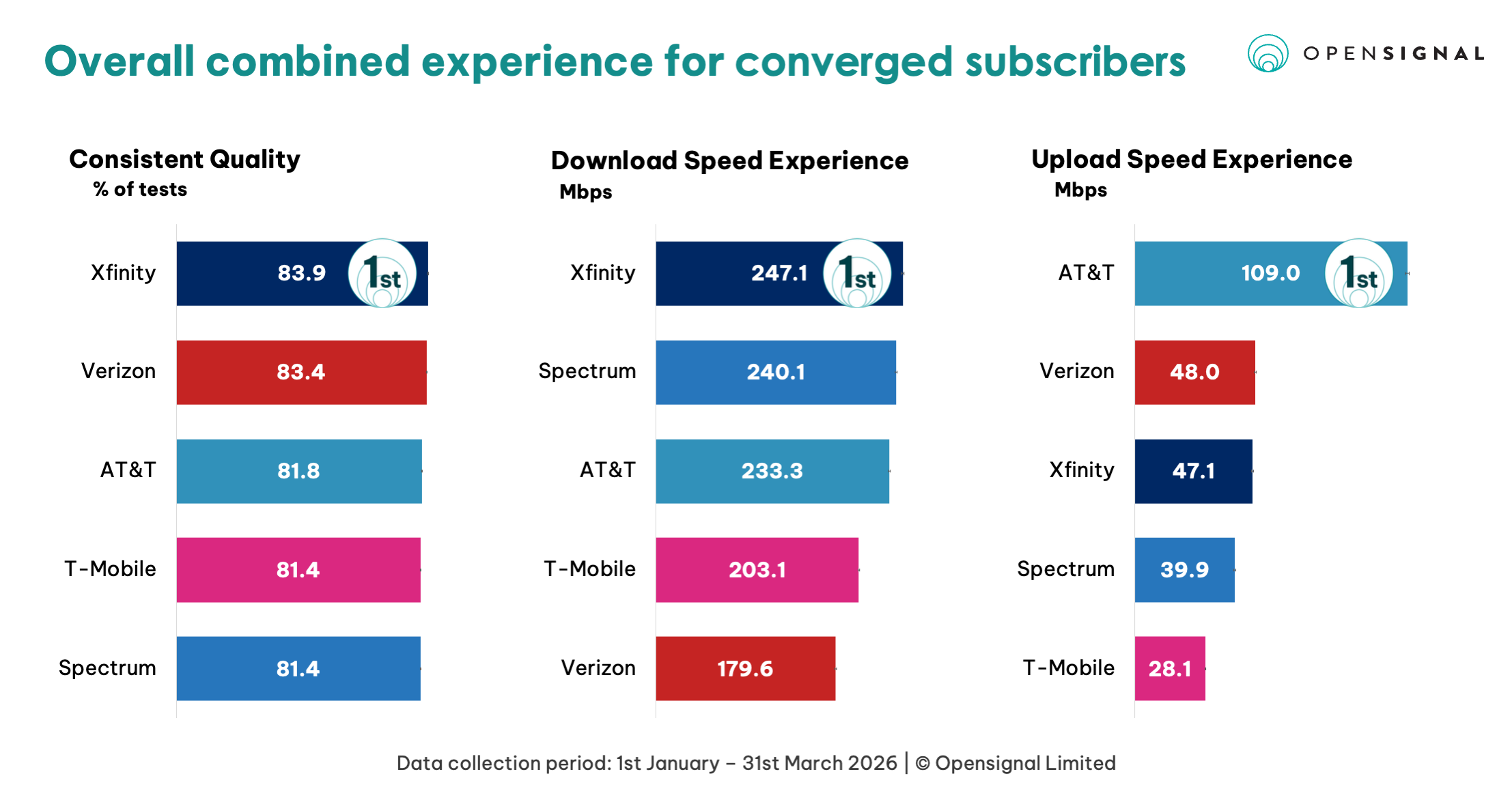
Xfinity tops the leaderboard for Consistent Quality, with a result of 83.9% and a lead of less than one percentage point over Verizon in second place. Results are close, with AT&T in third at 81.8%, while T-Mobile and Spectrum tie for fourth place at 81.4%.
Xfinity also wins for Download Speed Experience. It does so with a score of 247.1Mbps, 7Mbps higher than Spectrum, which finishes second. AT&T is a close third at 233.3Mbps.
For Upload Speed Experience, AT&T holds a clear lead. It scores 109.0Mbps, over double that of Verizon, which scores 48.0Mbps and is in second. Xfinity is a close third, less than 1Mbps behind Verizon, while Spectrum scores 39.9Mbps, and T-Mobile finishes at 28.1Mbps.
The impact of home broadband access technology on combined experience
Users’ home internet access technology has a large impact on their combined experience. This is because users in our converged cohort spend an average of more than 65% of their time on Wi-Fi, with that figure varying between different providers. As a result, we have broken out how converged experience varies for users on different access technologies – such as fiber, cable or FWA. These categories encapsulate all connections on a given access technology – including both current 5G and legacy 4G FWA solutions, as well as all DOCSIS versions on cable, to reflect the overall experience of consumers. It is important to note that newer technologies will outperform older ones; our results reflect the totality of current user experiences, while a subscriber on a newer generation solution will likely get a better experience.
Previous Opensignal research has demonstrated how users with fiber and cable at home typically see the highest speeds. However for combined experience, using our Consistent Quality metric, we have seen FWA deliver comparable results in some areas.
In this converged report we see a similar picture. Converged subscribers with fiber at home see a slightly better combined experience than those with cable, who in turn see slightly higher results than those on FWA. However, T-Mobile’s FWA result is less than half a percentage point behind Spectrum's cable score.
However, if we compare operators with both a significant fiber and FWA presence, there is a noticeable difference in results. Just short of eight percentage points separate Verizon’s fiber Consistent Quality score from its FWA one. On AT&T, this gap is slightly larger at 12 percentage points. While this difference between FWA and fixed-line services is noticeable, it is also not that large – which reinforces how well FWA can perform as part of the combined connectivity experience of many users.
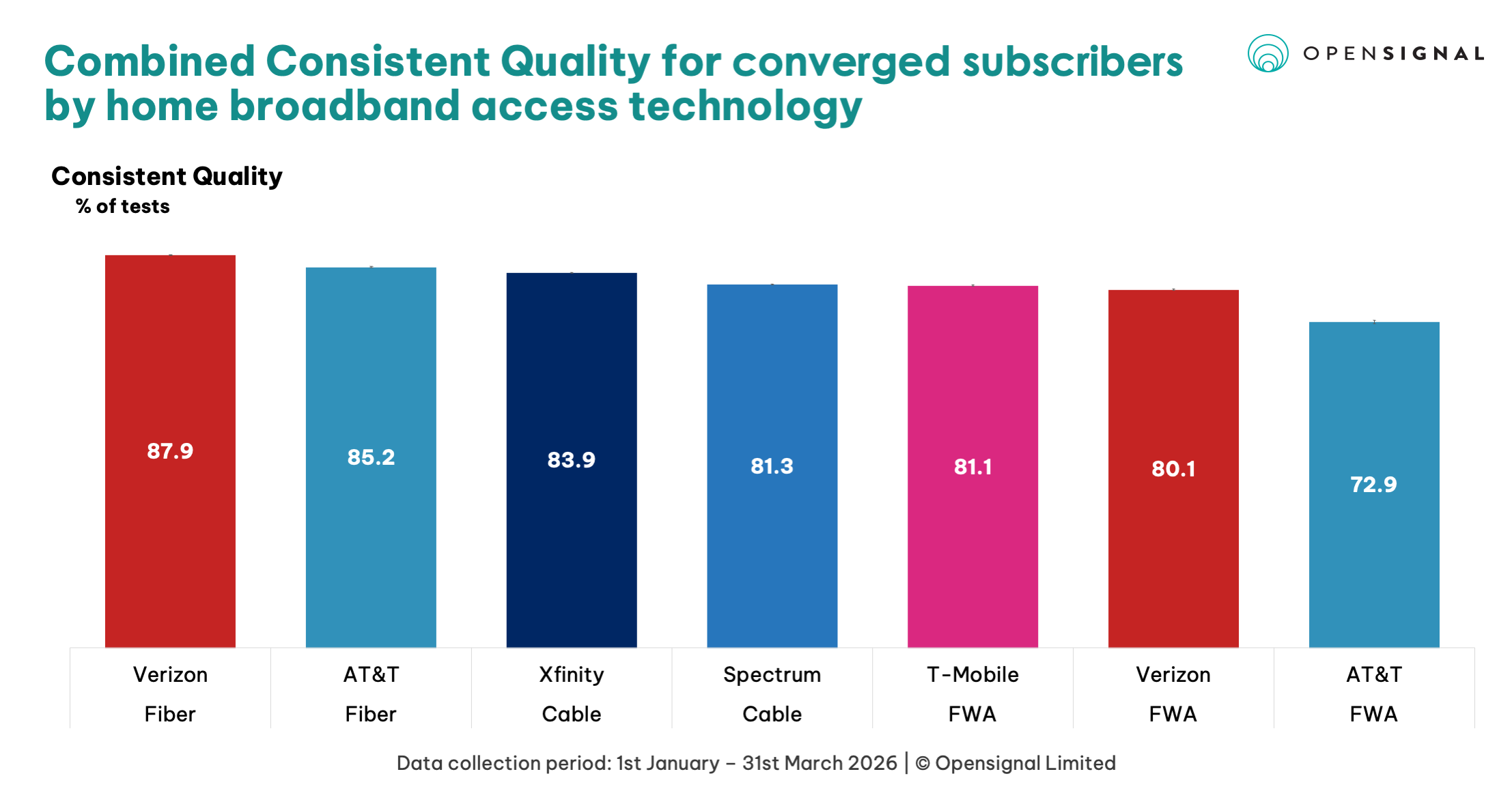
When we look at Download Speed Experience we start to see more significant differences. Our converged subscribers with AT&T fiber have the highest Download Speed Experience, with AT&T's result 37Mbps faster than the next provider and technology. They are followed by converged cable subscribers with Xfinity, while Verizon fiber subscribers are close behind. Spectrum’s converged users with cable experience download speeds slightly below those using Verizon fiber, and there’s a bigger drop to FWA. Over 40Mbps separate the converged Download Speed Experience for Spectrum cable subscribers and T-Mobile FWA subscribers, with a further drop of more than 50Mbps for converged users using Verizon FWA. T-Mobile’s significantly higher mobile speeds likely contributes to this result.
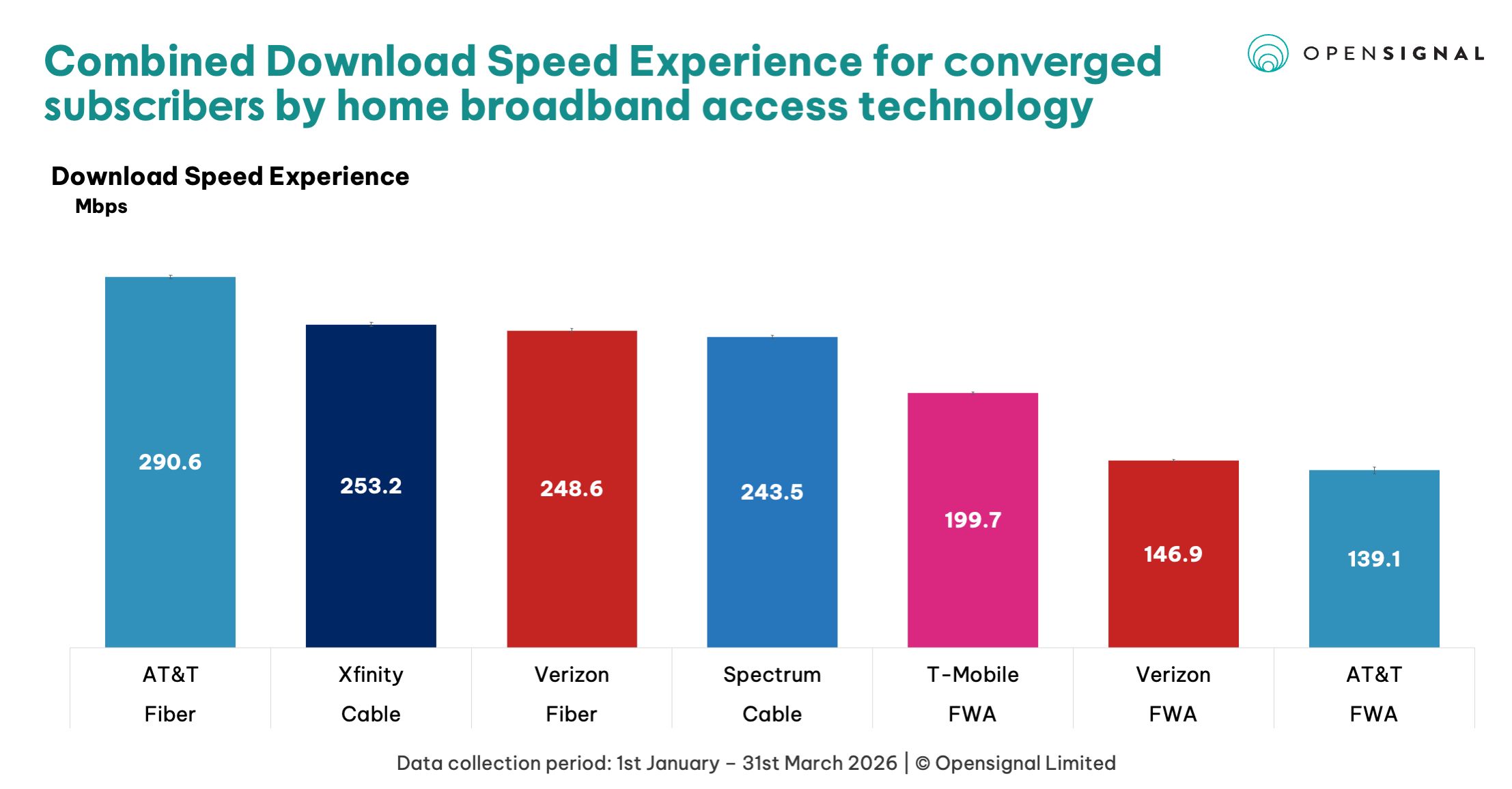
Upload experience shows greater separation between our converged users on fiber compared to cable. Our converged AT&T fiber users experience the fastest combined upload speeds at 161.2Mbps. Meanwhile, converged Verizon fiber subscribers see slower, but still remarkable upload speeds of 102.3Mbps. Xfinity and Spectrum’s converged cable subscribers see a combined Upload Speed Experience of 47.7Mbps and 36.4Mbps respectively. Out of the three FWA providers, T-Mobile has the highest combined Upload Speed Experience at 28.8Mbps, while AT&T narrowly outscores Verizon at 18.7Mbps compared to 18.1Mbps.
Methodology and definitions:
Opensignal references consumer-facing brand names in the reports, however, it is important to note that the ownership and operation of broadband infrastructure may be attributed to different corporate entities. We have included a table below that outlines the parent infrastructure companies associated with the consumer-facing broadband provider names.
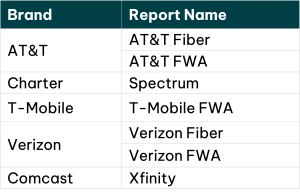
Plan characteristics — for example, speed tiers or data caps — vary greatly by provider and the dispersion of the plan mix will affect the average experience result. Opensignal’s measurements capture users’ experience, regardless of the plan that they have purchased from their provider. This report analyzes the real-world situation across all users’ plans.
Opensignal also captures user measurements across all mobile connections, and broadband network architectures, encompassing fiber (FTTx), xDSL, cable, fixed wireless access (FWA) via 4G and 5G, as well as satellite, and reports on a holistic evaluation of our users’ experience with the listed providers' internet services.
Our converged user cohort is composed of users who purchase both mobile and fixed-line services from the same provider. Converged Experience results encapsulate the combined connectivity experience across both cellular and Wi-Fi connections – including those times where users connect to Wi-Fi outside of their own home.
Download Speed:
Measured in Mbps, Download Speed represents the typical everyday speeds a user experiences across mobile and fixed broadband connections.
Upload Speed:
Measured in Mbps, Upload Speed measures the average upload speeds for each provider observed by our users across their mobile and fixed networks. Typically, upload speeds are slower than download speeds, but this often depends on the technology used, especially for broadband.
Consistent Quality:
Measures how often users’ experience on a network was sufficient to support common applications’ requirements. Consistent Quality uses six key performance indicators, including download and upload speed, latency, jitter, packet loss and time to first byte. Metrics are represented as a percentage of users’ tests that have met the minimum recommended performance thresholds to watch HD video, complete group video conference calls and play games.
Opensignal Limited retains ownership of this insight including all intellectual property rights, data, content, graphs & analysis. Reports and insights produced by Opensignal Limited may not be quoted, reproduced, distributed, published for any commercial purpose (including use in advertisements or other promotional content) without prior written consent. Journalists are encouraged to quote information included in Opensignal reports and insights provided they include clear source attribution. For more information, contact [email protected].
