


Authored by Robert Wyrzykowski, data support by Arith Hewathenna
Most people visiting Japan are paying more for a worse mobile experience — and don't know it.
Japan's tourism boom has created an exciting commercial opportunity for local operators. In 2025, the country welcomed a record 42.7 million international visitors — up 15.8% year-on-year — and the vast majority of them actively use mobile data throughout their stay.
Tourists' and travellers' choice of staying on a home network's roaming service might be convenient but could come at a cost — not just in bill terms, but in experience terms. That experiential gap between what travellers are getting and what they could get is where the opportunity sits for Japanese operators.
Key findings
- Local SIMs offer a better experience: In Japan, Local SIM swappers achieve a Network Quality Index score of 94.7% — higher than travel eSIM users at 87.6%, and much higher than that of roamers at 73.6%.
- Roaming is the preferred choice for shorter trips: The majority of visitors to Japan stay on their home network's roaming service. But after two weeks in the country, they are much more likely to switch to a local SIM.
- Users from some markets are more likely to swap to local SIMs: UK and Canadian visitors show the lowest roaming rates, with a significant share opting for local SIMs or travel eSIMs. Visitors from the US and Asia-Pacific show the strongest tendency to stick with their home networks, even up to nearly 80%.
- SoftBank leads the local SIM swapping market on average: Across all markets, SoftBank captures 34% of local SIM swappers — above its domestic market share. IIJ is strong among visitors from outside of Asia, while NTT docomo and au lead in specific Asian markets.
A substantial experience gap between connectivity options
For those who do swap to local SIMs — that is, purchase a physical SIM or eSIM from a local Japanese operator upon arrival — the benefits go beyond cost. Switching delivers a meaningfully better mobile experience, for reasons that lie in how roaming works in practice.
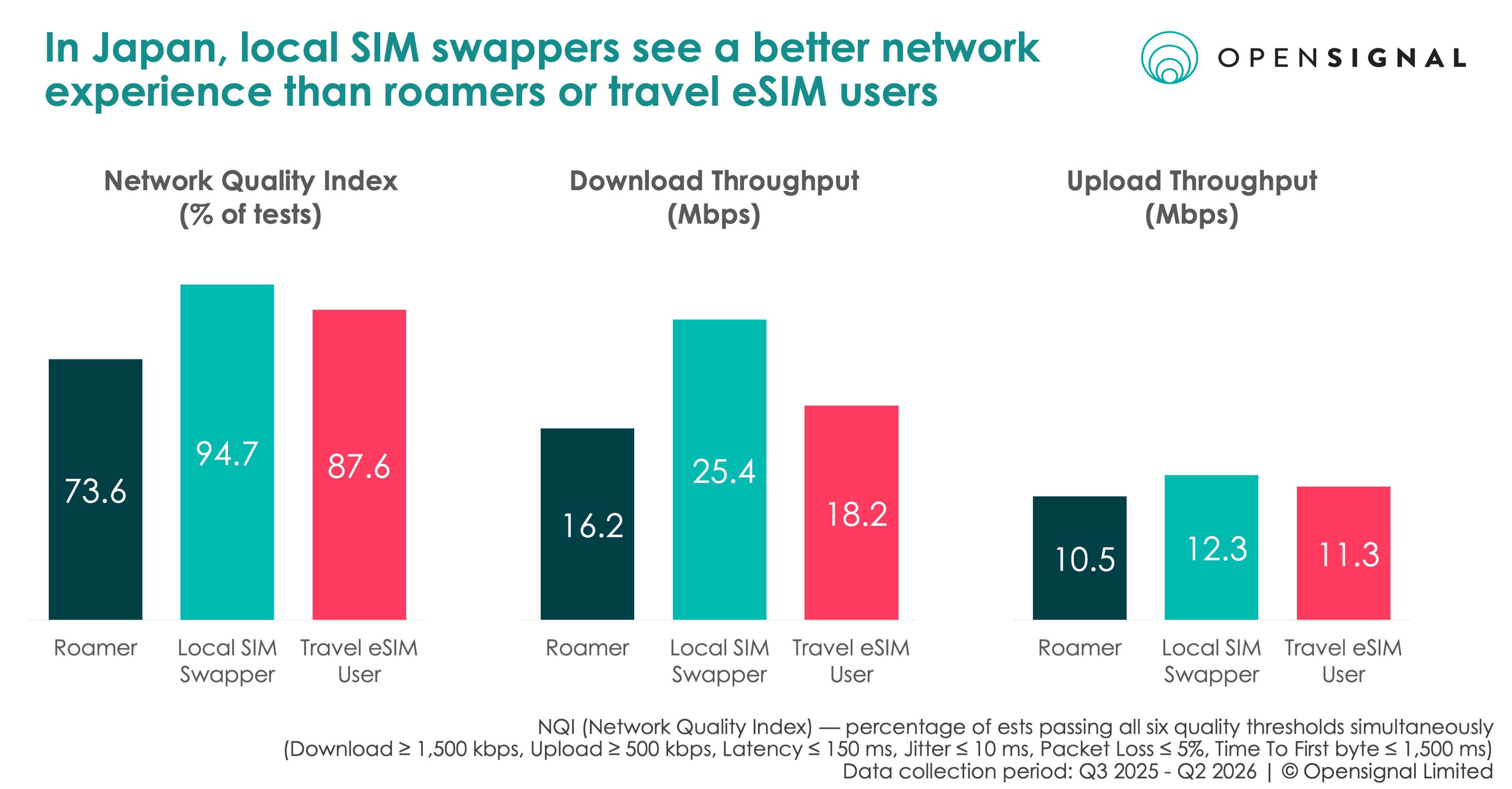
Opensignal local SIM swappers achieve far more consistent quality of mobile services than roamers — users who stay on their home network's roaming service — or travel eSIM users — those who buy international travel eSIMs such as Airalo, Holafly or Saily before departure. Local SIM swappers achieve a Network Quality Index score of 94.7% — higher than travel eSIM users at 87.6%, and much higher than that of roamers at 73.6%.
Network Quality Index is one of Opensignal’s consistent quality metrics. It measure how often a user gets a good enough connection to seamlessly and comfortably run basic connectivity apps when connecting abroad. For a tourist in Japan trying to use Google Maps around an area they have never been to before, find a good restaurant in the busy part of town on TripAdvisor, or upload pictures and videos from their trip on Instagram, it is a more meaningful measure of real-world experience than raw speed alone.
The mechanics of how roaming works explain the consistent quality gap between local SIMs and roamers. Because roaming traffic is routed back to the user's home network before being returned, latency rises significantly — and with it, perceived quality degrades. Distance makes this worse: the further a visitor's home country is from Japan, the worse and less consistent their roaming experience tends to be.
Yet most travellers are unaware of this — and that knowledge gap represents a genuine commercial opportunity for Japanese operators.
Travellers' behaviour changes over the length of their stay
That case may be easier to make to some travellers than others. For the majority, sticking to roaming is the easy solution when visiting Japan for a short trip — it requires no preparation, no new SIM and no eSIM-compatible device. But trip length changes that behaviour significantly.
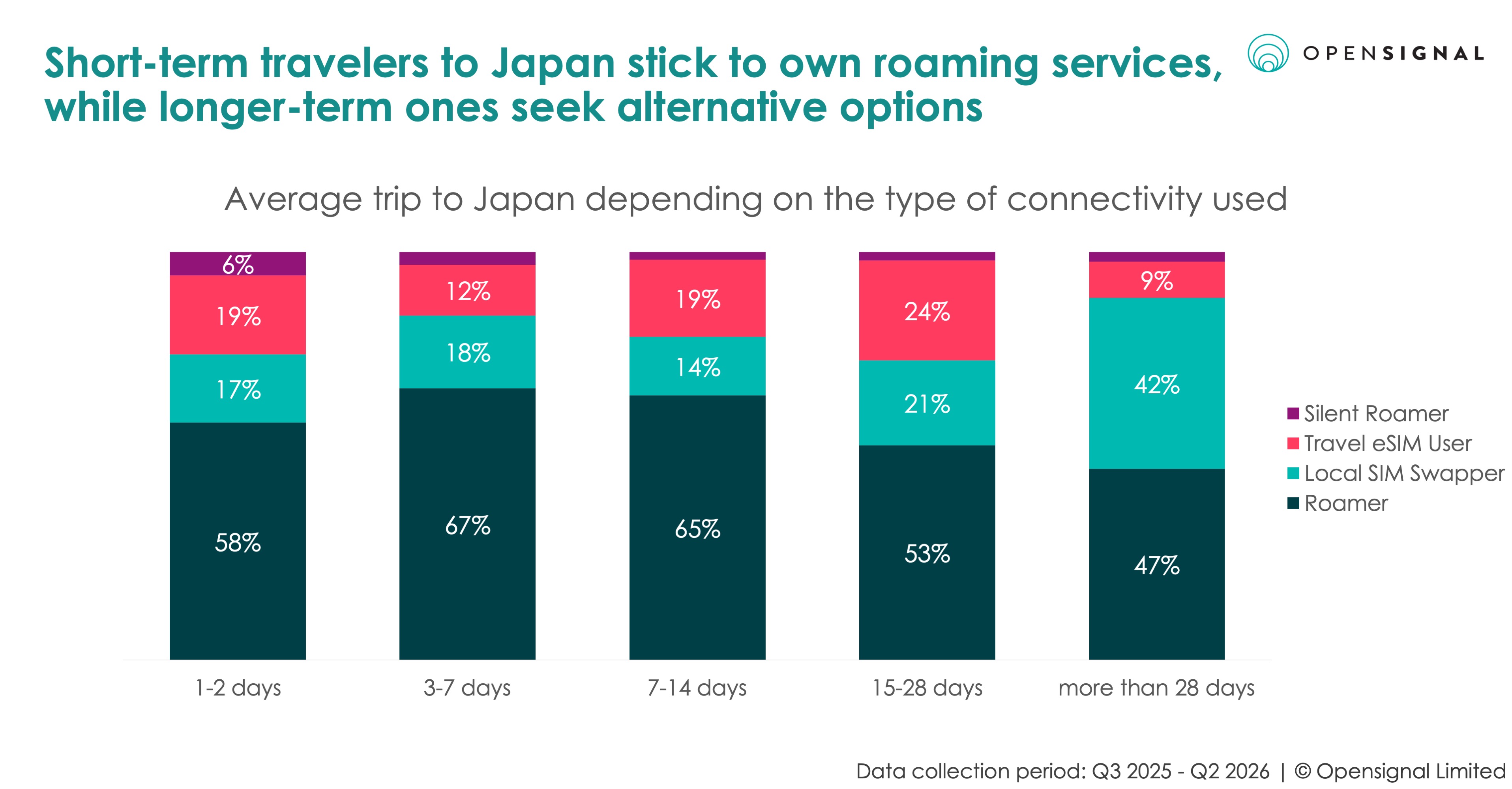
The majority of visitors to Japan stay on their home network's roaming service — but after two weeks in the country, they are much more likely to switch to a local SIM, with the roamer share dropping from 67% for 3–7 day stays to 53% for stays longer than two weeks.
Meanwhile, the local SIM market grows meaningfully with longer stays: the share of local SIM swappers increases to 21% after two weeks and to 42% after four weeks. Travel eSIM usage, by contrast, drops to just 9% among those staying beyond 28 days.
Silent roamers are cost-conscious users who disable data roaming entirely to avoid charges, relying on hotel or public Wi-Fi instead. In some cases, poor network quality abroad may reinforce that choice. Silent roamers are most visible on very short trips — understandably, as a one or two-day visit may not justify the cost of any data plan. Their share drops quickly as trip length increases, as travellers become more willing to invest in a data plan for a longer stay.
Home market shapes connectivity choices
Trip length, however, is only part of the story. Where travellers come from shapes their connectivity choices just as much — and the differences between markets are striking. Asia-Pacific visitors show the highest roaming rates, with roughly 60–70% remaining on home networks. US visitors follow a similar pattern, with nearly 80% staying on their home network.
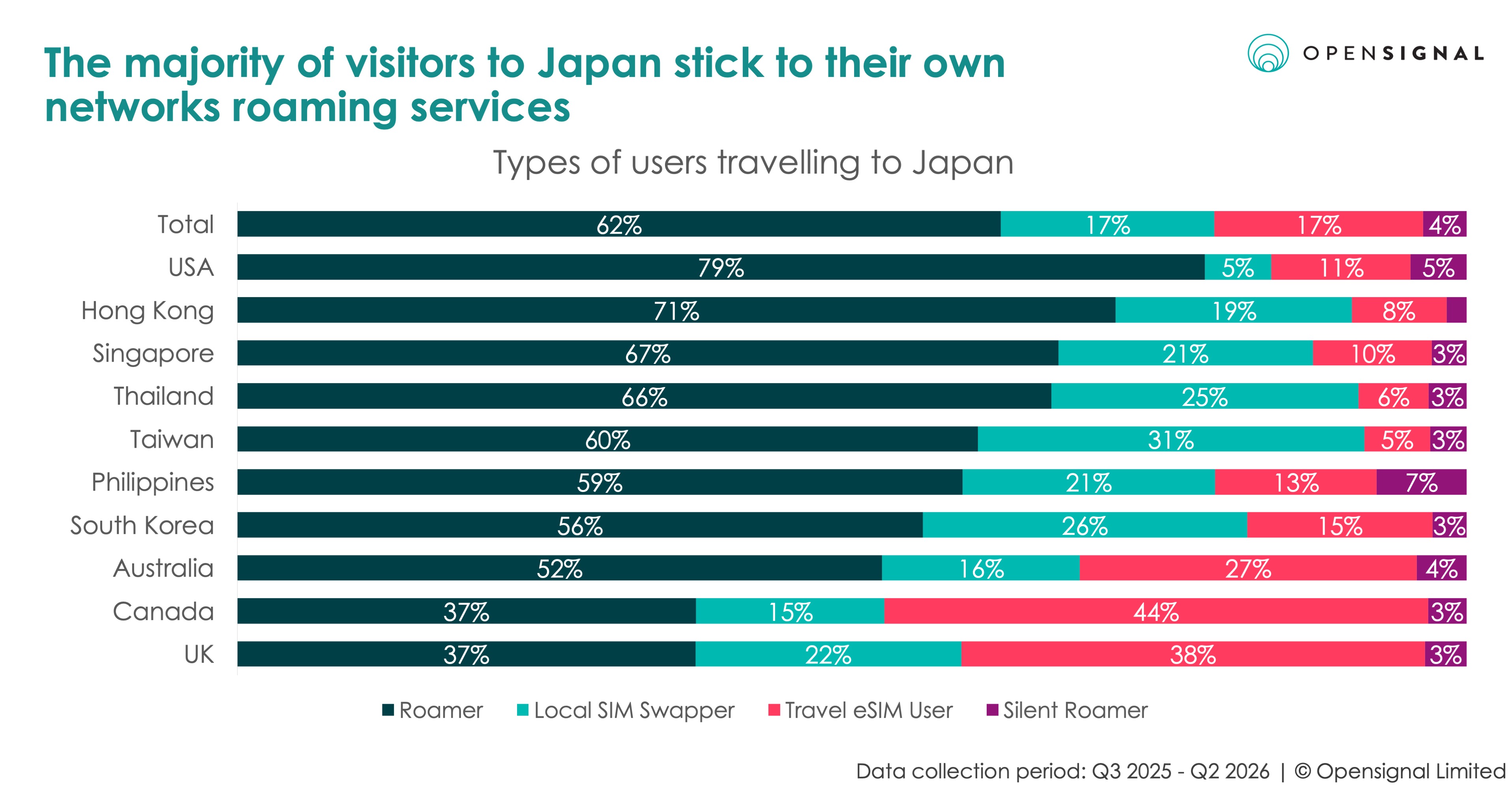
The picture looks quite different for visitors from the UK, Canada and Australia, where roamers are not the overwhelming majority and travellers are significantly more likely to use local SIM or travel eSIM options. This likely reflects a combination of higher roaming costs from these markets to Japan and greater consumer awareness of — and appetite for — connectivity alternatives.
There is clear room for Japanese operators to grow their share of local SIM swappers. So far, South Korea and Taiwan show the highest rates of local SIM adoption among Asia-Pacific visitors. Meanwhile, silent roamers remain a marginal group, at around 4% of travellers overall. However, visitors from the US and the Philippines are somewhat more likely to opt out of mobile data entirely when in Japan.
Who wins the inbound subscriber?
For those travellers who do make the switch, the competition among Japanese operators is fierce — and the results vary sharply depending on where visitors come from.
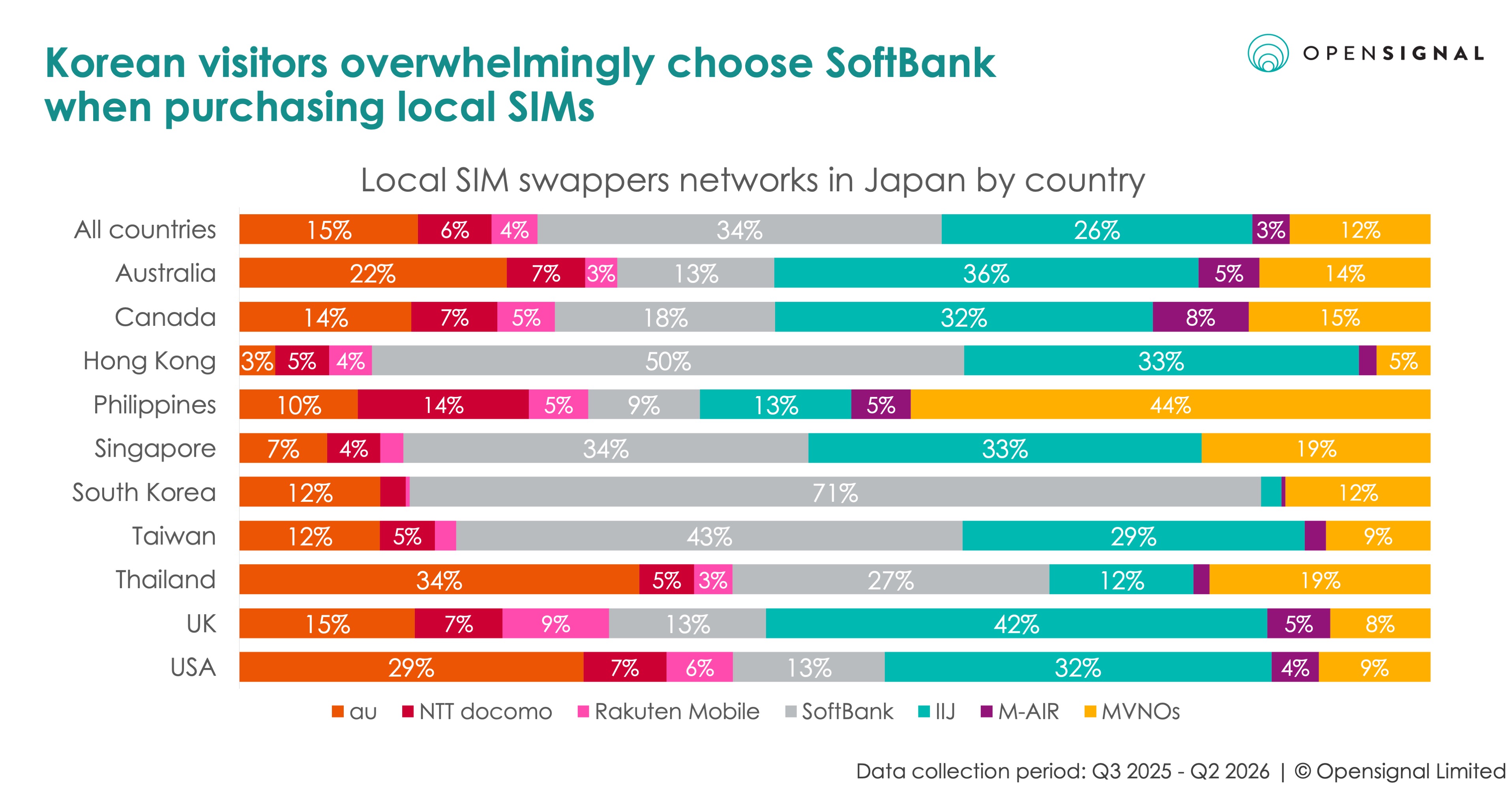
Overall, SoftBank captures 34% of local SIM swappers — notably above its roughly 29% share of Japan's domestic market — while IIJ accounts for 26%. The picture shifts considerably at market level, for example:
- SoftBank is the dominant choice for visitors from South Korea and Hong Kong,
- NTT docomo holds its largest share among Filipino travellers,
- au leads among visitors from Thailand and does very well among the U.S. and Australian travellers,
- IIJ's strength is concentrated in travellers from Singapore, Hong Kong, and visitors from further afield like Canada or the UK.
The untapped opportunity at the airports
The diversity of these results leads to one clear conclusion: there is no single, one-size-fits-all strategy for winning inbound travellers — but the prize for getting it right is significant.
The Japanese inbound wholesale roaming market — the revenue Japanese operators earn from hosting foreign visitors on their networks — was estimated at $1.76 billion in 2024 — around 1-2% of their total revenues. But wholesale roaming is largely a passive revenue stream, governed by bilateral agreements between operators. The more actively contestable opportunity lies in local SIM sales to tourists, a market that is fast growing. For Japanese operators willing to invest in visibility and marketing, that is where the real upside sits.
Roaming comes with obvious cost and quality limitations, often accepted by default rather than chosen deliberately. Visitors to Japan may self-impose data restrictions or rely on Wi-Fi wherever possible. Travel eSIMs, with their broad global coverage, are a compelling option for frequent international travellers — but less so for occasional visitors on a single-country holiday. For anyone spending more than a few days in Japan, local SIM products offer a combination of better value and demonstrably superior experience that neither alternative can match.
That advantage is real but largely invisible to the average tourist — and therein lies the opportunity. Most travellers stick to roaming out of habit and convenience, simply unaware that a better option exists. For Japanese operators willing to invest in visibility earlier in the traveller's journey — through airport presence, travel platform partnerships, and targeted marketing that leads with experience, price and ease of use — that is where the real upside sits. Japan's tourist boom is substantial, but the share of it flowing into local operators' revenues has yet to reach its potential.
Check out more of our insights on Japan. If you're interested in more of our tailored analysis then please contact us. Don’t forget to subscribe to Opensignal’s newsletter for deeper insights on Japan and global markets.
Opensignal Limited retains ownership of this insight including all intellectual property rights, data, content, graphs & analysis. Reports and insights produced by Opensignal Limited may not be quoted, reproduced, distributed, published for any commercial purpose (including use in advertisements or other promotional content) without prior written consent. Journalists are encouraged to quote information included in Opensignal reports and insights provided they include clear source attribution. For more information, contact [email protected].
