


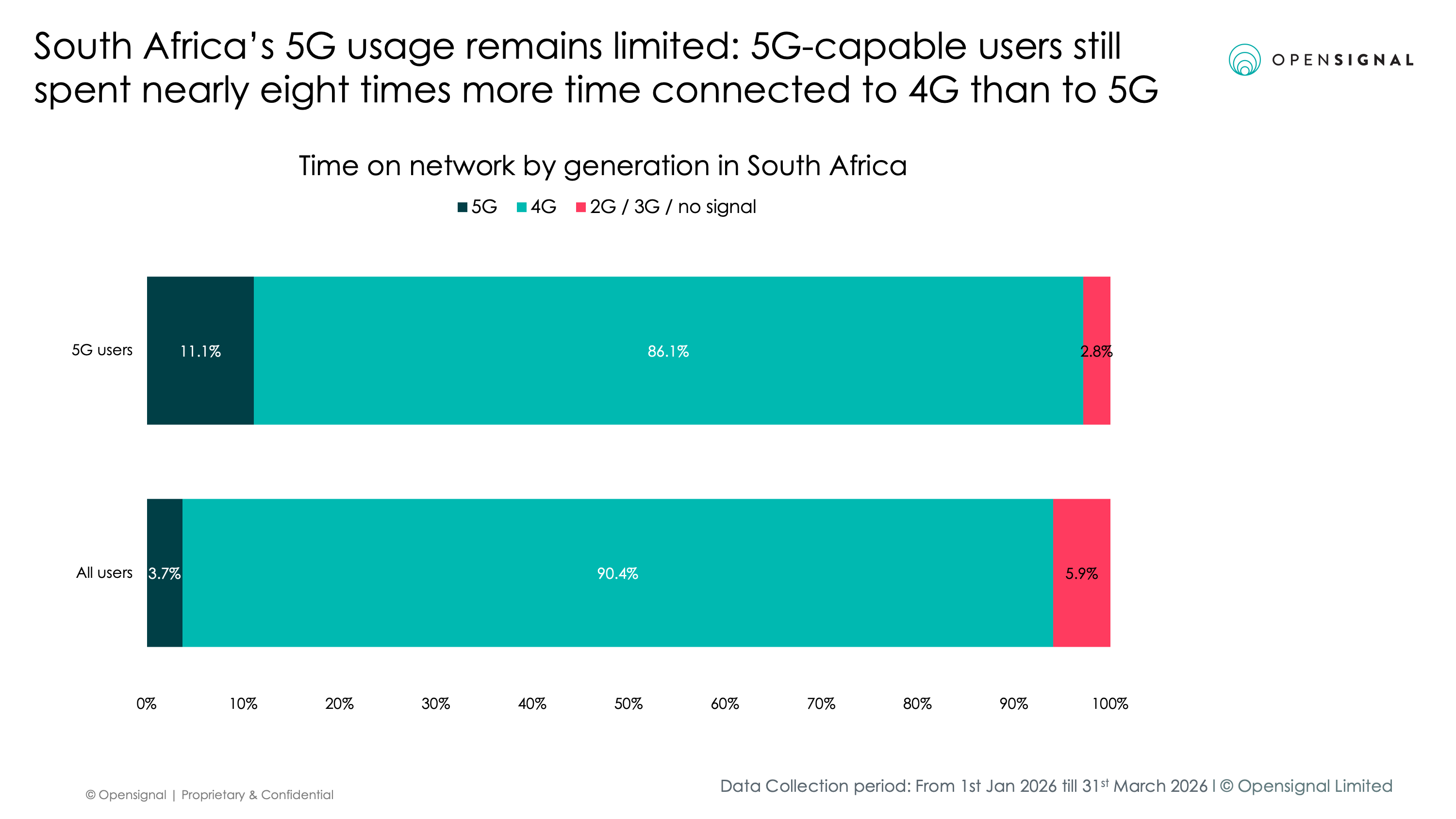
South Africa was an early African 5G mover, with launches in 2019 and 2020. Yet in Q1 2026, users spent just 3.7% of their connected time on 5G. Even among South Africans equipped with 5G-capable devices, time spent on 5G was limited to only 11.1% of their connectivity — 4G still anchors the daily mobile experience.
This does not mean South Africa's 5G networks lack performance. When users connect to 5G, they experience faster speeds and better consistent quality than on 4G. The challenge is persistence: users aren't connected to 5G often enough to materially change the national mobile experience.
Key findings:
- When users reach 5G, the uplift is clear. Average 5G download speeds were nearly five times faster than 4G, while 5G Consistent Quality was more than 15 percentage points higher. The technology delivers; the challenge is making that experience available more often.
- South Africa's 5G challenge is network reach, not adoption. 5G users spent just 11.1% of their connected time on 5G in Q1 2026, and 86.1% on 4G which is a network reach, not an adoption one.
- South Africa has a 5G capacity layer — not a 5G coverage layer. Mid-band spectrum carries almost all observed 5G traffic. The low-band frequencies that would push 5G indoors and into weaker signal areas are still overwhelmingly on LTE — a deployment choice, not a spectrum gap.
When users reach 5G, it works
In Q1 2026, average 5G download speed reached 196.4Mbps, nearly five times faster than 4G at 39.4Mbps. Upload was stronger too — 22.5Mbps on 5G against 8.1Mbps on 4G. The quality gap was just as clear: 5G Consistent Quality — the share of time the network meets the demands of common apps — was 81%, against 66.2% on 4G — an advantage of more than 15 percentage points.
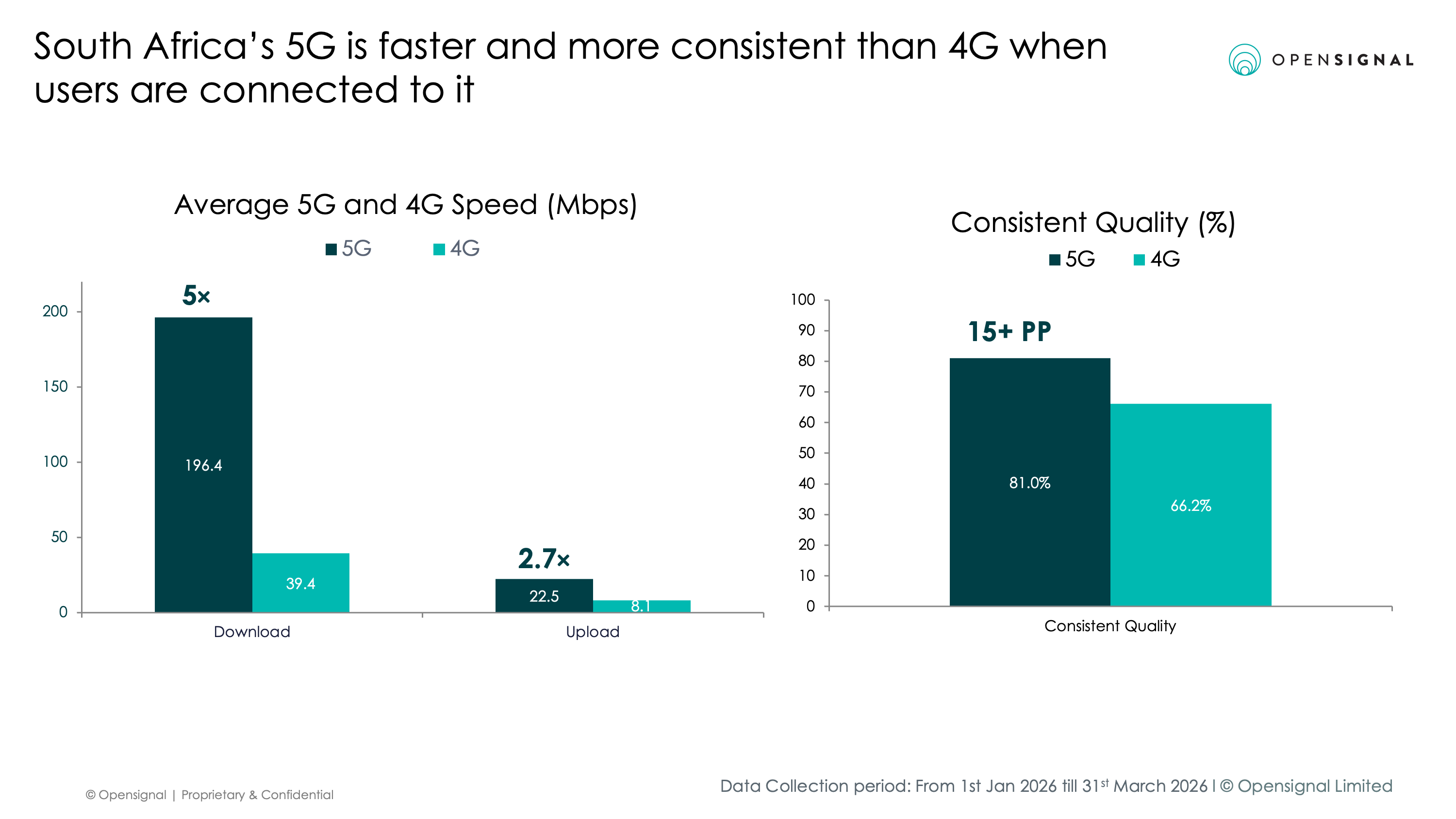
That means limited time on 5G is not a sign that South Africa's 5G underperforms — the opposite is true. When users do connect, the advantage over 4G is substantial.
5G coverage is growing, time on 5G isn't
According to the South African telecom regulator – Independent Communications Authority of South Africa (ICASA), 5G population coverage reached 58% in 2025, up from 46.6% a year earlier, with rollout concentrated in urban areas. Yet even users with a 5G device spent nearly eight times more connected time on 4G than on 5G in Q1 2026. That rules out handsets as the main cause — these users already own the phone.
Device affordability isn't the barrier either; entry-level 5G handsets are now widely available across South Africa. The constraint is how often the network actually delivers 5G — and that comes down to which spectrum operators have put it on.
5G Spectrum deployment explains the gap
ICASA's 2022 auction gave operators access to 700MHz, 800MHz, 2.6GHz and 3.5GHz. But in Q1 2026, mid-band carried almost all observed 5G traffic. Low-band tells a different story: 700MHz and 800MHz remain almost entirely on 4G.
In Q1 2026, 3.5GHz usage was entirely 5G, while 2.6GHz acted as the main transition band — 23% on 5G, 77% still on 4G. Together these bands carried almost all observed 5G usage, giving South Africa the foundation of the 5G capacity layer. By contrast, the low-band coverage layer remains LTE-led: 700MHz was 99.7% 4G and 800MHz 100% 4G.
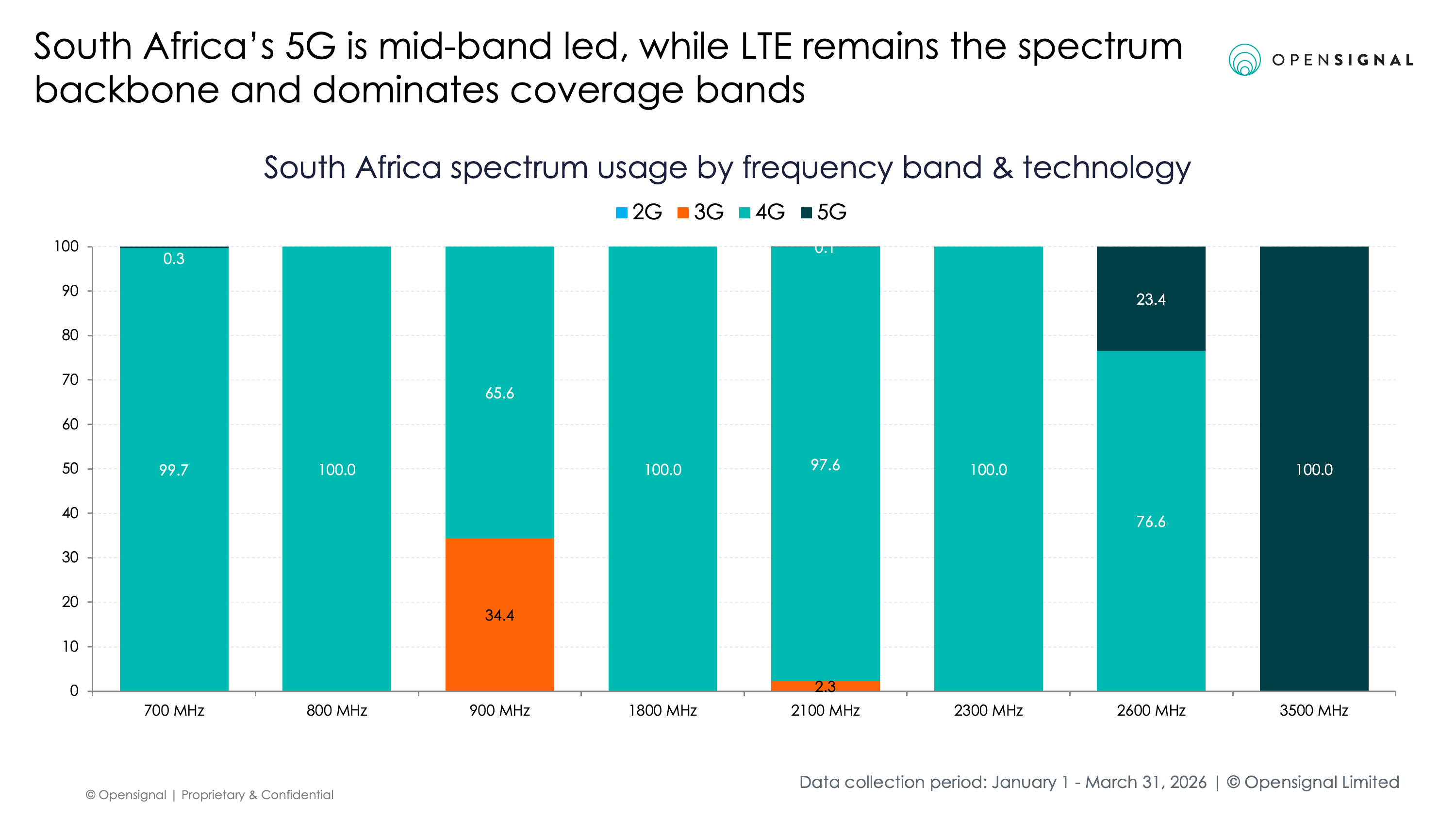
South Africa has built a 5G capacity layer, not a 5G coverage layer. Mid-band delivers strong speeds in good conditions; low-band is what keeps users connected indoors and at the edges of coverage. As long as low-band stays on LTE, 5G stays a layer users pass through briefly rather than one they stay on.
India highlights the value of a layered 5G spectrum strategy
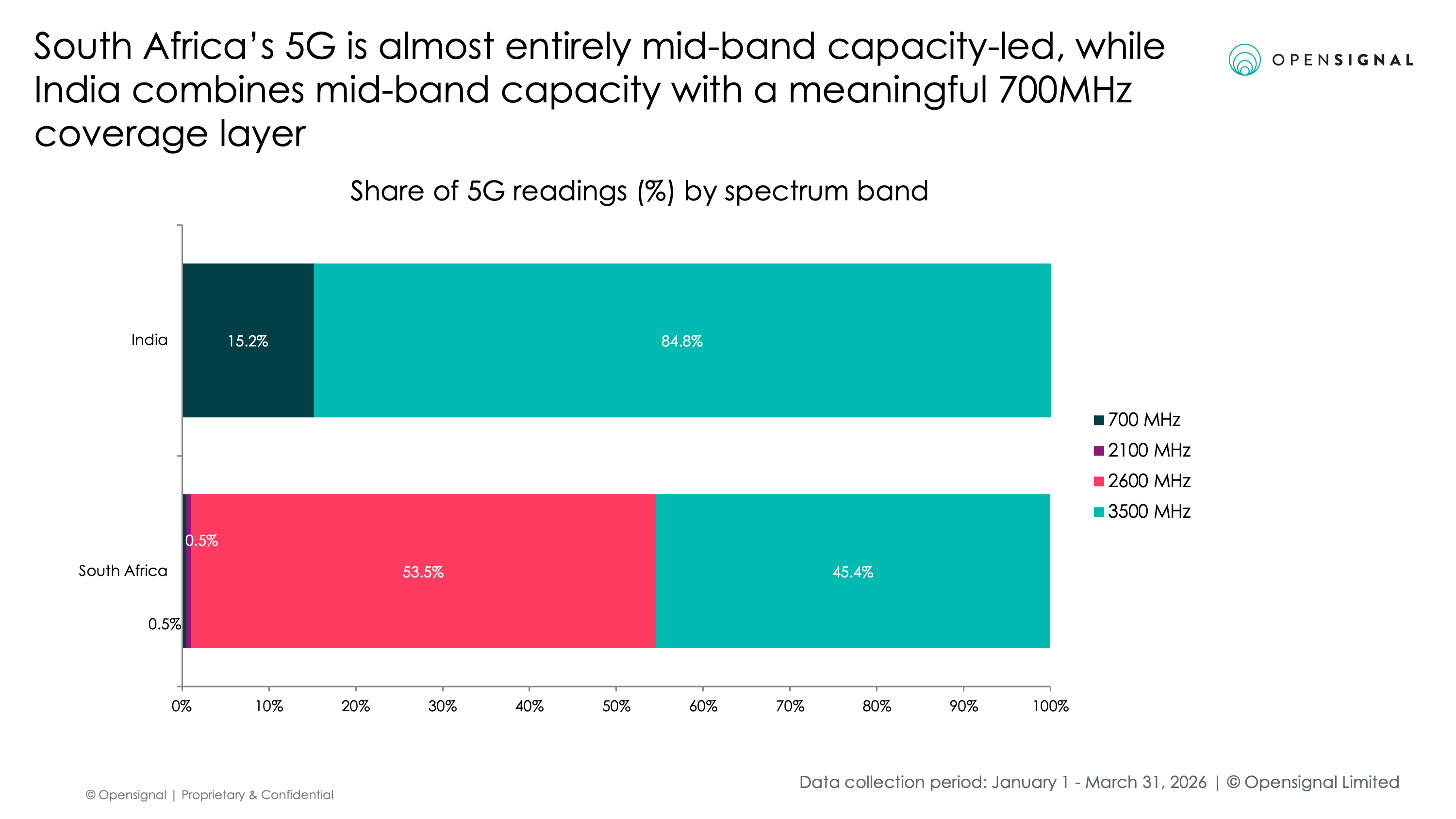
India is a useful benchmark — not because the markets are alike, but because they show what different spectrum strategies produce. Both use mid-band as their main 5G capacity layer, but India has given low-band a visible 5G role. Indian users spent 34.6% of their time on 5G in Q1 2026, against 3.7% in South Africa.
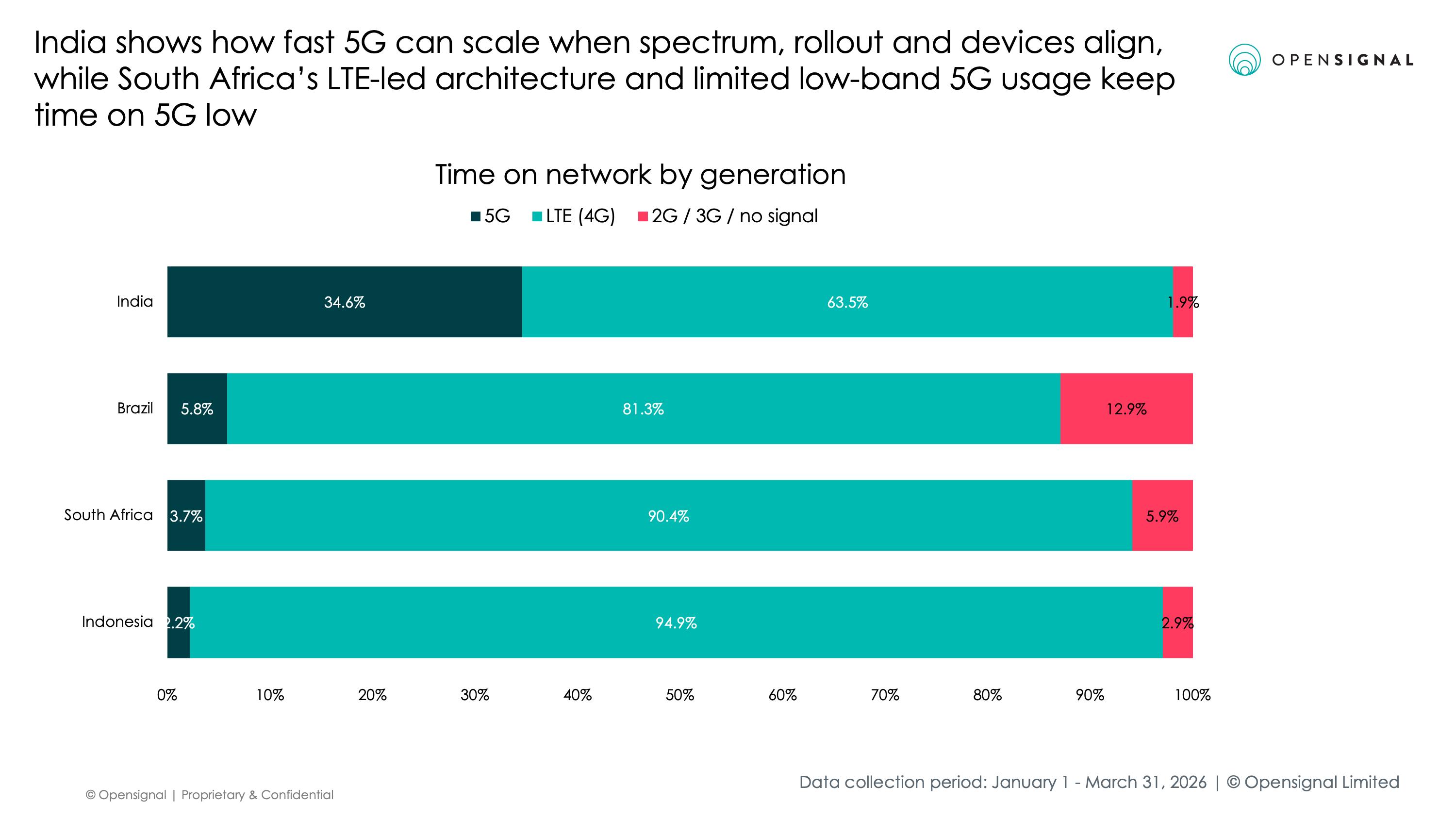
Part of that gap reflects differences in scale and rollout pace. But low-band 5G matters: it accounts for a meaningful share of India's 5G readings, against almost none in South Africa. That reach keeps users on 5G longer and indoors — exactly where South Africa's mid-band layer loses them.
The lesson isn't that India is a model to copy. It's that 5G scales fastest when mid-band capacity is paired with low-band reach.
The spectrum to extend 5G already exists — it's largely being held for LTE
South Africa's 5G story is not about proving the technology works. The Q1 2026 data settles that. It's about why a network that performs this well reaches so few users, so rarely — and the answer sits in operator deployment decisions, not in spectrum availability or device penetration.
Until low-band moves to 5G, the everyday mobile experience stays on 4G. The stronger network is already there. It's just not switched on for most people.
For more insights into how mobile network experience is evolving in South Africa and other markets, visit Opensignal's website and explore our latest reports and analysis.
Opensignal Limited retains ownership of this insight including all intellectual property rights, data, content, graphs & analysis. Reports and insights produced by Opensignal Limited may not be quoted, reproduced, distributed, published for any commercial purpose (including use in advertisements or other promotional content) without prior written consent. Journalists are encouraged to quote information included in Opensignal reports and insights provided they include clear source attribution. For more information, contact [email protected].
