


Indonesia's 5G story is one of strong ambitions meeting stubborn obstacles. The country made the deliberate decision to phase out 3G networks earlier than many Asia-Pacific markets to fast-track 4G and 5G. Yet years later, 5G roll-outs have remained sluggish — and users have felt it. 5G Availability and speeds continue to trail regional peers, a gap that traces back to one persistent bottleneck: spectrum scarcity.
That is now beginning to change. In October 2025, Surge and MyRepublic won regional licences in the 1.4GHz auction, with plans to deploy 5G Fixed Wireless Access (FWA) services under the Internet Rakyat initiative — a government push to make affordable broadband more widely accessible. Now, a second major spectrum assignment is under way, with Indonesian operators hopefully gaining access to the 700MHz and 2600MHz bands in August 2026. Taken together, these moves signal that Indonesia is executing a deliberate, multi-band strategy.
Not enough spectrum to properly get 5G off the ground
As our previous analysis shows, more spectrum bandwidth directly translates to faster speeds and better network performance. Before this auction, Indonesia is working with a notably thin slice of airwaves for 5G — relying almost entirely on 2100MHz and 2300MHz bands. These frequencies had been reorganised into larger contiguous blocks by Komdigi and its predecessor to maximise their utility. But in practice, 4G traffic already occupies the bulk of those frequencies, leaving very little headroom for 5G to shine.
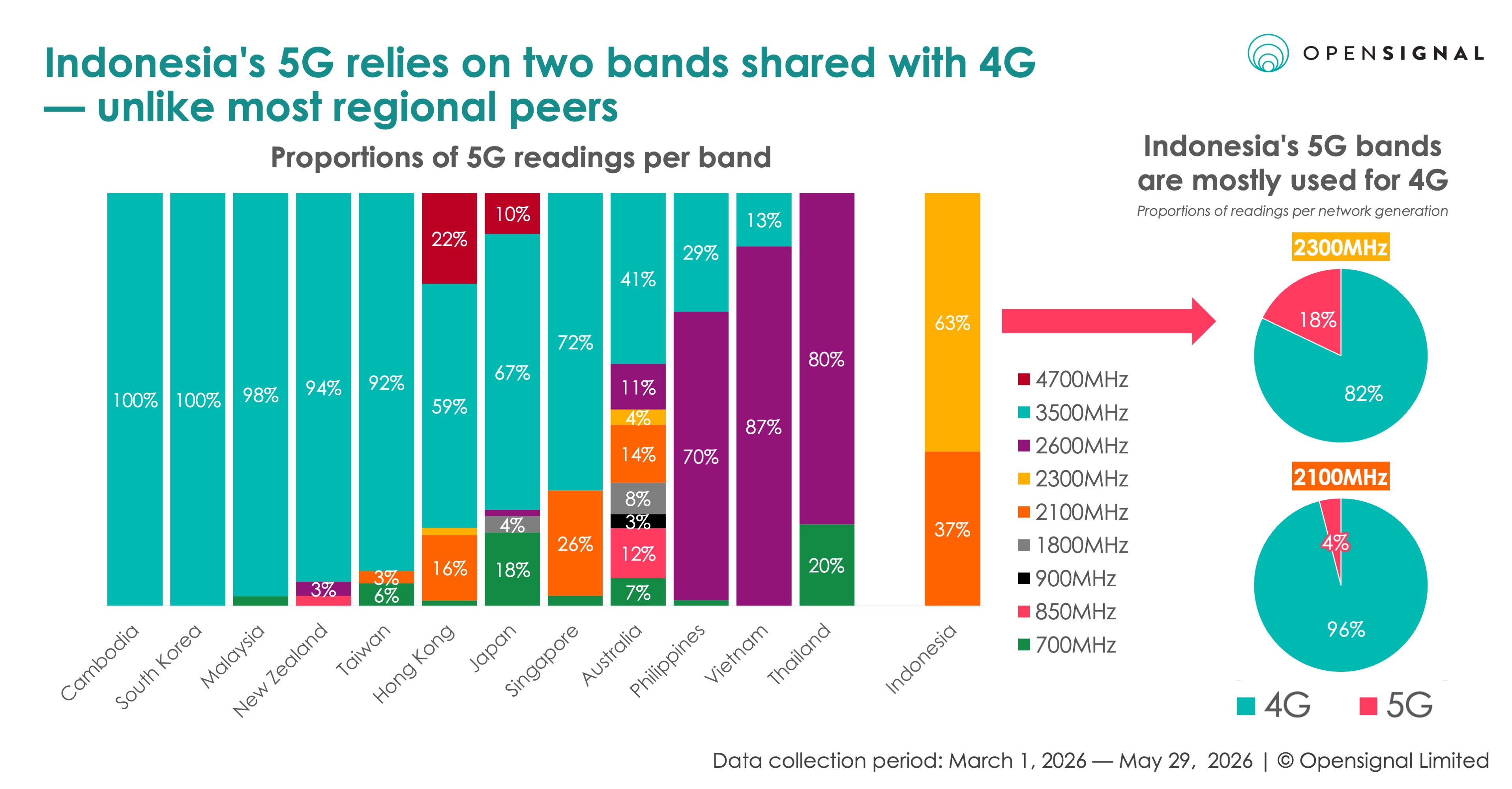
The gap becomes stark when set against regional peers. Most Asia-Pacific markets anchor their 5G on the 3.5GHz band — regarded as the sweet spot because it balances capacity and coverage, making it ideal for enhanced mobile broadband. Cambodia, South Korea, Malaysia, New Zealand, and Taiwan run their 5G almost exclusively on it. Australia, Hong Kong, and Japan go further, layering in additional frequency bands to broaden coverage, boost capacity, and ease congestion.
Indonesia, by contrast, cannot lean on the 3.5 GHz band at all — it remains occupied by fixed satellite services. That structural constraint, more than anything else, explains why Indonesia's 5G has lagged behind the rest of the region — along with Thailand, which has not released the 3.5 GHz band for 5G either. The good news for Indonesia is that Komdigi plans to release the 3.5 GHz band after completing the 700 MHz and 2.6 GHz auctions.
What the new spectrum will actually bring
The 700MHz and 2600MHz additions would mark a genuine step-change for Indonesian 5G — unlocking signal availability, network capacity, and congestion headroom that the old 2100/2300MHz configuration alone was never going to deliver.
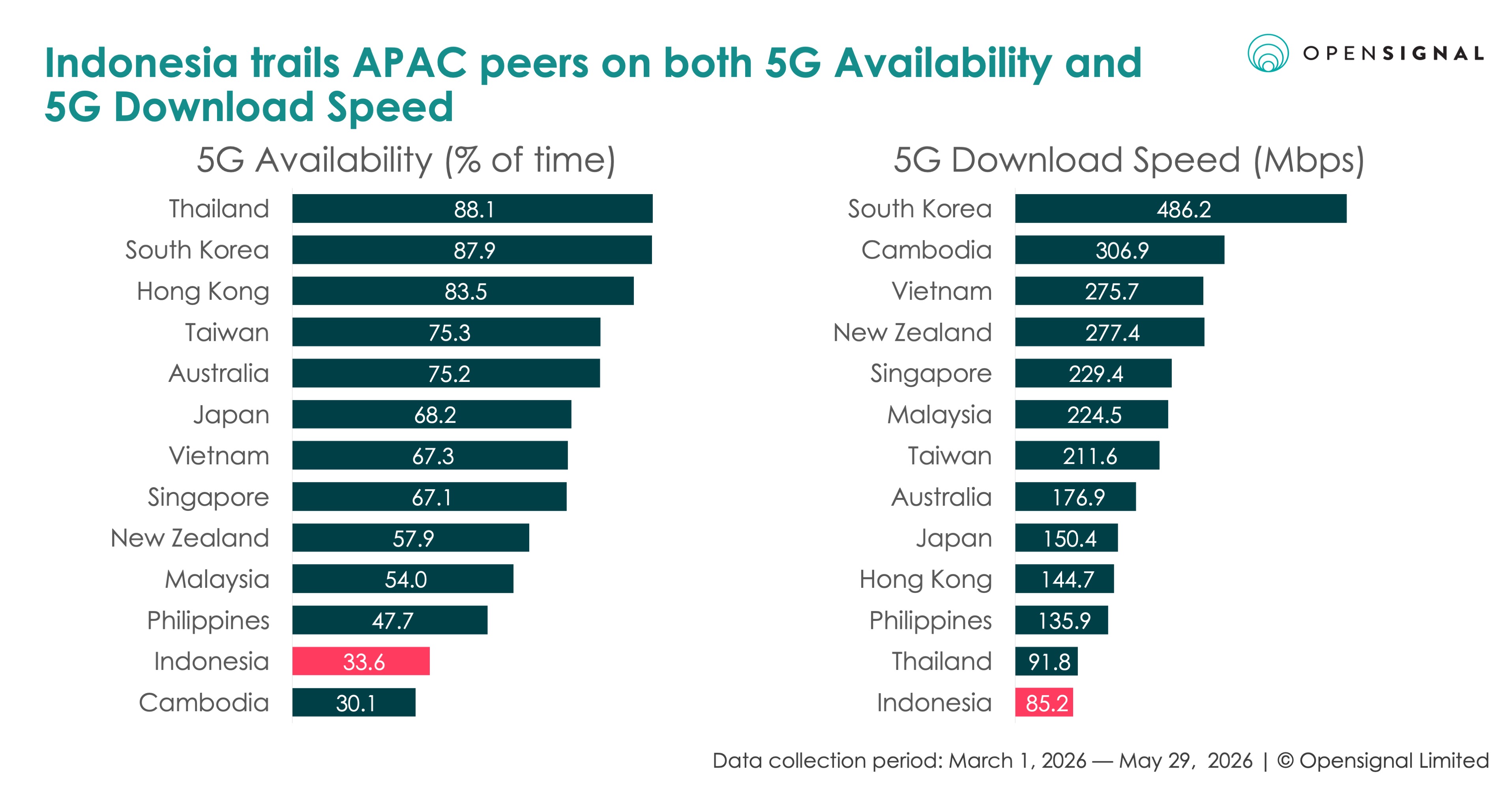
The 700MHz band sits in the sub-1GHz low-band range. This is the kind of spectrum that travels far, penetrates buildings well, and doesn't require a dense network of towers to deliver coverage — and comes with economic benefits from closing the digital divide. For a vast archipelago nation spanning more than 17,000 islands, this is a no-brainer. Deploying in the 700MHz band should meaningfully improve 5G Availability — the share of time Opensignal users have an active 5G connection, whether they were actively using it or not — especially in rural and underserved areas.
The 2600MHz band plays a different role — boosting capacity in densely populated urban areas and industrial hubs where data demand is highest. This injection of mid-band airwaves should lift 5G Download Speed, giving Indonesian networks the throughput they need to keep up. Together, the two bands address both ends of Indonesia's coverage and capacity challenge.
What's still missing
The 1.4 GHz FWA auction, along with the 700 MHz and 2.6 GHz tender and the planned 3.5 GHz release, represent Indonesia's coordinated push to build the multi-band foundation for 5G. However, spectrum alone won't close the digital gap.
For users to actually benefit from the new bands, they'll need access to affordable devices compatible with the new frequencies — a device ecosystem challenge that remains very real across much of the market. New airwaves are only as useful as the handsets that can receive them, and that constraint will shape how quickly the gains from this auction translate into a better experience for consumers on the ground. It is also critical for Indonesia as it extends Working from Home (WFH) policies as a way to minimise fuel consumption and rising energy costs arising from the Middle Eastern conflict.
Indonesia is moving in the right direction. The real test will come over the next 12 months after the spectrum auction: whether 5G Availability increases meaningfully across the country, whether operators hit their stated deployment milestones for the newly acquired spectrum and whether the 3.5 GHz band can also be released. Those indicators will reveal whether this auction marks a genuine inflection point — or another step that takes longer than expected to show up in users' hands.
If you’d like to hear more from Opensignal on our views and insights around the world of telecommunications, be sure to subscribe to our newsletter here. If you're interested in more of our tailored analysis, then please contact us
The editorial views expressed in this article are solely those of the author and do not necessarily reflect the views of Opensignal.
Opensignal Limited retains ownership of this insight including all intellectual property rights, data, content, graphs & analysis. Reports and insights produced by Opensignal Limited may not be quoted, reproduced, distributed, published for any commercial purpose (including use in advertisements or other promotional content) without prior written consent. Journalists are encouraged to quote information included in Opensignal reports and insights provided they include clear source attribution. For more information, contact [email protected].
