


Singapore made the news recently as the first market to offer nationwide 5G Standalone Access (SA) network slicing, to enterprise customers, through Singtel’s offering. While many nations are still testing the waters with Non-Standalone Access (NSA) 5G, Singapore has already made 5G SA a reality — with three of its four mobile operators having rolled out commercial services across the city-state. In this insight, we will look at how 5G SA networks in Singapore are faring, compared to 5G NSA ones.
Key findings:
- Improved mobile experience on 5G SA: Across the analyzed metrics, our Singaporean users generally enjoy faster average 5G download speeds and a better 5G Games Experience on 5G SA than on 5G NSA.
- Singtel excels on 5G SA networks: Our Singtel users enjoy the fastest 5G SA download speed and best 5G SA gaming experience in the country.
- 3.5GHz drives the 5G SA deployment in Singapore: So far, 5G SA deployments happen predominantly on the 3.5GHz band, followed by the 2.1GHz. Only Singtel uses the 700MHz band in a noticeable manner, to drive its 5G+ roll-outs.
- Onto the next chapter: With nearly ubiquitous 5G coverage on the island, Singaporean operators are now moving towards the next step of 5G evolution, to develop 5G SA and 5G-Advanced solutions.

In general, our users in Singapore observe a higher quality of 5G services when they connect to 5G SA networks. They enjoy faster 5G download speeds across all operators that deployed 5G SA, compared to the 5G NSA networks. Singtel wins the speed race on 5G SA networks, hitting the 400Mbps milestone.
But speed is only one way to measure the mobile network experience. Consistency of mobile services is also essential — as when mobile users struggle with prolonged buffering, their frustration with mobile services grows. Singtel and StarHub have similar excellent 5G Consistent Quality on 5G SA networks in Singapore — however, Singtel users have a substantially better experience on 5G SA compared to 5G NSA.
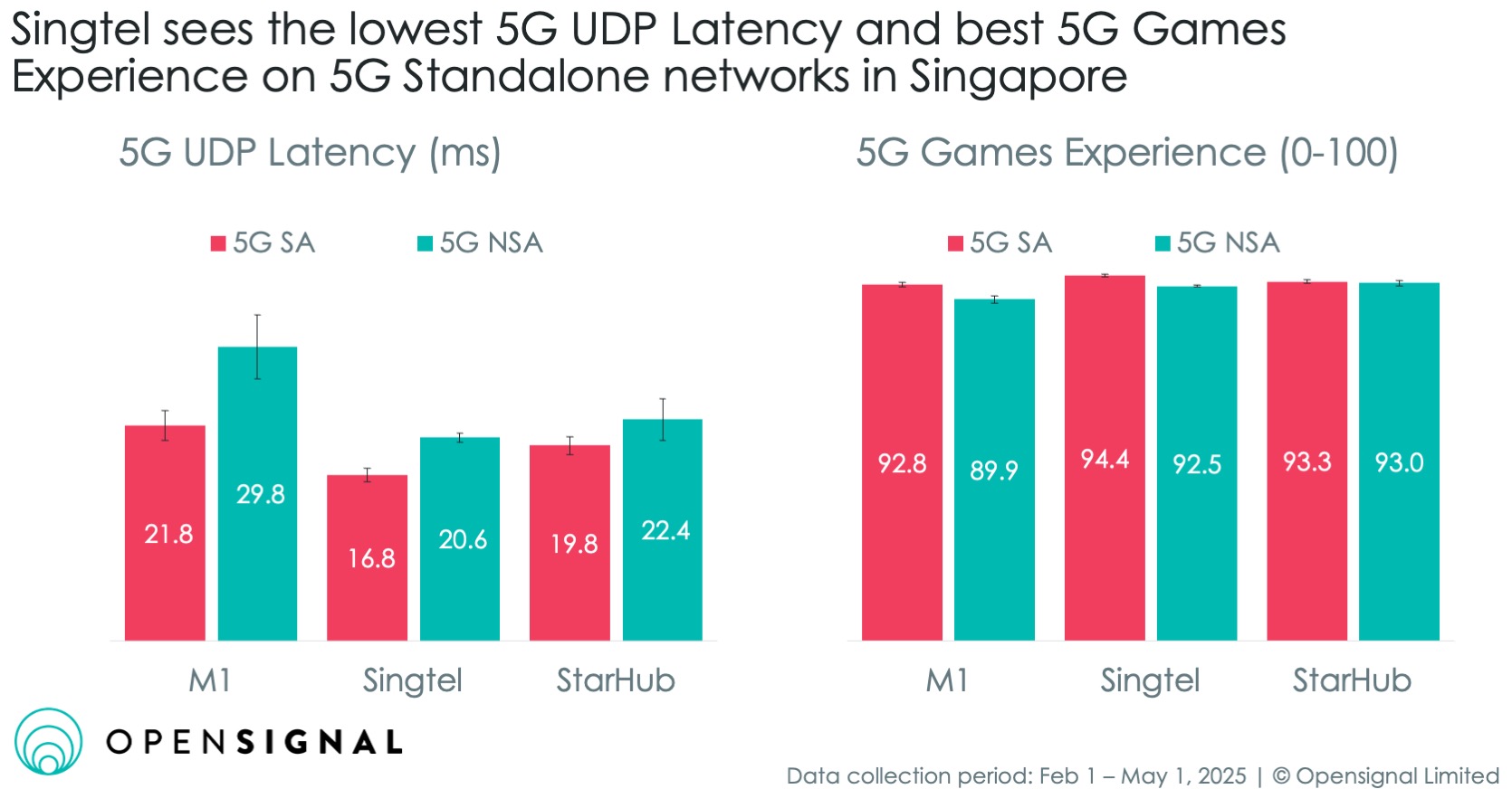
For mobile gamers, 5G SA is a game-changer — literally. By eliminating the 4G backbone, it slashes latency and delivers snappier, more responsive gameplay with far less lag. Singtel has the lowest 5G UDP Latency and the best 5G Games Experience vs its peers in Singapore when it comes to 5G Standalone networks.
All three analyzed operators rely mainly on the 3.5GHz band for their 5G SA deployments — which is a commonly used band in the Asia Pacific region. M1 and StarHub both use the 2.1GHz band for 5G Standalone deployments as well — they share a joint venture for facilitating 5G roll-outs in the city-state.
The reliance on the 2.1GHz band is much smaller for Singtel — but the operator is the first MNO in Singapore to deploy 700MHz for 5G SA. Singtel aims to boost its 5G coverage and strengthen its 5G signal to better serve both remote areas of the city-state but also high-rise indoor and underground spaces. Singtel already leads for 5G Coverage Experience in the latest Opensignal Mobile Network Experience report. This means it has the widest geographic footprint of 5G coverage in populated areas out of all mobile operators in the city-state.
With the 700MHz band, operators can achieve wider coverage with fewer base stations deployed, while also using the stronger signal at this lower bandwidth to improve in-building penetration. The enterprise segment also benefits from this band, with the enhanced performance of sectors like security and manufacturing which rely on seamless connectivity for emergency response and operational efficiency.
Where can Singapore go next with 5G SA?
Singapore owes its strong position in 5G SA deployments to a combination of strategic policymaking, robust infrastructure, and proactive industry collaboration. Instead of developing Non-Standalone (NSA) networks on top of 4G networks, the Singaporean government has been directly facilitating the deployment of 5G SA mobile networks since 2019, for example through allocating spectrum to national players. Singapore was also the first market to extend 5G SA coverage to the seas in August 2022, to support the growth of the nation’s maritime industry and boost its importance as a maritime hub.
This approach aimed to realise the full range of capabilities that 5G has to offer, including low latency and the potential for handling extremely high density of devices. While 5G SA improves the core network and capabilities, it does not necessarily boost mobile coverage by itself. However, when paired with the right spectrum and deployment strategies, 5G SA can support better overall performance over wider areas. Given Singapore's unique characteristics — it being a relatively small and highly urbanised area — the national operators were able to achieve nearly ubiquitous 5G coverage.
Singaporean operators are moving to the next phase of 5G roll-outs, focusing on expanding 5G SA — and even 5G-Advanced — coverage on the island and also introducing new features to customers. A good example is Singtel with its 5G+ offering, with advanced network slicing that dynamically adapts to subscribers’ needs. Meanwhile, M1 launched its commercial 5G RedCap network services for enterprise customers. The reduced capacity of this solution comes with lower latency and higher energy efficiency for enterprise applications. Opensignal will closely monitor the ongoing 5G SA developments in Singapore in our future insights.
If you are interested in more analysis of Singapore’s mobile or fixed broadband landscape — check out our previous reports on this market. Please contact us if you are looking for a more custom approach to our 5G SA analysis. Subscribe to our newsletter to stay up to date!
Opensignal Limited retains ownership of this insight including all intellectual property rights, data, content, graphs & analysis. Reports and insights produced by Opensignal Limited may not be quoted, reproduced, distributed, published for any commercial purpose (including use in advertisements or other promotional content) without prior written consent. Journalists are encouraged to quote information included in Opensignal reports and insights provided they include clear source attribution. For more information, contact [email protected].
