


Egypt switched on commercial 5G services in June 2025, and the performance uplift is clear when users connect to the technology. However, Opensignal’s Q3 2025 data shows that 5G in Egypt is still functioning as an add-on layer, not the main network. Limited access to large, contiguous mid-band spectrum has constrained operators’ ability to scale 5G nationally. That spectrum gap is a key reason Egypt is trailing the MENA front-runners, especially GCC markets that built 5G around 3.5GHz capacity layers.
In this insight, we assess how Egypt prepared for 5G, why early performance gains haven’t translated into national experience impact, and how the mid-band spectrum will determine whether 5G becomes a meaningful everyday technology for Egyptian users.
Key takeaways
- 5G is still in its early days in Egypt.
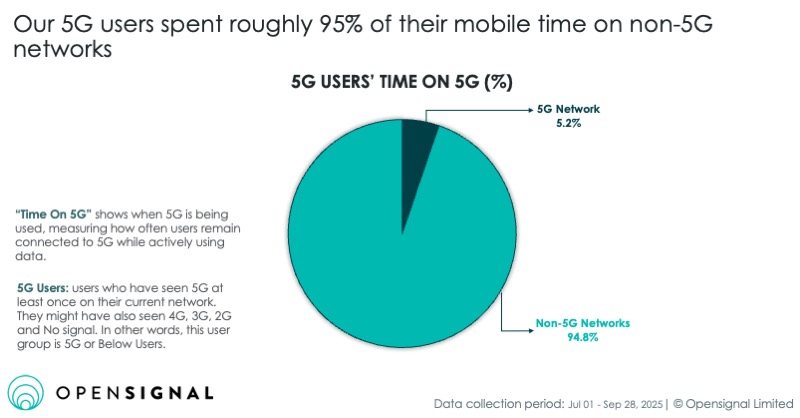
Despite the June 2025 launch, 5G users still spent the vast majority (95%) of their mobile time on non-5G networks in Q3 2025, limiting impact on national experience metrics. - When users connect to 5G, the uplift is clear.
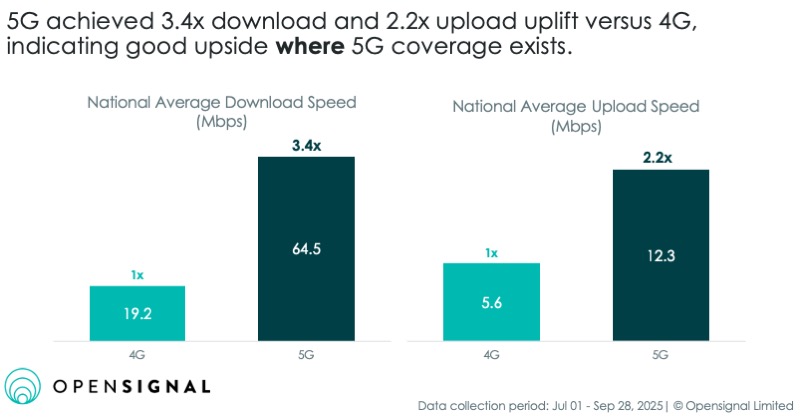
In Q3 2025, 5G delivered a 3.4x download and 2.2x upload speed uplift versus 4G, showing strong performance wherever consumers are on the 5G network. - Spectrum depth, not launch timing, will define Egypt’s 5G outcome.
Having only access to limited 2.6GHz spectrum from the start, caps capacity and keeps Egypt’s average 5G download speeds (~64.5 Mbps) at less than half of Tunisia’s, despite similar launch timelines.
Pre-launch: the foundations that made 5G possible
Egypt’s 5G journey did not begin with the June 2025 switch-on. Ahead of launch, operators focused on 5G readiness fundamentals: expanding fibre backhaul, increasing site density, strengthening data-center capacity, and executing vendor-led radio and core modernization.
For example, Telecom Egypt (WE) partnerships with Nokia and Huawei to strengthen the 5G rollout foundation, Etisalat partnerships with Ericsson to support a more efficient, energy-aware 5G rollout, and Vodafone Egypt signed agreements with Telecom Egypt, the primary infrastructure fiber provider, to connect Vodafone’s mobile sites with fiber optics, a prerequisite for the high data speeds 5G promises to ensure that the towers have the backhaul capacity to handle the massive traffic increase expected from 5G users.
These investments reduced rollout friction and ensured 5G performs well where deployed. However, they do not remove the binding constraint: without a deeper, more contiguous mid-band spectrum, 5G capacity and consistency will remain difficult to scale nationwide.
From 2.6GHz awards to 5G license: a launch path with limited national uplift
Unlike GCC and some North African peers such as Tunisia and Morocco, which launched 5G with deep, contiguous 3.5GHz holdings, Egypt entered the 5G utilizing 2.6GHz spectrum.
Egypt has yet to auction 3.5 GHz spectrum. Instead, the initial 5G licensing relied primarily on the refarming and reassignment of existing bands, particularly 2.6 GHz, rather than C-band spectrum release. National Telecommunications Regulatory Authority (NTRA) assigned 2600MHz (TDD) spectrum to Vodafone, Telecom Egypt (WE) and Etisalat in 2020, then added 30MHz (TDD) for Orange in 2022. Licensing followed in 2024 —Telecom Egypt received the license first in January, then Orange, Vodafone and e& in October under the same terms.
A 2.6GHz-led start is not “weak” 5G. In many markets, It can deliver strong performance when it sits alongside a deeper “core” mid-band layer. Egypt’s challenge is that 2.6GHz is being treated as the primary mid-band anchor and operators only hold between 20MHz to 40MHz plus that spectrum is originally carrying 4G traffic.
Once that limited bandwidth is shared or split between 4G and 5G, the effective 5G capacity is thin. This is why Egypt’s national experience still sits behind regional peers on broad measures such as average download speed (64.5 Mbps vs Tunisia’s 149.7 Mbps).
On 4 June 2025, NTRA officially launched 5G mobile services. The four mobile network operators offered the service to their customers after investing $2.7 billion in 5G spectrum and licenses since 2019.

Post Launch: 5G performance proved out, utilization held it back
Egypt’s early 5G journey is not “5G didn’t work”, it’s that 5G only delivers when users can connect to it. That’s why Opensignal’s Time on 5G metric matters: coverage maps show where 5G could be, but Time on 5G shows whether 5G is actually being used with consumers that have 5G plans and 5G device, becoming in fact the lived daily experience during real data sessions.
In Q3 2025, 5G users spent about 95% of their time on (non-5G) networks and only about 5% on 5G. That’s why 5G can look great theoretically but still be hard to notice day to day. Until people spend much more time on 5G, national experience scores will mostly reflect 4G.
However, that limited “Time on 5G” does not mean 5G lacks impact when users connect to it. In fact, 5G delivered a 3.4x download and 2.2x upload uplift versus 4G. This is validating the fact that 5G can drive meaningful experience gains, even if on the 2.6GHz spectrum comparing the 4G once be used in daily life.
Different 5G strategies, different outcomes: how Egypt’s operators are competing
Egypt’s operators are pursuing different early 5G strategies reflecting a classic tradeoff between expanding footprint first, or maximizing quality where 5G exists.
Opensignal’s September 2025 results show that split clearly.
- WE won the overall experience, but 5G remains less differentiated in daily use.
- Vodafone ahead on 5G coverage experience and overall reliability, but not on 5G speed which means that coverage comes before capacity.
- e& leads on 5G experience where available, but its footprint still limits how often users benefit.
- Orange is strong on 5G availability and 5G upload speed, but does not lead on 5G download or consistency.
From a user lens, the choice is clear: footprint-first makes 5G easier to encounter, while experience-first makes 5G better where it exists—but can feel “invisible” if availability remains limited.
Conclusion: The next phase is making 5G consistent, not just available
Egypt’s June 2025 launch answered the first question—does 5G improve performance when users are on it? The answer is clearly yes. The more important question for 2026 is whether spectrum and execution make 5G persistent enough to matter at a national level.
NTRA has signaled plans to allocate around 420MHz of new spectrum for the four operators, with agreements expected in January 2026 and a phased rollout throughout 2030.
If these awards deliver meaningful contiguous mid-band capacity and operators move quickly, Egypt can convert today’s patchy 5G experience into a real national uplift and improve its regional 5G standing as availability, consistency, and real-world speeds rise together. If not, 5G risks remaining impressive in hotspots but rare in daily use, delaying both consumer impact and Egypt’s progress against benchmark progress.
Meet Opensignal at MWC 2026, or contact sales to discuss how Opensignal can help translate spectrum and rollout plans into measurable improvements in real-world customer experience. Also, to gain more information on the Egypt market landscape, follow this link to read the latest Mobile Network and Fixed Broadband Experience Reports and other relevant insights.
Opensignal Limited retains ownership of this insight including all intellectual property rights, data, content, graphs & analysis. Reports and insights produced by Opensignal Limited may not be quoted, reproduced, distributed, published for any commercial purpose (including use in advertisements or other promotional content) without prior written consent. Journalists are encouraged to quote information included in Opensignal reports and insights provided they include clear source attribution. For more information, contact [email protected].
