


Germany is entering an important phase in its mobile market evolution. When the German telecom regulator, Bundesnetzagentur (BNetzA) designed the 2019 5G auction, its intention was clear: open the door to a fourth operator and reshape competitive dynamics. Several years on, 1&1’s transition shows that this ambition is taking shape — though the path is still unfolding.
Building on our recent Germany Mobile Network Experience report, this insight examines how far 1&1 has progressed, what Opensignal data reveals about its performance, and how this reshapes the market outlook.
From MVNO roots to a cloud-native challenger
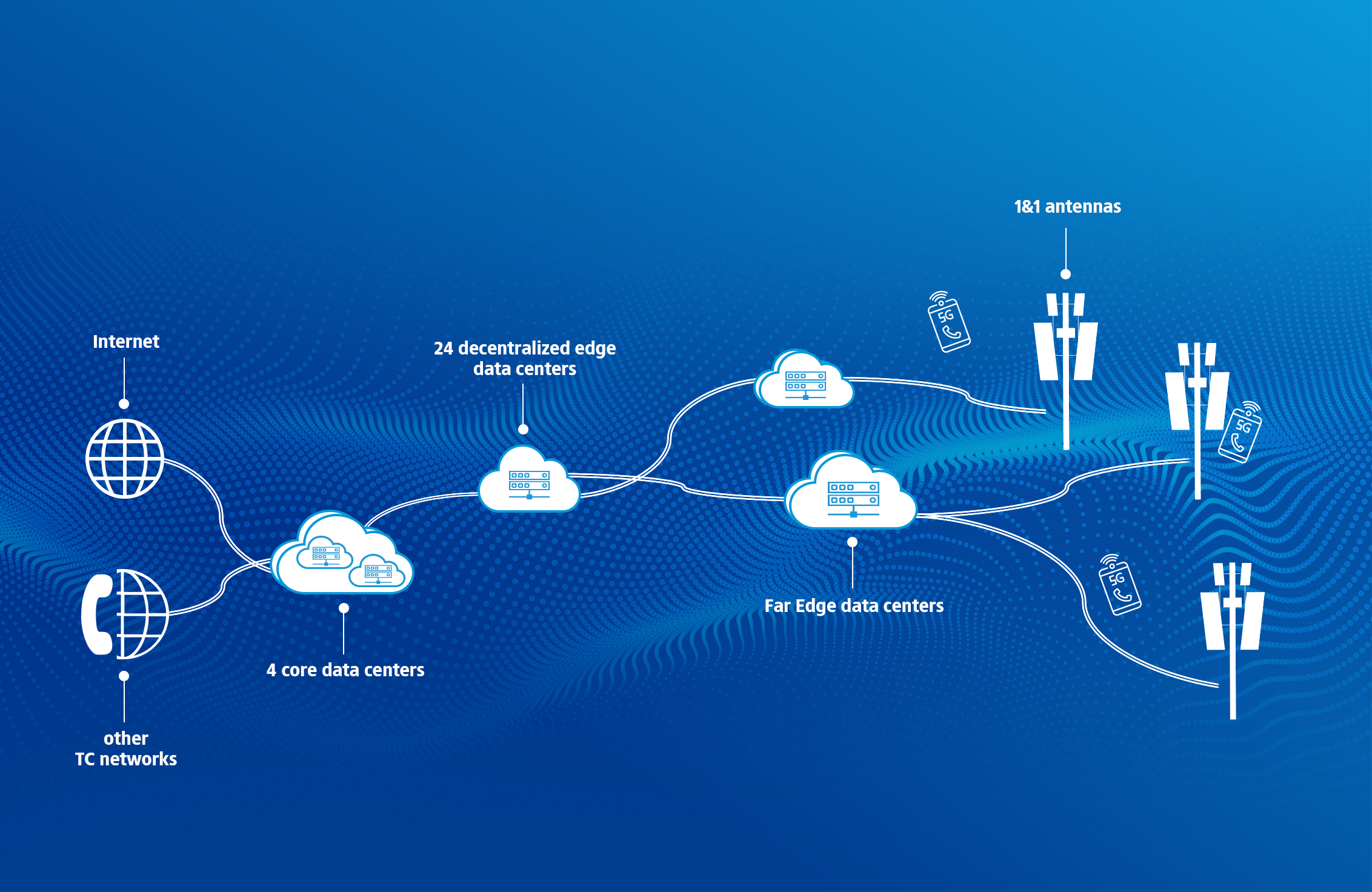
For most of its history, 1&1 operated as an MVNO, achieving scale but lacking direct control over network performance and the technological levers needed to differentiate user experience. The activation of its first Open RAN (O-RAN) sites in late 2023 marked a clear turning point, signalling its transition from reseller to network owner.
Two priorities have defined this early phase:
- Ensuring continuity for its large customer base
- Building a cloud-native O-RAN network designed for automation and efficiency
BNetzA allowed 1&1 to continue MVNO operations during the rollout phase but required full migration by end-2025. 1&1 met this target ahead of schedule. In mid-November 2025, the company announced that it serves over 12 million customers on its own core network, the vast majority of which had been migrated onto its O-RAN core network — creating the world’s largest Open RAN deployment with an immediate, live user base.
1&1 O-RAN: Europe's first fully virtualized 5G network based on Open RAN technology
Roaming partners transition
In August 2024, Vodafone and 1&1 announced that they launched a national roaming partnership, marking a transition away from Telefonica as 1&1’s roaming partner. National roaming remains a central pillar of 1&1’s strategy during the early rollout phase, ensuring seamless nationwide coverage while the operator accelerates site deployment and densification.
Spectrum: support measures with long-term implications
1&1’s spectrum position continues to reflect its late-entrant status. In the 2019 5G spectrum auction the operator acquired two frequency blocks of 2 x 5 MHz in the 2 GHz band and five frequency blocks of 10 MHz in the 3.6 GHz band, for a total price of €1.07 billion.
BNetzA's recent decision to extend licenses for the 800, 1800, and 2600 MHz bands until end-2030 was designed to avoid a messy, piecemeal auction and allow for a larger, combined auction around 2029/2030, which will include the 700 and 900 MHz bands (expiring 2033). While this framework supports investment stability for incumbents, it also means that 1&1 was unable to acquire additional spectrum in the interim.
As a result, 1&1 does not hold any sub-1 GHz licences, which presents challenges for indoor and rural coverage during the early rollout phase. As part of the licence extension, and in order to "promote competition” BNetzA requires incumbents to negotiate shared use of low-band spectrum, but as a result, 1&1 does not have the same level of certainty or operational independence as it might with exclusive spectrum ownership. Furthermore, it continues to lease 10 MHz of 2.6 GHz spectrum from Telefónica under regulatory obligations to support the new entrant.
Network performance: 1&1 is steadily improving
1&1 already performs strongly in Opensignal’s latest Fixed Broadband Experience report, winning Fixed-line Consistent Quality and Video Experience, and jointly winning Consistent Quality on Fixed Wireless Access (FWA). While Opensignal measures fixed and mobile network performance separately, improvements across both of those domains reflect broader infrastructural and operational progress.
On the mobile side, Opensignal data shows clear improvements in users’ experience over the past year, as 1&1 accelerates site deployments and optimises its O-RAN-based network.
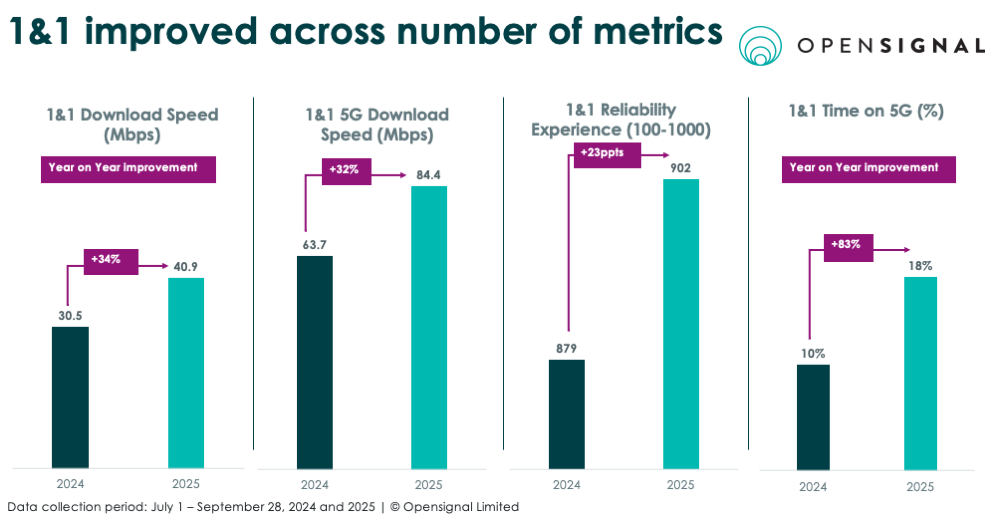
Between Q3 2024 and Q3 2025:
- Average mobile download speed increased from 30.5 Mbps to 40.8 Mbps, a year-on-year gain of 10 Mbps (a 34% year on year increase).
- 5G download speeds rose sharply – by 32% – supported by expanding 5G coverage, particularly in the 3.6 GHz band, combined with access to Vodafone’s 5G network through national roaming.
- Time spent on 5G — when a 5G network is actively in use — nearly doubled year-on-year (83% Y-Y improvement), rising from 9.9% in Q3 2024 to 18.0% in Q3 2025.
- At the same time, combined network maturation, improved mobility integration and successful transition to Vodafone’s national roaming have delivered a more stable operational environment and end user experience contributing to a 23-point uplift in reliability.
These gains indicate that 1&1’s cloud-native architecture is scaling as intended. A fully virtualised O-RAN design, automated resource management, and a cloud-native 5G core allow the network to scale efficiently as traffic grows. Improved utilisation of mid-band spectrum, combined with fibre-backed fronthaul, midhaul and backhaul reduces latency and will, over time, further strengthen network stability and performance by connecting radio sites directly to fibre infrastructure.
The operator is also actively monitoring performance — including through crowdsourced data — to optimize network operations and deliver measurable improvements in real-world user experience.
Overall, 1&1 is improving across several key indicators, reflecting increasing network maturity and consistency. Early build-out challenges are giving way to measurable user benefits, signalling a transition from foundational deployment to early network maturity.
Outlook: a more competitive market shaped by a maturing fourth operator
1&1’s progress marks a meaningful shift in Germany’s mobile landscape. Recently, the operator has announced that it met the regulatory rollout obligation to reach 25% household coverage by end-2025.
The combination of a cloud-native core, accelerating O-RAN rollout, and integrated fibre and fixed-line assets positions 1&1 as a credible long-term challenger — even if its journey is still at an early stage.
Over the next phase of development, three dynamics are likely to shape the market:
1. Faster rollout and targeted densification: 1&1’s build strategy prioritises high-demand areas where it has access, allowing it to focus investment where it can deliver the greatest impact on user experience. This approach is also economically efficient, as shifting the heaviest traffic volumes onto 1&1’s own network reduces reliance on usage-based national roaming, improving cost efficiency as more sites — particularly in the 3.6 GHz band — come online and drive gains in speed, reliability and time spent on 5G.
2. Gradual reduction in national roaming dependency: While national roaming will remain essential in the short to medium term, growing site density will allow 1&1 to shift more traffic onto its own network. As this happens, customers will increasingly benefit from 1&1's cloud-native architecture directly, which will result in better end user experience.
3. Strengthening competitive pressure across the ecosystem: As 1&1 enhances its network maturity and leverages its fixed portfolio to offer converged services, we expect meaningful competitive tension; particularly in urban markets where churn dynamics and price sensitivity are highest. A more capable fourth operator ultimately supports BNetzA’s objective of broadening choice and driving long-term improvements in user experience.
For more insight make sure you sign up to our newsletter. To gain more information on the German market landscape, follow this link to read the latest Mobile Network and Fixed Broadband Experience Reports and other relevant insights.
Opensignal Limited retains ownership of this insight including all intellectual property rights, data, content, graphs & analysis. Reports and insights produced by Opensignal Limited may not be quoted, reproduced, distributed, published for any commercial purpose (including use in advertisements or other promotional content) without prior written consent. Journalists are encouraged to quote information included in Opensignal reports and insights provided they include clear source attribution. For more information, contact [email protected].
