


Imagine trying to squeeze eight lanes of rush-hour traffic into a two-lane alleyway. That is the daily reality for Pakistan’s 240 million inhabitants, as described by the IT Minister Shaza Fatima Khawaja. While the appetite for data is rising, the limited spectrum dedicated to mobile services has historically created a “digital bottleneck”. This has resulted in congestion, slow speeds — averaging below the 20 Mbps mark — and frequent disruptions. In Opensignal’s Global Network Excellence Index for Q4 2025, Pakistan lags behind its peers in South Asia, ranking 5th for Download Speed and 6th for Excellent Consistent Quality out of six markets in the region.
But this reality is finally shifting. In March 2026, Pakistan concluded its most significant spectrum auction to date, with three major operators — Jazz, Zong, and Ufone — investing US$510 million in total to secure 480 MHz of spectrum (out of 600 MHz offered). This marks a near-tripling of the total spectrum assigned to mobile operators, expanding it from 274 MHz to over 750 MHz.
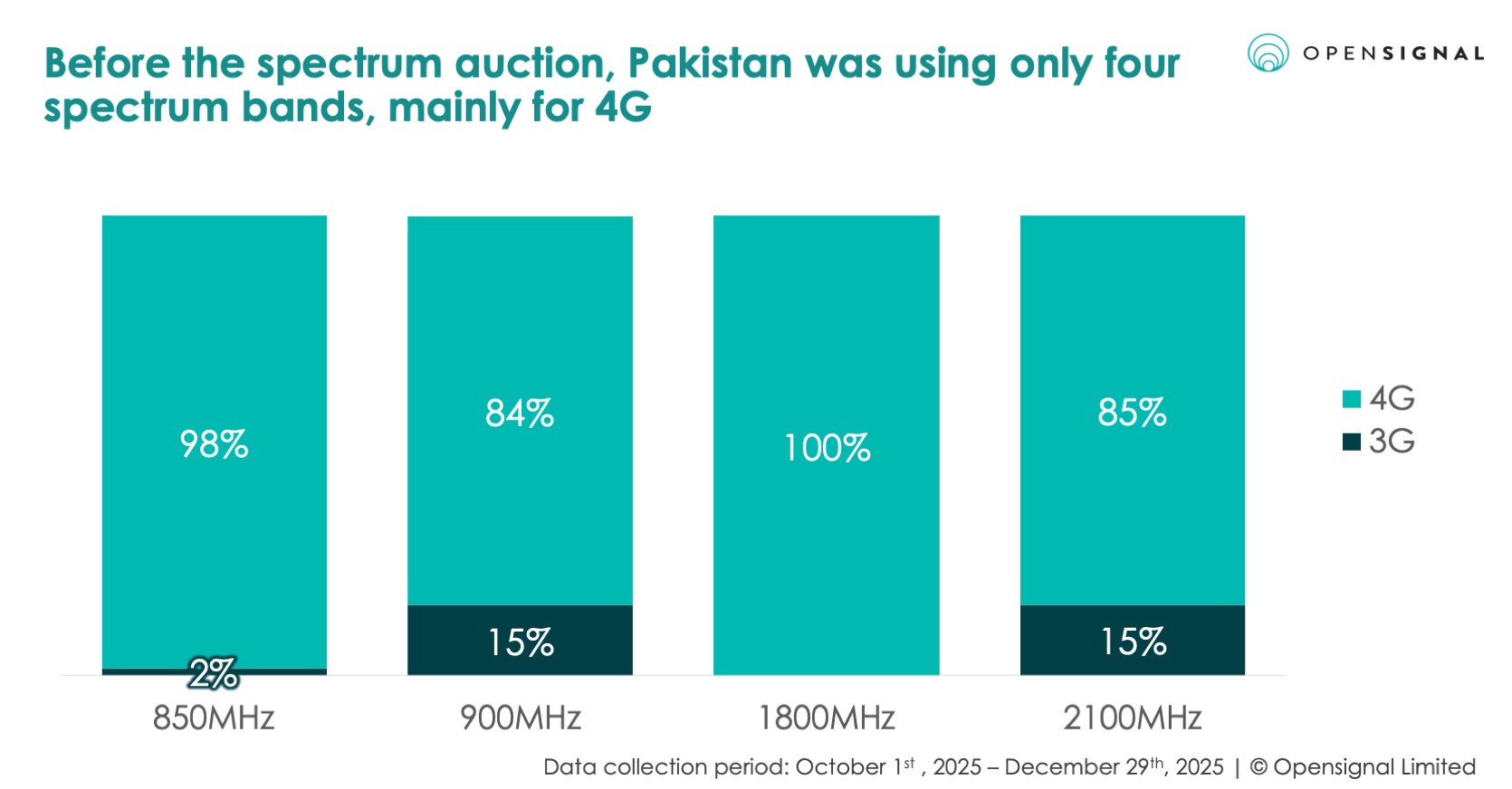
With a clear push toward modernization, the Pakistan Telecommunication Authority (PTA) has made bidding in the 2.6 GHz and 3.5 GHz bands mandatory for all qualified participants. These are two foundational mid-band frequencies powering 5G deployments across Europe, MENA and APAC.
However, the PTA’s primary objective was not immediate fiscal revenue. In fact, the relative price of the spectrum sold was fairly low, sitting at $0.004/MHz/Pop — significantly lower than recent auctions in Sri Lanka and Bangladesh. This indicates a deliberate regulatory shift — the PTA is prioritizing rapid infrastructure transformation over short-term treasury gains. And this shows in some of the auction’s obligations:
- Speedy launch: Commercial 5G services must go live within 3 – 6 months of the auction’s conclusion.
- Coverage expansion: Operators must deploy 1,000 new sites annually, with at least 200 targeting existing coverage gaps in underserved areas.
- Quality of Service (QoS): The PTA is introducing increasingly stringent benchmarks for latency and download/upload throughput — for example the requirement for median 4G download speed will increase from 20 Mbps to 50 Mbps by 2030–35.
To ease the transition, the government has introduced key facilitations, including greater flexibility in spectrum sharing, a one-year payment holiday on spectrum fees and abolishment of right-of-way (RoW) charges, reducing them from PKR36,000 (US$128.85) per kilometre. This allows operators to redirect capital toward physical infrastructure and fiber deployment rather than upfront licensing costs.
4G-first: the pragmatic road to 5G
While headlines about 5G’s arrival in Pakistan dominate the news, both the PTA and local operators are playing a more nuanced game: prioritizing a "4G-first" transition. This strategy acknowledges a fundamental technical reality — initial 5G deployments will almost exclusively utilize Non-Standalone (NSA) architecture. Because NSA 5G anchors itself to the existing 4G core and signaling, the next generation cannot actually function without a robust, uncongested 4G foundation.
While it would rely on the 4G core at first, 5G is far more than a simple "add-on"; it brings significantly higher spectral efficiency, allowing operators to pack more data into the same amount of airwaves. This is vital for a market as price-sensitive as Pakistan, where the cost-per-bit must remain low to keep services accessible. Despite this efficiency gain, device affordability remains the primary structural constraint. In a region where the average consumer is highly budget-conscious, the transition hinges on the mass availability of affordable devices. While local 5G smartphone manufacturing has crossed the 500,000-unit mark, this remains a drop in the ocean for a nation of 240 million.
But even with the right devices and the right amount of spectrum, the “pipes” behind the towers must be upgraded. Expanding fiber backhaul is the final piece of the puzzle; as of early 2026, only about 18% of Pakistan's mobile sites are fiber-connected, making the Ministry of IT’s 80% target for 2029 the true benchmark for a digital "quick fix." Without fiber densification, additional spectrum risks delivering theoretical capacity rather than real-world performance gains.
The regional context: not just a race
Pakistan’s auction marks the third major spectrum tender in South Asia in the past three months. Sri Lanka concluded its 5G spectrum auction in December and has already launched commercial 5G services. Meanwhile, in January 2026, Grameenphone emerged as the sole bidder in Bangladesh’s 700 MHz spectrum auction, as Bangladesh launched its 5G services back in September 2025. However, Pakistan is not simply joining a regional race — it is building the eight-lane highway its citizens deserve, as the PTA has cleared the path for a new era of connectivity. While regional peers like Sri Lanka and Bangladesh have moved into the 5G era slightly earlier, their starting positions were fundamentally different.
- Sri Lanka has historically assigned more spectrum to mobile services. The December 2025 auction added 200MHz in the 3.5GHz band to the already existing 4G footprint. This allowed for an immediate transition to commercial 5G services within the same month.
- Bangladesh assigned 190 MHz of 2.3 GHz and 2.6 GHz spectrum as early as March 2022. However, commercial 5G services did not happen until September 2025, largely due to high spectrum pricing and a slow maturation of the 5G handset market. The January 2026 auction of the 700 MHz band further highlights a market where regulatory costs have occasionally dampened competitive intensity.
In contrast, Pakistan entered 2026 with less spectrum than its peers but with a solid plan for action. The release of 480 MHz in this auction is a critical expansion of the country’s digital capacity. The PTA launched the auction with affordable spectrum prices, significant structural reforms, and facilitations to ensure that spectrum acquisition translates into speedy site and fiber densifications. As these capacity bottlenecks ease, Pakistan’s digital infrastructure is finally scaling to match its massive market potential.
If you’d like to hear more from Opensignal on our views and insights around the world of telecommunications, be sure to subscribe to our newsletter here. If you're interested in more of our tailored analysis, then please contact us
The editorial views expressed in this article are solely those of the author and do not necessarily reflect the views of Opensignal.
Opensignal Limited retains ownership of this insight including all intellectual property rights, data, content, graphs & analysis. Reports and insights produced by Opensignal Limited may not be quoted, reproduced, distributed, published for any commercial purpose (including use in advertisements or other promotional content) without prior written consent. Journalists are encouraged to quote information included in Opensignal reports and insights provided they include clear source attribution. For more information, contact [email protected].
