


6G is already being framed as an AI-native generation. But before focusing on what it could become, it is worth asking a more fundamental question:
Will it meaningfully improve the consistency and reliability of user experience?
At a recent Fierce Network panel with Joe Madden (Mobile Experts), Eric Hardouin (Orange, NGMN), and Alain Mourad (InterDigital, ETSI), this question sat at the center of the discussion.
Because based on what we measure today, consistency—not peak performance — remains one of the industry’s biggest gaps.
AI in networks: already present
AI is often positioned as something that will arrive with 6G. In reality, it is already embedded in today’s networks.
Operators use AI to support:
- Traffic prediction
- Energy efficiency
- Fault detection and resolution
These applications are delivering value—but they remain largely optimization-driven and supervised.
As Alain Mourad highlighted, we are still in an “AI-assisted” phase. AI supports decision-making, but it does not yet operate networks autonomously.
Much of the 6G narrative assumes a transition to self-operating systems. In practice, the industry is still building the data foundations, architectural integration, and operational trust required to enable that shift.
As Eric Hardouin noted, operators such as Orange are already deploying AI across the network—but within defined boundaries, and with human oversight remaining essential. This aligns with the NGMN's view: AI is advancing, but the industry is not yet operating in a fully AI-native environment.
5G Standalone: foundation, not outcome
Before looking ahead to 6G, it is worth grounding the discussion in where we are today.
We’ve made real progress with 5G Standalone. With 90+ operators deploying SA globally, we are firmly in the execution phase — not experimentation.
In some markets, we see lower latency and more stable performance. But it’s not consistent. From an Opensignal perspective, deploying a 5G Core does not automatically translate into better user experience because constraints like spectrum limitations and backhaul bottlenecks remain. SA is the foundation, but as noted in the NGMN 6G Key Messages, the industry must ensure 6G provides "incremental value" that 5G SA hasn't fully unlocked yet.
5G-Advanced: the bridge to 6G
5G-Advanced (Release 18 and above) represents the next step in this evolution — and a critical link to 6G.
It is here that many of the building blocks of an AI-native network are being introduced:
- Greater use of AI in the Radio Access Network (RAN) and Core Network (CN)
- More dynamic and adaptive network behavior
- Early forms of automation and closed-loop control
- AI framework for data collection and life cycle management, which is seen as the foundations for AI in 5G-A and 6G
However, deployments today remain:
- Domain-specific
- Fragmented across network layers
- Largely supervised
This makes 5G-Advanced less an end state, and more a testing ground.
It is where the industry is:
- Testing how AI can be embedded into network operations
- Understanding the limits of automation
- Identifying gaps in data integration and system design
In that sense, the 6G vision is already being shaped by what we are learning — both successes and limitations — in 5G-Advanced today.
This raises an important question:
Are we moving toward autonomy — or simply improving automation?
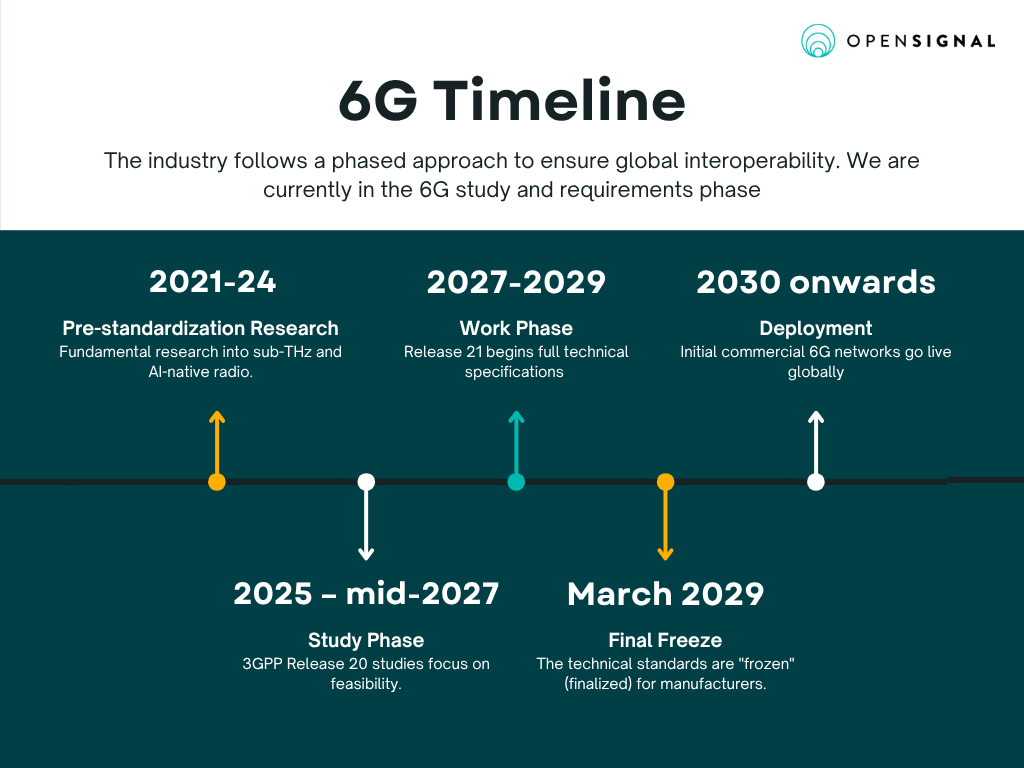
6G standardization: still defining the direction
From a standardization perspective, 6G remains in an early phase.
Two key bodies are shaping its development:
- ITU-R (IMT-2030), which defines performance requirements
- 3GPP, which develops the technical specification
Recent progress includes:
- Finalization of initial 6G performance requirements by the ITU, including new KPIs
- Recent finalization of the 6G use cases and service requirements from 3GPP SA1
- Ongoing 3GPP studies (Release 20) on AI-native RAN and system architecture, AI traffic characterization in SA4
- The RAN plenary performance and functional requirements are also nearly 90% complete and align with the minimum technical performance requirements from ITU-R IMT-2030, but are more extensive than what is included in the ITU-R IMT-2030.
However, most of this progress remains at the level of:
- Frameworks
- Requirements
- Early-stage studies
We are still defining the “what” — not yet implementing the “how”.
The real barriers are structural
A key point of alignment across the panel was that the main challenges are not technological.
They are structural.
- Data is fragmented across domains. Furthermore, there is also the issue of data governance and sovereignty, not just the fragmentation.
- Architectures are complex
- And most importantly — there is limited trust in autonomous systems
Operators are not yet ready to hand over control to AI without clear transparency and safeguards.
This is not a lack of ambition — it reflects the operational reality of running large-scale networks where failures have immediate user impact.
What operators expect from 6G
Despite the forward-looking nature of 6G discussions, operator priorities remain pragmatic.
Three priorities stand out.
1. Efficiency. AI has to reduce cost per bit — especially as traffic evolves with AI-driven services. We still don’t know how the traffic patterns will change.
2. Consistency. This is where the industry needs to focus.
Our data consistently shows that reliability matters more than peak speed.
Users don’t experience “headline speeds.” They experience whether the network works — consistently.
3. Simplicity. Operators don’t want more complexity.
They want:
- Fewer manual interventions
- Systems that actually work autonomously
This mirrors the NGMN’s stance that 6G must be an evolutionary step that is economically sustainable, rather than a forced, high-CapEx revolution.
Standardization: enabling interoperability
There’s a risk in trying to standardize too much. The balance is actually quite clear.
Standardize:
- Interfaces
- Data models
- Interoperability across domains
Because today, fragmentation is a major limitation.
Do not standardize:
- AI algorithms
Innovation is moving too fast for that.
However, as Alain Mourad highlighted, standardization still has a critical role to play — particularly in how AI is deployed and governed within the network, and how is the network evolving to cater for the use of AI and its traffic characteristics in an interoperable manner and at scale.
This includes:
- How models are introduced into the network
- How their lifecycle is managed (updates, monitoring, control)
- How operators maintain visibility and trust in their behavior
Another key area is the RAN, where AI can directly impact performance.
Here, practical questions emerge:
- How should base stations and UE (user equipment) use AI models effectively?
- Which testing framework should be standardized to ensure consistent behavior across vendors?
There are clear use cases where specifications will be needed.
Final Thought
AI will undoubtedly shape 6G.
But AI is not the objective.
The real measure of success will be whether 6G delivers:
- Improved operational efficiency, e.g. reduced cost
- More consistent performance
- Lower complexity, not just more capability
- Greater reliability
- Incremental value over 5G SA, rather than being a new technology for the technology sake
- Clearer monetization paths for operators and enterprises
- And meaningful improvements in real-world experience
If 6G delivers a network that is both aware and consistent, it will represent a genuine step forward.
If it does not address the consistency gap we still observe today, then “AI-native” risks remaining a concept — rather than a measurable improvement.
For more insights on how your mobile network is actually performing today, visit https://insights.opensignal.com/market-insights
Opensignal Limited retains ownership of this insight including all intellectual property rights, data, content, graphs & analysis. Reports and insights produced by Opensignal Limited may not be quoted, reproduced, distributed, published for any commercial purpose (including use in advertisements or other promotional content) without prior written consent. Journalists are encouraged to quote information included in Opensignal reports and insights provided they include clear source attribution. For more information, contact [email protected].
