


Satellite internet has become a central focus in the quest for digital inclusion in the US. Its role in closing the digital divide has become more visible with the Broadband Equity, Access and Deployment (BEAD) program.
After new guidance in mid-2025, BEAD moved towards a “tech-neutral” approach. Now, revised state proposals suggest satellites could play a significant role. Starlink alone stands to cover a large share of broadband serviceable locations (BSLs) and receive grants totalling $738.8 million. This is because satellites can cover more locations faster, making them a cost-effective solution. However, there are concerns that the program will solve for access, and not for adequacy – even with the minimum standard requirements in place.
Beyond this, digital inclusion is not just a rural access problem, but also an urban affordability one, and there is interest in whether Starlink can also compete in more urbanized areas. Given the success of fixed wireless access (FWA) in urban areas, there have been questions about whether Starlink could have the same effect in attracting cost-conscious consumers.
Following on from our recent research into Starlink’s global successes, we investigate whether Starlink can deliver scalable, high-quality connectivity for U.S. digital inclusion both within and beyond the BEAD program — or whether its underlying capacity constraints limit it to an access stopgap or rural-focused provider.
The short version? Our findings suggest that while Starlink might offer “good enough” access to unserved locations, it is not currently a scalable solution for digital inclusion in more urban areas. Its performance and affordability decrease as subscriber density increases, limiting its role in more populated areas. These areas are also more likely to be served by a different provider with potentially better performance, and here Starlink remains more of a complementary access layer than a long-term substitute for terrestrial networks.
Key findings:
- Performance constraints: Starlink underperforms other access technologies in both rural and urban areas – at least where those other technologies are available
Starlink places behind major fiber and cable operators in both rural and urban locations for Broadband Consistent Quality. It also places behind two of the three FWA providers in rural areas. While Starlink can bring access to areas where other high speed technologies are limited or non-existent, in areas where they are available, these will most likely outperform Starlink.
- Capacity constraints: Subscriber load already leads to degraded performance
Our users in areas with the highest Starlink subscriber density experience worse performance than those in lower subscriber density areas. Not only is their Broadband Consistent Quality worse overall, but subscribers in these high density areas also see a steeper decline in performance during peak hours.
- Affordability constraints: Starlink is most affordable in areas with low relative demand
Starlink is most affordable where existing demand — and therefore capacity constraints — are lower. Given that the need for affordable internet is not constrained to just areas of low Starlink demand, this severely limits Starlink’s role in reducing the digital divide at a meaningful scale.
Is Starlink just access or does it offer meaningful connectivity?
To assuage these concerns of access over adequacy, BEAD grants come with performance conditions. Most obvious are the minimum standard of 100Mbps download speed, 20Mbps upload speed, and 100ms latency - which it is required to meet 80% of the time at 80% of the requirements. However, Starlink raised concerns that compliance with the requirements designed to ensure this would be “untenable”. The NTIA has advised states against signing this exemption waiver, but it’s clear that there are already concerns behind the scenes about whether Starlink can meet the requirements.
To understand how Starlink performance may look in the future, we can look at how Starlink currently performs compared to other technologies. For this report, we will focus on Broadband Consistent Quality. We use Broadband Consistent Quality to assess whether a single user on a single device can reliably accomplish a range of common real-world applications. Unlike the FCC requirements, this metric also incorporates jitter and packet loss, which can noticeably shape user experience during activities like video calling.
Fiber and cable providers deliver the strongest Broadband Consistent Quality performance, with very similar performance in both urban and rural areas. Meanwhile Starlink places slightly below both T-Mobile and Verizon’s FWA services in rural areas. In urban areas, it struggles – placing significantly below all three telcos’ FWA services in urban areas.
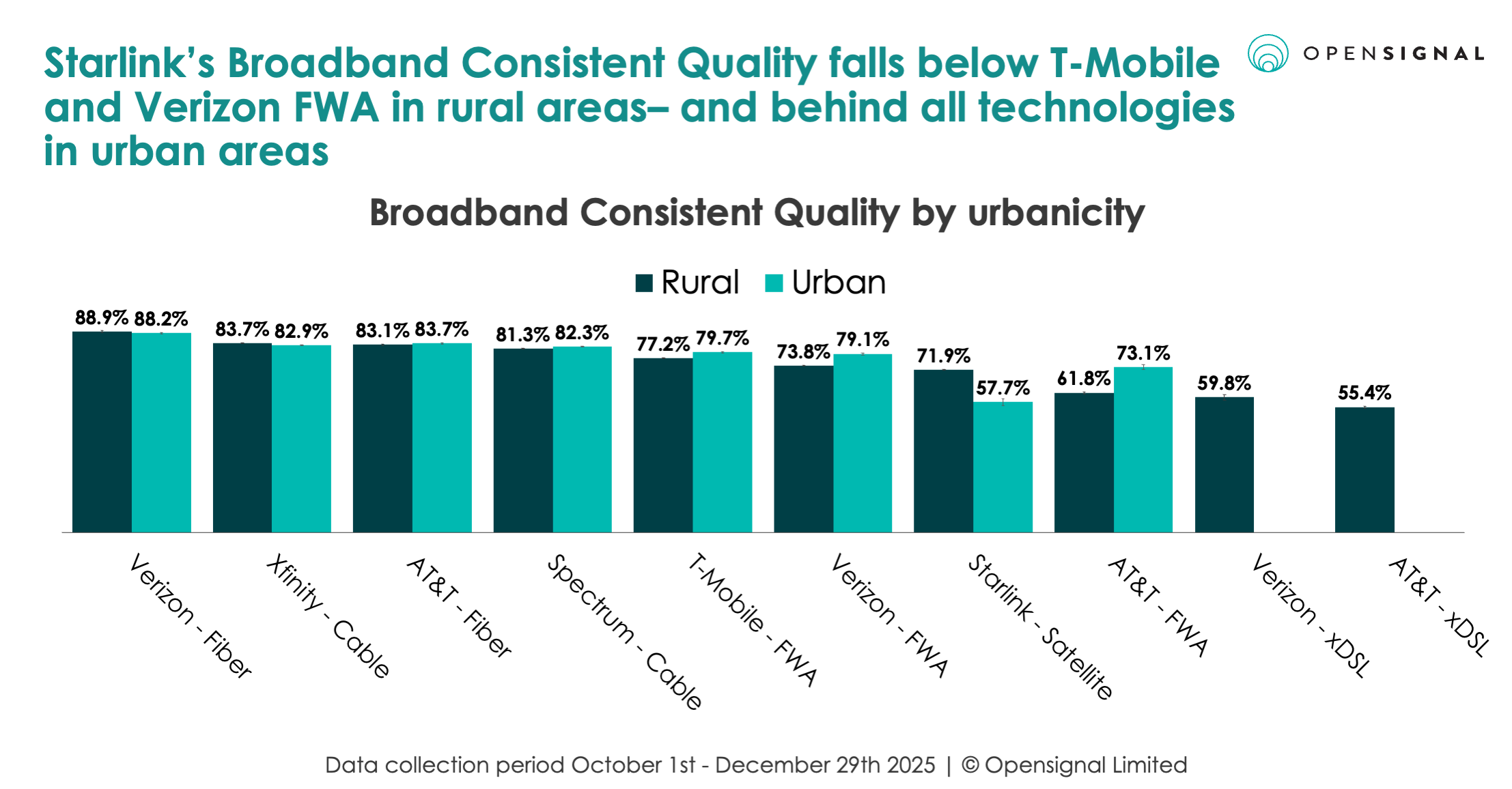
This confirms a clear limitation: where alternatives exist, they outperform Starlink. Starlink’s primary advantage then is being able to quickly reach areas where other technologies can not.
Is Starlink the new FWA?
Starlink’s proximity to FWA in this performance table raises an interesting question: Is Starlink following the same trajectory as FWA? Certainly there are similarities, especially in market approach. Like initial FWA offerings, Starlink is prioritizing targeted market approaches, aggressive pricing and “good enough” performance – and this is driving market growth. At the moment, the main place we see this growth is in rural locations where competition is limited. We measure this using win share, looking at the switchers that choose Starlink. For the fairest comparison, we limit this to “non-movers” – or people who stayed at their existing address but changed their broadband provider.
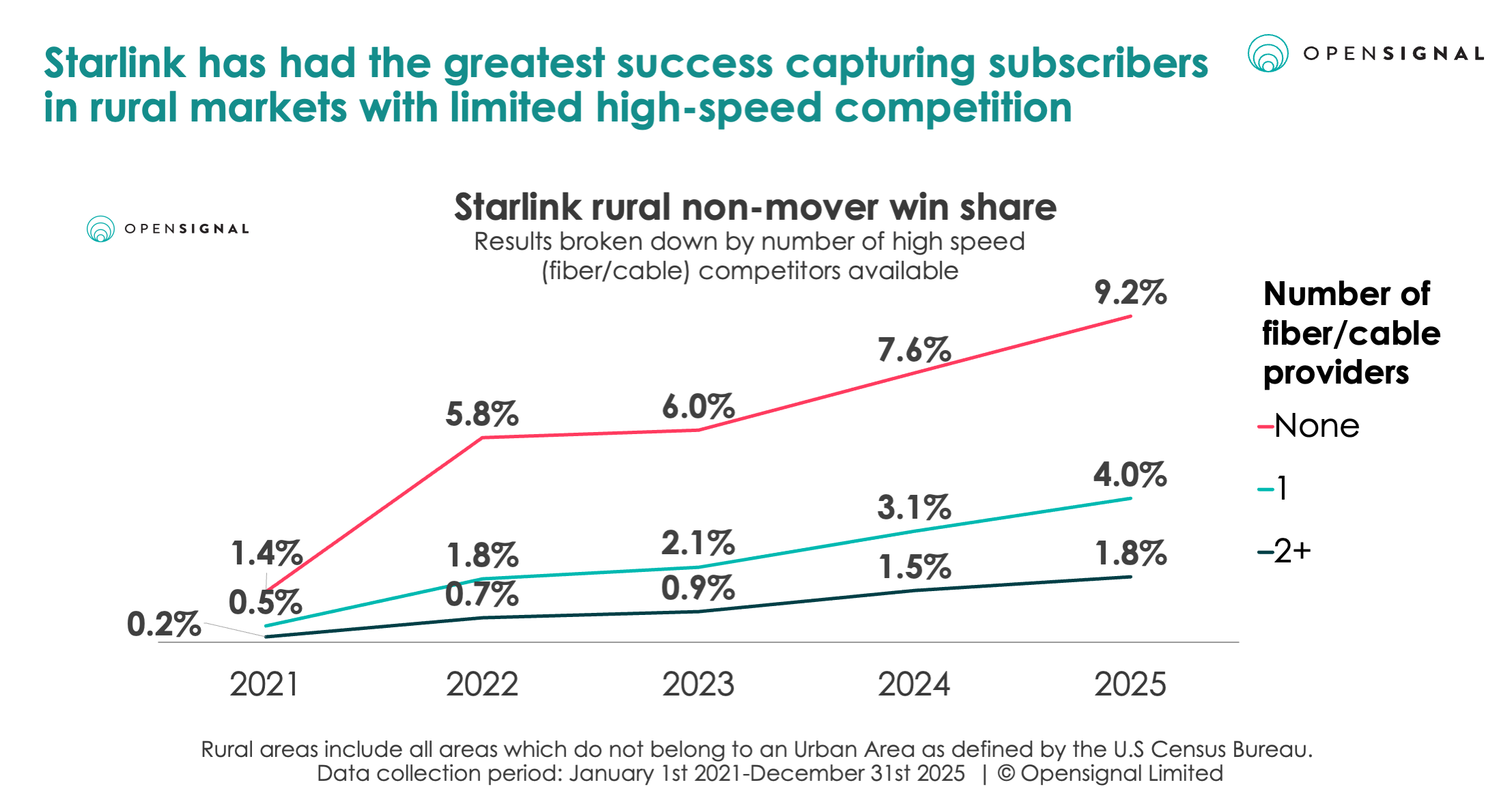
However, FWA was also initially talked about as a rural solution. Despite that, its success in urban areas has been a major component of its growth story. This raises a key question: could Starlink follow the same path — extending beyond its rural niche by competing on price and accessibility rather than performance? In our previous insight, we also noticed some urban growth, which initially seems to support the idea.
Capacity constraints (and their performance implications) limit Starlink’s reach
Starlink’s urban potential is also important from a digital inclusion perspective. Despite typically having better access to fixed line services, urban areas still show signs of a digital divide. Pew research suggests that broadband adoption rates for urban areas are only slightly higher than in rural areas. This brings to light how affordability, not just access, is a critical factor for broadband inclusion. So could Starlink add competition and reasonably priced performance beyond rural areas?
There’s certainly some scepticism. In 2025, The Washington Post ran an article based on The XLab's research that gave the pithy advice: “If Starlink works great for you, keep it a secret from your neighbors.” Our data backs this up: as subscriber load scales, performance worsens.
In our analysis, Broadband Consistent Quality is notably worse in the areas where we see the highest density of Starlink subscribers than in less dense areas. It also shows a greater decline in performance during peak hours. At worst, during peak hours, this leads to an experience that only meets subscriber’s needs for common applications 60.2% of the time. This is the defining constraint of Starlink: as adoption increases in a specific concentrated area, performance declines — limiting its ability to scale without degrading user experience.
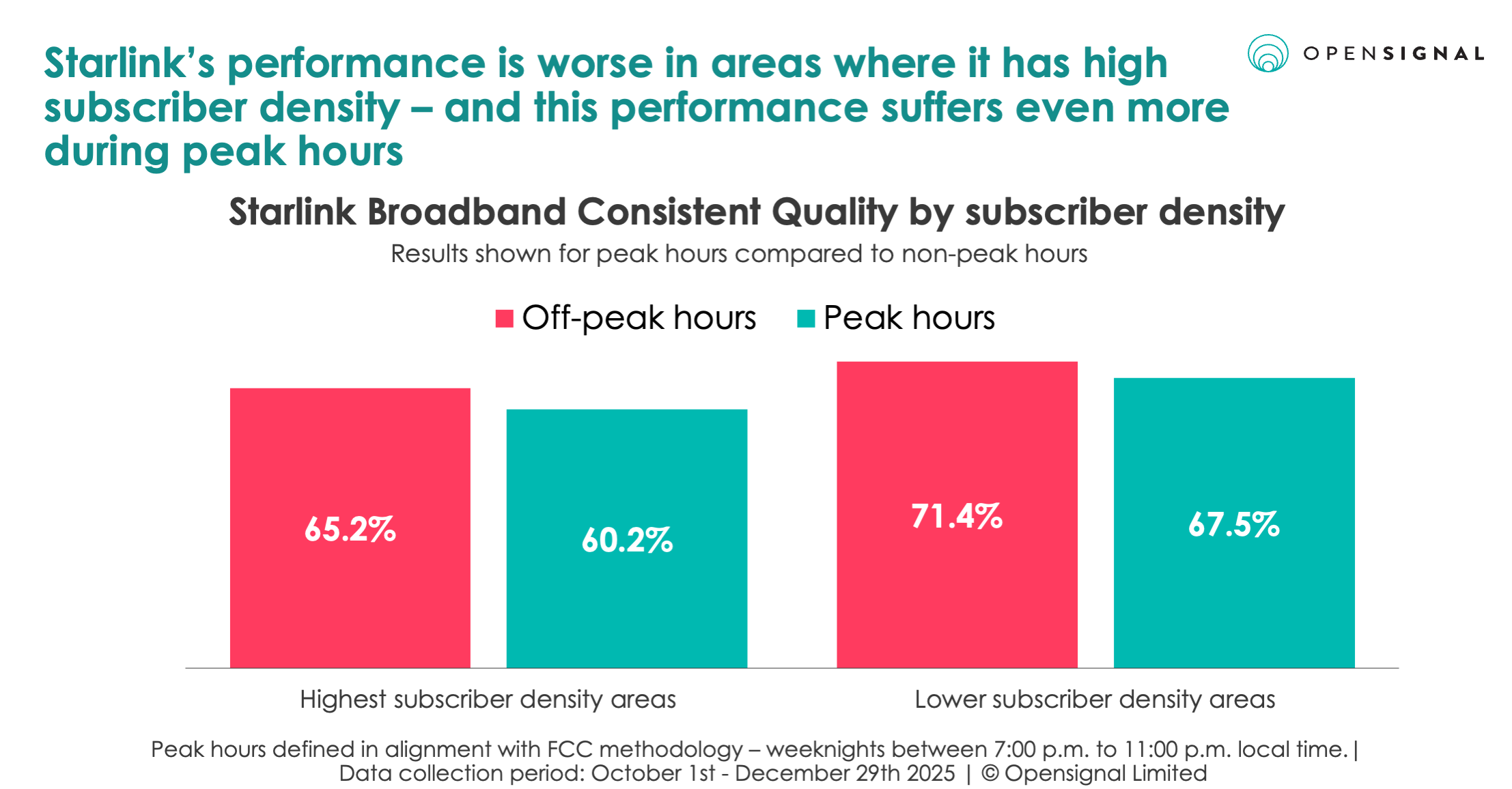
This effect is currently limited to only the most dense areas of Starlink subscribers in our data, but the impact is significant – and speaks to how potential performance might be affected as Starlink grows in popularity, especially in more urban areas.
The key question now is if this is a short-term constraint, or a long-term reality. Starlink is working on improving its performance, including a new V3 satellite due for Q4 2026 release. These claim to have more than 10x the downlink capacity of the V2 mini. However, whether this additional capacity offsets density-driven degradation — or simply raises the ceiling — remains an open question.
Pricing reflects these capacity constraints
Beyond performance, affordability is key for digital inclusion. In low-demand areas relative to its available capacity, Starlink undercuts competitors. Its plans start at up to 100 Mbps download speed (rental equipment included) for $35 a month. This is significantly less than the list price for entry level plans offered by FWA providers (typically seen as the value leaders) – which currently sit around $50 a month for non-mobile subscribers. In areas with high demand relative to available capacity in an area, like in Alaska or the Pacific Northwest, costs rise sharply. Subscribers here can only access Starlink’s more expensive “residential max” plan. This costs $120, and often comes with significant upfront equipment costs and even a demand surcharge fee, reaching as much as $1,500.
This pricing model is not incidental — it reflects capacity limits. Starlink is cheapest where it has spare capacity, and most expensive where demand is highest relative to its available resources. Unlike other technologies like fiber, where customer scale unlocks affordability, Starlink does the opposite. Affordability declines in exactly the areas where adoption is greatest, reinforcing the same constraints seen in performance.
Starlink’s best fit: a connectivity backstop, or for otherwise unserved locations
With the additional resources available to Starlink to improve capacity and performance, it likely will be able to provide access at a cost-effective rate, and with reasonable quality service, to the vast majority of rural areas covered under BEAD – which tend to be very low density. While its current performance may not fully match the minimum thresholds of the program, we have seen significant improvements over the last few years which should be an encouraging sign.
However, beyond these low-density environments, our data suggests that Starlink is unlikely to become a broadly scalable solution for urban digital inclusion in the near future. While ongoing developments, including more next-generation satellites, additional spectrum, or looser power limits may increase the total capacity available for an area, it cannot fundamentally change that more subscribers, each consuming increasing volumes of data each year, increases competition for a relatively fixed capacity pool. And so as subscriber density rises, performance and affordability come under pressure. While future upgrades may change exactly where that structural limit sits, they do not alter the dynamic itself.
This has direct implications for future digital inclusion policy initiatives. Solving for coverage alone, particularly if capacity remains a shared and constrained resource within local areas, risks funding infrastructure that fails to deliver sustainable, affordable connectivity over time. Without accounting for scalability, digital inclusion policy risks solving for access while entrenching new forms of exclusion — inadequate or unaffordable service.
Opensignal Limited retains ownership of this insight including all intellectual property rights, data, content, graphs & analysis. Reports and insights produced by Opensignal Limited may not be quoted, reproduced, distributed, published for any commercial purpose (including use in advertisements or other promotional content) without prior written consent. Journalists are encouraged to quote information included in Opensignal reports and insights provided they include clear source attribution. For more information, contact [email protected].
