


Authored by Robert Wyrzykowski, data support by Arith Hewathenna and Yi En Gan
A crowded shopping mall is where a 5G network proves its true value. While operators often deliver strong outdoor performance, maintaining consistent indoor connectivity — where users spend most of their time — is significantly more challenging.
With the launch of its ULTRA5G network in August 2025, U Mobile is taking a differentiated approach in Malaysia by focusing not just on speed, but also on reliability and indoor coverage.
For years, Malaysia’s 5G story relied on a single wholesale network — Digital Nasional Berhad (DNB). The decision to grant a second 5G licence to U Mobile marks a fundamental shift away from this shared model, allowing the operator to build its own infrastructure using dedicated spectrum. By managing its own network architecture, U Mobile can now position itself to differentiate on performance and reliability, specifically targeting the high-traffic indoor environments where the vast majority of data usage occurs.
The transition to a dual-network model introduces a new layer of infrastructure-based competition into Malaysia’s mobile landscape. Beyond competing on price, operators are now incentivized to differentiate through quality of experience, using specialized strategies to meet diverse consumer needs. This structural shift encourages long-term investment and helps prevent technical stagnation, ensuring the nation’s 5G ecosystem remains competitive.
Within this new competitive framework, we examine how U Mobile’s 5G network has evolved in the months since its independent launch, with a particular focus on indoor performance and its impact on user behavior.
Key findings
- Faster and more consistent 5G experience: U Mobile’s ULTRA5G users experience higher 5G download and upload speeds, alongside more consistent performance, compared to competing networks.
- Clear indoor performance advantage: U Mobile users are twice as likely to experience Excellent 5G signal strength indoors, while weak signal conditions are less common.
Shifting user behavior: Improvements in indoor 5G performance coincide with increased reliance on mobile data and reduced dependence on Wi-Fi.
Improved speed and consistency following network transition
Since launching the ULTRA5G network in August 2025, U Mobile has moved away from reliance on the DNB wholesale model and deployed its own infrastructure using a combination of low- and mid-band spectrum.
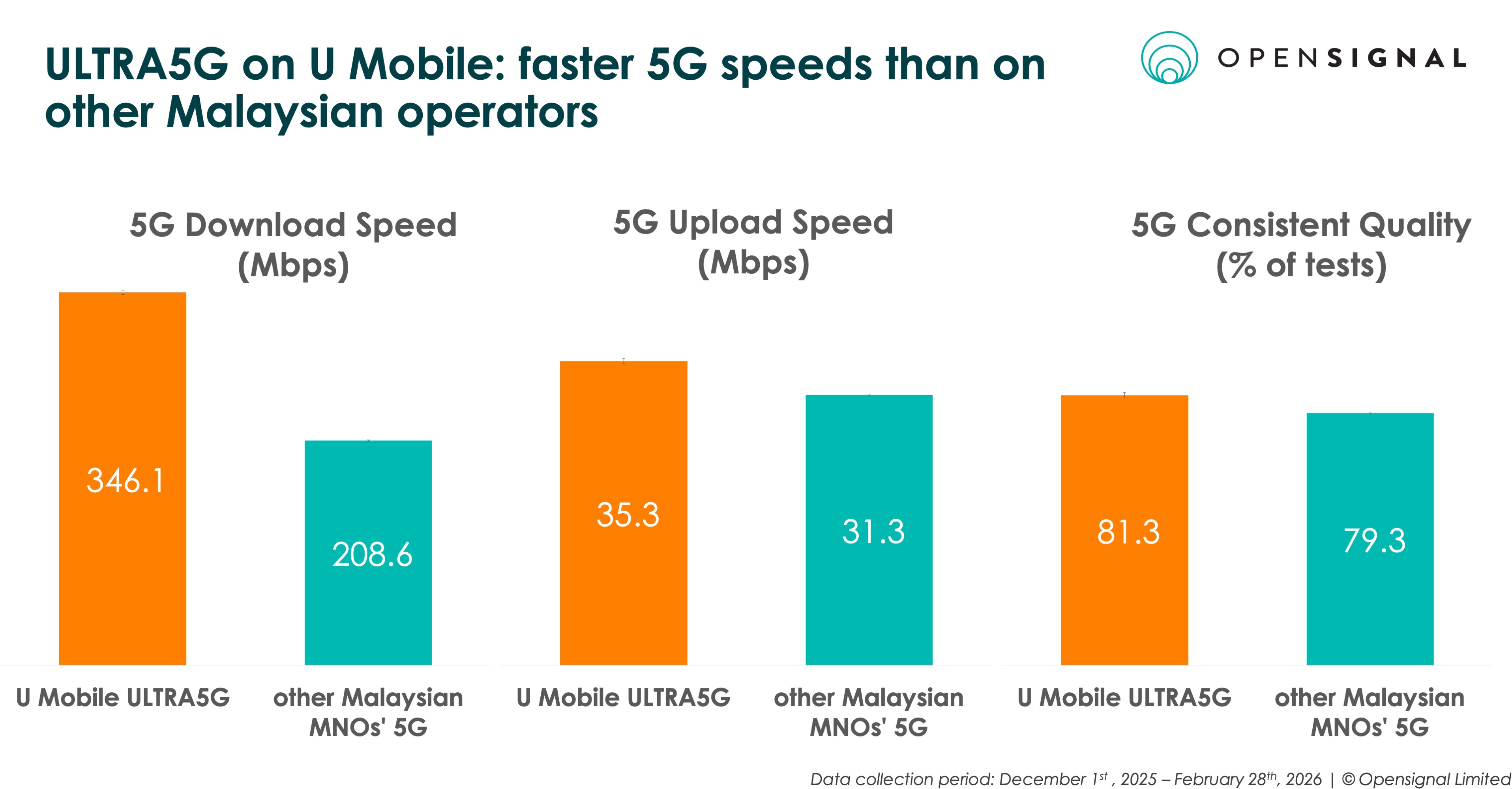
Our data shows that this transition has significantly improved 5G performance. Our U Mobile users now experience 5G download speeds around two-thirds higher than the competitors, alongside faster upload speeds and more consistent quality of service.
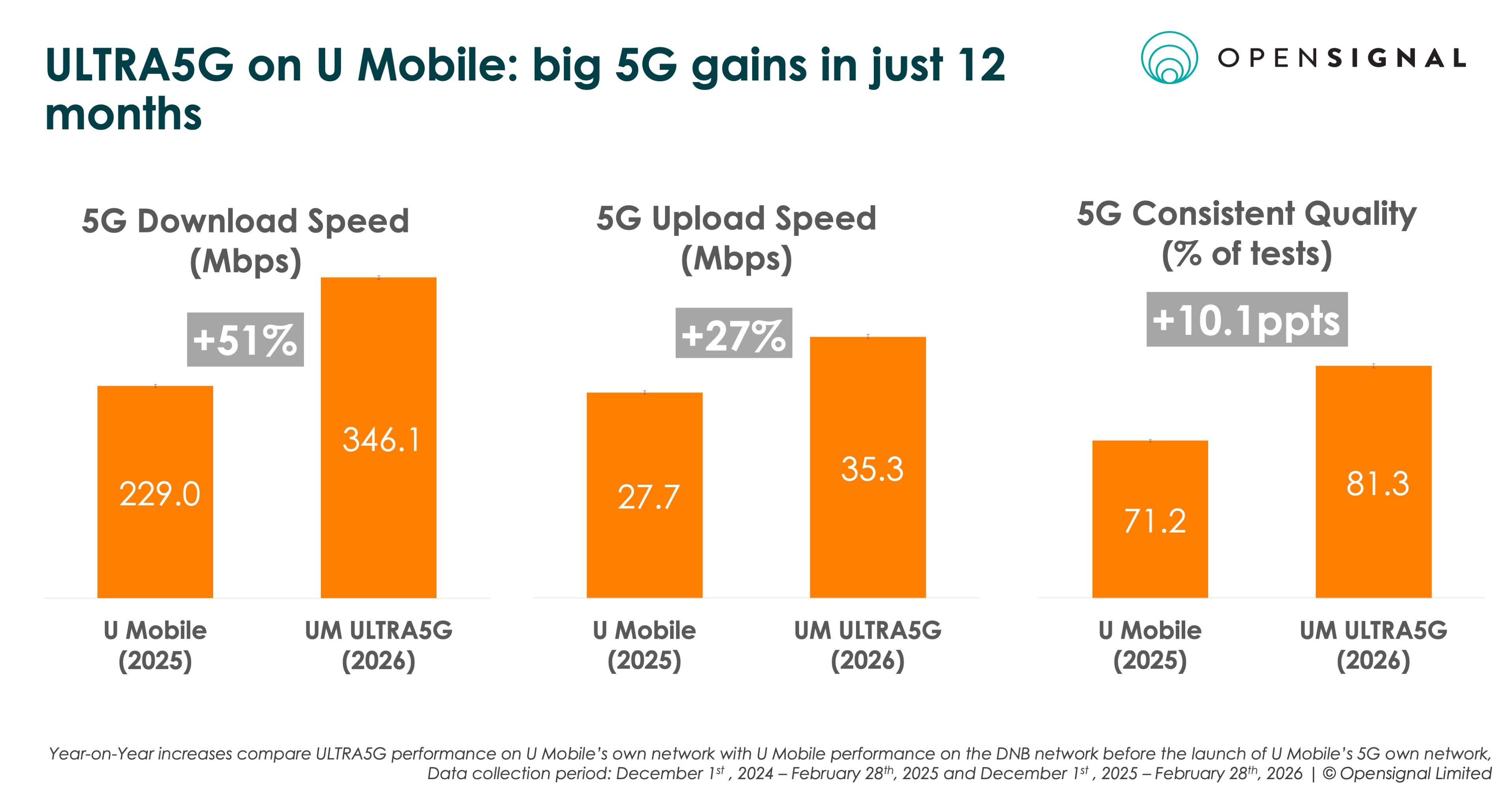
Over the past 12 months, our users on the U Mobile 5G networks have seen improvements in 5G download speed by 51% and upload speed by 27%.
Beyond raw speed, U Mobile’s progress is best captured by Opensignal’s 5G Consistent Quality metric. This benchmark tracks how often a mobile network delivers the seamless, consistent experience, without the common frustrations of modern connectivity. When this metric is low, users face frozen video calls, sluggish app loading, and the frustration of timed-out mobile payments. Our ONX Focus data shows that U Mobile’s significant year-on-year gains in 5G Consistent Quality are fuelled by lower latency and faster response times (time to first byte) — which means users can rely on a smooth, glitch-free connection more often.
At the same time, U Mobile has strengthened its 5G Availability — the proportion of time users are connected to 5G, whether actively using it or not. After scoring 57.8% in our latest Malaysia report, it increased this to 60.4% in the 90-day period starting December 1, 2025, extending its lead over competitors.
Indoor performance emerges as a key differentiator
However, improving speed and consistency is only part of the story — and just one element of U Mobile’s strategy. Indoor coverage remains one of 5G’s greatest challenges, and where user experience often deteriorates. High-frequency signals struggle to penetrate walls, glass and dense urban structures, making consistent indoor performance difficult to achieve. U Mobile has made indoor coverage a central focus of its ULTRA5G rollout strategy and marketing — and the results are clear: it is already delivering measurable gains.
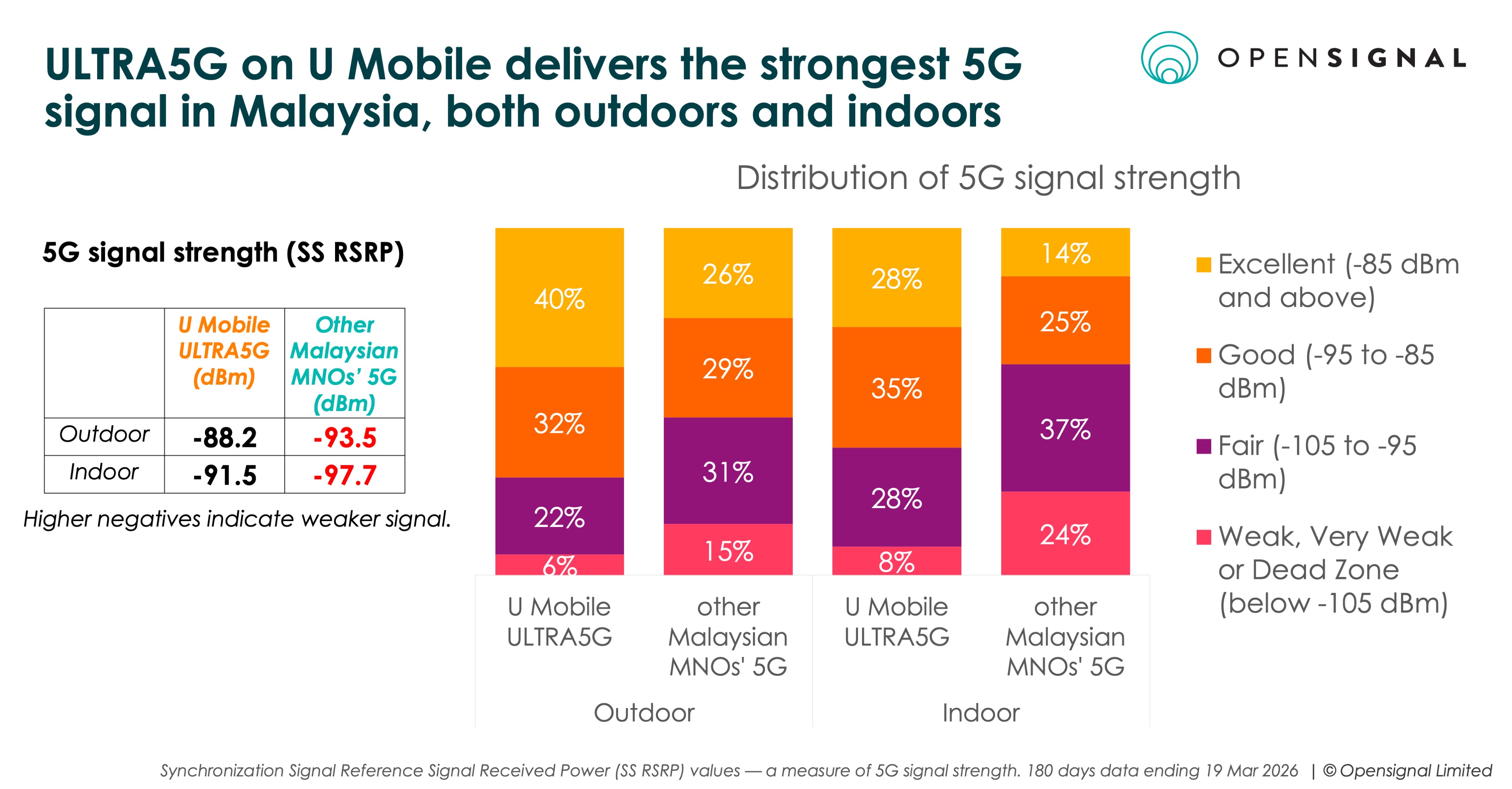
Our data shows that U Mobile users are twice as likely to experience an Excellent 5G signal indoors (≥85 dBm) compared to users on other Malaysian networks. At the same time, only 8% of indoor readings fall into the “Weak”, “Very Weak” or “Dead Zone” categories — roughly a third of the rate seen on other networks (24%), and only slightly above U Mobile’s outdoor performance (6%).
While U Mobile deploys both 700MHz and 3.5GHz spectrum across its entire site footprint — the same bands as DNB — its indoor performance lead stems from a specialised infrastructure strategy rather than spectrum alone. The operator is aggressively rolling out next-generation 5G In-Building Coverage (IBC) solutions to overcome the physical barriers that typically degrade indoor signals. By integrating 5G infrastructure into high-traffic locations, U Mobile aims to maintain consistent performance in areas with the greatest demand.
Strong performance in high-traffic indoor environments
As a result, ULTRA5G delivers stronger 5G signal strength and maintains solid performance even in busy indoor environments such as major shopping centres and transport hubs across Malaysia — which are some of U Mobile’s key ULTRA5G deployment targets. Opensignal data shows that U Mobile’s ULTRA5G significantly outperforms other Malaysian operators in maintaining consistent connectivity in these complex indoor settings.
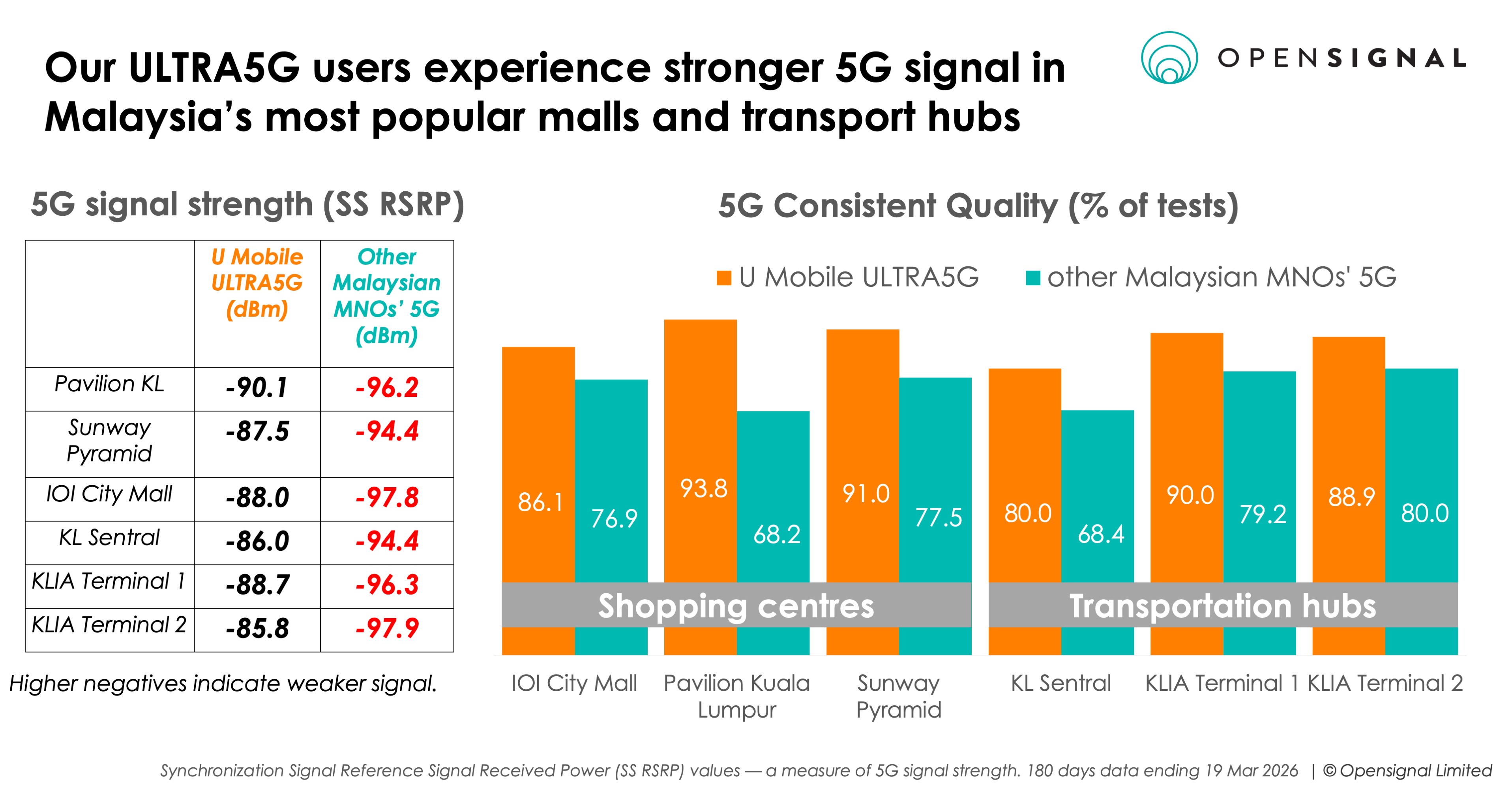
In major shopping centres such as Pavilion Kuala Lumpur and Sunway Pyramid, U Mobile achieves 5G Consistent Quality scores above 90% — far exceeding the sub-80% average seen among other Malaysian operators in these malls, according to Opensignal data. This level of consistent service quality is particularly important in crowded indoor environments, where many visitors are simultaneously connecting to message friends, post on social media, compare prices or navigate the mall. While these activities do not require lightning-fast speeds, they do depend on a stable and responsive mobile connection.
This trend continues in key transport hubs such as Kuala Lumpur Sentral station and Kuala Lumpur International Airport, where ULTRA5G outpaces its competitors, while also offering special plans for international tourists, including free 100GB of ultra-fast data for 24 hours. As seen in our previous analyses in markets such as the U.S. and Japan, users at airports are less likely to rely on Wi-Fi than the national average — making “good enough” 5G services all the more important.
The behavioral shift: gravitating towards 5G
This strong indoor performance is also driving a shift in how users connect. Perhaps the most striking outcome of ULTRA5G is not technical — but behavioral. As indoor 5G performance improves, users are becoming less reliant on Wi-Fi. While Malaysia has already seen relatively lower dependence on Wi-Fi compared to other APAC markets, due to widespread 5G rollouts and unlimited prepaid data plans, ULTRA5G is accelerating this shift.
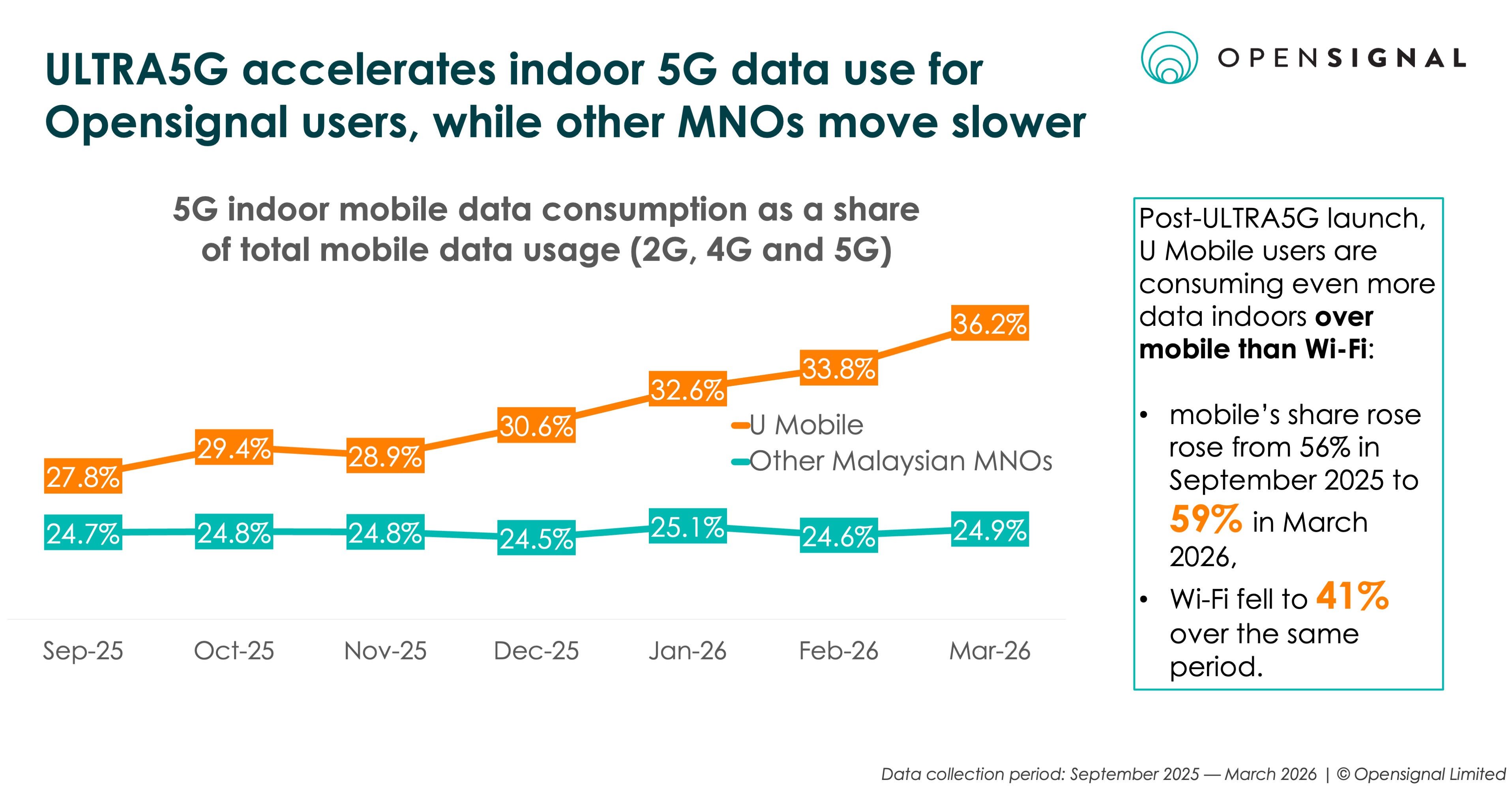
Since the launch of ULTRA5G, the share of indoor mobile data usage among Opensignal users on U Mobile’s network has increased from 56% to 59%, while reliance on Wi-Fi has declined to 41%. At the same time, 5G’s share of overall indoor mobile data consumption has risen from around 28% to 36%. This trend contrasts with Opensignal users on other Malaysian networks, whose 5G usage has remained relatively stable over the same period.
While multiple factors may influence user behavior, this shift suggests that improved indoor 5G performance is reducing the need to switch to Wi-Fi — particularly where networks can deliver a “good enough” experience.
Implications for Malaysia’s 5G market
U Mobile’s strategic focus on indoor coverage is delivering tangible results. By addressing one of 5G’s most persistent weaknesses, ULTRA5G is enhancing 5G performance both outdoors and indoors. Backed by US$1 billion in secured funding, the operator is targeting 80% population coverage in Malaysia by the second half of 2026. As ULTRA5G expands nationwide, reliable indoor 5G is moving from aspiration to expectation —becoming the new standard for user experience in Malaysia.
However, the benefits of U Mobile’s 5G network may extend beyond its own customers. The operator has signed a three-year wholesale agreement with Telekom Malaysia to provide end-to-end 5G services, enabling broader access to scalable, high-quality connectivity. This could further reshape the country’s competitive landscape and drive improvements for all Malaysian users.
Read our global insight on data consumption in Asia Pacific or check out more of our reports on Malaysia. If you're interested in more of our tailored analysis then please contact us. Don’t forget to subscribe to Opensignal’s newsletter for deeper insights on Malaysia and global markets.
Opensignal Limited retains ownership of this insight including all intellectual property rights, data, content, graphs & analysis. Reports and insights produced by Opensignal Limited may not be quoted, reproduced, distributed, published for any commercial purpose (including use in advertisements or other promotional content) without prior written consent. Journalists are encouraged to quote information included in Opensignal reports and insights provided they include clear source attribution. For more information, contact [email protected].
