


Authored by Robert Wyrzykowski, data support by Adam Winstanley
While national mobile operators in most countries provide broadly similar coverage footprints, Australia stands as a striking exception. Telstra, the incumbent, has invested heavily in extending its reach into rural and remote areas, while Optus and Vodafone have focused primarily on densely populated urban and suburban locations where returns are higher.
This creates a structural advantage for Telstra in areas where it provides coverage but competing networks do not. However, in locations where all three operators are present — typically in metropolitan and regional areas— the nature of competition shifts. Coverage is no longer the main differentiator — instead, operators must compete on the quality and consistency of the mobile experience.
To understand this dynamic, Opensignal analyzed user experience in Australia’s Common Coverage Areas (CCAs) — locations where all three national operators provide service, including via domestic roaming. These areas are primarily located in metropolitan and more densely populated regional locations, enabling a like-for-like comparison of performance. This analysis complements Opensignal’s national Mobile Network Experience report by examining experience in common coverage areas, to see how the competitive landscape changes when the playing field is levelled.
Key findings
- Consistency metrics tell a different story in CCAs: Telstra moves from third place nationally to first for Consistent Quality across CCAs, while also statistically tying for Reliability Experience — a marked shift from national results.
- Speeds increase across the board, but gains vary: All operators generally deliver faster 4G and 5G speeds in CCAs. Telstra shows the largest gains on 4G, while Optus leads improvements on 5G.
- Vodafone sees limited uplift in CCAs: Vodafone’s performance remains broadly similar to its national results, suggesting its subscriber base is already largely concentrated in these shared coverage areas.
Consistency: Telstra’s metropolitan edge
The most significant shift between national and CCA performance appears in Opensignal's consistency metrics: Consistent Quality and Reliability Experience.
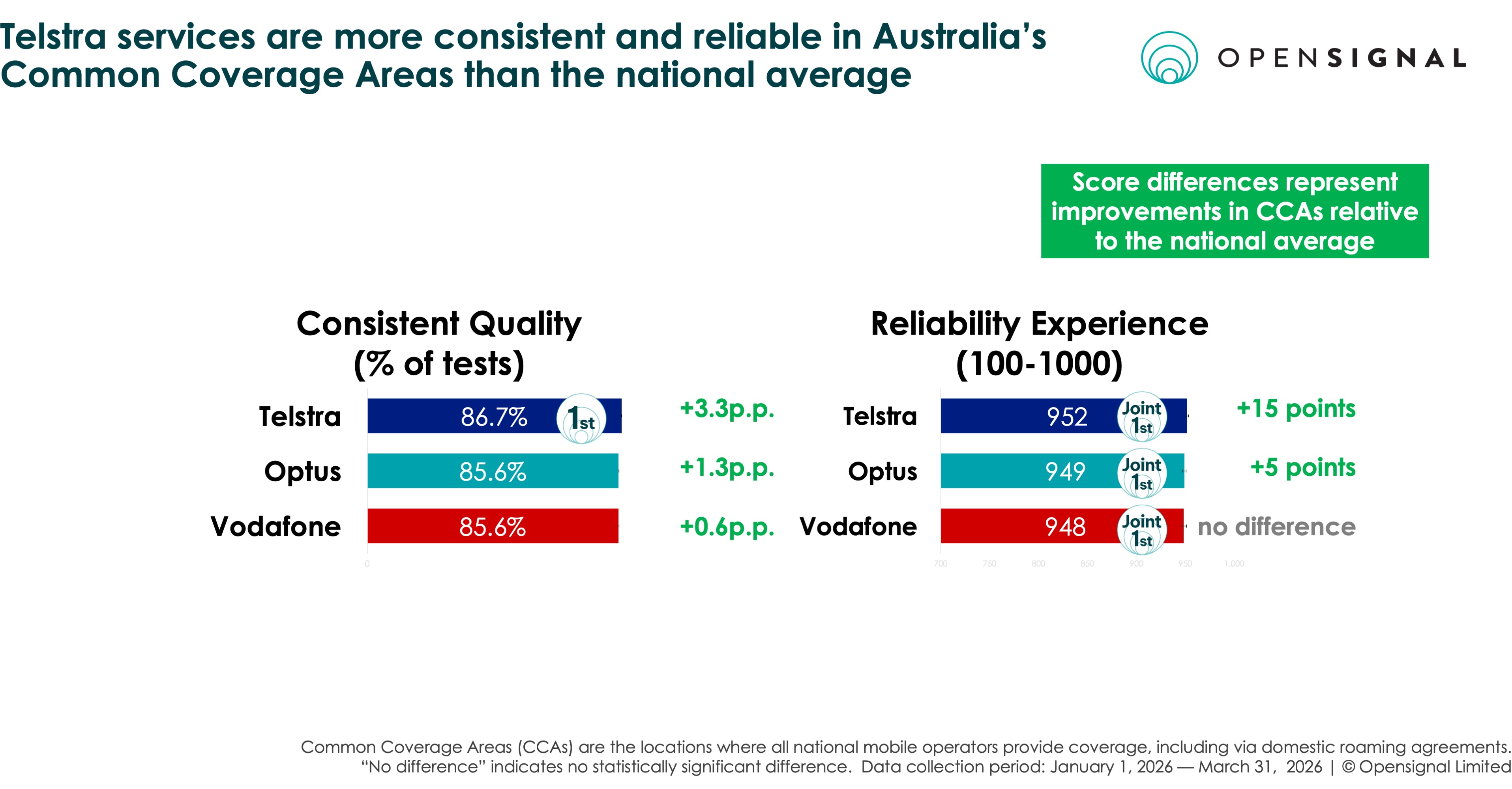
Nationally, Vodafone leads for Consistent Quality. However, in CCAs, it is Telstra that delivers the most consistent experience. Telstra’s Consistent Quality score increases by 3.3 percentage points in shared coverage areas — enough to move it from third place nationally to first. Consistent Quality captures something tangible for users, measuring whether experience is “good enough”, and reflects how often they can get through a video call without it freezing, load an app without waiting, or complete a mobile payment without it failing.
A similar pattern appears in Reliability Experience. Telstra improves enough to statistically tie with Optus and Vodafone in CCAs, whereas it ranked third nationally. This metric measures whether users can successfully connect and complete everyday tasks such as streaming video, making OTT calls, or browsing the web.
MNOs’ improvements in consistency and reliability across CCAs — which are mainly urban and suburban areas — reflect differing strategies between urban and rural network deployments. In urban areas, operators deploy denser networks supported by fibre backhaul, with users rarely far from cell sites. Handovers between cells are smoother due to the higher density of towers, reducing the risk of drops in signal or quality.
Meanwhile, in rural areas, towers are more sparsely distributed, often rely on microwave backhaul, and are sometimes not fully upgraded. This may lead to drops in quality, which would affect Consistent Quality and Reliability Experience scores. Telstra's national figures reflect the full diversity of its footprint. Its CCA scores highlight how users experience the network in locations where all operators provide coverage.
Speed: the metropolitan and regional strategy
While performance improves in CCAs, the leaderboard for speed remains unchanged. Optus continues to lead for download speeds, while Vodafone leads for upload speeds — consistent with our national results.
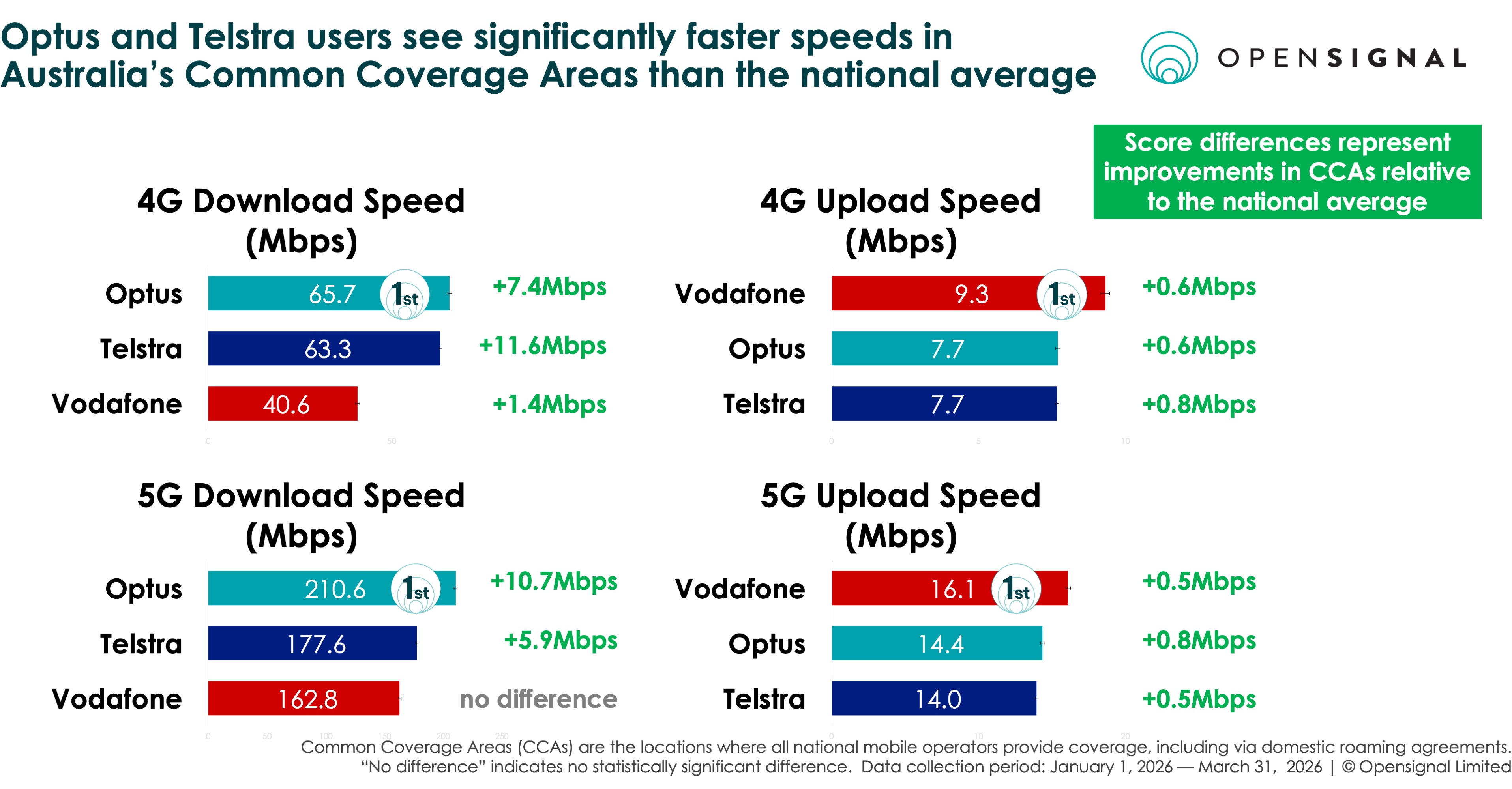
That said, operators benefit from significantly stronger performance in shared coverage areas. Telstra’s 4G download speeds are 22% faster in CCAs compared to its national average, while Optus records a 13% increase. Both operators also see improvements in 5G download speeds.
Telstra’s lower national speed scores likely reflect its broader coverage strategy. While CCAs are predominantly metropolitan and regional, Telstra’s national averages are influenced by its extensive rural footprint. In these areas, lower-band spectrum, such as the 700MHz or 850MHz bands (the latter repurposed after 3G shutdowns), is often the primary layer — and in some cases, the only one in use. This is great for coverage but less so for capacity, as the bandwidth of these low bands is limited. Meanwhile, MNOs in metropolitan and regional areas typically prioritise the deployment of higher-frequency spectrum to provide sufficient capacity in high-traffic locations.
In contrast, Vodafone’s gains are more limited, with 5G download speeds statistically unchanged compared to its national average. This suggests that Vodafone’s network footprint overlaps with CCAs and its subscriber base is already concentrated in these areas. Historically, Vodafone has had the smallest footprint in Australia, but it has recently expanded its reach following a regional network-sharing deal with Optus. While Vodafone now has reach in regional areas via Optus, its owned infrastructure remains heavily concentrated in cities, with 85.4% of Vodafone’s sites in major cities.
From reach to reliability
The Australian mobile landscape is currently in a state of flux. With 3G networks now fully switched off, operators’ focus has shifted toward 5G densification and the expansion of regional 4G capacity — all while working to meet government requirements for universal nationwide coverage.
As efforts to expand coverage begin to reduce the historical gap in rural areas, the basis for competition is gradually shifting. While being the only provider in a remote location remains a competitive advantage — as it does for Telstra — network performance is becoming a more important factor for customer loyalty in areas where multiple operators offer service, such as in CCAs. Market leadership in these areas will depend not just on coverage, but also on the quality of the connection.
Methodology note
Common Coverage Areas are evaluated at Geohash 7 (150m x 150m) level - in line with the resolution granularity supported throughout the ONX product suite. Individual Geohash 7s are qualified as “covered” on a per-operator basis and all MNOs must cover the Geohash 7 to qualify as a CCA. Coverage provided via a domestic roaming agreement with a partner network counts as coverage.
Read our recent Mobile Network Experience report on Australia or check out more of our insights on this market. If you're interested in more of our tailored analysis then please contact us. Don’t forget to subscribe to Opensignal’s newsletter for deeper insights on Australia and global markets.
Opensignal Limited retains ownership of this insight including all intellectual property rights, data, content, graphs & analysis. Reports and insights produced by Opensignal Limited may not be quoted, reproduced, distributed, published for any commercial purpose (including use in advertisements or other promotional content) without prior written consent. Journalists are encouraged to quote information included in Opensignal reports and insights provided they include clear source attribution. For more information, contact [email protected].
