


Türkiye’s 5G journey has moved from a spectrum auction milestone to live network performance. Following the country’s 2025 5G auction, which set the stage for commercial 5G services from April 1, 2026, the first 30 days after launch show a clear step-change in user experience. This early snapshot of 5G network performance also shows that operators are delivering 5G using distinct strategies to consumers.
Key findings
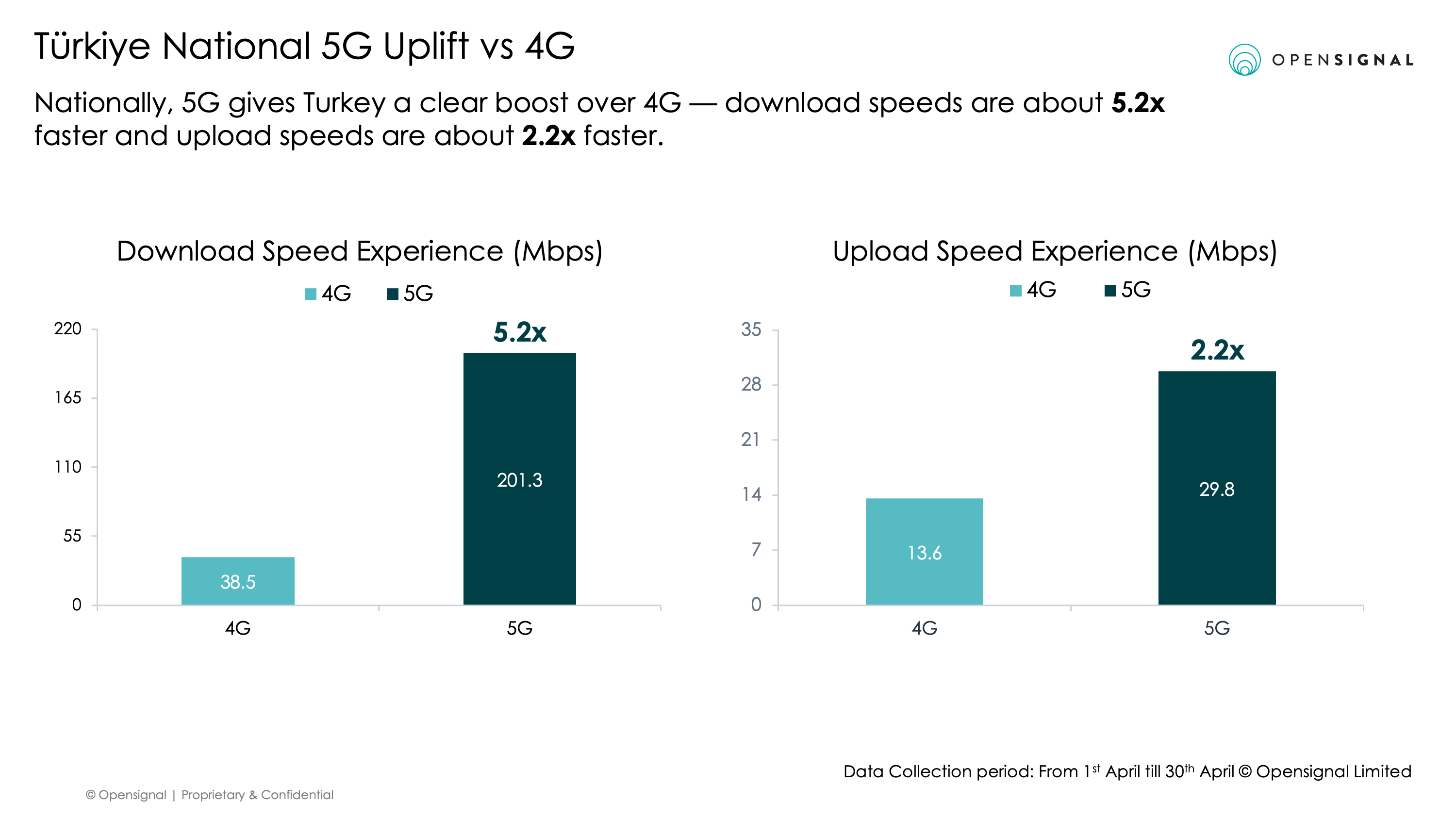
- Strong early 5G uplift. Türkiye’s 5G launch delivered immediate gains, with 5G Download Speed 5.2x faster and Upload Speed 2.2x faster than 4G.
- Distinct operator strategies emerge. Turkcell leads on speed, Vodafone on 5G Availability and 700MHz usage, while Türk Telekom records the strongest 5G Reliability score.
- Mid-band drives speed leadership. The 3.5GHz spectrum band dominates Türkiye’s early 5G NSA deployment with 68.5% of 5G records, supporting strong speed gains.
5G delivers an immediate step-change over 4G
Türkiye’s 5G launch has delivered an immediate uplift in mobile network experience. During the first 30 days of commercial 5G availability, from April 1 to April 30, 2026, our users in Türkiye experienced average 5G download speeds of 201.3 Mbps, compared with 38.5 Mbps on 4G. This means 5G was 5.2 times faster than 4G for download speeds. Upload speeds also improved, with 5G reaching 29.8 Mbps, compared with 13.6 Mbps on 4G — a 2.2 times uplift.
This early performance gap highlights the scale of the step-change that 5G is already bringing to the Turkish consumers mobile experience. While 4G remains the foundation of nationwide mobile connectivity, 5G is already creating a much faster experience for those users who are able to connect to it.
Turkcell leads the early 5G speed race
At the operator level, Turkcell is setting the pace on 5G speeds. Our users on Turkcell saw 5G download speeds of around 249 Mbps, ahead of Türk Telekom at around 201 Mbps and Vodafone at around 140 Mbps. This means Turkcell’s 5G Download Speed was around 24% faster than Türk Telekom’s and substantially ahead of Vodafone’s.
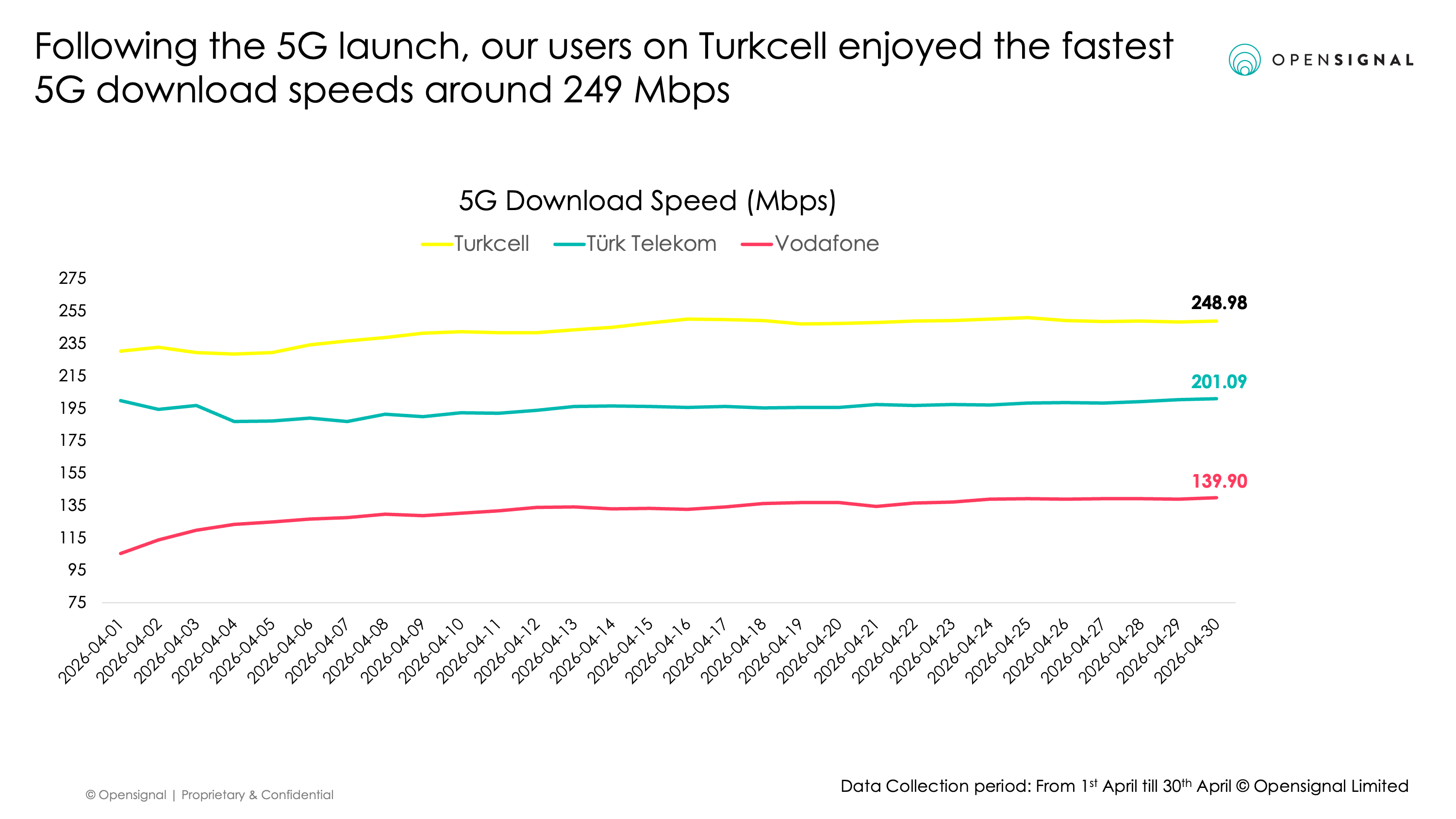
This performance advantage is largely supported by spectrum positioning. Turkcell secured the largest 3.5GHz allocation in the auction, with 1×140 MHz, compared with 1×120 MHz for Türk Telekom and 1×80 MHz for Vodafone. A wider 3.5GHz mid-band allocation gives Turkcell more capacity for 5G traffic and supports higher achievable download speeds, helping explain its lead in early 5G speed performance.
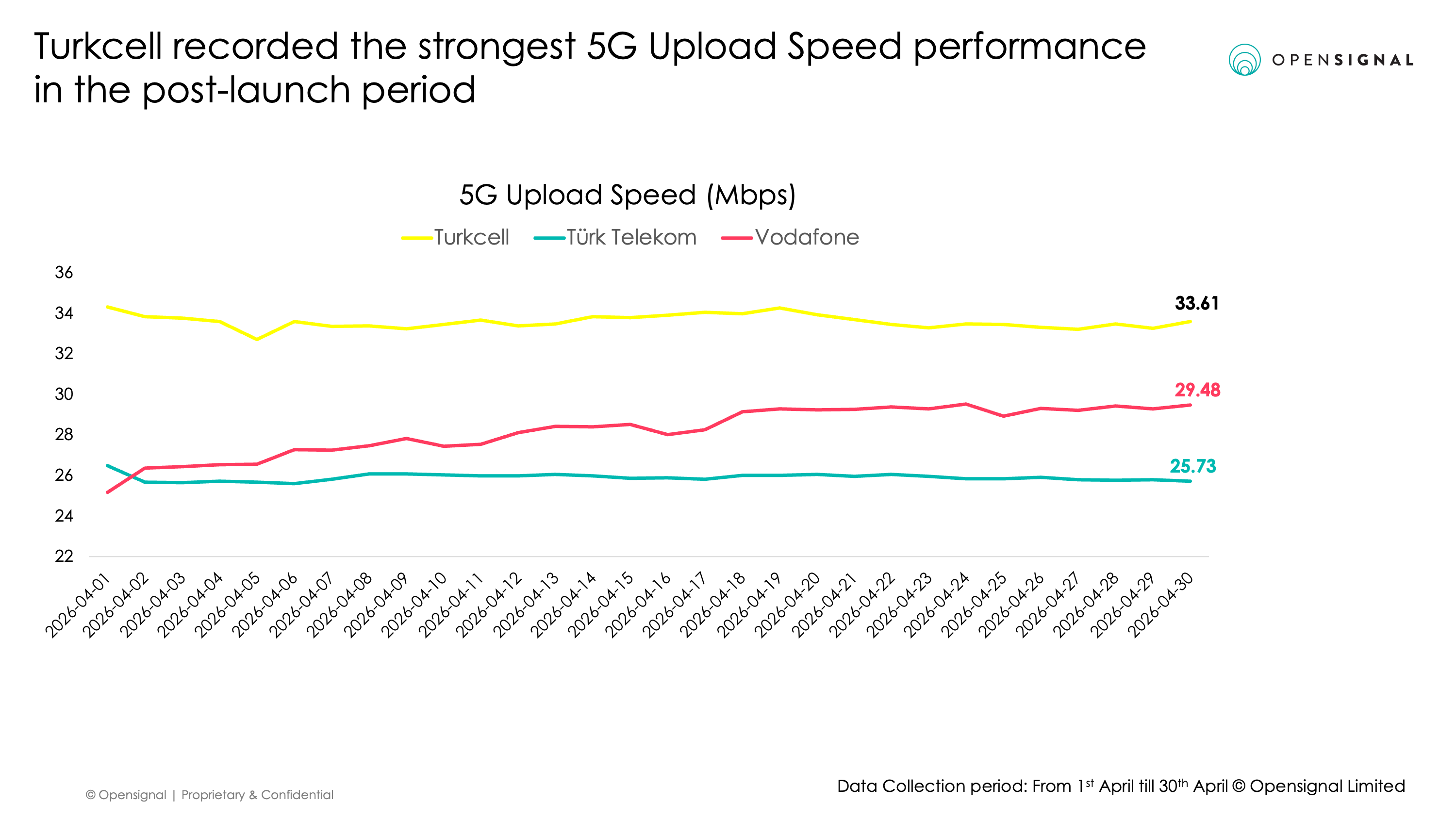
Turkcell also led on 5G Upload Speed. Its users recorded around 33.6 Mbps compared with 29.5 Mbps on Vodafone and 25.7 Mbps on Türk Telekom. This puts Turkcell around 14% ahead of Vodafone and nearly 30% ahead of Türk Telekom for 5G Upload Speed.
Vodafone takes the lead on 5G Availability
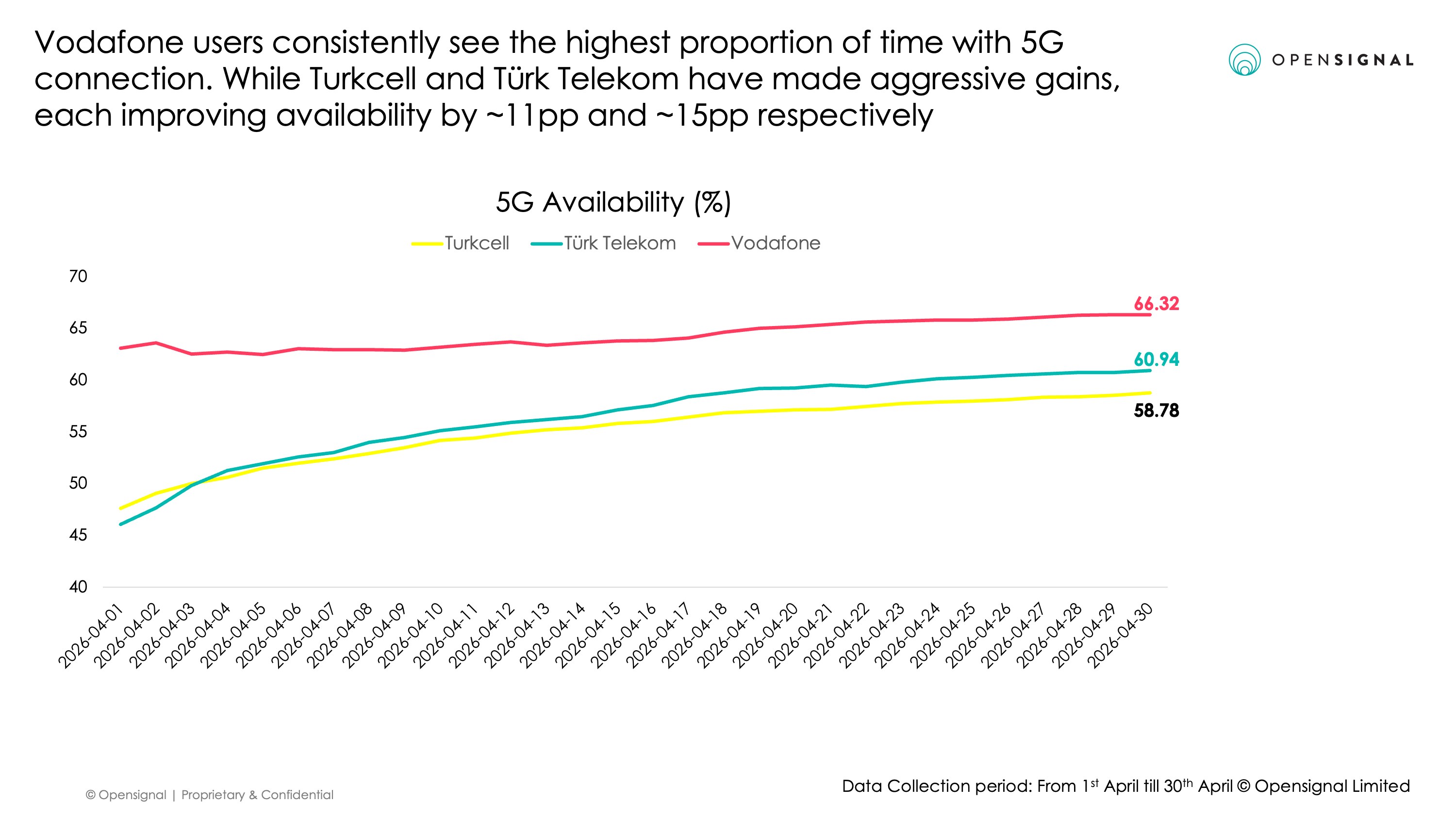
Vodafone, however, leads on a different dimension of the early 5G experience: 5G Availability. Our Vodafone users spent the highest proportion of time connected to 5G during the first 30 days with 5G Availability 66%. Turkcell and Türk Telekom started lower but improved quickly. Türk Telekom increased from 47.6% to 60.9%, while Turkcell rose from 46.0% to 58.7%.
This suggests that Vodafone entered the launch period with a stronger 5G availability position while Turkcell and Türk Telekom rapidly expanded the time their users spent connected to 5G during the first three weeks.
Türk Telekom records the strongest 5G Reliability score
For 5G Reliability, Türk Telekom leveraged its extensive fiber network backbone to achieve the highest 5G Reliability score recording 847 points. Vodafone closed the gap significantly, following closely with 842 points, while Turkcell reached 821 points. This places Türk Telekom slightly ahead on the point score, with Vodafone close enough to share leadership in the early 5G reliability picture.
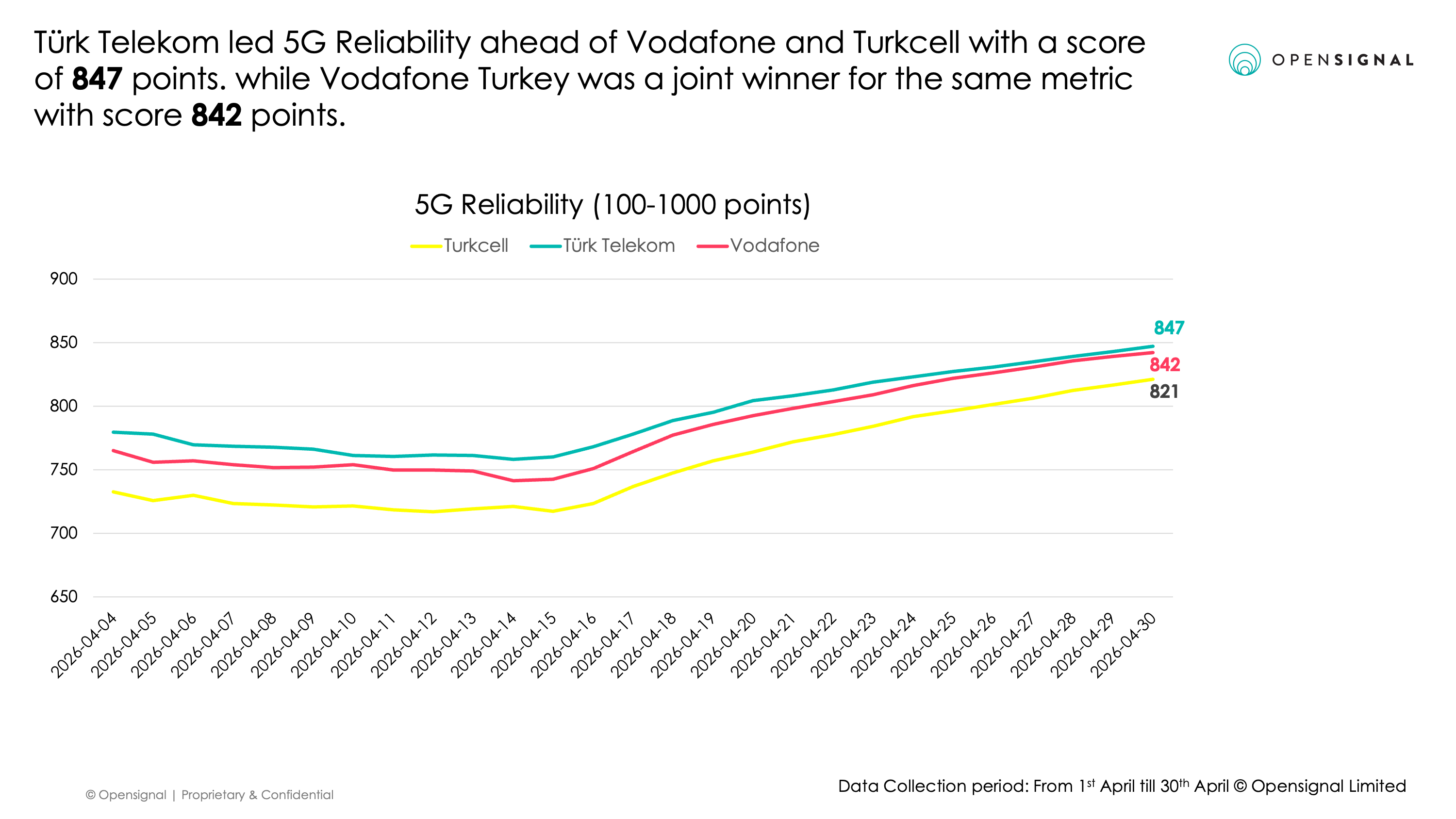
The 5G Reliability score reflects how consistently users can stay connected and complete everyday tasks on 5G networks, making it an important indicator of user confidence in services such as video streaming, cloud applications and real-time communications.
3.5GHz dominates Türkiye’s early 5G deployment
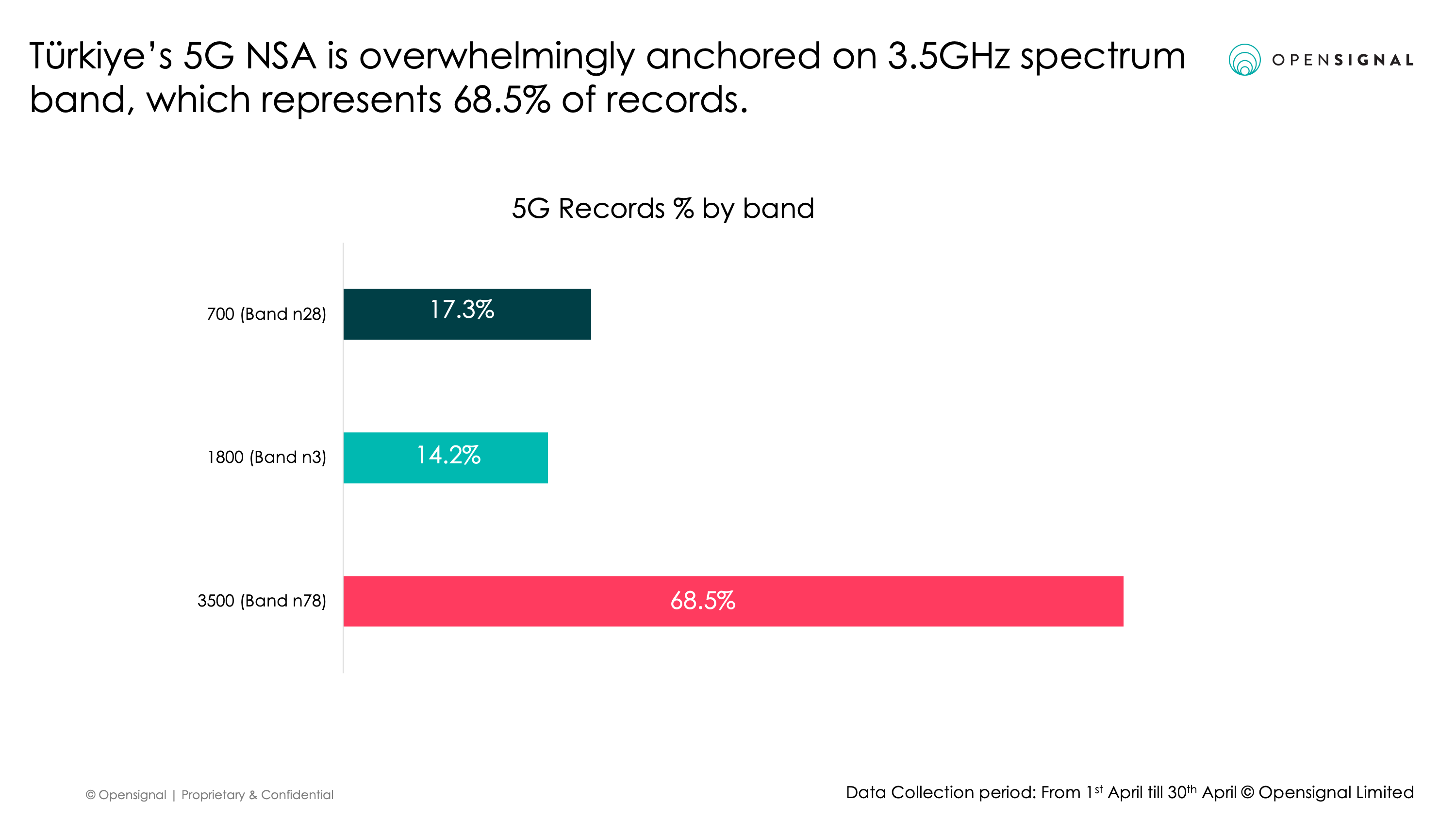
Türkiye’s early 5G rollout is mainly concentrated on the 3.5GHz band, which represents 68.5% of observed 5G records. This suggests operators are prioritizing capacity and higher speeds in the initial phase. The remaining records are split between 700MHz at 17.3% and 1800MHz at 14.2%. This mix helps explain differences in operator performance: 3.5GHz improves speed and capacity, while 700MHz helps expand coverage and increase the time users remain connected to 5G.
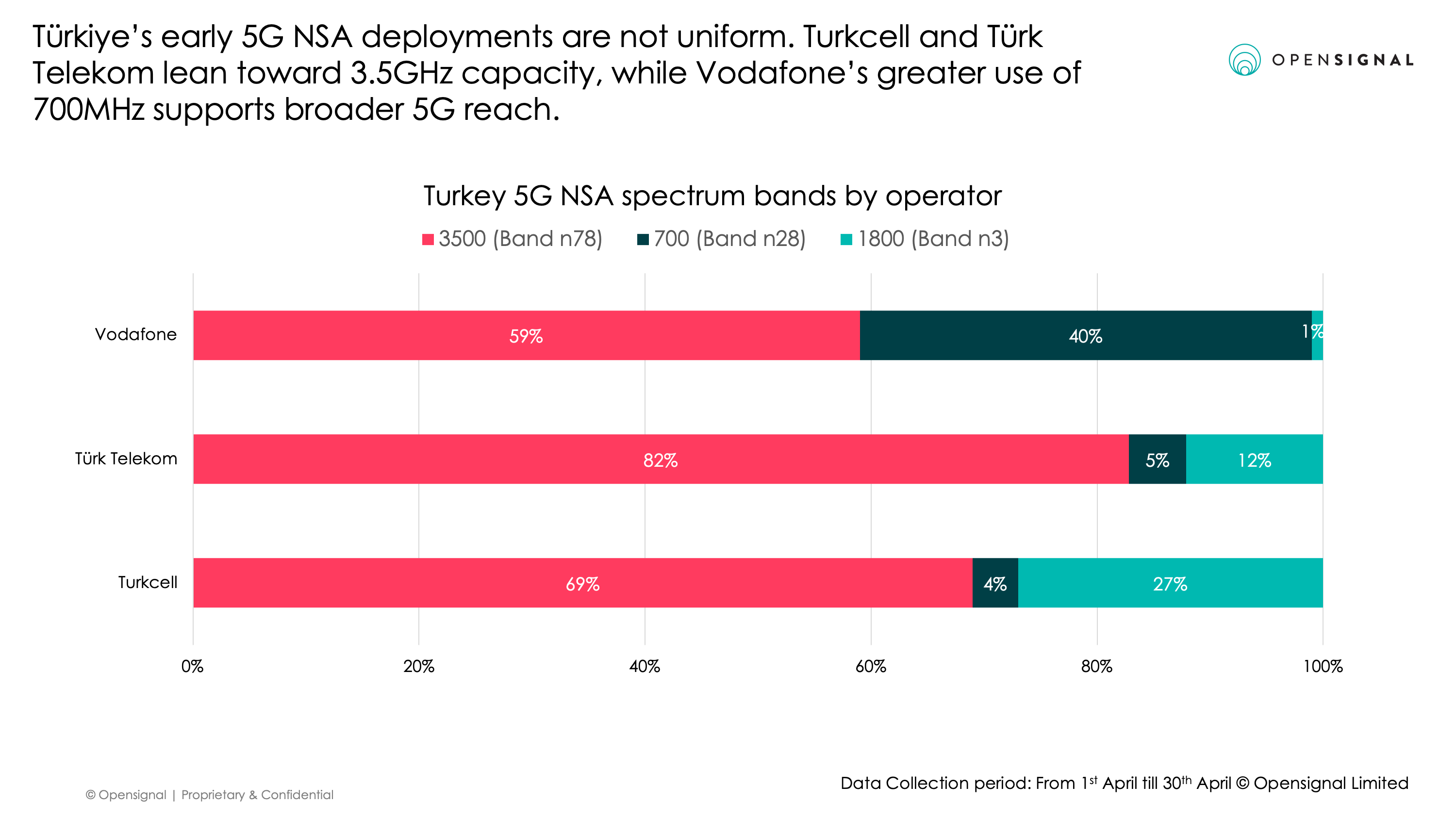
From an operator-lens perspective, within Vodafone’s own 5G record mix, 700MHz represents around 40%, compared with just 5% for both Turkcell and Türk Telekom. This suggests Vodafone adopted a more coverage-oriented early 5G strategy, using 700MHz to extend reach and improve users’ ability to remain connected to 5G.
By contrast, Turkcell and Türk Telekom rely more heavily on n78. Around 69% of Turkcell’s observed 5G NSA records and 82% of Türk Telekom’s are on 3.5GHz, indicating a stronger emphasis on mid-band capacity and speed. Turkcell also has the largest share of 1800 MHz records, suggesting a more mixed mid-band and refarmed-band approach in its early 5G layer.
Overall, Türkiye’s first 30 days of 5G show a strong early market entry. The national uplift over 4G is already substantial, especially for download speeds, while the operators are beginning to differentiate. Turkcell leads on 5G speed, supported by strong 3.5GHz usage and the highest download and upload results. Vodafone leads on 5G Availability, helped by its much stronger use of the 700MHz layer. Türk Telekom performs strongly on 5G Reliability and has also made the largest improvement in 5G Availability during the period.
Türkiye’s 5G market enters its next phase
The next phase of Turkey’s 5G development will depend on how quickly operators can balance these three dimensions: speed, availability and reliability. Turkey’s early 5G results show a clear improvement over 4G, while competition between operators is still developing.
As operators move from initial rollout to network optimization, independent mobile experience data will be critical for tracking competitive performance across speed, availability, reliability and spectrum strategy. Contact our team to learn how Opensignal insights can help you benchmark 5G performance, identify network improvement opportunities and understand where Turkey’s mobile experience is heading next.
Opensignal Limited retains ownership of this insight including all intellectual property rights, data, content, graphs & analysis. Reports and insights produced by Opensignal Limited may not be quoted, reproduced, distributed, published for any commercial purpose (including use in advertisements or other promotional content) without prior written consent. Journalists are encouraged to quote information included in Opensignal reports and insights provided they include clear source attribution. For more information, contact [email protected].
