


I recently moderated Opensignal’s webinar featuring experts from Kaleido Intelligence and KPN, alongside our own team at Opensignal. The session focused on travel eSIM adoption and network experience — where the market is growing, where the experience gap is real, and what operators can actually do about it. Here are the key takeaways from the discussion, you can watch the full recording here.
The growth is real, but it's concentrated
Opensignal data shows travel eSIM users among our global user base nearly doubled year-on-year, from 1.7% in Q2 2025 to 3.3% in Q2 2026. That growth came largely at the expense of roaming, which shed 5.2 percentage points over the same period.
But travel eSIM adoption is not evenly distributed. Long-haul travelers — those crossing into a different geographic region — are 2.5 times more likely to use a travel eSIM than those staying closer to home. Multi-country travelers are 1.5 times more likely. Within roam-like-home zones like the EU, roaming still dominates.
That segmentation matters. Travel eSIMs are winning on the trips where roaming has historically been most expensive and most frustrating: intercontinental journeys, complex itineraries, markets without reciprocal agreements. They are not yet competing head-on with roaming across all corridors. For operators, that is both a warning and an opening — but the window is not indefinitely wide.
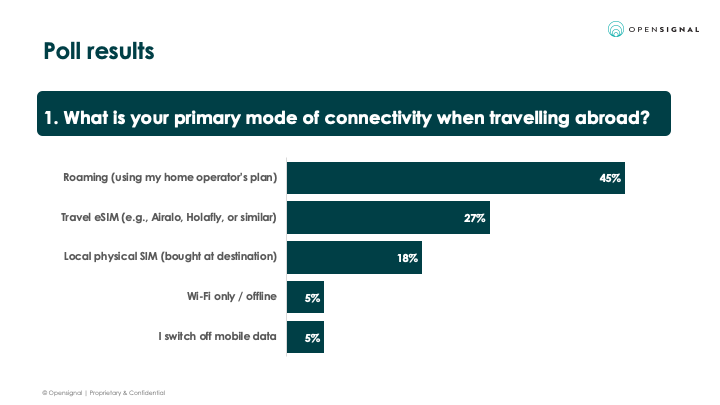
Our webinar audience illustrated this well. When we asked how they connect when traveling abroad, 27% said they use a travel eSIM and 18% use a local SIM, while 45% still roam. Against the Opensignal global user base, where travel eSIM sits at 3.3%, that 27% is striking. Industry audiences over-index on early adoption. The general traveler market has not moved that fast yet — but the direction is clear.
The experience gap is real — but so is the nuance
Using our Network Quality Index, which measures what percentage of time a user gets a connection good enough to run everyday apps, Opensignal data shows travel eSIMs outperform roaming for long-haul trips (NQI 75 vs. 70). On regional travel, traditional roaming retains an edge.
The explanation is infrastructure. Most travel eSIM traffic is technically roaming, routed through wholesale aggregators — the same basic architecture as traditional roaming. The quality ceiling is set by the aggregator's geographic footprint, not by the brand on the eSIM. The further a user is from an aggregator's core network, the higher the latency. Travel eSIM providers with aggregators that have in-region infrastructure deliver materially better results. Those without do not.
On latency, travel eSIMs currently hold an advantage. On packet loss, they often lag, because they do not control the full routing path the way operators do. Packet loss directly affects connection reliability — not just speed — so this is not a minor caveat.
A poll we ran during the webinar adds context. When asked to rate their most recent connectivity experience abroad, 43% of our audience said excellent and 30% said good. But 22% reported average, with noticeable gaps or slowdowns. That 22% is not a rounding error — it maps directly to the packet loss and latency issues Giulio described, and it suggests neither roaming nor travel eSIM has fully solved the reliability question.
Leendert made the architecture point plainly: a travel eSIM provider can usually select a different aggregator — ideally one geographically closer to where their users are traveling — to get lower latency. Regional breakout would potentially deliver a lower latency for operators, but requires a fair amount of work for an operator to arrange. His point was simple: if travel eSIM providers are doing something well on routing, operators should be learning from it, not dismissing it as a different category of product.
The routing architecture decisions operators make — which wholesale agreements to sign, whether to invest in regional breakout — are quality decisions. We’re seeing that this is becoming increasingly more important now.
Price is no longer the whole story
Kaleido Intelligence's survey data, drawn from 20 outbound markets in their sixth annual study, reinforces what the network data suggests: travelers are not choosing travel eSIMs purely on price. Bill shock got them in the door initially, but that is no longer what drives the decision.
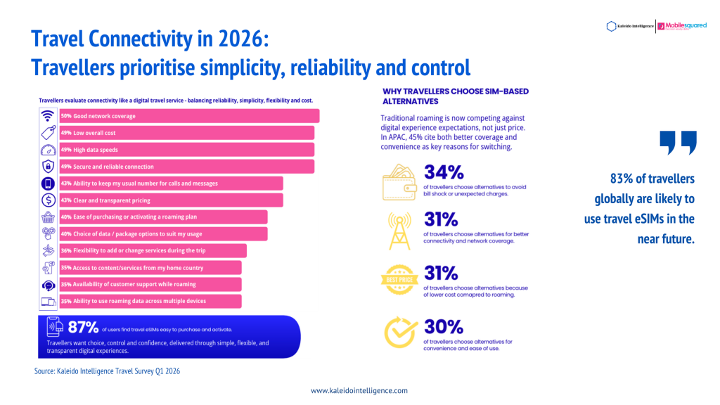
What travelers want now is control — knowing what they are buying, what the data allowance is, and what happens when they run out. They want the purchase inside the digital journey they are already on. Not a trip to a store. Not a call to customer care.
Leendert framed the operator challenge plainly: "You start by fixing your roof." Pricing clarity comes first because it is the most visible gap. But his broader point was that lowering prices is not a strategy on its own — operators need to learn from what new entrants are doing well on usability and product design, and compete with them on that, not just on cost.
Kaleido's 2026 data shows average travel eSIM spend per trip has risen 133% year-on-year to around $28, while roaming trip spend has fallen 9% to $42. The spend increase reflects a shift toward larger data allowances, longer trips, and more confident usage — 15% of travel eSIM users are now buying unlimited plans. The category is not competing on cheapness anymore.
Operators have the trust. They do not yet have the transaction.
Across all markets Kaleido surveyed, 89% of travelers said they would prefer to buy a travel eSIM from their home operator. Only 60% said they would buy from a dedicated travel eSIM provider. That trust gap is significant — and it is closing.
Leendert was specific about what is working at KPN and where the limits are. Bundle design and pricing clarity are achievable — you adjust your plans and make them easier to understand. The harder problem is latency. Closing that gap at scale means investing in equipment internationally, which is a significant ask for any operator and a substantial one for smaller players. Local breakout is an option, but it carries a well-known complication: users end up with a foreign IP address, so Google and other services treat them as a local in the visited country rather than at home. That breaks the experience in a different way.
The honest answer from the panel was that competing effectively requires coordination across wholesale, product, digital, and network teams. That is a harder organizational problem than repricing a tariff.
The regulatory gap is not going away
Travel eSIM providers and mobile operators do not operate under the same regulatory obligations. Operators carry lawful intercept requirements, emergency services obligations, security and compliance mandates. Many travel eSIM providers, operating as resellers or intermediaries, do not.
Leendert put the concern directly: a provider with no clear country of origin can target any customer anywhere, while operators are bound by national licensing and consumer protection rules. That asymmetry creates a cost and flexibility gap that compounds the product experience gap. His view was unambiguous — competition in roaming is good, it keeps operators sharp and gives consumers genuine choice, but it needs to happen on a level playing field.
The rules have not kept pace with how fast this category has grown. That catch-up is coming.
What comes next
The panel agreed on the direction, if not the pace. The next phase of competition in this market is not about who offers the cheapest data abroad. It is about who owns the relationship before, during, and after the trip.
For Leendert, the focus is on the infrastructure layer. Travel eSIM providers have shown that routing choices determine experience quality. Operators who take that seriously and for instance invest in regional breakout — or partner with infrastructure providers who already have it — will close the gap. Those who do not will keep losing long-haul travelers to providers who made that investment.
Nitin's view is that operators need to decide whether to compete directly, partner with travel eSIM providers, or embed their own propositions inside the digital journeys travelers already use. Kaleido estimates travel eSIM retail spend will approach $5 billion in 2026. The trust advantage — 89% of travelers preferring their home operator — is real but not permanent. It will not survive a product experience that feels harder and less transparent than the alternative.
The picture that emerged is not one of roaming in decline and travel eSIM in ascent. It is more specific: a category growing fast in the segments where connectivity has historically been the worst, driven by travelers who want control and transparency, and shaped at the infrastructure level by routing decisions that both operators and eSIM providers are only beginning to treat as competitive levers. The operators that recognize that they have a stronger hand than the current market gives them credit for.
Further reading:
- Beyond Roaming: How Japanese Operators Can Win the Inbound Traveler
- Travel SIMs Outperform Roaming — The Further You Go
- Does the Quality of the Roaming Experience Matter?
- Measuring Roaming Experiences: How Do Travelers' Mobile Experiences Compare to Locals?
Watch the full webinar recording here.
Opensignal Limited retains ownership of this insight including all intellectual property rights, data, content, graphs & analysis. Reports and insights produced by Opensignal Limited may not be quoted, reproduced, distributed, published for any commercial purpose (including use in advertisements or other promotional content) without prior written consent. Journalists are encouraged to quote information included in Opensignal reports and insights provided they include clear source attribution. For more information, contact [email protected].
