


Three of the five Central Asian markets have now launched commercial 5G. Opensignal's Q1 2026 Global Network Excellence Index places those same five markets between rank 76 and rank 142 globally — a 66-place spread that shows how far deployment announcements and real user experience have diverged.
On 21 May, I will be moderating the Always-On Central Asia: 5G, Data Centres, and Infrastructure Reliability session at M360 Eurasia in Samarkand.The question it puts to policymakers and operators is not whether 5G has launched — it has, in Kazakhstan, Uzbekistan, and Tajikistan. The question is whether the infrastructure being built can hold up as AI adoption, cloud growth, and digitalization keep raising what connectivity must deliver.
The EU–Central Asia strategic partnership, agreed at the first summit in Samarkand in April 2025, explicitly links spectrum policy, infrastructure investment, and digital skills to competitiveness. Opensignal's Global Network Excellence Index gives that ambition a specific, market-by-market score, which will be explored in this article.
Key Findings:
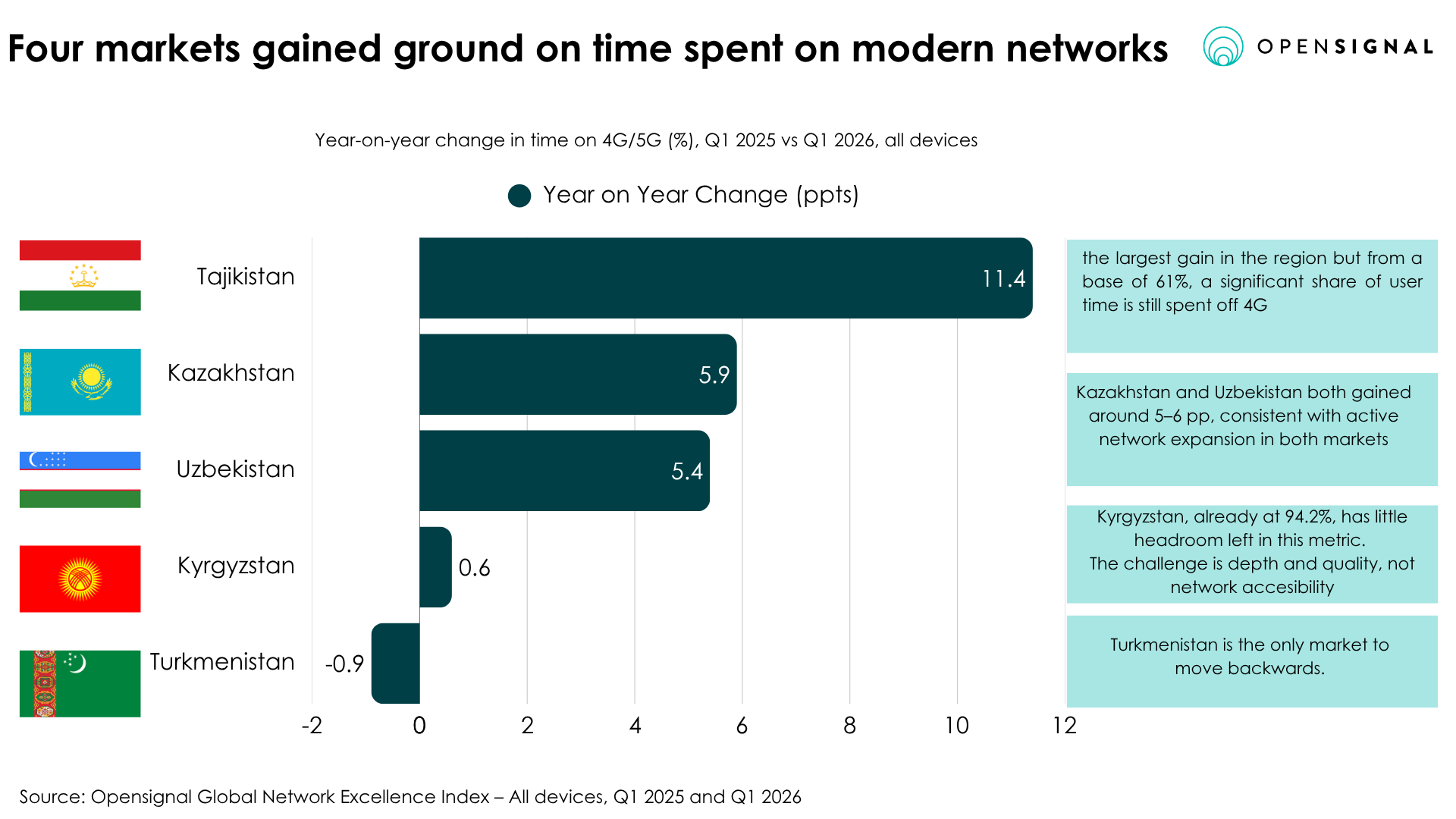
Coverage gains are real, but uneven. Kazakhstan and Uzbekistan have seen time spent on 4G/5G increase by 5–6 percentage points year-on-year. Tajikistan gained 11.4 pp — but from a base of 61%, meaning a large share of user time is still spent off 4G. Turkmenistan moved backwards.
5G is present in three markets. It is performing in two. Kazakhstan and Uzbekistan both show strong speed uplift on high-end devices. But 5G users in both markets still spend the majority of their time connected to 4G — pointing to a density gap, not a coverage gap.
Consistency is the missing piece. Across the region, ECQ — the share of time users receive performance good enough for demanding applications — remains the hardest metric to move
Table of Contents:
How Opensignal measures network excellence
At Opensignal, we measure what users actually experience — not what networks theoretically can deliver.
The Global Network Excellence Index is built on three equally weighted pillars, chosen to balance access, reliability and capacity:
- Time on 4G/5G – the proportion of time users spend connected to 4G or 5G, indicating when users have access to modern infrastructure. It reflects how accessible advanced mobile infrastructure is in everyday use and highlights gaps in coverage that can affect productivity, digital inclusion and economic development.
- Excellent Consistent Quality, or ECQ – the share of time users receive performance good enough for the most mainstream applications, such as video streaming, video calls, gaming and mobile banking. Rather than focusing on peak performance, ECQ captures whether the experience is consistently “good enough” for users to complete common tasks without frustration.
- Download Speed – an indicator of network capacity and future readiness: sufficient spectrum, dense infrastructure, modern radio technologies, and robust backhaul, all essential for growing data demand and next-generation services.
Together, they capture not just what a network is theoretically able to deliver, but how a network behaves for ordinary users, in ordinary places, every day. Delivering consistency, not speed, is the hard part.
The regional picture
The Q1 2026 rankings span 66 places. Kazakhstan (76) and Kyrgyzstan (85) rank above the global median. Uzbekistan is 105th. Tajikistan (140) and Turkmenistan (142) sit in the bottom quartile globally.
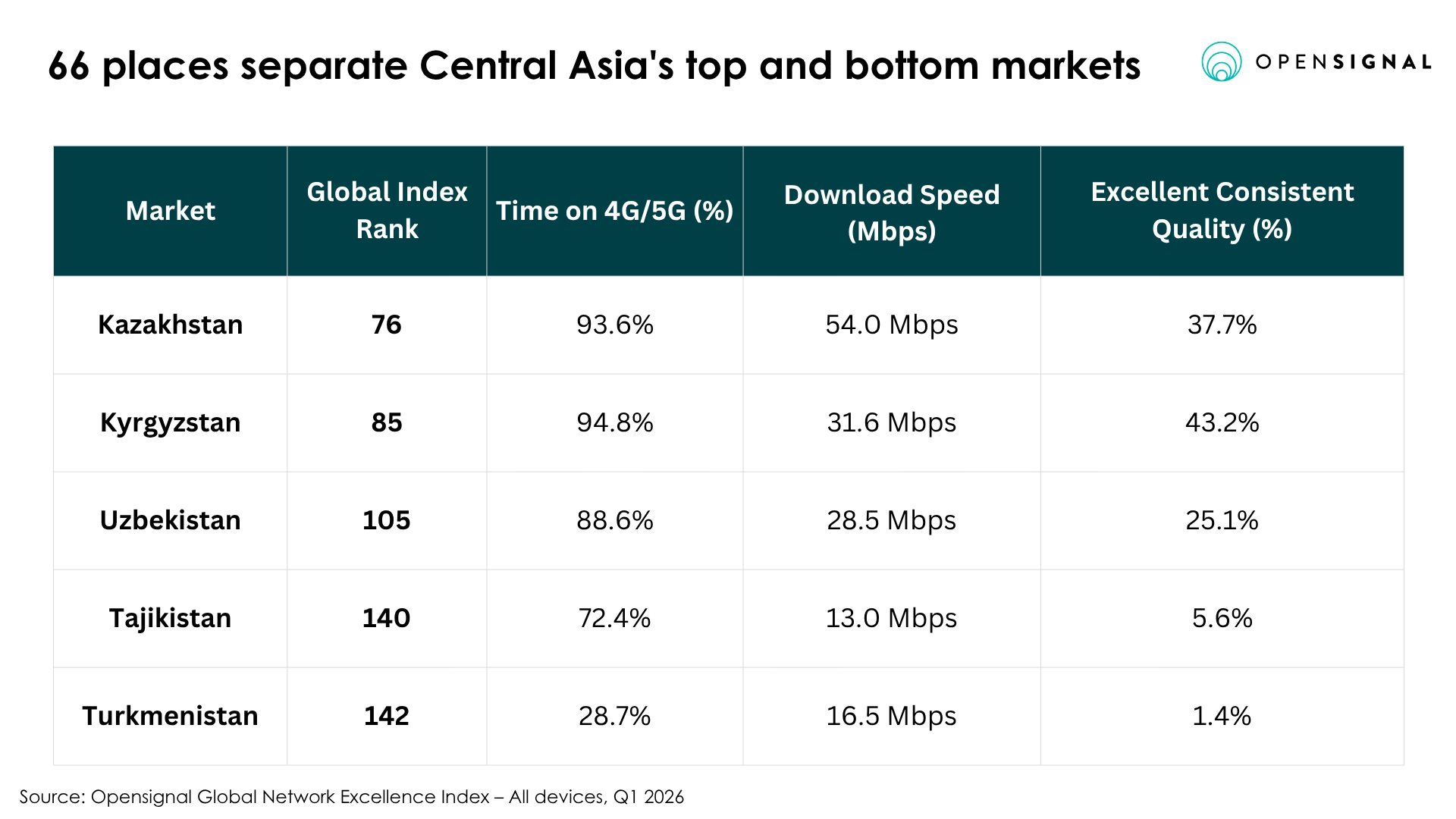
Kazakhstan leads at rank 76, driven by download speed. Kyrgyzstan ranks second despite lower raw throughput — 94.8% 4G/5G availability and 43.2% ECQ show that coverage depth matters as much as peak speed. Tajikistan and Turkmenistan face structural deficits — including limited backhaul infrastructure, low smartphone penetration, and affordability constraints — that 5G announcements alone will not close.
The year-on-year movement on 4G/5G availability makes the divergence concrete:
Is 5G translating into better user experience?
Comparing all-device and high-end device performance separates network capability from population-wide experience — a distinction that matters even in world-class networks. The high-end device view shows what a network delivers when hardware is not the constraint. The all-device view shows how much of that reaches the broader user base. Where the gap is wide, the bottleneck is either site density, spectrum depth, or device penetration — in Central Asia, all three are factors.
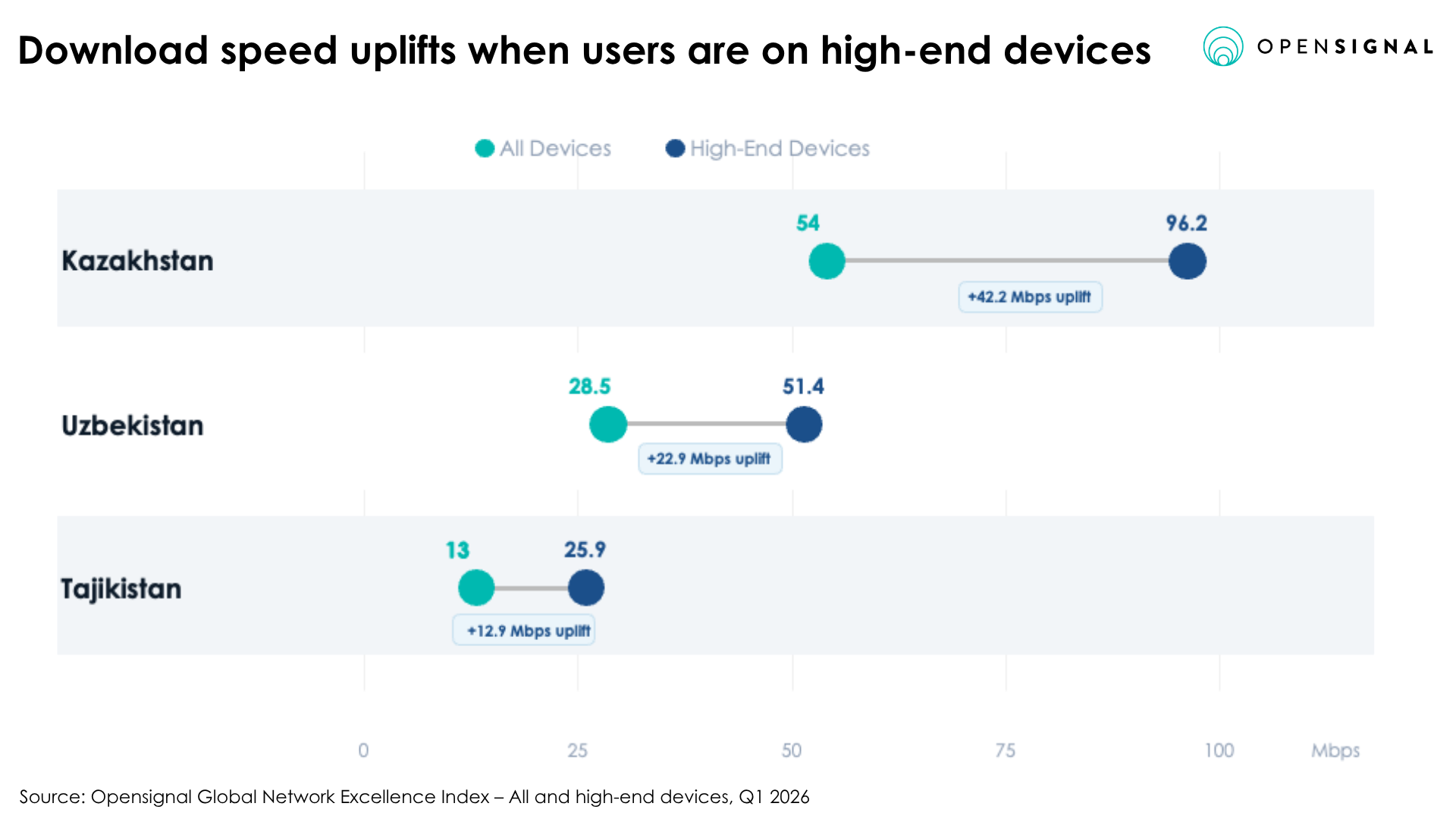
Kyrgyzstan and Turkmenistan do not appear in the high-end device dataset — a direct consequence of having no commercial 5G service.
Kazakhstan. Download speed jumped from 54.0 to 96.2 Mbps on high-end devices — a 78% gain, the largest absolute uplift in the region. But the 5G picture is more nuanced. 5G Availability, which measures the proportion of time 5G users with 5G subscription are within 5G signal whether or not they are connected to 5G stood at 29.0% in Q1 2026. In contrast, 5G users spent 23% of their time actively connected to the 5G network. Kcell's full-year 2025 results put 5G population coverage at 53.54% — meaning more than half the population lives within a 5G footprint, yet users are still frequently falling back to 4G. When assessing position globally its overall rank barely moved (76 to 77) because ECQ holds flat. That is a density and consistency problem, not a deployment one.
Uzbekistan. Download speed rose from 28.5 to 51.4 Mbps on high-end devices (+80%), and global rank improved seven places, from 105 to 98. The 5G context matters: 5G Availability was 13.4%, and 5G users spent less than 10% of their time on 5G. Uzbekistan is extracting measurable gains from an early-stage footprint — the network is not yet wide, but where it exists, it is performing.
Tajikistan. With 5G Availability at 11.9% and Time on 5G at 11.1%, nearly every user with a compatible device within the 5G footprint is connecting to it. Coverage is extremely limited, 84 stations operational, concentrated in Dushanbe, with ZET-Mobile continuing to add sites in the capital, but what exists is being used. The Communications Service has noted that adoption is also constrained by handset compatibility.
Kazakhstan: investment is real, but consistency hasn't followed
Kazakhstan has the most structurally mature mobile network in the region — and the operator investment data shows why.
Kcell invested KZT 102.8 billion in capex in 2025, part of KZT 255 billion deployed over two years, including KZT 78 billion for 5G spectrum. The result: 5G population coverage at 53.54%, 1,600+ 5G base stations live across 23 cities, and 4G coverage at 86.01%. Mobile data traffic grew 66.6% to 1,439 PB, and average monthly usage per user reached 21.5 GB — demand growth that is itself driving continued capex. Rural expansion is part of the strategy too: Kcell added 965 base stations in 2025, bringing 4G to 592 additional villages.
The architecture is also modernizing beneath the headline numbers.
Mobile Telecom Service completed the 3G-to-4G replacement in major cities by end of 2025, freeing spectrum for 4G densification, VoWiFi launches in 2026 and a national target of 99% of the population with high-speed internet by 2027.
Beeline Kazakhstan is extending its strategy beyond terrestrial networks: a Starlink Direct to Cell partnership targets connectivity in areas where ground infrastructure cannot reach, and a Hyper Cloud data center in Almaty — due live by end of 2026 — signals where the commercial model is heading: sovereign cloud and AI services built on top of the network layer.
The Global Network Excellence Index data reflects this foundation. A 96.2 Mbps download speed on high-end devices and 93.6% time spent on 4G/5G is a strong baseline. The outstanding challenge is converting that investment into consistent quality.
Uzbekistan: spectrum strategy is producing results
Uzbekistan is the first country in Central Asia to allocate the 700 MHz band for IMT, and is leading coordination with Kazakhstan, Kyrgyzstan, and Tajikistan to harmonize the band across borders. The government has also allocated 300 MHz in the 3.5 GHz range for 5G — 100 MHz per operator — across three licensed operators. Uztelecom launched NSA 5G across all regional centers in September 2024, has since deployed more than 3,500 5G base stations, and is rolling out dynamic spectrum sharing to optimize allocation between 3G, 4G, and 5G in real time. Ucell extended commercial 5G to Termez in February 2026, the latest in a series of city-by-city expansions since its 2021 launch in Tashkent.
Digital Uzbekistan 2030 links those spectrum and investment decisions to outcomes in services, manufacturing, and public administration — where the GSMA projects mobile's largest economic contribution in the region.
The markets still building the foundation
The contrast with the remaining three markets is significant.
Kyrgyzstan has achieved 99.2% 4G population coverage and ranks second in the region on time on 4G/5G . But network depth is uneven, and there is no commercial 5G. Operators are testing 5G, but the right investment priority is reinforcing 4G quality. ECQ at 43.2% is strong for the region, and that should be protected and extended before any architecture transition begins.
Tajikistan sits at rank 140, very near the bottom. The Communications Service head attributed persistent mobile internet quality problems to infrastructure shortages, rising demand, and power supply constraints. Average monthly data consumption has grown tenfold in five years — from 3GB to 30GB — overloading base stations built for a different era. Only 62% of base stations have backup power. The Communications Service's own assessment identifies outdated infrastructure and insufficient modern base stations as the primary constraint — not electricity per se. The policy timeline is clear: full 4G coverage by 2027, 5G to 65 cities and districts by 2030. A Communication Sector Strategy to 2040 was approved in May 2026. Investment is moving: the ADB signed a $30 million deal with Tcell in October 2025, and MegaFon Tajikistan deployed 450 new 4G base stations in 2025. But closing the gap on power, base station density, and 4G completeness is the precondition for 5G targets to be achievable.
Turkmenistan at rank 142, with 28.7% time on 4G/5G and extremely low QoE (1.4%) ECQ, faces the most constrained conditions in the region. The path to network excellence starts with basic coverage expansion. 5G cannot compensate for 4G gaps.
What the data tells policymakers and operators
Central Asia's network experience data makes one thing clear: 5G launch dates are a poor proxy for network progress. Three factors separate markets that are converting investment into measurable user experience gains from those that are not.
Spectrum strategy determines what operators can build. Uzbekistan's 700 MHz allocation, combined with 300 MHz of mid-band capacity, is producing measurable gains in real-world experience. Cross-border harmonization — Uzbekistan leading negotiations with neighbors on the 700 MHz band — extends that value beyond a single market.
Coverage completeness sets the floor. Kyrgyzstan's strong Global Network Excellence Index performance relative to its speed profile shows that comprehensive 4G availability creates a higher floor for user experience. Markets still completing their 4G build cannot skip that foundation by moving to 5G architecture.
Density determines consistency. Kazakhstan's flat ECQ between all-device and high-end device rankings shows that raw 5G speed gains do not translate into consistent quality without sufficient network density. The overall rank improvement requires ECQ to move, not just download speed. That is Kazakhstan's next challenge — and the region's most instructive case study in why infrastructure investment and infrastructure performance are not the same metric.
Opensignal will continue to measure where these differences are visible in real-world experience, and where policy and investment choices are — or are not — producing results.
Join the session at M360 Eurasia
On 21 May, I will be moderating Always-On Central Asia: 5G, Data Centres, and Infrastructure Reliability at M360 Eurasia in Samarkand. If you are attending and would like to discuss how Opensignal's data can support your network strategy or regulatory decisions, contact our team.
Interested in how other countries perform on the Global Network Excellence Index? Explore the full rankings here.
Opensignal Limited retains ownership of this insight including all intellectual property rights, data, content, graphs & analysis. Reports and insights produced by Opensignal Limited may not be quoted, reproduced, distributed, published for any commercial purpose (including use in advertisements or other promotional content) without prior written consent. Journalists are encouraged to quote information included in Opensignal reports and insights provided they include clear source attribution. For more information, contact [email protected].
