


North Africa entered the 5G era in phases rather than as a single wave. Tunisia launched in mid-February 2025. Egypt followed with a nationwide rollout in early June 2025 after licences were granted throughout 2024. Morocco’s regulator switched on 5G in November 2025, with a city-focused start shaped by population coverage targets. Algeria began deployments in early December 2025, starting with pilot areas as part of a multi-year expansion plan.
Launch timing alone does not determine early 5G experience. What users experience in the first weeks of 5G depends heavily on the spectrum available on day one — and that first impression can shift quickly as adoption rises. To compare markets fairly, we assess each country’s performance in its first 30 days after its 5G launch month, and then compare this with the most recent 30-day period ending 28 February 2026.
Key Findings
- Mid-band spectrum at launch sets the performance ceiling. Markets that utilized dedicated 3.5 GHz spectrum (Algeria, Morocco, and Tunisia) delivered immediate 5G Download Speed uplifts of 5x–10x over 4G in their first 30 days. Conversely, Egypt’s reliance on existing 2.6GHz spectrum resulted in a less measured 3.3x uplift (63.2 Mbps), nearly 3.4x lower than the average of its neighbors.
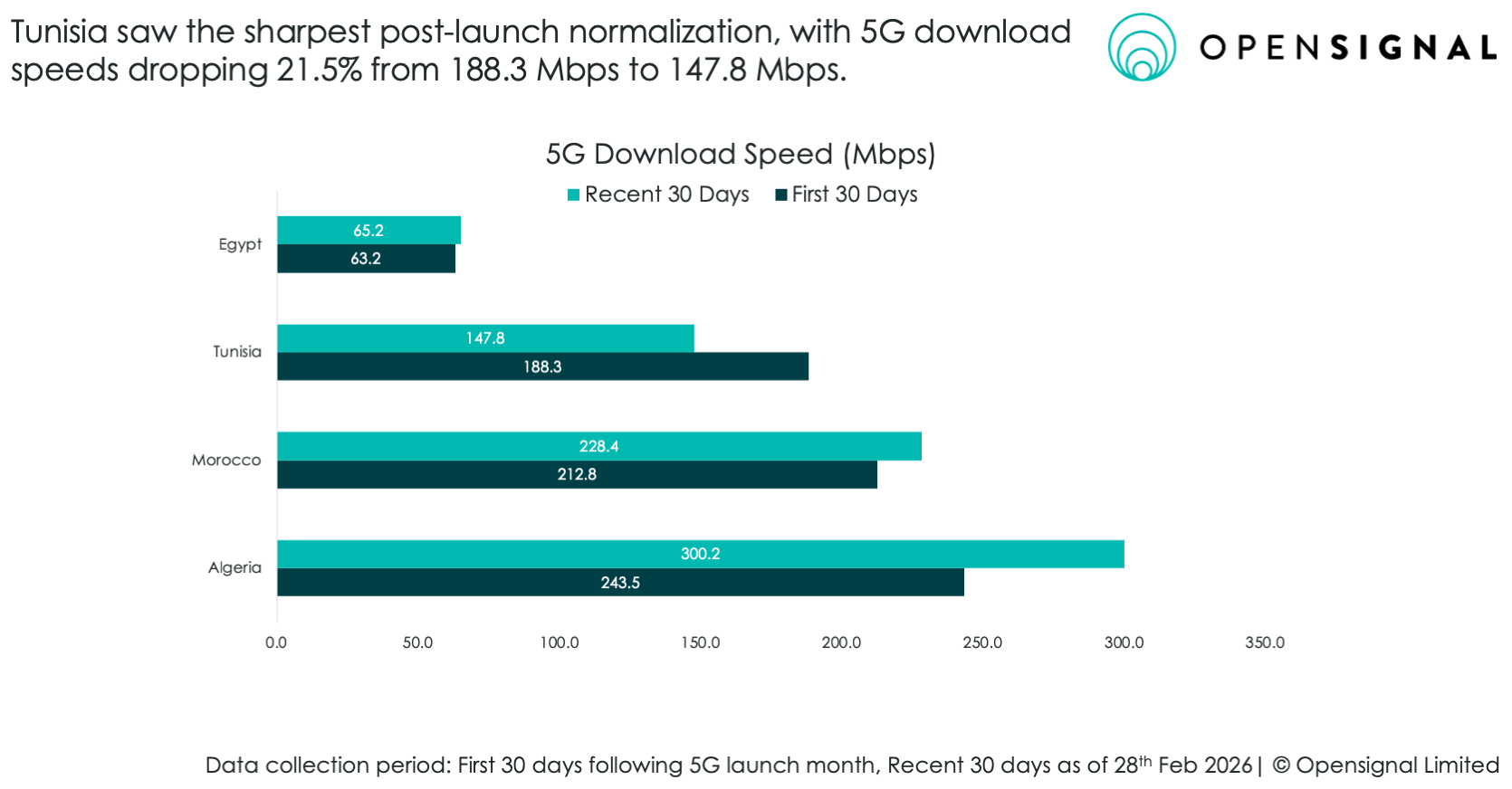
- Speeds normalize as traffic ramps. Tunisia illustrates the typical pattern: early high speeds ease as more users share available capacity. Tunisia’s average 5G Download Speed fell from 188.3 Mbps in its first 30 days to 147.8 Mbps in the most recent 30-day period (a 21.5% decline).
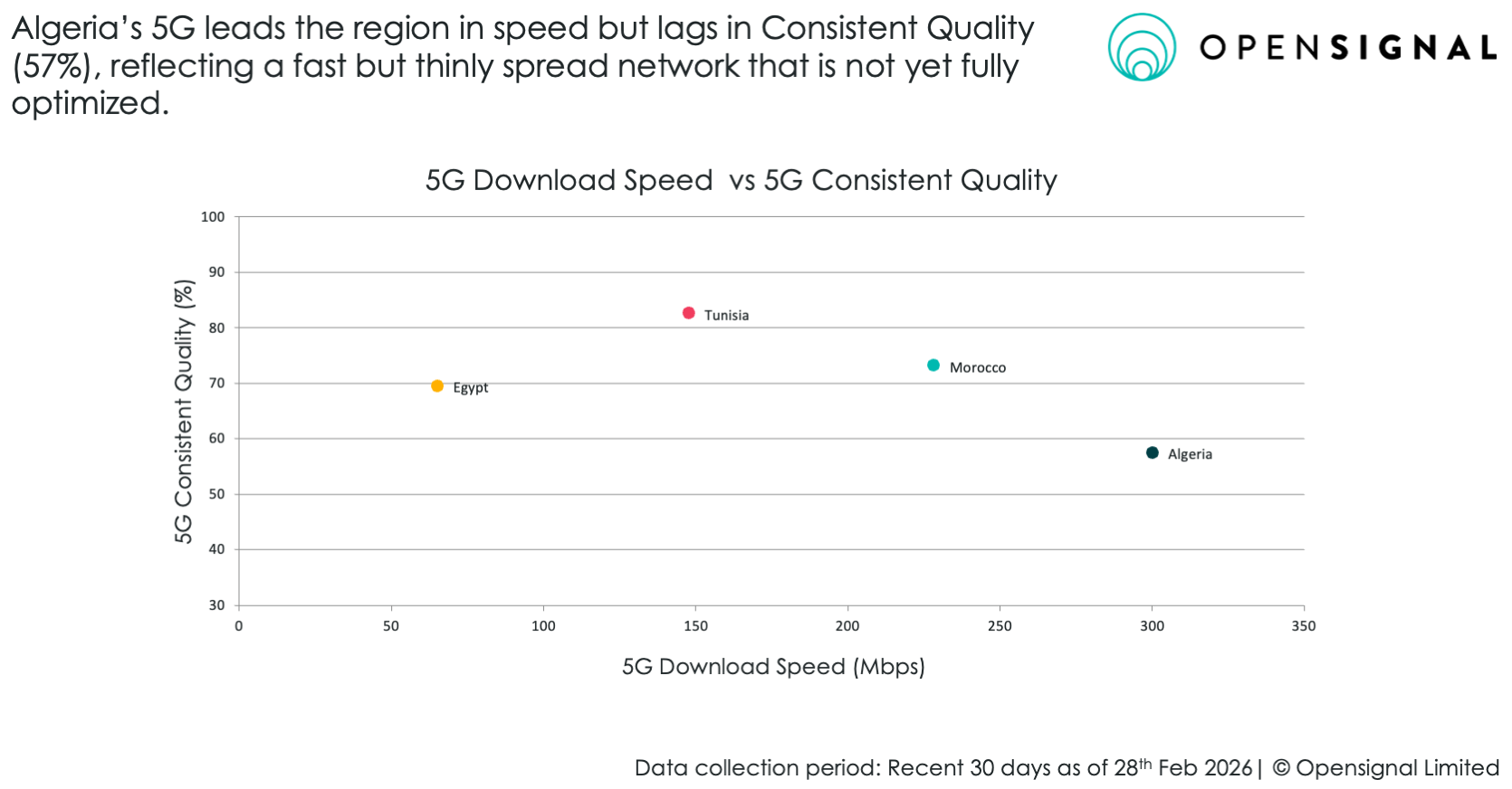
- Network maturity improves consistency. In the more mature launches, 5G Consistent Quality improved even as speeds stabilised. Tunisia rose from 76.3% to 82.5% and Egypt from 65.2% to 69.4%. Algeria remains the outlier: it leads on speed in the most recent period (300.2 Mbps) but trails on 5G Consistent Quality (57%), indicating a strong experience where 5G is available, but a less uniform experience at scale.
Spectrum allocations: defining long-term 5G potential
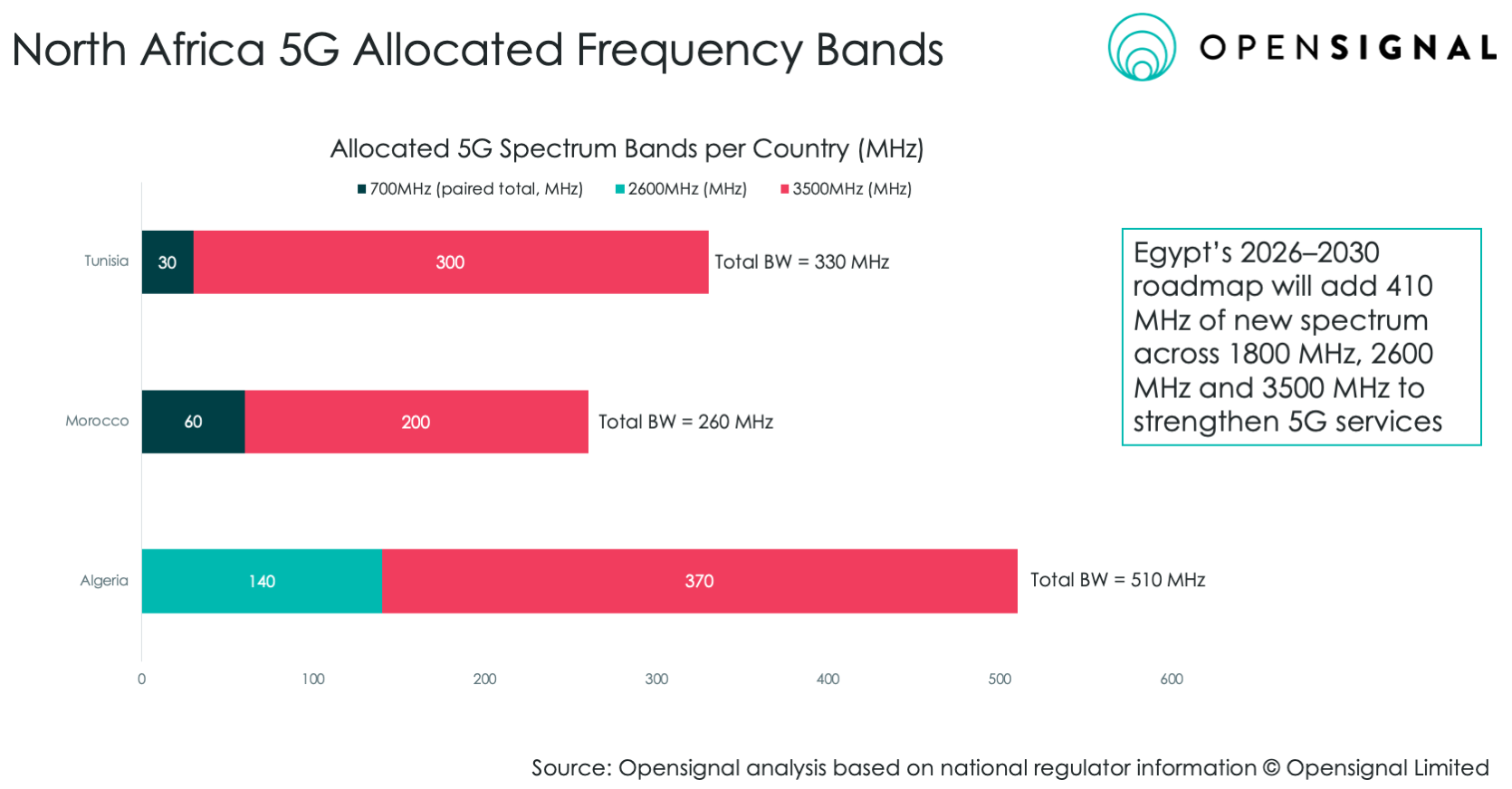
At 5G launch, most markets globally lean on the same playbook: mid-band spectrum to deliver capacity and speed, complemented by low-band to extend reach and improve indoor coverage. We’ve seen a similar trend in North Africa:
- Tunisia allocated 100 MHz of TDD spectrum in the 3.5GHz band to each operator, alongside paired 700MHz spectrum.
- Morocco prepared both 700MHz and 3.4–3.8 GHz for 5G. Licences include 2x10 MHz (700MHz) and 50–100 MHz (3.5GHz band) per operator, with defined population coverage milestones.
- Algeria followed a similar approach. Its 2025 awards anchored 5G on 3.5GHz TDD, awarding two 100 MHz blocks plus a 170 MHz assignment across 3.63–3.8 GHz. A roadmap includes additional 2.6GHz TDD capacity, starting with 40 MHz at licence award and further allocations within three to four years.
- Egypt adopted a more phased path to 5G spectrum allocation. 5G launched nationwide in June 2025 using the existing 2.6GHz spectrum allocated in 2020. Future capacity expansion is tied to its 2026–2030 spectrum strategy, which includes new assignments in the 1800MHz and 3.5GHz bands and the renewal of 2.6GHz, staged over multiple years.
These allocation decisions shape both immediate performance and longer-term scaling potential.
First 30 Days: how the 5G networks performed at launch
Because these four markets launched at different times, a fixed calendar window would unfairly compare mature networks with brand-new deployments. Instead, we compare each market on the same lifecycle basis: performance in the first 30 days following its 5G launch month.
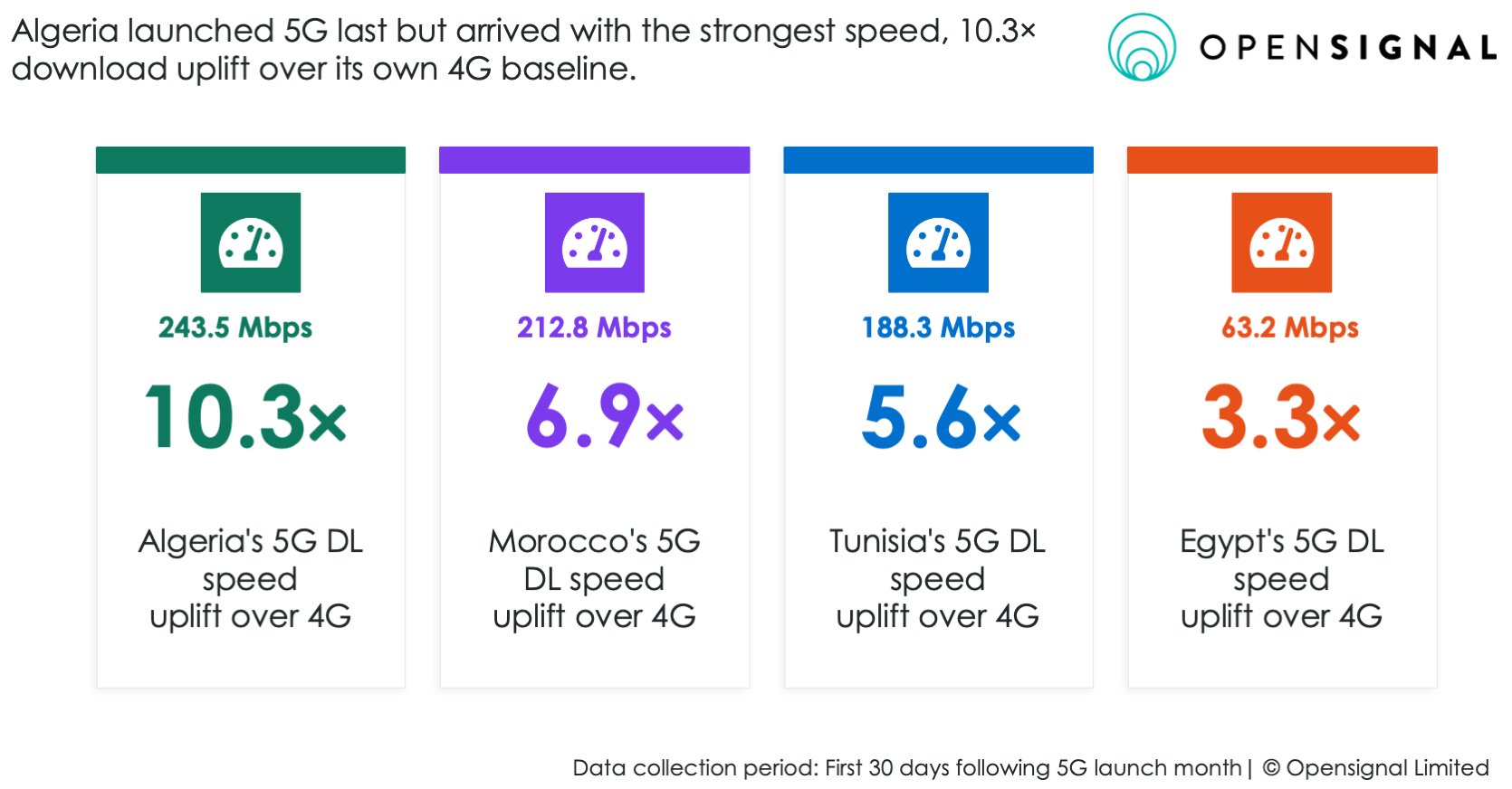
The results underline how spectrum choices shape early user experience. In Algeria, Morocco and Tunisia — where operators used dedicated 3.5 GHz mid-band spectrum — users saw the strongest first-month speeds, with average 5G Download Speed above 150 Mbps. Algeria led at 243.5 Mbps (10.3x faster than 4G), followed by Morocco at 212.8 Mbps (6.9x) and Tunisia at 188.3 Mbps (5.6x).
Egypt’s first-month results reflect its initial spectrum configuration. Average 5G Download Speed reached 63.2 Mbps (3.3x faster than 4G). That still represents a clear step-up, but it is materially below the 3.5GHz-led launches — suggesting that the biggest early gains are easier to achieve when dedicated mid-band capacity is available from the start.
From launch to today: how 5G Download Speed is evolving
As 5G moves beyond launch, average speeds reflect the balance between available capacity and network load. That balance helps explain the divergence between North Africa’s initial and more recent deployments.
Tunisia illustrates the typical post-launch pattern: as adoption grows, early bandwidth is shared more widely and speeds ease. Tunisia’s 5G Download Speed fell from 188.3 Mbps in its first 30 days to 147.8 Mbps in the most recent 30-day period. GSMA-reported 5G connection growth from Q1 to Q4 2025 (up nearly ten times) is consistent with a meaningful increase in network load over the same timeframe.
Egypt, by contrast, maintained stable speeds despite rapid adoption. While GSMA reports 5G connections rising by about 22.3x from Q2 to Q4 2025, Egypt’s average 5G Download Speed edged up slightly from 63.2 Mbps to 65.2 Mbps. This stability suggests that operators have so far matched demand growth with capacity planning and optimization.
Morocco and Algeria remain in the early-stage ‘low-load’ phase. Morocco’s average 5G Download Speed increased from 212.8 Mbps to 228.4 Mbps, while Algeria’s rose from 243.5 Mbps to 300.2 Mbps. These gains are consistent with expanding coverage and ongoing optimization, though further adoption growth may moderate average speeds over time.
5G maturity shifts the story: Consistent Quality up, speeds level off
While peak speeds get the headlines, everyday user experience depends on how consistently networks deliver performance sufficient for high definition video, real-time communication and other performance-sensitive applications. Opensignal’s 5G Consistent Quality captures how often users experience ‘good enough’ performance for these use cases.
That maturity effect is visible in Tunisia and Egypt. Even as Tunisia’s 5G Download Speed eased, its 5G Consistent Quality improved from 76.3% to 82.5%. Egypt shows a similar pattern, rising from 65.2% to 69.4% alongside broadly stable speeds.
Algeria is the counterpoint. It leads the region on speed in the most recent period, but its 5G Consistent Quality remains in the low-50% range (57% in the most recent period), pointing to a network that can be very fast where 5G is available, but is not yet delivering the same experience consistently across a wider footprint.
Conclusion: One Region, Four Lessons
North Africa’s early 5G results point to four lessons.
- First, spectrum shapes first impressions: dedicated mid-band delivers the biggest early speed uplift versus 4G.
- Second, speeds normalize as adoption and traffic grow.
- Third, as networks mature, differentiation shifts from peak speeds to Consistent Quality.
- Fourth, sustained leadership depends on translating spectrum assets into reliable experience at scale.
For operators, the implication is practical: sustaining a strong 5G experience requires balancing mid-band capacity with rollout and optimisation, so performance remains reliable as the user base expands. For regulators, early outcomes reinforce that licence design and spectrum availability don’t just influence launch timing — they shape how quickly users feel meaningful 5G benefits.
Explore the full Q4 2025 Global Network Excellence Index to see how North Africa compares across the wider Middle East and North Africa region — and how 5G performance contributes to overall mobile experience leadership.
To access detailed market and operator-level analysis, contact Opensignal for bespoke benchmarking insights.
Opensignal Limited retains ownership of this insight including all intellectual property rights, data, content, graphs & analysis. Reports and insights produced by Opensignal Limited may not be quoted, reproduced, distributed, published for any commercial purpose (including use in advertisements or other promotional content) without prior written consent. Journalists are encouraged to quote information included in Opensignal reports and insights provided they include clear source attribution. For more information, contact [email protected].
